Affiliate Disclosure: As an Amazon Associate we earn from qualifying purchases. Some links may earn us a commission at no cost to you.

Best UPS for a Gaming PC (2026): 5 Pure-Sine Picks
Most UPS buying advice starts and ends with the number stamped on the box. For a gaming PC that number is misleading twice over: VA is not watts, and the watts that matter are your build's real draw at the wall, not the sticker on your power supply. Size a battery backup by what your rig actually pulls, not by the biggest figure on the carton.
The other half nobody centers: a modern gaming PC runs an active-PFC power supply, and an active-PFC unit fed a stepped-approximation waveform on battery can buzz, log errors, or shut down mid-session. Every pick here is true pure sine, sized by the wattage it clears.
Our top pick: CyberPower CP1500PFCLCD
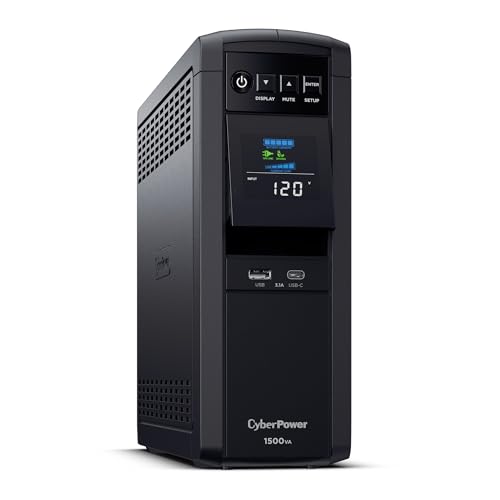
The CyberPower CP1500PFCLCD is the default enthusiast battery backup: a full 1000W pure-sine ceiling that clears most single-GPU builds, twelve outlets, and an LCD that reads your live load so you can confirm draw against capacity instead of guessing.
How to size a UPS for your build
Start with VA versus watts. A unit labeled 1500VA is only rated for 900 to 1000W of real load, and watts is the number that decides whether it can carry your PC. Ignore the VA headline and read the wattage.
Then size to your actual draw. Add up the PC, the monitor, and anything else you want backed up, measured at the wall with a plug-in meter rather than guessed from your PSU's label (a 750W PSU rarely pulls 750W). A good rule of thumb is roughly 1.5 times your measured total load, with 20 percent or more of headroom for transient spikes and for the battery losing capacity as it ages. If you are still working out how much PSU wattage your build needs, settle that first, then size the UPS above it.
Insist on pure sine wave. Every modern gaming PSU uses active power-factor correction, and active-PFC circuitry expects a clean sine wave. Fed a stepped-approximation or simulated-sine output on battery transfer, it can buzz audibly, throw power errors, or drop the system entirely. Pure sine is the one spec you cannot compromise on for a gaming rig, and it is the thread that ties every pick below together.
Set honest runtime expectations. A UPS is a bridge to a clean shutdown, not a generator. At a gaming load, expect a couple of minutes on the smaller units and up to roughly ten on the larger ones. That is enough to save your work, quit safely, and power down or ride out a brief flicker, which is exactly the job.
Which UPS for your build wattage
Your build's real draw | Recommended UPS | Est. runtime at load | Where to buy |
|---|---|---|---|
Under ~400W (compact or entry rigs) | ~2 to 6 min | ||
~400 to 650W (mainstream single-GPU) | ~2 to 10 min | ||
~650 to 850W (high-end single-GPU) | ~2 to 6 min | ||
Longest runtime / buy-once | longest in test, LiFePO4 |
Under ~400W (compact or entry rigs)
- Recommended UPS
- Est. runtime at load
~2 to 6 min
- Where to buy
~400 to 650W (mainstream single-GPU)
- Recommended UPS
- Est. runtime at load
~2 to 10 min
- Where to buy
~650 to 850W (high-end single-GPU)
- Recommended UPS
- Est. runtime at load
~2 to 6 min
- Where to buy
Longest runtime / buy-once
- Recommended UPS
- Est. runtime at load
longest in test, LiFePO4
- Where to buy
Quick picks
Pick | UPS | Best for | Where to buy |
|---|---|---|---|
Best Overall | Mainstream 400 to 650W builds | ||
Best Value | Builds under ~550W draw | ||
Best Premium | Long-haul owners, replaceable battery | ||
Best Budget | Lean or compact builds under ~400W | ||
Editor's Pick | Longest runtime, no battery swaps |
Best Overall
- UPS
- Best for
Mainstream 400 to 650W builds
- Where to buy
Best Value
- UPS
- Best for
Builds under ~550W draw
- Where to buy
Best Premium
- UPS
- Best for
Long-haul owners, replaceable battery
- Where to buy
Best Budget
- UPS
- Best for
Lean or compact builds under ~400W
- Where to buy
Editor's Pick
- UPS
- Best for
Longest runtime, no battery swaps
- Where to buy
Specs at a glance
UPS | Capacity | Waveform | Outlets | Battery | Warranty |
|---|---|---|---|---|---|
1500VA / 1000W | Pure sine | 12 | Sealed lead-acid | 3 years | |
1350VA / 880W | Pure sine | 12 | Sealed lead-acid | 3 years | |
1500VA / 900W | Pure sine | 10 | Replaceable lead-acid | 3 years | |
1000VA / 600W | Pure sine | 10 | Sealed lead-acid | 3 years | |
1500VA / 1000W | Pure sine | 8 | LiFePO4 296Wh | ~10-yr pack |
- Capacity
1500VA / 1000W
- Waveform
Pure sine
- Outlets
12
- Battery
Sealed lead-acid
- Warranty
3 years
- Capacity
1350VA / 880W
- Waveform
Pure sine
- Outlets
12
- Battery
Sealed lead-acid
- Warranty
3 years
- Capacity
1500VA / 900W
- Waveform
Pure sine
- Outlets
10
- Battery
Replaceable lead-acid
- Warranty
3 years
- Capacity
1000VA / 600W
- Waveform
Pure sine
- Outlets
10
- Battery
Sealed lead-acid
- Warranty
3 years
- Capacity
1500VA / 1000W
- Waveform
Pure sine
- Outlets
8
- Battery
LiFePO4 296Wh
- Warranty
~10-yr pack
Best Overall: CyberPower CP1500PFCLCD
Specs
Capacity | 1500VA / 1000W |
Topology | Line-interactive, pure sine wave |
Outlets | 12 (6 battery + surge, 6 surge-only) |
USB charging | 1x USB-A, 1x USB-C |
AVR | Yes |
Est. runtime | ~10 min half load, ~2.5 min full load |
Display | Color LCD (tilting) |
Warranty | 3 years incl. battery |
Capacity
1500VA / 1000W
Topology
Line-interactive, pure sine wave
Outlets
12 (6 battery + surge, 6 surge-only)
USB charging
1x USB-A, 1x USB-C
AVR
Yes
Est. runtime
~10 min half load, ~2.5 min full load
Display
Color LCD (tilting)
Warranty
3 years incl. battery
What it does well
The 1000W rating is the widest real headroom in CyberPower's consumer line, so a mid-to-high gaming rig sits comfortably in the sub-70 percent band where the battery lasts longest. Pure sine output means an active-PFC PSU transfers to battery cleanly, with no buzzing or dropout.
Automatic voltage regulation handles brownouts and minor sags without dipping into the battery at all, which spares the cells and extends their service life. Twelve outlets let you split the PC, monitor, and network gear onto the battery side while running non-critical loads on the surge-only bank.
The tilting LCD reads live load in watts, so you can confirm your actual draw against the unit's ceiling instead of guessing at it. That single readout is the difference between sizing by hope and sizing by measurement.
What you give up
The battery is sealed lead-acid, so plan on a replacement in roughly three to five years, and the warranty runs three years rather than the longer terms some units carry. Runtime is short by design, a couple of minutes at a heavy gaming load, because this is a bridge to a safe shutdown and not a generator.
There is no hot-swap battery tray, so a replacement means powering the unit down to do it.
Who it's for
The mainstream gaming builder with a single-GPU rig pulling somewhere in the 400 to 650W range at the wall, who wants one proven unit that covers the PC, monitor, and router with enough time to save work and shut down cleanly.
Best Value: CyberPower CP1350PFCLCD

Specs
Capacity | 1350VA / 880W |
Topology | Line-interactive, pure sine wave |
Outlets | 12 (6 battery + surge, 6 surge-only) |
AVR | Yes |
Est. runtime | ~8 min half load, ~2 min full load |
Display | Color LCD (tilting) |
Warranty | 3 years incl. battery |
Capacity
1350VA / 880W
Topology
Line-interactive, pure sine wave
Outlets
12 (6 battery + surge, 6 surge-only)
AVR
Yes
Est. runtime
~8 min half load, ~2 min full load
Display
Color LCD (tilting)
Warranty
3 years incl. battery
What it does well
An 880W ceiling clears any mainstream single-GPU build that isn't running a top-tier card alongside a heavy CPU. You keep the pure-sine output, the AVR, and the same tilting color LCD as the flagship.
Twelve outlets give the same PC-plus-monitor-plus-network split. For a reader whose measured draw sits in the 350 to 550W band, this delivers identical protection to the CP1500 for less outlay.
What you give up
The 880W ceiling is roughly 120W below the CP1500, so a build that pulls hard, a power-hungry GPU plus an overclocked CPU under full load, can nudge the unit into the high-load band where runtime shrinks fastest.
There are no USB charging ports on this model, unlike the CP1500 and CP1000. The battery is the same sealed lead-acid pack with the same three-year warranty as the flagship.
Who it's for
The value-focused builder with a measured wall draw under about 550W who wants the full pure-sine, AVR, and LCD feature set and does not need the extra headroom or the USB ports the CP1500 adds.
Best Premium: APC Back-UPS Pro BR1500MS2

Specs
Capacity | 1500VA / 900W |
Topology | Line-interactive, pure sine wave |
Outlets | 10 (6 battery + surge, 4 surge-only) |
USB charging | 1x USB-A, 1x USB-C |
AVR | Yes |
Battery | User-replaceable (APCRBC163) |
Display | LCD (load in W, runtime, health) |
Warranty | 3 years |
Capacity
1500VA / 900W
Topology
Line-interactive, pure sine wave
Outlets
10 (6 battery + surge, 4 surge-only)
USB charging
1x USB-A, 1x USB-C
AVR
Yes
Battery
User-replaceable (APCRBC163)
Display
LCD (load in W, runtime, health)
Warranty
3 years
What it does well
The replaceable battery is the long-game advantage. Sealed-battery units become e-waste when the cells die in a few years; this one takes a fresh APCRBC163 pack for a fraction of a full replacement, so the ten-year cost of ownership lands lower than a disposable unit.
APC's LCD is one of the more informative in class, showing live load in watts, remaining runtime, and battery health. Pure sine output keeps active-PFC PSUs happy, AVR handles line irregularities, and the 900W rating suits most single-GPU builds. APC's PowerChute shutdown software and support ecosystem are mature and widely documented.
What you give up
At 900W the ceiling sits below the two 1000W picks, so a hard-pulling build gets slightly less breathing room. Replacement battery packs are an ongoing cost you are opting into over time, even if they beat buying a whole new unit.
The BR1500MS2 typically carries a premium over the comparable CyberPower units at similar wattage, and the payoff is realized over years of ownership rather than up front.
Who it's for
The builder who plans to keep the same rig protected for the long haul and would rather swap a battery pack than replace a whole UPS, and who values APC's brand support and software maturity enough to pay the premium.
Best Budget: CyberPower CP1000PFCLCD

Specs
Capacity | 1000VA / 600W |
Topology | Line-interactive, pure sine wave |
Outlets | 10 (5 battery + surge, 5 surge-only) |
USB charging | 1x USB-A, 1x USB-C |
AVR | Yes |
Est. runtime | ~6 min half load, ~2 min full load |
Display | Color LCD |
Warranty | 3 years incl. battery |
Capacity
1000VA / 600W
Topology
Line-interactive, pure sine wave
Outlets
10 (5 battery + surge, 5 surge-only)
USB charging
1x USB-A, 1x USB-C
AVR
Yes
Est. runtime
~6 min half load, ~2 min full load
Display
Color LCD
Warranty
3 years incl. battery
What it does well
It delivers the one non-negotiable, pure sine for active-PFC PSUs, at the lowest capacity tier, so a budget builder isn't forced into a stepped-approximation unit just to hit a price. Ten outlets and USB-A plus USB-C charging match the flagship's connectivity.
AVR corrects brownouts without touching the battery. For a small-form-factor or mainstream build that genuinely draws under about 400W at the wall, the 600W ceiling still leaves the unit in a healthy load band.
What you give up
600W is a real limit. Load a current high-end GPU plus a hungry CPU and you can exceed it, which either trips the overload or collapses runtime to seconds. This unit rewards knowing your actual draw before you buy.
It uses the same sealed lead-acid battery and three-year warranty as its siblings, and runtime at anything near full load is very short.
Who it's for
The budget or small-build gamer whose measured wall draw is comfortably under 400W, who needs pure-sine protection for a PC and a monitor without paying for headroom a lean rig will never use.
Editor's Pick: GOLDENMATE 1500VA LiFePO4

Specs
Capacity | 1500VA / 1000W |
Topology | Line-interactive, pure sine wave |
Battery | LiFePO4 296Wh, 3000+ cycles / ~10-yr |
Outlets | 8 |
USB charging | 1x USB-A, 1x USB-C |
Transfer time | <10 ms |
AVR | Yes |
Display | LCD |
Capacity
1500VA / 1000W
Topology
Line-interactive, pure sine wave
Battery
LiFePO4 296Wh, 3000+ cycles / ~10-yr
Outlets
8
USB charging
1x USB-A, 1x USB-C
Transfer time
<10 ms
AVR
Yes
Display
LCD
What it does well
Lithium iron phosphate sidesteps the biggest lead-acid annoyance: the three-to-five-year battery death that turns a cheap UPS into e-waste. The 296Wh reservoir is substantially larger than the roughly 100 to 130Wh in typical 1500VA lead-acid units, so real-world runtime at a gaming load runs meaningfully longer.
The sub-10ms transfer time is well inside what an active-PFC PSU tolerates, and the pure-sine output keeps the transfer clean. A full 1000W ceiling matches the flagship, and the vendor's ten-year pack lifespan reframes the higher up-front price as a lower cost per year.
What you give up
GOLDENMATE is a newer, less-established name than CyberPower or APC, so the long-term support and RMA track record is not as proven. Eight outlets is fewer than the CyberPower flagship's twelve.
The up-front price is higher than a lead-acid 1500VA unit, and the payoff depends on you actually keeping it long enough for the lithium longevity to pay back. Third-party review coverage is thinner than the incumbent brands, so buyers lean more on vendor specs.
Who it's for
The builder who hates replacing batteries, wants the longest runtime and lifespan in the roundup, and is comfortable paying more up front for a LiFePO4 pack that should outlast several lead-acid replacement cycles.
What to skip
Skip anything that says sine wave without saying pure sine. Stepped-approximation and simulated-sine units, including CyberPower's own cheaper CST-series backups and most generic office UPS boxes, output a blocky waveform that an active-PFC gaming PSU can reject on battery transfer. It may work for a while and then buzz or drop the system during the exact outage you bought it for. For a gaming rig, pure sine is the floor, not an upgrade.
Skip sizing by VA alone, and skip buying purely for runtime. The VA headline overstates what the unit can actually carry, so read the watt rating against your measured draw. And do not chase a UPS that promises hours of backup at PC loads; that is generator territory. A few minutes to save and shut down safely is the right target, and paying for more usually means paying for capacity a desktop will never use before it powers down. If your real worry is spikes and dirty power rather than outages, the cheaper answer sits at the wall, and our surge protector guide for gaming PCs sizes joule budget and outlet count for a full desk.
Bottom line
If you want one unit that covers most single-GPU gaming builds, buy the CyberPower CP1500PFCLCD. If your measured draw stays under about 550W and you want to spend less for the same features, the CyberPower CP1350PFCLCD is the value call. If you plan to keep the rig for years and would rather swap a battery than the whole box, pay up for the APC Back-UPS Pro BR1500MS2.
If your build is compact or lean and draws under 400W, the CyberPower CP1000PFCLCD gets you real pure-sine protection for less. And if you never want to think about battery replacement again, the GOLDENMATE 1500VA LiFePO4 trades a higher up-front price for the longest runtime and lifespan here. Size to your real draw, insist on pure sine, and any of these will do its job.
FAQ
What size UPS do I need for a gaming PC?
Size it to your build's real wall draw, not the VA number or your PSU's label. Measure total load (PC plus monitor and anything else you want backed up) with a plug-in meter, then aim for roughly 1.5 times that with 20 percent or more of headroom. Most mainstream single-GPU builds land well inside a 1000W pure-sine unit like the CyberPower CP1500PFCLCD.
Why does pure sine wave matter for a gaming PC UPS?
Modern gaming power supplies use active power-factor correction, which expects a clean sine wave. On battery, a stepped-approximation or simulated-sine UPS outputs a blocky waveform that an active-PFC PSU can reject, causing buzzing, power errors, or an outright shutdown during the outage. Every pick in this guide is true pure sine, which is the one spec you cannot compromise on for a gaming rig.
How long will a UPS keep my gaming PC running during an outage?
Not long, and that is by design. At a gaming load, expect roughly two minutes on smaller units and up to about ten on the larger ones. A UPS is a bridge to a clean shutdown, giving you time to save your work, quit, and power down or ride out a brief flicker. If you need hours, that is a generator, not a battery backup.
Does a UPS protect my PC, or can it damage it?
A pure-sine UPS with automatic voltage regulation protects your PC. AVR corrects brownouts and voltage sags without switching to battery, and the battery covers full outages so the system never hard-crashes. The damage risk comes from the wrong kind of unit: a cheap stepped-approximation UPS feeding an active-PFC PSU, which stresses the power supply. Match a pure-sine unit to your build and it only helps.
Should I plug my monitor and peripherals into the UPS too?
Plug the PC, the monitor, and your network gear (router and modem) into the battery-backed outlets, since a black screen is useless even if the tower stays alive, and staying online matters during a brief outage. Leave printers, speakers, and phone chargers on the surge-only outlets. Every pick here splits its outlets between battery-backed and surge-only banks for exactly this reason. Remember that adding the monitor to the battery side raises your draw, so factor it into sizing.
Is a lithium (LiFePO4) UPS worth it over a standard lead-acid one?
It depends on how long you plan to keep it. Lead-acid batteries fade in three to five years and either need replacing or turn the unit into e-waste. A LiFePO4 unit like the GOLDENMATE 1500VA costs more up front but is rated for thousands of cycles and roughly a decade, and it tends to hold more capacity for longer runtime. If you keep hardware a long time, the lower cost per year can favor lithium; if you replace gear often, a lead-acid CyberPower is the cheaper call.
Related Articles

How to Choose a PSU, Cooler, and Case
A builder's framework for the chassis side of a PC: size the PSU with sane headroom, match the cooler to the chip, and pick a case that fits and breathes.
Jun 29, 2026

Best 1000W PSU for RTX 5070 Ti (2026): 750W Is the Floor
The best 1000W PSU for an RTX 5070 Ti absorbs the CPU spikes a 750W unit rides at its limit. Five ATX 3.1 native 12V-2x6 picks, and when 850W is enough.
Aug 25, 2026

Do More Case Fans Lower Temperatures? Not Past Three (2026)
Do more case fans lower temperatures? Past two intakes and one exhaust, barely. Here is why airflow path beats fan count, and the 3-fan setup that fixes temps.
Oct 7, 2026

Best RTX 5080 Gaming Laptops (2026): 5 TGP-Ranked Picks
The best RTX 5080 gaming laptops in 2026, ranked by the GPU power each chassis can sustain. Five picks from 16-inch OLED to 18-inch, plus the 5080 Ti myth.
Oct 8, 2026

Ryzen 5 9600X vs Core Ultra 5 235: 8-Game Benchmarks 2026
Ryzen 5 9600X vs Core Ultra 5 235: the 9600X leads gaming by 10-15% at 1080p, the 235 wins multithread by about 33%. See which CPU fits your 2026 build.
Oct 8, 2026