Affiliate Disclosure: As an Amazon Associate we earn from qualifying purchases. Some links may earn us a commission at no cost to you.
Best $1000 Gaming PC
The closest gaming PC to a thousand dollars at today's prices: an Intel Arc B570 and Ryzen 5 9600X for 1080p, with live Amazon pricing on every part.
$1,000.00(target price)
Components
| Component | Part Name | Price | Buy |
|---|---|---|---|
| GPU | $289.99 | Buy on Amazon | |
| CPU | $177.99$220.00 | Buy on Amazon | |
| Mobo | $99.99 | Buy on Amazon | |
| RAM | $249.99 | Buy on Amazon | |
| SSD | $156.99$215.99 | Buy on Amazon | |
| Cooler | $31.41$34.90 | Buy on Amazon | |
| PSU | $72.99$144.99 | Buy on Amazon | |
| Case | $79.99 | Buy on Amazon | |
| Total at today's prices | $1,159.34Normally about $960 at MSRP | ||
Prices are running high. A build at the ~$1,000 target isn't possible with today's prices; this is the closest one we can put together.
Who This Build Is For
This is the closest gaming PC we can put together to a thousand dollars at today's prices, and it is honest about what that money buys right now: a capable 1080p machine, not the 1440p build this budget used to deliver. Memory, SSDs and graphics cards are all selling well above their normal prices because of a DRAM, NAND and GPU shortage, so even the cheapest sensible parts list lands above the target. The live total on this page shows by how much.
It suits a first-time builder who needs a PC now, a player coming off an older quad-core or a 4GB or 6GB card, and anyone who plays a mix of competitive shooters and single-player games on a 1080p monitor. If you can wait, waiting is a fair choice too: once memory and graphics card prices come back down, a thousand dollars will reach a faster card and a real 1440p build again.
Build Overview
Key Specs
CPU | AMD Ryzen 5 9600X (6 cores / 12 threads, Zen 5) |
GPU | ASRock Intel Arc B570 Challenger 10GB GDDR6 |
Motherboard | ASRock B650M-HDV/M.2 (micro-ATX, AM5, no Wi-Fi) |
Memory | Patriot Viper Venom 16GB (2x8GB) DDR5-6000 CL36 |
Storage | Kingston NV3 1TB NVMe Gen4 |
Power Supply | Corsair RM850e 850W 80+ Gold, fully modular |
Case | Montech AIR 903 MAX (ATX mid-tower, 4x140mm fans included) |
Cooling | Thermalright Peerless Assassin 120 SE (dual-tower air, 2x120mm fans) |
CPU
AMD Ryzen 5 9600X (6 cores / 12 threads, Zen 5)
GPU
ASRock Intel Arc B570 Challenger 10GB GDDR6
Motherboard
ASRock B650M-HDV/M.2 (micro-ATX, AM5, no Wi-Fi)
Memory
Patriot Viper Venom 16GB (2x8GB) DDR5-6000 CL36
Storage
Kingston NV3 1TB NVMe Gen4
Power Supply
Corsair RM850e 850W 80+ Gold, fully modular
Case
Montech AIR 903 MAX (ATX mid-tower, 4x140mm fans included)
Cooling
Thermalright Peerless Assassin 120 SE (dual-tower air, 2x120mm fans)
Here are the parts that make up this build, with a link to current Amazon pricing for each one.
Performance Summary
At 1080p with the heaviest presets turned on, Cyberpunk 2077 and Baldur's Gate 3 run in the low 80s, Alan Wake 2 and Hogwarts Legacy sit in the low 50s, Starfield lands in the mid 40s and Stalker 2 in the high 30s. Dropping a preset step and turning on XeSS is how you push the heavier games toward 60 fps. At 1440p only Baldur's Gate 3 holds 60 natively, so treat that resolution as a stretch for this build, not its target.
Performance Expectations
Average FPS across 6 current AAA titles, native (no upscaling).
- Cyberpunk 207781 FPS
- Alan Wake 252 FPS
- Stalker 238 FPS
- Starfield46 FPS
- Baldur's Gate 382 FPS
- Hogwarts Legacy52 FPS
Average FPS across six current AAA titles at 1080p and 1440p, native with no upscaling, at the maximum presets listed under the chart. Each figure is the lower of what the graphics card does in one reviewer's test suite and what the processor manages when it is the limit, so expect about 10% either way depending on the scene.
These presets are the most demanding each game offers, which is why several numbers sit below 60. The Ryzen 5 9600X is far from the limit in every game on the chart, so the graphics card sets the frame rate throughout and the settings menu is where you find extra frames. Black Myth: Wukong and Marvel's Spider-Man 2 are left off because there is no matching sourced result for this processor and graphics card pairing yet.
Parts Breakdown
CPU

The Ryzen 5 9600X is a six-core, twelve-thread Zen 5 chip with a 65W default power limit. In every game on our chart its CPU-bound result sits well above what the Arc B570 can deliver, so the graphics card always sets the pace. A Ryzen 5 7600 would game the same at this graphics card level; the 9600X earns its spot with quicker single-threaded work and more room before it holds back a faster card later. It also matters for Intel's Battlemage cards specifically, which reviewers found lose more performance on older, slower processors than NVIDIA or AMD cards do. The AM5 socket means the board and memory carry over to a future processor.
GPU

The ASRock Arc B570 Challenger 10GB is the part this build is shaped around. It is the strongest card that keeps the total anywhere near a thousand dollars while graphics cards are this expensive, and its 10GB of video memory gives more room than the 8GB cards around it in newer games. The trade-off against the Arc B580 is a little less speed and 2GB less memory in exchange for keeping the total closer to budget. It supports XeSS upscaling and frame generation in games that offer them, and its AV1 encoder handles streaming and recording without loading the processor. The Challenger is a dual-fan, two-slot card that runs off a single 8-pin connector.
Motherboard

The ASRock B650M-HDV/M.2 is a no-frills micro-ATX AM5 board that covers what this build needs: DDR5 support, a PCIe 5.0 x16 slot for the graphics card, a PCIe 5.0 M.2 slot plus a second Gen4 M.2 slot, and 2.5 gigabit Ethernet. It has no Wi-Fi or Bluetooth, so plan on a wired connection or add a USB or PCIe Wi-Fi adapter. It also has only two memory slots, which means going to 32GB later is a kit swap, not an add-on. A B650 board with four slots and Wi-Fi built in is the step up, at the cost of pushing the total further over budget.
Memory (RAM)

The Patriot Viper Venom 16GB kit is two 8GB sticks of DDR5-6000 CL36, the speed AM5 runs best at because the memory controller stays in step with the memory. Memory is the part hit hardest by the shortage, which is the main reason this build stops at 16GB. That is enough for nearly every current game, though a few newer releases and heavy multitasking already use more, and 32GB is the first thing to add once memory prices settle. The kit stands about 43mm tall, which matters for the cooler covered below.
Storage

The Kingston NV3 1TB is a Gen4 NVMe drive rated for reads up to 6,000 MB/s, fast enough that game load times come down to the game rather than the drive. The trade-off against a drive like the WD Black SN7100 is sustained write speed: the NV3 has no DRAM cache and Kingston does not guarantee the flash type, so long copies slow down once its cache fills. For installing and loading games that rarely shows. 1TB fills quickly with modern AAA installs, and the board's second M.2 slot makes adding a drive simple.
Power Supply

The Corsair RM850e is an 850-watt, 80 Plus Gold, fully modular ATX 3.1 unit. That is far more than this build needs: the Arc B570 runs off one 8-pin connector and ASRock recommends a 600-watt supply for the card. A good 650-watt unit would power this system fine. The reason to keep the extra capacity is the upgrade path, since the RM850e also carries a native 12V-2x6 cable and has the headroom for the kind of card a thousand dollars should buy once prices recover.
Case

The Montech AIR 903 MAX is a full-size ATX mid-tower with a mesh front and four 140mm fans installed, three in the front and one at the back, so airflow is handled out of the box. It takes graphics cards up to 400mm long and coolers up to 180mm tall, which leaves plenty of room around the 249mm Arc B570 and the 155mm tower cooler. The trade-off against a compact micro-ATX case is size on the desk; in return you get easy cable routing, room for a 360mm radiator up front, and space for almost any future graphics card.
Cooling
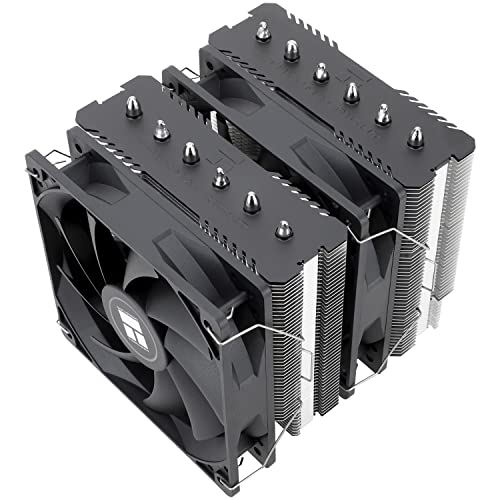
The Thermalright Peerless Assassin 120 SE is a dual-tower air cooler with six heat pipes and two 120mm fans. It is more cooler than a 65-watt six-core strictly needs, and that is the point: it keeps the 9600X at full boost with the fans turning slowly, so the system stays quiet under load, and it can handle an eight-core chip later. A single-tower cooler would do the job for a little less and clear memory more easily. On this build, check the front fan against the Viper Venom sticks: the stock fan position leaves about 42mm of memory clearance, so slide the front fan up a few millimetres on its clips.
Why This Build Works
Every part here was picked on today's prices, not on what it costs in a normal year. The Arc B570 decides how this build plays, and it is the card that keeps the total closest to a thousand dollars while still clearing 80 fps at max presets in Cyberpunk 2077 and Baldur's Gate 3 at 1080p, with the heavier games playable once settings come down a step. The Ryzen 5 9600X never holds it back.
The platform around it is chosen to outlast the shortage. AM5 takes newer processors, the 850-watt supply and the roomy case already fit a much faster graphics card, and the fans and cooler are in place. When memory and graphics card prices fall, this machine needs a card and more memory, not a rebuild.
Alternative Options
The twelve-hundred-dollar build currently uses this same processor and graphics card, differing in the cooler, case and SSD, so spending more there does not buy more frames today. The next real step in graphics performance is the fifteen-hundred-dollar build, which moves to a Radeon RX 9070 and is the one to look at if 1440p matters to you now.
If you only play competitive shooters such as Valorant, Counter-Strike 2 or Fortnite on low or medium settings, this build already has more than enough. If you mostly play single-player games and can wait, holding off until memory and graphics card prices come down will get you more for the same money.
Build & Setup Tips
Before you install the cooler, slide its front fan up on the clips so it sits above the Viper Venom heat spreaders, and mount the cooler with the board on the desk where the socket is easy to reach. In the BIOS, turn on EXPO so the memory runs at DDR5-6000 instead of the slower default. The first boot after that can sit on a black screen for a minute or two while AM5 trains the memory, which is normal.
Intel Arc cards need Resizable BAR to perform properly, so confirm it is enabled in the BIOS (ASRock lists it as Re-Size BAR Support, alongside Above 4G Decoding) and that CSM is off. Install the latest Intel Arc driver from Intel's site rather than relying on the one Windows picks. Recent stock of this board ships with Ryzen 9000 support; once it boots, update to the newest BIOS from ASRock's support page for memory and stability fixes. Use one of the RM850e's 8-pin PCIe cables for the card; the 12V-2x6 cable stays in the box for now.
Upgrade Paths
The graphics card is the upgrade that changes this machine the most, and the 850-watt supply, the 12V-2x6 cable and the 400mm of GPU clearance already allow for a much larger card. Once graphics card prices fall, a 16GB card in the class of the RX 9070 turns this into the 1440p build a thousand dollars used to buy.
Memory is the second upgrade. Because the board has two slots, moving to 32GB means replacing the 16GB kit with a 2x16GB DDR5-6000 kit rather than adding sticks. After that, the second M.2 slot takes another SSD, and AM5 leaves room for a faster processor such as a Ryzen 7 9800X3D if you later move to a high-refresh monitor.
Final Thoughts
A thousand-dollar gaming PC that also handles 1440p is not possible at today's prices, and this page will not pretend otherwise. What this build does is get as close as current pricing allows: an Arc B570 that plays current games at 1080p with sensible settings, a Ryzen 5 9600X that never holds it back, and a platform, power supply and case ready for the faster graphics card and extra memory the shortage is keeping out of reach. Buy it if you need a PC now; the upgrade path is already in place for when prices come back down.
FAQs
Can you build a good gaming PC for a thousand dollars right now?
Not one that hits the target. Memory, SSDs and graphics cards are selling well above their normal prices, so even this, the cheapest sensible build we could put together, lands above a thousand dollars, and the notice at the top of the page says so. It also had to step down from a 1440p build to a 1080p one. Once those prices fall, the target becomes reachable again.
How well does the Arc B570 run games at 1080p?
At the heaviest presets, Cyberpunk 2077 runs at 81 fps and Baldur's Gate 3 at 82, Alan Wake 2 and Hogwarts Legacy at 52, Starfield at 46 and Stalker 2 at 38, with no upscaling. Expect about 10% either way depending on the scene. Dropping a preset step and turning on XeSS pushes the heavier games toward 60 fps, and competitive shooters run far higher than any of these.
Can this PC play games at 1440p?
It can, but it is a stretch. At 1440p native with max presets, Baldur's Gate 3 holds 61 fps and Cyberpunk 2077 runs at 52, while Hogwarts Legacy, Alan Wake 2, Starfield and Stalker 2 fall between 26 and 38. You would need lower presets and XeSS in most new releases. If 1440p is the goal today, the fifteen-hundred-dollar build with a Radeon RX 9070 is the one to look at.
Does the Arc B570 need any special setup?
Yes, two things. Turn on Resizable BAR (and Above 4G Decoding) in the BIOS, because Arc cards lose a lot of performance without it, and install the current Intel Arc driver from Intel's site. A modern processor matters too: reviewers found Battlemage cards lose more frames on older, slower CPUs, which the Ryzen 5 9600X avoids.
Is 16GB of RAM enough for this build?
For gaming today, mostly yes. A few newer releases and heavy multitasking already use more, and memory is the part most affected by the shortage, which is why this build stops at 16GB. The board has two memory slots, so the upgrade to 32GB is a straight swap for a 2x16GB DDR5-6000 kit once prices settle.
Does this build have Wi-Fi?
No. The ASRock B650M-HDV/M.2 has 2.5 gigabit Ethernet but no Wi-Fi or Bluetooth. Use a wired connection, or add a USB or PCIe Wi-Fi adapter if the PC has to sit away from your router.
What should I upgrade first when prices come down?
The graphics card. The 850-watt supply, its 12V-2x6 cable and the case's 400mm of GPU clearance already fit a much faster card, and a 16GB card in the RX 9070 class is what turns this into a real 1440p machine. After that, go to 32GB of memory, then add a second SSD in the free M.2 slot.