Affiliate Disclosure: As an Amazon Associate we earn from qualifying purchases. Some links may earn us a commission at no cost to you.

Best 850W PSUs for the RTX 5080 (2026): 5 ATX 3.1 Picks
NVIDIA's recommended PSU floor for the RTX 5080 is 850W, and for most builds the unit that clears it cleanest is the Corsair RM850x SHIFT (2025). That 850W is the floor for the card, not for the build. Add a 9800X3D-class CPU, a couple of NVMe drives, and the transient spikes that hit when Blackwell ramps from idle into a heavy raster scene, and 850W stops looking generous and starts looking like the right floor specifically.
The headroom you build on top of that floor comes from the spec the PSU is built to: ATX 3.1 with a native 12V-2x6 connector, a premium efficiency tier, and a cable-management plan that doesn't fight the connector's stiffness. This guide is organized that way. Five picks, five use cases (850W ATX 3.1 mainstream, value-tier Cybenetics Platinum, quiet operation, entry ATX 3.1 budget, and a buy-once-cry-once Titanium pick). Spec checkboxes are consistent across the top four: ATX 3.1 native, PCIe 5.1 ready, 12V-2x6 cable in the box, 80+ Gold or better efficiency, ten-year warranty floor.
If the open question is whether you need 850W at all, the 750W versus 850W call for the RTX 5080 answers that one directly. The cluster pillar how to choose a power supply, cooling, and case covers the buyer-framework version of this question. This article is the buying guide. If you're building around the bigger sibling, the RTX 5090 PSU guide covers the 1200W tier. For the full ATX 3.1 field beyond 850W, see best ATX 3.1 power supplies.
Quick picks
Pick | PSU | Use case | Where to buy |
|---|---|---|---|
Best Overall | 850W ATX 3.1 with the cleanest cable routing | Check Price | |
Best Value | ATX 3.1 native at the lowest credible price | Check Price | |
Best Quiet | Zero-fan operation through most gaming load | Check Price | |
Best Budget | Entry ATX 3.1 + PCIe 5.1 with 10-year warranty | Check Price | |
Best Premium | 80+ Titanium efficiency, 12-year warranty | Check Price |
Best Overall
- PSU
- Use case
850W ATX 3.1 with the cleanest cable routing
- Where to buy
- Check Price
Best Value
- PSU
- Use case
ATX 3.1 native at the lowest credible price
- Where to buy
- Check Price
Best Quiet
- PSU
- Use case
Zero-fan operation through most gaming load
- Where to buy
- Check Price
Best Budget
- PSU
- Use case
Entry ATX 3.1 + PCIe 5.1 with 10-year warranty
- Where to buy
- Check Price
Best Premium
- PSU
- Use case
80+ Titanium efficiency, 12-year warranty
- Where to buy
- Check Price
How we picked the best 850W PSU for the RTX 5080
Four things separate an 850W PSU built for a 5080 from a generic high-wattage unit.
The 850W floor is real, not generous. NVIDIA's spec assumes a single 5080 plus a non-X3D CPU at moderate load. Add a 9800X3D class chip, a couple of NVMe drives, the case fans, and any RGB, and a typical 5080 build sits at roughly 60 to 75 percent PSU load under sustained gaming. That's the band where a quality 850W still has headroom for transient spikes and where Platinum or Gold efficiency lands in its sweet spot. Drop below 850W and the picture gets uncomfortable; push to 1000W and you're paying for headroom you mostly won't use unless a future upgrade demands it. Wattage floors scale with the card, not with the wallet. If the build at hand is a budget machine rather than a 5080 rig, the best budget PSU under $80 shortlist applies the same safety filters at a much lower ceiling.
ATX 3.1 plus native 12V-2x6. ATX 3.1 is not a sticker change from 3.0. The spec mandates the 12V-2x6 connector (the four sense pins are recessed so the cable physically can't seat partially and arc), tightens transient response from the older 200 percent spike tolerance window, and aligns with PCIe 5.1. In practice, an ATX 3.0 PSU plus an adapter cable will run a 5080 fine on day one. What you give up is the cleanest connector geometry, the tightest transient response spec, and the manufacturer warranty positioning around 5080 use specifically.
Cable management is part of the spec. The 12V-2x6 cable is short, stiff, and exits a standard ATX PSU at a perpendicular angle to the GPU. On a case with under 50mm of clearance behind the GPU PCB, the cable forces a tight bend that looks bad and can stress the connector pins. The cleanest fix is a side-mount PSU design where the connector exits the PSU horizontally toward the motherboard tray rather than vertically. Corsair pioneered this with the SHIFT line, and on a 5080 build behind tempered glass it's a real win.
Efficiency tier reads on a 5080 differently than a 5090. A 5090 build at 70 to 90 percent of a 1200W PSU lives in the band where Platinum versus Gold efficiency compounds to real heat across a 24/7 workload. A 5080 build at 60 to 75 percent of an 850W PSU lives one tier down. Gold efficiency carries the load fine for gaming. Cybenetics Platinum (one step above 80+ Gold by Cybenetics' own scale) is the value sweet spot. 80+ Titanium is genuine premium territory for buyers who treat the PSU as a 12-year asset.
For the broader build context, see the Tier 2 mainstream gaming build (this is the natural 5080 home), the RTX 5090 vs RTX 5080 editorial for GPU positioning, the RTX 5070 Ti vs RTX 5080 comparison if you're still picking the GPU, and the best ATX mid-tower cases for airflow for the chassis side.
Specs at a glance
PSU | Wattage | ATX | Connector | Efficiency | Warranty |
|---|---|---|---|---|---|
850W | ATX 3.1 | Native 12V-2x6 (side-mount) | Cybenetics Gold | 10 years | |
850W | ATX 3.1 | Native 12V-2x6 | Cybenetics Platinum | 10 years | |
850W | ATX 3.1 | Native 12V-2x6 | 80+ Gold | 10 years | |
850W | ATX 3.1 | Native 12V-2x6 | 80+ Gold | 10 years | |
850W | ATX 3.0 | 12VHPWR (PCIe Gen 5 cable) | 80+ Titanium | 12 years |
- Wattage
850W
- ATX
ATX 3.1
- Connector
Native 12V-2x6 (side-mount)
- Efficiency
Cybenetics Gold
- Warranty
10 years
- Wattage
850W
- ATX
ATX 3.1
- Connector
Native 12V-2x6
- Efficiency
Cybenetics Platinum
- Warranty
10 years
- Wattage
850W
- ATX
ATX 3.1
- Connector
Native 12V-2x6
- Efficiency
80+ Gold
- Warranty
10 years
- Wattage
850W
- ATX
ATX 3.1
- Connector
Native 12V-2x6
- Efficiency
80+ Gold
- Warranty
10 years
- Wattage
850W
- ATX
ATX 3.0
- Connector
12VHPWR (PCIe Gen 5 cable)
- Efficiency
80+ Titanium
- Warranty
12 years
Best Overall: Corsair RM850x SHIFT (2025)
Specs
Wattage | 850W |
ATX spec | ATX 3.1, PCIe 5.1 ready |
Connector | Native 12V-2x6, side-mount |
Efficiency | Cybenetics Gold |
Modularity | Fully modular |
Warranty | 10 years |
Wattage
850W
ATX spec
ATX 3.1, PCIe 5.1 ready
Connector
Native 12V-2x6, side-mount
Efficiency
Cybenetics Gold
Modularity
Fully modular
Warranty
10 years
The Corsair RM850x SHIFT (2025) is the cleanest 850W ATX 3.1 PSU on the market for a mainstream 5080 build. It hits all four spec checkboxes: ATX 3.1 native, PCIe 5.1 ready, 12V-2x6 cable in the box, Cybenetics Gold efficiency. The differentiator versus standard rear-connector 850W units is the side-mount cable interface. The 12V-2x6 cable exits the PSU horizontally toward the motherboard tray instead of perpendicular to the GPU, runs cleanly through the rear cable cutouts, and never has to bend around the GPU PCB. On a case with a tempered-glass side panel, the build looks dramatically better than it does with a standard rear-connector PSU.
The 10-year warranty and Cybenetics Gold rating are the table stakes for this tier. The fan-stop mode at low load keeps the case quiet at desktop, and Corsair's 105 degree-rated capacitors are the long-life story for a build kirbs expects to hold for years. The 2025 revision (this pick) ships the native 12V-2x6 cable in the retail box. Older SHIFT generations needed Corsair's adapter cable sold separately.
Where it loses: the side-mount geometry assumes your case has rear cable cutouts in roughly the same vertical position as a standard ATX PSU. Most modern cases (Lian Li O11D series, Fractal North, NZXT H7, Corsair 5000D and up) work fine. Older or non-standard cases can leave the side connectors pointing at a wall, and a few compact ATX cases are tight enough that the side-mount cables don't have room to bend the way the design intends. Confirm case compatibility before adding to cart.
There's a real variant trap on this SKU. The 2025 revision is the one to buy: native 12V-2x6 cable in the box, ATX 3.1 compliant, Cybenetics Gold. Older SHIFT listings ship the older 12VHPWR connector or require the separately-sold adapter. Confirm the listing title includes "RM850x Shift (2025)" or shows the native 12V-2x6 cable in the box contents.
This is the default pick. If you're buying an 850W PSU for a 5080 build and you don't have a strong reason to choose one of the other slots below, this is the one.
Best Value: Seasonic Focus GX-850 ATX 3.1
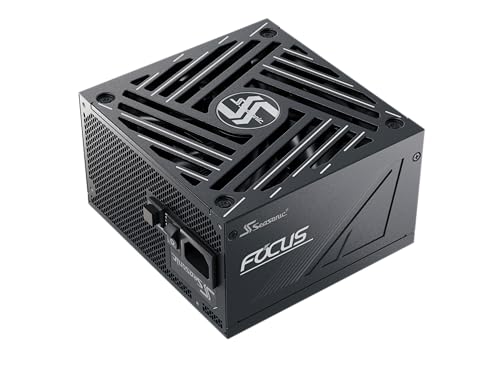
Specs
Wattage | 850W |
ATX spec | ATX 3.1, PCIe 5.1 ready |
Connector | Native 12V-2x6 |
Efficiency | Cybenetics Platinum |
Modularity | Fully modular |
Warranty | 10 years |
SKU | SRP-FGX851 |
Wattage
850W
ATX spec
ATX 3.1, PCIe 5.1 ready
Connector
Native 12V-2x6
Efficiency
Cybenetics Platinum
Modularity
Fully modular
Warranty
10 years
SKU
SRP-FGX851
The Seasonic Focus GX-850 ATX 3.1 is the price-conscious pick that doesn't compromise the spec story. ATX 3.1 native, PCIe 5.1, native 12V-2x6 cable, Cybenetics Platinum efficiency (one tier above 80+ Gold by Cybenetics' own scale), 10-year warranty, premium Japanese capacitors. Seasonic's reputation in the 850W tier is the cleanest in the category, and the Focus GX line has the lowest credible price for the spec set.
Cybenetics Platinum at 850W and a 5080-class load lands the PSU in the most efficient operating band, with fanless or near-fanless operation at desktop and modest fan ramp under sustained gaming. The 10-year warranty matches the Best Overall pick. Where the Focus GX edges other value picks is the Cybenetics rating itself: independent efficiency testing run by a third party using load-curve methodology that tracks closer to real PSU operation than the 80 Plus single-point measurement.
Where it loses: cable management is standard rear-connector geometry, so the 12V-2x6 cable bends the same way every traditional ATX PSU does. If your case has under 50mm of rear clearance and a glass side panel is part of the build, the Best Overall pick is the cleaner buy. For a closed-panel case or any build where the cable bend doesn't matter aesthetically, this PSU is functionally identical at the load curve that matters for a 5080.
Variant trap (load-bearing): the SKU is SRP-FGX851. The black listing on Amazon at the time of writing displays older 80+ Gold / ATX 3.0 description text, while the white variant under the same SKU shows the updated ATX 3.1 PCIe 5.1 Cybenetics Platinum spec. The hardware is the same across both colors. Look for "SRP-FGX851" in the listing detail and confirm the bullet points mention ATX 3.1 and 12V-2x6 before clicking buy. Seasonic's older Focus GX-850 SKU (SSR-850FX3) is a different product and is the one to avoid.
For builders who want the spec checkboxes without the side-mount geometry premium, this is the right pick.
Best Quiet: NZXT C850 Gold ATX 3.1

Specs
Wattage | 850W |
ATX spec | ATX 3.1, PCIe 5.1 ready |
Connector | Native 12V-2x6 |
Efficiency | 80+ Gold |
Fan | Zero Fan Mode, fluid-dynamic bearing |
Modularity | Fully modular |
Warranty | 10 years |
Wattage
850W
ATX spec
ATX 3.1, PCIe 5.1 ready
Connector
Native 12V-2x6
Efficiency
80+ Gold
Fan
Zero Fan Mode, fluid-dynamic bearing
Modularity
Fully modular
Warranty
10 years
The NZXT C850 Gold ATX 3.1 is the pick for builders who want the PSU to disappear acoustically. Zero Fan Mode keeps the unit completely silent at desktop and modest gaming loads. The fan curve only spins up at sustained load above roughly 40 percent of rated wattage, which in a 5080 build means light gaming and productivity sessions produce no audible PSU noise at all.
Spec is ATX 3.1, native 12V-2x6 connector, 80+ Gold efficiency, 100 percent Japanese capacitors throughout, fully modular, 10-year warranty. The fluid-dynamic bearing fan is rated for long-life quiet operation, and NZXT's build quality has been consistent across the C-series line. For a small-form-factor or compact tower build where the PSU sits close to the user's ears, the silence advantage matters more than the efficiency tier difference.
Where it loses: efficiency tops out at 80+ Gold rather than Cybenetics Platinum, so under sustained creator load or extended high-FPS gaming the unit will spend more time at audible fan speed than the Seasonic Focus GX would. The fan map prioritizes silence, so when it does spin up the curve is gentle but it does reach audible RPM faster than a Platinum unit at the same load. For pure gaming workloads with breaks, this is a non-issue. For sustained 8-plus hour rendering sessions, the Best Value pick stays quieter longer.
Variant trap: NZXT also ships a newer C850 Gold Core variant with Cybenetics Platinum efficiency. The Core version is a more recent release. The standard C850 Gold ATX 3.1 (this pick) is the more proven SKU with a longer market track record for the silence story specifically. If you'd rather have the Platinum efficiency upgrade and the slight fan-curve difference, the Gold Core is the alternative; for the silence-first profile this slot is built around, the standard ATX 3.1 unit is the right choice.
For builders who notice PSU fan noise more than they notice 1 to 2 percent of efficiency, this is the pick.
Best Budget: MSI MAG A850GL PCIE5

Specs
Wattage | 850W |
ATX spec | ATX 3.1, PCIe 5.1 ready |
Connector | Native 12V-2x6 |
Efficiency | 80+ Gold |
Modularity | Fully modular |
Warranty | 10 years |
Wattage
850W
ATX spec
ATX 3.1, PCIe 5.1 ready
Connector
Native 12V-2x6
Efficiency
80+ Gold
Modularity
Fully modular
Warranty
10 years
The MSI MAG A850GL PCIE5 is the entry-tier ATX 3.1 pick that holds the spec story without padding the price. Fully modular, 80+ Gold efficiency, ATX 3.1 and PCIe 5.1 ready, native 12V-2x6 cable in the box, 10-year warranty. MSI's dual-color 12V-2x6 cable is a nice quality-of-life touch: the connector half that plugs into the GPU is a different color from the other half, so the user can visually confirm full seating at the GPU side without pulling the cable to verify.
The unit is built on a compact ATX form factor, which gives it the same cable run as a standard ATX PSU but at slightly tighter overall dimensions. For an air-cooled 5080 build in a mid-tower case, this is a non-factor. For an SFF build that accepts ATX PSUs but has tight clearances, it can help. The fan map is standard 80+ Gold quiet-at-low-load, audible-under-high-load behavior.
Where it loses: there's no fan-stop mode at idle (the fan runs continuously at low RPM rather than stopping entirely), the capacitor pedigree is mid-tier rather than full Japanese-throughout, and the warranty honoring process is more paperwork-heavy than Corsair's or Seasonic's well-known RMA flow. The PSU is a quality unit at the budget tier; what you give up is the polish around it.
Variant trap: MSI also ships the MSI MAG A850GL PCIE5 WHITE under a separate SKU. Same hardware, different color. If you want black, this is the SKU. If you want white to match a build, the white version exists under its own ASIN; pricing tracks similar between the two. The original A850GL non-PCIE5 SKU is the previous-generation product and lacks the 12V-2x6 cable; confirm "PCIE5" in the model name before ordering.
For first-time 5080 builders or anyone treating the PSU as a working part rather than a long-term flagship investment, this is the cleanest entry into ATX 3.1 territory.
Best Premium: Seasonic PRIME TX-850

Specs
Wattage | 850W |
ATX spec | ATX 3.0 |
Connector | 12VHPWR (PCIe Gen 5 cable) |
Efficiency | 80+ Titanium |
Modularity | Fully modular |
Warranty | 12 years |
Wattage
850W
ATX spec
ATX 3.0
Connector
12VHPWR (PCIe Gen 5 cable)
Efficiency
80+ Titanium
Modularity
Fully modular
Warranty
12 years
The Seasonic PRIME TX-850 is the buy-once-cry-once pick for buyers treating the PSU as a 12-year asset. 80+ Titanium efficiency (roughly 94 percent at 50 percent system load), 12-year warranty (the longest in the category), full Japanese capacitor build, hybrid silent fan control with three modes (fanless, silent, cooling), and Seasonic's flagship engineering pedigree. For sustained workloads or buyers who carry components across multiple builds, the math on Titanium efficiency plus the warranty length wins on a long enough horizon.
Where it loses: this is ATX 3.0, not ATX 3.1. The PSU ships with a PCIe Gen 5 16-pin cable that drives the 5080's power connector fine, but it's the older 12VHPWR design with the four sense pins flush with the main pins rather than recessed.
For a 5080 at typical 60 to 70 percent PSU load, the connector geometry is lower-stakes than it would be for a 5090; the melted-plug history was concentrated in 4090 cases with partially-seated connectors at near-full load. Practically, when fully seated and run at spec, the 12VHPWR cable handles the 5080 with margin to spare. The honest framing is that the connector spec is the trade-off you accept for the Titanium efficiency and 12-year warranty.
The other consideration is whether the efficiency tier matters for your workload. A 5080 build that spends most of its time gaming sits in a load band where Gold versus Platinum versus Titanium produces single-digit-percent differences in heat and electricity. A 5080 build that does sustained creator work (Blender renders, video encoding, sustained AI inference) sits at higher load for longer and benefits from Titanium's load-curve flatness. For pure gaming, the premium pick's value compresses; for mixed-use workstation duty, it widens. There is a prior question worth settling too, because whether 750W is enough for an RTX 5080 or you need 850W turns on the CPU class sitting next to the card rather than on the GPU alone.
Variant trap: Seasonic ships the PRIME series in three efficiency tiers (TX-850 Titanium, PX-850 Platinum, GX-850 Gold). This pick is specifically the TX-850 Titanium SKU SSR-850TR. The PRIME PX-850 (Platinum) and PRIME GX-850 (Gold) are different products at different price points. Confirm "PRIME TX" and the Titanium spec in the listing detail.
For buyers who want the absolute top of the efficiency curve and the longest warranty in the category, the connector-spec trade-off is the one to make.
Bottom line
If you're building a standard ATX 5080 rig and want a clean default with the cleanest cable routing, Corsair RM850x SHIFT (2025) is the right answer.
If price matters and the spec story can't compromise, the Seasonic Focus GX-850 ATX 3.1 is the value tier with Cybenetics Platinum efficiency at the lowest credible price.
If silence is the headline requirement and the build sits close to the user, the NZXT C850 Gold ATX 3.1 is the quiet-first pick.
If this is a first 5080 build or a budget-conscious upgrade, the MSI MAG A850GL PCIE5 is the cleanest entry into ATX 3.1 territory.
If you treat the PSU as a 12-year asset and you can live with the ATX 3.0 connector trade-off, the Seasonic PRIME TX-850 is the Titanium-efficiency, longest-warranty pick.
FAQ
Is 850W enough for an RTX 5080 build?
Yes. NVIDIA's recommended PSU floor for the RTX 5080 is 850W, and a quality 850W ATX 3.1 unit with a native 12V-2x6 cable will run a 5080 plus a 9800X3D class CPU at 60 to 75 percent sustained PSU load under heavy gaming. That's the operating band where Gold or Platinum efficiency lands in its sweet spot, the unit has comfortable headroom for transient spikes, and fan noise stays modest. The case where 850W stops being enough is when you stack a second high-wattage component (a workstation GPU add, an AI accelerator card, a 100W-plus continuous-draw drive bank) on top of the 5080 plus CPU. For any standard single-GPU 5080 build, 850W is the right floor.
Do I need an ATX 3.1 PSU for the RTX 5080?
You don't strictly need it. An ATX 3.0 PSU with a quality 12VHPWR connector and a high-grade PCIe Gen 5 cable will run a 5080 fine. What ATX 3.1 gives you is the recessed-pin 12V-2x6 connector geometry (the cable physically can't seat partially and arc), tighter transient response spec (more headroom for the 5080's Blackwell-architecture spike behavior), and PCIe 5.1 alignment for any current and near-future 5080-class component. The price delta between ATX 3.0 and ATX 3.1 in the same wattage class is small. For a new purchase, the newer spec is the safer call.
What is the 12V-2x6 connector and why does it matter on the 5080?
The 12V-2x6 connector is the GPU power connector on every high-end Blackwell card. It carries up to 600W on a single cable and replaces the older bank of 8-pin PCIe connectors. The spec evolved twice. The original 12VHPWR (used on 4090 launch units) had four sense pins flush with the main power pins, which let the cable seat partially without triggering an error, which led to the melted-plug failures that made news in 2022 and 2023. The 12V-2x6 revision (mandated by ATX 3.1) recesses the sense pins so the cable physically can't run if it isn't fully seated. The 5080 uses less peak power than the 5090, so the connector risk is genuinely lower at this tier, but for a new purchase the recessed-pin design is the right buy.
Can I keep my old 850W ATX 3.0 PSU for an RTX 5080 upgrade?
In most cases, yes. A quality 850W ATX 3.0 PSU from a reputable vendor will run a 5080 build under normal gaming load. The two things to verify: that the PSU ships a PCIe Gen 5 16-pin cable (or that the GPU package includes the 8-pin to 16-pin adapter, which 5080 retail boxes do), and that the PSU was sized for a 5080 class workload rather than barely passing the original GPU's spec. If the PSU is more than five or six years old, the capacitor pedigree and rail stability matter more than the spec year, and an upgrade is worth considering on lifespan grounds alone. If the PSU is recent and well-rated, keep it; the 5080 will run on it.
Should I bump to 1000W or 1200W for headroom?
Bump if you're planning a multi-year upgrade path that adds a second high-draw component (a workstation GPU accelerator, a 1200W-class future GPU, a high-wattage CPU upgrade). Otherwise, 850W is the right sizing for a 5080 build. A typical 5080 plus 9800X3D system at full gaming load draws roughly 525 to 575 watts continuous, putting the PSU at 60 to 70 percent of an 850W rail. That's the efficiency sweet spot. Pushing to 1000W or 1200W moves the operating point lower on the load curve, where efficiency drops slightly for most PSUs (efficiency curves peak around 40 to 60 percent load) and you're paying premium pricing for headroom you won't use. The right reason to oversize is a clear future upgrade, not generic insurance.
Related Articles

Best RTX 5090 PSU 2026: Why 1000W Isn't Enough (5 Picks)
The best PSU for an RTX 5090 is not Nvidia's 1000W floor. Transient spikes explained, five 1200W to 1500W ATX 3.1 picks, and 12V-2x6 cable notes that matter.
Aug 10, 2026

RTX 5090 vs RTX 5080 (2026): Which GPU Should You Buy?
RTX 5090 vs RTX 5080 in 2026: the 5090 is the no-compromise 4K flagship, the 5080 saves half the spend at 4K 120Hz. Pick by panel, workload, and PSU budget.
Jul 7, 2026

RTX 5070 Ti vs RTX 5080 (2026): Which GPU Wins?
RTX 5070 Ti vs RTX 5080: which Blackwell card earns the upgrade tax, decided by panel tier, RT workload, and creator workload alongside gaming.
May 9, 2026

Best $2,000 Gaming PC Build 2026: RTX 5080 + Ryzen 9
Build the best $2,000 gaming PC for 2026 — RTX 5080 and Ryzen 9 9900X parts list, 4K Ultra performance, streaming-ready, with a clear upgrade path.
Aug 3, 2025

Best ATX Mid-Tower Cases for Airflow (2026): Five Picks
RTX 5090 and 9950X3D builds need real airflow, not 2022 thinking. Five ATX mid-tower cases by build tier, from budget mesh to fan-forward thermal monster.
May 13, 2026