Affiliate Disclosure: As an Amazon Associate we earn from qualifying purchases. Some links may earn us a commission at no cost to you.

Best SSD for Steam Deck & ROG Ally X: 5 Picks (2026)
The best SSD for Steam Deck is the WD_BLACK SN770M 2TB, a native single-sided M.2 2230 drive with TLC NAND that fits under the Deck's EMI shield. On a ROG Ally X or Legion Go 2, which take full-length 2280 drives, buy the WD_BLACK SN7100 2TB instead. Valve, ASUS and Lenovo all ship these handhelds with the smallest SSD they can get away with, and the first thing most owners want back is space.
Form factor decides whether a drive fits at all. Single-sided decides whether it fits safely. NAND type decides whether a big install stays fast. Peak sequential read, the number on the box, matters least, and in a Steam Deck's Gen3 slot it barely registers. Here are five drives, matched to the handheld you actually own.
Our top pick: WD_BLACK SN770M 2TB 2230
Native single-sided 2230, TLC NAND, 2 TB, and the drive that tops the 2230 sequential charts. For a Steam Deck or an original ROG Ally, this is the upgrade that ends the conversation.

Quick picks
Drive | Form factor | Capacity | Best for | Buy |
|---|---|---|---|---|
M.2 2230 | 2 TB | Steam Deck and original ROG Ally | ||
M.2 2230 | 1 TB | Gen4 handhelds on a budget | ||
M.2 2230 | 2 TB | Max capacity plus TLC in a 2230 | ||
M.2 2230 | 1 TB | Cheapest TLC drop-in for a Deck | ||
M.2 2280 | 2 TB | Ally X, Legion Go 2 and other 2280 handhelds |
- Form factor
M.2 2230
- Capacity
2 TB
- Best for
Steam Deck and original ROG Ally
- Buy
- Form factor
M.2 2230
- Capacity
1 TB
- Best for
Gen4 handhelds on a budget
- Buy
- Form factor
M.2 2230
- Capacity
2 TB
- Best for
Max capacity plus TLC in a 2230
- Buy
- Form factor
M.2 2230
- Capacity
1 TB
- Best for
Cheapest TLC drop-in for a Deck
- Buy
- Form factor
M.2 2280
- Capacity
2 TB
- Best for
Ally X, Legion Go 2 and other 2280 handhelds
- Buy
Match the drive to your handheld
Start here, because the wrong form factor is the only mistake in this category that cannot be fixed in software. If you are still shopping for the device itself, our best handheld gaming PC guide covers the SteamOS versus Windows split.
Handheld | Slot | PCIe generation | Our pick |
|---|---|---|---|
Steam Deck (LCD and OLED) | M.2 2230 | Gen 3.0 x4 | |
ROG Ally (original) | M.2 2230 | Gen 4.0 x4 | |
ROG Ally X / ROG Xbox Ally X | M.2 2280 | Gen 4.0 x4 | |
Legion Go S | M.2 2242 | Gen 4.0 x4 | |
Legion Go 2 | M.2 2280 | Gen 4.0 x4 | |
MSI Claw | M.2 2230 | Gen 4.0 x4 |
Steam Deck (LCD and OLED)
- Slot
M.2 2230
- PCIe generation
Gen 3.0 x4
- Our pick
ROG Ally (original)
- Slot
M.2 2230
- PCIe generation
Gen 4.0 x4
- Our pick
ROG Ally X / ROG Xbox Ally X
- Slot
M.2 2280
- PCIe generation
Gen 4.0 x4
- Our pick
Legion Go S
- Slot
M.2 2242
- PCIe generation
Gen 4.0 x4
- Our pick
Legion Go 2
- Slot
M.2 2280
- PCIe generation
Gen 4.0 x4
- Our pick
MSI Claw
- Slot
M.2 2230
- PCIe generation
Gen 4.0 x4
- Our pick
Specs at a glance
Drive | Form factor | Interface | Capacity | NAND | Peak read |
|---|---|---|---|---|---|
M.2 2230, single-sided | PCIe Gen 4.0 x4 | 2 TB | TLC 3D NAND | 5,150 MB/s | |
M.2 2230, single-sided | PCIe Gen 4.0 x4 | 1 TB | QLC (232-layer) | 7,100 MB/s | |
M.2 2230, single-sided | PCIe Gen 4.0 x4 | 2 TB | 3D TLC | 7,000 MB/s | |
M.2 2230, single-sided | PCIe Gen 4.0 x4 | 1 TB | 3D TLC | 5,000 MB/s | |
M.2 2280, single-sided | PCIe Gen 4.0 x4 | 2 TB | TLC 3D NAND | 7,250 MB/s |
- Form factor
M.2 2230, single-sided
- Interface
PCIe Gen 4.0 x4
- Capacity
2 TB
- NAND
TLC 3D NAND
- Peak read
5,150 MB/s
- Form factor
M.2 2230, single-sided
- Interface
PCIe Gen 4.0 x4
- Capacity
1 TB
- NAND
QLC (232-layer)
- Peak read
7,100 MB/s
- Form factor
M.2 2230, single-sided
- Interface
PCIe Gen 4.0 x4
- Capacity
2 TB
- NAND
3D TLC
- Peak read
7,000 MB/s
- Form factor
M.2 2230, single-sided
- Interface
PCIe Gen 4.0 x4
- Capacity
1 TB
- NAND
3D TLC
- Peak read
5,000 MB/s
- Form factor
M.2 2280, single-sided
- Interface
PCIe Gen 4.0 x4
- Capacity
2 TB
- NAND
TLC 3D NAND
- Peak read
7,250 MB/s
Benchmarks
Peak sequential read is the number every listing leads with, so here it is. Read the caption before you read the bars.
Peak sequential read as reported by Tom's Hardware review testing and vendor specifications.
- 5150 MB/s
- 7100 MB/s
- 7000 MB/s
- 5000 MB/s
- 7250 MB/s
How we picked
Form factor came first and everything else came second. A drive that does not physically fit is not a slow drive, it is a returned drive, so the lineup is organised by what your handheld's slot will accept rather than by a ranked speed list.
Single-sided was treated as a hard requirement, not a preference. On a Steam Deck the back plate presses down on whatever is under it, and NAND packages on the reverse face of a 2230 have been reported to foul the EMI shield. Every pick here puts its chips on one side.
NAND type decided the value tier. TLC holds its write speed when the SLC cache runs out; QLC does not. That distinction is invisible when you are copying a save file and very visible when you are installing three big games in a row, so it is called out honestly in every section below rather than buried in a spec row.
Peak sequential read was ranked last. It is the headline spec and it is the least useful one for this category, particularly on a Deck. If you want the version of this framework that applies to a desktop, where the calculus genuinely is different, that lives in how to choose RAM and storage.
Best Overall: WD_BLACK SN770M 2TB 2230
The WD_BLACK SN770M is the drive you buy when you want the upgrade finished, not researched. Native single-sided 2230, TLC NAND, 2 TB.
Specs
Form factor | M.2 2230, single-sided |
Interface | PCIe Gen 4.0 x4 |
Capacity | 2 TB |
NAND | TLC 3D NAND |
Peak sequential read | 5,150 MB/s |
DRAM | None (Host Memory Buffer) |
Endurance | 900 TBW |
Form factor
M.2 2230, single-sided
Interface
PCIe Gen 4.0 x4
Capacity
2 TB
NAND
TLC 3D NAND
Peak sequential read
5,150 MB/s
DRAM
None (Host Memory Buffer)
Endurance
900 TBW
What it does well
The SN770M is a purpose-built 2230, not a shrunk-down desktop drive. It is single-sided, which means the chips sit on one face of the PCB and nothing pushes against the Steam Deck's EMI shield when you screw the back plate down. That sounds like a detail. It is the difference between a drive that works and a drive that throws I/O errors after twenty minutes.
The NAND is TLC. When the drive's fast SLC cache fills up, writes fall back to a real TLC write path rather than the crawl you get from QLC. Installing a 90 GB game does not stall halfway through. Tom's Hardware puts the SN770M at the top of its 2230 sequential rankings, and it earns that spot with consistency rather than a headline number.
At 2 TB you stop curating. That is the actual upgrade most handheld owners are buying, and it is worth more than any megabyte-per-second figure on the box.
What you give up
On paper it is the slowest Gen4 drive in this lineup at 5,150 MB/s. If your handheld has a Gen4 slot, the Crucial P310 and the Corsair MP600 Mini will both beat it in a synthetic benchmark, and they will beat it by a lot.
It is DRAM-less, leaning on Host Memory Buffer instead. For gaming that is fine. For heavy random-write work it is not the drive. And it sits above the value tier on price for the same capacity, which is the cost of buying the safe answer.
Who it's for
The Steam Deck LCD or OLED owner, or the original ROG Ally owner, who wants a 2 TB upgrade that just works and does not want to read controller datasheets to get there.
Best Value: Crucial P310 1TB 2230

The Crucial P310 is the fastest 2230 you can buy and the most efficient controller in this lineup. The catch is the NAND.
Specs
Form factor | M.2 2230, single-sided |
Interface | PCIe Gen 4.0 x4 |
Capacity | 1 TB |
Controller | Phison E27T (DRAM-less, HMB) |
NAND | Micron 232-layer QLC |
Peak sequential read | 7,100 MB/s |
Peak sequential write | 6,000 MB/s |
Form factor
M.2 2230, single-sided
Interface
PCIe Gen 4.0 x4
Capacity
1 TB
Controller
Phison E27T (DRAM-less, HMB)
NAND
Micron 232-layer QLC
Peak sequential read
7,100 MB/s
Peak sequential write
6,000 MB/s
What it does well
Crucial pairs the Phison E27T controller with a 7,100 MB/s peak read, and the E27T is genuinely frugal with power. That combination is why reviewers keep reaching for the word handheld when they talk about this drive. It runs cooler than the SN770M under sustained load, which on a Steam Deck translates to a fan that spins up less often.
If your handheld actually has a Gen4 slot, and the original ROG Ally and the MSI Claw both do, the P310 is the one drive here that can use the bandwidth it advertises. Single-sided, native 2230, drops straight in with no shim and no shield surgery.
What you give up
It is QLC. Micron's 232-layer QLC, specifically. Once the SLC cache runs dry, sustained write speed falls off hard compared to a TLC drive, and a 1 TB QLC drive has less cache to fall back on than a 2 TB one does. If you rebuild your library in an evening, dumping one hundred gigabyte installs back to back, you will feel that cliff.
It is DRAM-less like everything else in this class, and at 1 TB it carries the lowest endurance rating in the lineup. This is a drive that rewards a normal download cadence and punishes a bulk transfer.
Who it's for
The Gen4-handheld owner who wants the fastest 2230 available, downloads a game or two at a time, and would rather spend the savings on the next game than on TLC insurance.
Best Premium: Corsair MP600 Mini 2TB

The Corsair MP600 Mini is the only 2230 that refuses to compromise on capacity, NAND type, or speed. You pay for that.
Specs
Form factor | M.2 2230, single-sided |
Interface | PCIe Gen 4.0 x4 |
Capacity | 2 TB |
NAND | High-density 3D TLC |
Peak sequential read | 7,000 MB/s |
Peak sequential write | 6,200 MB/s |
DRAM | None (Host Memory Buffer) |
Form factor
M.2 2230, single-sided
Interface
PCIe Gen 4.0 x4
Capacity
2 TB
NAND
High-density 3D TLC
Peak sequential read
7,000 MB/s
Peak sequential write
6,200 MB/s
DRAM
None (Host Memory Buffer)
What it does well
Two terabytes, TLC NAND, 7,000 MB/s peak read, single-sided 2230. No other drive in this class puts all four in the same box. The TLC at 2 TB means the largest SLC cache here and a soft landing when it empties, so back-to-back big installs stay fast instead of collapsing.
Corsair's board layout is clean and genuinely single-sided, so it clears the Steam Deck's shield without argument. This is the drive for someone who treats the handheld as a primary machine rather than a couch companion, and who expects it to behave like one.
What you give up
It is the most expensive drive on this list by a wide margin. On a Steam Deck you are buying bandwidth the slot cannot deliver, which makes it a strange purchase for the device most people are upgrading.
Corsair also sells an MP600 CORE Mini. Same brand, same family, one word apart, and it is QLC with a 5,000 MB/s ceiling. Buyers have flagged that collision repeatedly. Read the listing title before you check out.
Who it's for
The ROG Ally X or Legion Go S owner who wants maximum capacity with TLC endurance and is not price-shopping, plus the Deck owner who plans to move the drive into a Gen4 device later.
Best Budget: Sabrent Rocket 2230 1TB
![SABRENT Rocket 2230 1TB NVMe SSD – PCIe Gen4 M.2 2230 Internal SSD for Steam Deck, Surface Pro, ROG Ally – Up to 5000 MB/s Gen4 x4 Speed, DRAM-Less HMB Design [SB-2130-1TB]](https://m.media-amazon.com/images/I/41rcTPqpxQL._SL500_.jpg)
The Sabrent Rocket 2230 is the cheapest way to get TLC NAND into a native single-sided 2230, which is the combination that actually matters on a Deck.
Specs
Form factor | M.2 2230, single-sided |
Interface | PCIe Gen 4.0 x4 |
Capacity | 1 TB |
NAND | 3D TLC |
Peak sequential read | 5,000 MB/s |
Peak sequential write | 4,300 MB/s |
DRAM | None (Host Memory Buffer) |
Form factor
M.2 2230, single-sided
Interface
PCIe Gen 4.0 x4
Capacity
1 TB
NAND
3D TLC
Peak sequential read
5,000 MB/s
Peak sequential write
4,300 MB/s
DRAM
None (Host Memory Buffer)
What it does well
TLC at the budget tier is the whole argument. The drive degrades gracefully on long installs rather than falling into a QLC crawl, and its 5,000 MB/s ceiling costs you nothing on a Steam Deck because the slot caps you first. You are not paying for speed the device will never show you.
Sabrent was one of the first vendors to ship a real 2230 for the Deck, and the drive has years of community install reports behind it. Low idle power, cool under load, no clearance problem with the shield.
What you give up
It is the slowest drive here and it finishes last in every synthetic benchmark. On a Gen4 handheld that gap is real, not academic. One terabyte is also the only capacity in this tier that makes financial sense, so it is not the drive for a large library.
Sabrent's firmware tooling and dashboard support are thinner than what WD or Crucial ship. And watch the model name: Sabrent also sells a Rocket Q4 2230, which is QLC. The plain Rocket 2230 is the TLC one.
Who it's for
The Steam Deck LCD owner climbing off a stock 64 GB or 256 GB drive who wants the biggest jump for the least money and does not care about numbers the slot cannot deliver.
Editor's Pick: WD_BLACK SN7100 2TB 2280
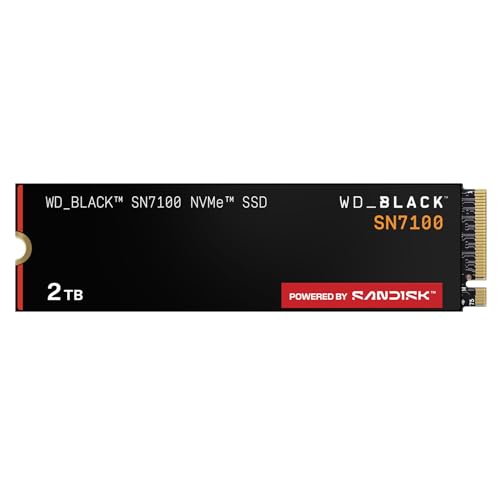
Not every handheld takes a 2230. If yours has a full-length slot, the WD_BLACK SN7100 is the drive to fit.
Specs
Form factor | M.2 2280, single-sided |
Interface | PCIe Gen 4.0 x4 |
Capacity | 2 TB |
NAND | Next-gen TLC 3D NAND |
Peak sequential read | 7,250 MB/s |
Peak sequential write | 6,900 MB/s |
DRAM | None (low-power HMB design) |
Form factor
M.2 2280, single-sided
Interface
PCIe Gen 4.0 x4
Capacity
2 TB
NAND
Next-gen TLC 3D NAND
Peak sequential read
7,250 MB/s
Peak sequential write
6,900 MB/s
DRAM
None (low-power HMB design)
What it does well
WD built the SN7100 with laptops and handhelds in mind rather than desktops, and it shows in the power curve. It is one of the most efficient Gen4 drives shipping, it is single-sided, and it uses TLC, so the write path holds up on large installs where the QLC 2230 drives sag.
At 7,250 MB/s peak read it leaves nothing on the table in a Gen4 slot. In a handheld with a proper 2280 bay, this is the drive that makes the machine stop feeling like a compromise. If you are still deciding between devices, our Steam Deck OLED vs ROG Ally X breakdown covers which slot you are actually buying into.
What you give up
It will not fit a Steam Deck, an original ROG Ally, or any 2230-only device, and no adapter makes that safe. Measure your slot before you order.
It is DRAM-less like the rest of the low-power class, so it is not a workstation drive. And in a thermally tight chassis, a Gen4 drive running flat out will warm up more than a 2230 doing half the throughput.
Who it's for
Anyone whose handheld takes a full-length 2280 drive and wants the fastest, coolest-running option instead of a repurposed desktop SSD. Valve's Steam Machine takes the same full-size 2280, and our verdict on whether 512GB is enough for the Steam Machine walks through that swap.
What to skip
Double-sided 2230 drives. They exist, they are often cheaper, and they are the single most common cause of a failed Steam Deck upgrade. If the listing photos show chips on both faces of the board, close the tab.
Gen5 drives. No handheld on the market has a Gen5 slot, and even if one did, a Gen5 controller's power draw is the wrong shape for a battery-powered device. That is desktop hardware solving a desktop problem, and it belongs in a desktop NVMe build, not in your bag. Console owners face the same ceiling, since the PS5 bay is Gen4 too, and the drives that fit it are in our best SSD for PS5 roundup.
2242 drives sold under handheld SSD listings. Outside the Legion Go S, almost nothing in the current lineup takes one, and the listings rarely say so. And if the teardown is the part you do not want to do at all, an external SSD over USB-C is a legitimate way out, just a slower one.
SSD or microSD?
If you are willing to open the device, the internal drive wins and it is not close. NVMe is several times faster than any microSD card, and on shader-heavy modern titles that gap shows up as shorter loads and fewer traversal hitches, not just as a number in a benchmark. The one handheld where that comparison does not apply is the Switch 2, which takes no internal drive at all and stores games only on Express cards, so the best microSD Express cards for Switch 2 are the upgrade path there instead.
If a teardown is a step too far, a bigger microSD card is a real answer, particularly for an emulation and indie library where the read speeds are not the bottleneck. Plenty of owners run both: the NVMe for the games that care, the card for everything else.
Bottom line
If you own a Steam Deck or an original ROG Ally, buy the WD_BLACK SN770M at 2 TB and stop thinking about it. If you own a Gen4 handheld and want the most speed for the money, the Crucial P310 is the pick, as long as you accept the QLC write cliff. If you want 2 TB of TLC in a 2230 and price is not the constraint, the Corsair MP600 Mini is the only drive that does it.
On the smallest budget, the Sabrent Rocket 2230 gives you TLC in a native single-sided board, and on a Deck's Gen3 slot you give up almost nothing real. And if your handheld takes a full-length 2280, the WD_BLACK SN7100 is the drive built for that job. Measure the slot, check that the board is single-sided, then buy on capacity.
FAQ
Does the Steam Deck use a 2230 or a 2280 SSD?
Every Steam Deck, LCD and OLED alike, uses an M.2 2230 drive. That is 22 mm wide by 30 mm long, roughly the size of a postage stamp. A 2280 drive is 80 mm long and physically will not fit, and no adapter makes it fit safely. Check the form factor before anything else, because it is the only spec that can turn a good drive into a returned one.
Will a PCIe Gen4 SSD run at full speed in a Steam Deck?
No. The Steam Deck's M.2 slot runs at PCIe 3.0 x4, so a drive rated for 7,100 MB/s will land somewhere around 3,500 MB/s in a Deck. Gen4 drives still work, they just get capped. This is why paying a premium for peak sequential read is a poor use of money on a Deck, and why the Sabrent Rocket 2230 1TB makes more sense there than its benchmark position suggests. On a Gen4 handheld like the ROG Ally X, the extra bandwidth is real.
Does a different SSD actually improve handheld battery life?
A little, and less than the marketing suggests. More efficient controllers like the Phison E27T in the Crucial P310 do draw less power and run cooler, which keeps the fan quieter. But Tom's Hardware measured an hour of actual Steam Deck gameplay and found no meaningful battery delta between drives, because a game session is mostly reads from memory with the drive parked in a low-power state. Treat power draw as a tiebreaker between two drives you already like, not as a reason to pick one.
Is a double-sided 2230 SSD safe to install in a Steam Deck?
No. Treat single-sided as a hard requirement. A double-sided 2230 puts NAND packages on both faces of the PCB, and the back face can press against the Steam Deck's EMI shield once the plate is screwed down. Owners have reported install failures, thermal throttling, and intermittent I/O errors from exactly this. Every pick in this guide is single-sided for that reason.
Do I have to reinstall SteamOS after swapping the drive?
Yes. The new drive arrives blank, so you write the SteamOS Recovery Image to a USB stick, boot the Deck from it, and run the reimage. Valve publishes the image and the steps directly. Budget about thirty minutes for the software side on top of the teardown, and back up any local saves that are not synced to Steam Cloud first.
Should I upgrade the internal SSD or just buy a bigger microSD card?
If you are comfortable opening the device, upgrade the SSD. Internal NVMe is several times faster than any microSD card, and on shader-heavy modern titles that shows up as shorter load times and fewer traversal hitches. If you would rather not void your comfort level with a teardown, a bigger microSD card is a legitimate answer for your emulation and indie library, and you can run both.
Related Articles

Best Handheld Gaming PC (2026): SteamOS vs Windows
The best handheld gaming PC in 2026 comes down to SteamOS vs Windows and battery vs raw performance. Picks for AAA, Game Pass, emulation, and budget.
Jul 7, 2026

Best microSD Cards for Steam Deck & ROG Ally: 5 Picks (2026)
The best microSD cards for Steam Deck and ROG Ally in 2026. The handheld slot caps near 104 MB/s, so we pick on A2 random reads and capacity, not box speed.
Aug 21, 2026

Best NVMe SSDs for Gaming 2026: Five Picks by Use Case
Best NVMe SSDs for gaming in 2026 — load times plateau above 5,000 MB/s, so capacity beats Gen5 specs. Five picks: mainstream, value, Gen5, capacity, boot.
May 11, 2026

Best External SSDs for Gaming (2026): 5 Picks by USB Port
The best external SSD for gaming depends on your USB port. 5 picks for PC, PS5, Xbox, and Steam Deck, from 1,050 MB/s USB drives to 6,000 MB/s Thunderbolt 5.
Oct 6, 2026

How to Choose RAM and Storage
A builder's framework for RAM and storage: match the platform, buy capacity over speed, and put your money in the right SSD tier.
Jun 29, 2026