Affiliate Disclosure: As an Amazon Associate we earn from qualifying purchases. Some links may earn us a commission at no cost to you.

What Gear Do iRacing Pros Use in 2026? Full Rig Breakdown
iRacing pro gear splits neatly into two worlds. The top split-one aliens and the eSports drivers on Verstappen.com Racing or Team Redline run direct-drive bases north of 15 Nm, hydraulic-feel load-cell pedals, bespoke formula rims, and either triple 32-inch screens or a high-end VR headset. Almost none of that top-shelf hardware sells on Amazon.
The good news: the feel that actually wins races comes from the technology, not the price tag, and the Amazon-buyable version of each category gets you most of the way there. Here is what the pros run, category by category, and the equivalent you can add to cart today.
Our top pick: MOZA R9 V3 Wheelbase
If you upgrade one thing, make it the base. A true 9 Nm direct-drive motor is the single change that makes iRacing feel like the pros describe it, and the MOZA R9 V3 is the cleanest entry into real direct drive.

Quick picks
Category | The Amazon pick | What the pros run | Where to buy |
|---|---|---|---|
Wheelbase | Simucube 2 Pro, Asetek Invicta (15 to 25 Nm) | ||
Steering wheel | Cube Controls, Ascher Racing formula rims | ||
Pedals | Heusinkveld Ultimate+, Asetek Invicta | ||
Cockpit | Sim-Lab and custom 80/20 aluminum rigs | ||
Screen | Triple 32-inch panels or high-end VR |
Wheelbase
- The Amazon pick
- What the pros run
Simucube 2 Pro, Asetek Invicta (15 to 25 Nm)
- Where to buy
Steering wheel
- The Amazon pick
- What the pros run
Cube Controls, Ascher Racing formula rims
- Where to buy
Pedals
- The Amazon pick
- What the pros run
Heusinkveld Ultimate+, Asetek Invicta
- Where to buy
Cockpit
- The Amazon pick
- What the pros run
Sim-Lab and custom 80/20 aluminum rigs
- Where to buy
Screen
- The Amazon pick
- What the pros run
Triple 32-inch panels or high-end VR
- Where to buy
How iRacing pros pick gear
Sim racing hardware ladders differently than a mouse or a keyboard. Spend in the wrong order and you waste money on parts that never touch your lap time. Here is the order the fast guys actually follow.
Base first, everything else second. Force feedback is your only channel of information from the car. A direct-drive motor delivers the tire scrub, kerb strikes, and the exact moment of grip loss with a detail belt-and-gear wheels physically cannot reproduce. Every alien runs direct drive, and it is the first thing they would buy again.
Brake feel is the second-biggest lap-time lever. Pros brake by pressure, not by pedal travel, which is why the load-cell brake is non-negotiable at the top. A load cell measures how hard you push rather than how far the pedal moves, so your threshold braking becomes repeatable corner after corner. It is the upgrade that most directly turns into consistency.
Rigidity is invisible until you skip it. A strong motor twisting a flimsy wheel stand feels vague and rattly, and it kills the very detail you paid for. This is why pros mount to 80/20 aluminum profile, and why a stiff static cockpit matters more than a motion platform for most drivers.
One honest caveat before the picks: do not copy the pros blindly. A 25 Nm base, a carbon formula rim, and triple 4K screens are what a sponsored driver runs because a sponsor pays for them. You do not need any of that to be fast, and for a deeper look at the wheel tier itself, see our sim racing wheel guide. Chase the technology, not the torque number.
Wheelbase: MOZA R9 V3 (9 Nm Direct Drive)
Specs
Peak torque | 9 Nm |
Motor type | Direct drive servo |
FFB algorithm | NexGen 4.0 |
Quick release | MOZA magnetic QR |
Platform | PC (Xbox via licensed wheel) |
Mounting | Desk clamp or hard mount |
Peak torque
9 Nm
Motor type
Direct drive servo
FFB algorithm
NexGen 4.0
Quick release
MOZA magnetic QR
Platform
PC (Xbox via licensed wheel)
Mounting
Desk clamp or hard mount
What it does well
Nine newton-metres of true direct drive is the sweet spot most drivers never realize they wanted. It is enough torque to load up under heavy cornering and snap back the instant a rear steps out, and the NexGen 4.0 algorithm reads cleaner through the mid-range than the R9 did a generation ago. This is the same category of feel Kevin Siggy and the Verstappen.com drivers get from a Simucube 2, just dialed to a level a desk or a mid-size cockpit can actually restrain.
The practical win is detail. You feel the front tires start to wash wide before the car visually understeers, so you learn to trail off throttle a beat earlier. That is where the lap time hides, and a belt-driven wheel simply blurs it away.
What you give up
Nine Nm is not 25 Nm. If you already run a big DD base you will notice the R9 V3 runs out of headroom on kerb-heavy tracks and in the heaviest formula cars. It also needs a stable mount. Clamp it to a flexy desk and the motor will shake the whole thing, which masks the detail you bought it for.
Who it's for
Drivers moving up from a Logitech or Thrustmaster belt wheel who want their first real direct-drive base without jumping to sponsor-tier torque.
Steering wheel: MOZA KS (300mm GT)
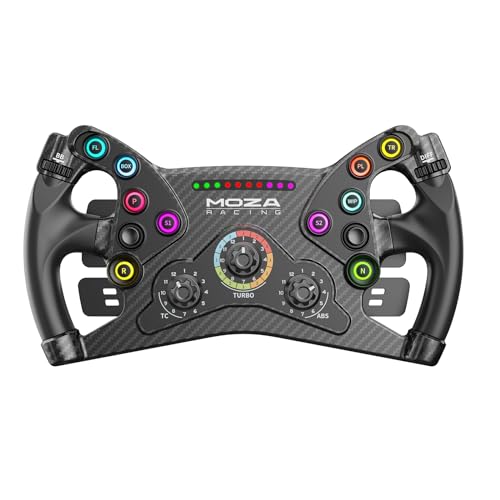
Specs
Diameter | 300mm |
Style | Butterfly GT |
Construction | Carbon-reinforced, aluminum QR |
Paddles | Dual magnetic shifters |
Inputs | Programmable buttons, dual clutch |
Compatibility | MOZA and third-party bases via hub |
Diameter
300mm
Style
Butterfly GT
Construction
Carbon-reinforced, aluminum QR
Paddles
Dual magnetic shifters
Inputs
Programmable buttons, dual clutch
Compatibility
MOZA and third-party bases via hub
What it does well
Pro rims are bespoke. Max Verstappen turns a Cube Controls wheel, and most eSports formula drivers run Ascher Racing or similar. The KS gets you the parts that matter: a 300mm butterfly GT shape that suits the mixed iRacing grid, crisp magnetic paddles with a positive click, and enough programmable buttons to map your black-box controls without reaching for the keyboard. If you want the full picture of what sim rig Max Verstappen uses at home and on the road, we broke down the F1 driver rigs part by part.
It is a genuinely versatile shape. GT3, road cars, and even oval work all feel natural on a round-ish butterfly wheel, which is exactly what most iRacing schedules throw at you week to week.
What you give up
A dedicated formula rim it is not. If you only race open-wheel, a flat-bottom or rectangular formula wheel with a full button matrix and rotary encoders gives you more inputs and a more authentic hand position. The KS also leans on MOZA's app for button mapping, which has a small learning curve.
Who it's for
iRacing drivers who run a mixed schedule of GT, road, and oval and want one wheel that does all three well rather than a single-discipline formula rim.
Pedals: MOZA CRP2 (Load Cell)

Specs
Configuration | Throttle and brake (clutch optional) |
Brake sensor | 200 kg load cell |
Body | CNC aluminum, carbon heel plate |
Angle sensor | 15-bit high precision |
Adjustment | Tool-free travel and angle |
Platform | PC and Xbox |
Configuration
Throttle and brake (clutch optional)
Brake sensor
200 kg load cell
Body
CNC aluminum, carbon heel plate
Angle sensor
15-bit high precision
Adjustment
Tool-free travel and angle
Platform
PC and Xbox
What it does well
This is the upgrade that pros would protect first. A 200 kg load-cell brake measures pressure, not travel, so you brake to a feeling in your leg rather than a distance your foot moves. That is precisely how Heusinkveld Ultimate and Asetek Invicta pedals work, and it is why threshold braking on a load cell becomes repeatable in a way a potentiometer pedal never is.
The CNC aluminum body and carbon heel plate do the other half of the job. There is no flex under a hard stop, so the only variable left is your foot. Tool-free travel and angle adjustment means you can match the brake stiffness to how you actually push.
What you give up
The out-of-box brake is firm, and drivers coming from a soft rubber-stop pedal will need a few sessions to recalibrate their leg. The two-pedal set covers most iRacing content, but rally and vintage-car fans will want to add the clutch module separately.
Who it's for
Anyone braking on a stock potentiometer set who keeps locking up or missing the same apex. Load-cell consistency is the fastest path from inconsistent to repeatable.
Cockpit: Next Level Racing F-GT Elite

Specs
Frame | 40x40 aluminum profile (80/20) |
Seating | Formula and GT positions |
Wheel deck | Front and side mount |
Base support | Direct drive rated |
Pedal plate | Adjustable, inverted-mount ready |
Expansion | Monitor and shifter add-ons |
Frame
40x40 aluminum profile (80/20)
Seating
Formula and GT positions
Wheel deck
Front and side mount
Base support
Direct drive rated
Pedal plate
Adjustable, inverted-mount ready
Expansion
Monitor and shifter add-ons
What it does well
Pro rigs are built on 80/20 aluminum profile for one reason: it does not move. Bolt the R9 V3 to the F-GT Elite's front or side wheel deck and the base has nothing to twist against, so every bit of that 9 Nm goes into your hands instead of into chassis flex. The Elite swaps between a reclined GT position and an upright formula position without tools, which matters if your iRacing schedule spans both.
It is also an upgrade platform, not a dead end. The same profile accepts a monitor stand, a shifter and handbrake, and stiffer pedal plates as you grow, which is exactly how the custom Sim-Lab rigs the pros use are meant to evolve.
What you give up
Aluminum profile is heavy and the build takes an evening with the included hardware. It is not a fold-away wheel stand, so you need dedicated floor space. And while it is rock solid, the seat is a racing shell rather than a plush recliner, so long endurance stints reward adding a good seat cushion.
Who it's for
Drivers ready to move off a wheel stand or desk clamp who want a rigid, expandable rig that will not flex under a direct-drive base.
Monitor: Samsung Odyssey G9 (49-inch)

Specs
Panel | 49-inch VA, 1000R curve |
Resolution | 5120 x 1440 (DQHD 32:9) |
Refresh | 240 Hz |
Response | 1 ms GtG |
HDR | VESA DisplayHDR 1000 |
Sync | AMD FreeSync Premium Pro |
Panel
49-inch VA, 1000R curve
Resolution
5120 x 1440 (DQHD 32:9)
Refresh
240 Hz
Response
1 ms GtG
HDR
VESA DisplayHDR 1000
Sync
AMD FreeSync Premium Pro
What it does well
The pro standard is triples. Max Verstappen races on triple 32-inch Samsung Odyssey panels, no VR and no motion, because he wants stable, consistent situational awareness. Triples are expensive and fiddly to align, though, and the single 49-inch Odyssey G9 is the one-purchase route to most of that benefit. The 1000R curve wraps the 32:9 image around your peripheral vision so you can place the car against the apex and clock a rival drawing alongside without swinging your eyes off the racing line. If you would rather race in a headset than align three panels, our best VR headsets for sim racing guide weighs the Quest 3 against the Pimax Crystal Light on clarity and GPU cost.
The 240 Hz refresh is real for racing. Fast panning at speed stays sharp, so kerbs and braking markers do not smear as they rush past, and the extra frames tighten the feel between your inputs and the car.
What you give up
One ultrawide is not three panels. Your true horizontal field of view is narrower than a triple setup angled around you, so cars sitting fully beside you in a side-by-side can still fall outside the frame. VA contrast is excellent but response is a step behind the fastest esports panels, and 32:9 at this size wants a strong GPU to hold 240 frames in a heavy field.
Who it's for
Drivers who want a wraparound view and a cleaner desk in one purchase, and who would rather start here than commit to the cost and alignment of a triple-monitor stand.
The bottom line
If you buy in the pros' order, start with the base. The MOZA R9 V3 is the change that makes iRacing feel like a real car, and it anchors everything else. Add the MOZA CRP2 load-cell pedals next, because brake consistency is where lap time actually lives. The MOZA KS wheel, the Next Level Racing F-GT Elite cockpit, and the Samsung Odyssey G9 round out a setup that gets you most of the way to a sponsored driver's rig without the sponsor.
The gear only gets you to the grid. For the PC side of an iRacing rig, see our best GPUs for sim racing and best CPU for VR sim racing guides, and if you want to go deeper on any one category, our sim racing pedals and sim racing monitors breakdowns pick apart the full tier ladder.
FAQ
Do you need a direct-drive wheel to be competitive in iRacing?
You can be quick on a good belt or gear wheel, but direct drive is the single upgrade every pro shares. The detail it delivers, feeling the tires start to slide before the car visually reacts, lets you correct earlier and drive closer to the limit lap after lap. You do not need a 25 Nm sponsor-tier base to get there. A true 9 Nm direct-drive motor already provides the clean, fast force feedback that belt wheels blur, which is why it is the first thing most drivers upgrade.
How much wheelbase torque do iRacing pros actually run?
Sponsored drivers often run bases capable of 15 to 25 Nm, but almost none of them use full torque in game. Most set their in-game force feedback well below the maximum so the wheel stays controllable through long stints and does not fatigue their arms. That is good news for buyers: a 9 to 12 Nm base gives you the same quality of detail, and you simply have less headroom on the very heaviest kerbs and formula cars. Torque is about ceiling, not about feel.
Are load-cell pedals worth it for iRacing?
They are arguably the best value upgrade after the base. A load cell measures how hard you press rather than how far the pedal travels, so your braking becomes a repeatable pressure your leg learns. That consistency is exactly what drops lap time and cuts lockups. Pros run hydraulic and load-cell pedals like Heusinkveld and Asetek for this reason, and a good 100 to 200 kg load-cell set gives you the same core benefit for a fraction of the outlay.
Triple monitors or VR for iRacing?
Both beat a single flat screen, and the right answer depends on how you race. Triples give the widest situational awareness and are less tiring over a long endurance stint, which is why drivers like Max Verstappen run three panels. VR gives you true depth perception and one-to-one head movement, which many drivers find faster to learn on. A single 49-inch ultrawide sits between the two: most of the wraparound view of triples in one purchase, without the alignment headache.
Can you use MOZA pedals or a MOZA wheel with a non-MOZA base?
The pedals, yes. Load-cell pedal sets like the CRP2 connect over USB and work independently of your wheelbase brand, so you can pair them with almost any base. Steering wheels are more brand-locked because the quick release and data pins are proprietary, though the MOZA KS can run on some third-party bases through an adapter hub. As a rule, treat pedals as universal and wheels as ecosystem parts when you plan upgrades.
What single upgrade drops the most lap time?
For most drivers it is the pedals, specifically a load-cell brake. Once your braking is a consistent pressure instead of a guess at pedal travel, your entry speed and trail-braking become repeatable, and that repeatability is what shows up on the stopwatch. If you are still on a potentiometer brake, upgrading there usually pays off faster than another few newton-metres of wheel torque. Base first for feel, pedals first for lap time.
Related Articles

Best Sim Racing Wheel for iRacing and Assetto Corsa (2026)
The best sim racing wheels for iRacing and Assetto Corsa, from the MOZA R5 direct drive bundle to the Logitech G Pro, matched to your torque and mounting.
Jul 3, 2026

Best Sim Racing Pedals 2026: 5 Load Cell Picks, Desk or Rig
Best sim racing pedals for 2026: five load cell sets ranked by tier, with brake force ratings and a straight answer on desk clamp versus cockpit mounting.
Sep 20, 2026

Best Sim Racing Cockpits 2026: 5 Picks Under $1,000
The best sim racing cockpits of 2026 for your room and wheel: a rig that folds in 10 seconds, a seat-included 13 Nm direct drive pick, and an aluminum frame.
Oct 12, 2026

Best Monitor for Sim Racing (2026): Ultrawide vs Triples
The best monitor for sim racing in 2026, with the GPU tier every config needs: 34-inch ultrawide, 49-inch super ultrawide, or 1440p triples on a real rig.
Sep 21, 2026

Best GPUs for Sim Racing 2026: 5 Picks for Triples and VR
Best GPUs for sim racing in 2026: 5 picks by display setup, from one 1440p panel to triple screens and VR, plus the iRacing no-DLSS math that sets your tier.
Aug 30, 2026