Affiliate Disclosure: As an Amazon Associate we earn from qualifying purchases. Some links may earn us a commission at no cost to you.

Best CPU Coolers for the Ryzen 9 9950X3D (2026 Picks)
The Ryzen 9 9950X3D is a 16-core flagship that pulls real power and packs its heat into a dense stack of cores and 3D V-cache. That combination makes the cooler question less about raw wattage and more about how you actually run the chip.
Game on it and a strong air tower keeps it happy. Push all 32 threads through a long render or compile and the extra headroom of a 360mm AIO starts to earn its keep. This guide sorts the coolers by that split, so you buy for your workload instead of overbuying by reflex.
Our top pick: Arctic Liquid Freezer III Pro 360
For a chip AMD itself points toward liquid, the Arctic Liquid Freezer III Pro 360 gives the 9950X3D the widest thermal margin here, and it does it for less than most 280mm units cost.

Quick picks
Pick | Cooler | Best for | Where to buy |
|---|---|---|---|
Best Overall | Sustained all-core work | ||
Best Value | Gaming-first builds | ||
Best Premium | A hard quiet requirement | ||
Best Budget | Lowest sane price | ||
Editor's Pick | A clean single-cable build |
Best Overall
- Cooler
- Best for
Sustained all-core work
- Where to buy
Best Value
- Cooler
- Best for
Gaming-first builds
- Where to buy
Best Premium
- Cooler
- Best for
A hard quiet requirement
- Where to buy
Best Budget
- Cooler
- Best for
Lowest sane price
- Where to buy
Editor's Pick
- Cooler
- Best for
A clean single-cable build
- Where to buy
Specs at a glance
Cooler | Type | Class | Height / radiator | Fans | Sockets |
|---|---|---|---|---|---|
360mm AIO | Liquid | 360mm rad, 38mm thick | 3x 120mm P12 Pro A-RGB | AM5/AM4, LGA1851/1700 | |
Dual-tower air | Air | 154mm | 2x 120mm PWM, A-RGB | AM5/AM4, LGA1700/1851 | |
Dual-tower air | Air | 168mm | 2x 140mm NF-A14x25 G2 | AM5/AM4, LGA1851/1700 | |
Dual-tower air | Air | 155mm | 2x 120mm PWM | AM5/AM4, LGA1700/1851 | |
360mm AIO | Liquid | 360mm rad | 3x RX120 RGB | AM5/AM4, LGA1851/1700 |
- Type
360mm AIO
- Class
Liquid
- Height / radiator
360mm rad, 38mm thick
- Fans
3x 120mm P12 Pro A-RGB
- Sockets
AM5/AM4, LGA1851/1700
- Type
Dual-tower air
- Class
Air
- Height / radiator
154mm
- Fans
2x 120mm PWM, A-RGB
- Sockets
AM5/AM4, LGA1700/1851
- Type
Dual-tower air
- Class
Air
- Height / radiator
168mm
- Fans
2x 140mm NF-A14x25 G2
- Sockets
AM5/AM4, LGA1851/1700
- Type
Dual-tower air
- Class
Air
- Height / radiator
155mm
- Fans
2x 120mm PWM
- Sockets
AM5/AM4, LGA1700/1851
- Type
360mm AIO
- Class
Liquid
- Height / radiator
360mm rad
- Fans
3x RX120 RGB
- Sockets
AM5/AM4, LGA1851/1700
Does the 9950X3D actually need a 360? The thermal reality
Short answer: no, not the way most people mean it. The 9950X3D carries a 170 to 230 watt power range and a 95C thermal limit, and its 3D V-cache sits on top of one core die, which concentrates heat and slows how fast it moves into the cooler. So the chip reads warm under load no matter what you bolt on. That is the chip, not a failing cooler.
What changes with the cooler is headroom. In games, where only a few cores are stressed, a good air tower holds the 9950X3D in the 60s and low 70s Celsius and never comes close to throttling. The strongest 360mm units, like the Arctic, hold sustained all-core temperatures in the high 60s to low 70s, while top air coolers and 280mm units land in the mid 80s under the same load and can brush the low 90s during long AVX runs. None of those are dangerous. If you are still speccing the platform, the board that feeds a 16-core chip matters as much as the cooler you put on it.
240 vs 360 vs air: the decision ledger
Cooler class | Gaming load | Sustained all-core | Noise | Best for |
|---|---|---|---|---|
Top-tier air | 60s to low 70s C | Mid to high 80s C | Very low on a tuned curve | Gaming-first builds, no pump risk |
240mm AIO | 60s C | High 80s, can near 90C | Low to moderate | Compact builds, gaming plus light all-core |
280mm AIO | 60s C | Mid 80s C | Low | A middle ground when a 360 will not fit |
360mm AIO | 60s C | High 60s to low 70s C | Low, the thick rad stays calm | Sustained all-core and productivity |
Top-tier air
- Gaming load
60s to low 70s C
- Sustained all-core
Mid to high 80s C
- Noise
Very low on a tuned curve
- Best for
Gaming-first builds, no pump risk
240mm AIO
- Gaming load
60s C
- Sustained all-core
High 80s, can near 90C
- Noise
Low to moderate
- Best for
Compact builds, gaming plus light all-core
280mm AIO
- Gaming load
60s C
- Sustained all-core
Mid 80s C
- Noise
Low
- Best for
A middle ground when a 360 will not fit
360mm AIO
- Gaming load
60s C
- Sustained all-core
High 60s to low 70s C
- Noise
Low, the thick rad stays calm
- Best for
Sustained all-core and productivity
How we picked
We size the cooler to how the chip gets used, not to the sticker on the box. On a gaming-first 9950X3D, a quality dual-tower air cooler is the honest answer: it matches the temperatures that matter, costs a fraction of a liquid loop, and has no pump to fail in year four and drip onto the parts below it. That last point is why we still reach for air first, the same way we do in our 9800X3D cooler guide.
Liquid earns the top slot here because this specific chip does spend real time at full tilt for the people who buy 16 cores, and a thick 360mm radiator holds the most margin during those long all-core sessions. Beyond that, the picks split cleanly by priority: lowest sane price, a hard quiet requirement, or a tidy single-cable build. One aside worth a few dollars on a chip this hot: a PTM7950 phase-change pad instead of paste holds a degree or two more over the life of the build and will not pump out. Skip liquid metal unless you know exactly why you want it. For the full chassis-side picture, see our guide to choosing a cooler, PSU, and case.
Best Overall: Arctic Liquid Freezer III Pro 360
Specs
Type | 360mm AIO liquid |
Radiator | 360mm (3x120mm), 38mm thick |
Fans | 3x Arctic P12 Pro PWM, A-RGB |
Pump | In-house PWM, integrated VRM fan |
Sockets | AM5/AM4, LGA1851/1700 (contact frame incl.) |
Warranty | 6 years |
Type
360mm AIO liquid
Radiator
360mm (3x120mm), 38mm thick
Fans
3x Arctic P12 Pro PWM, A-RGB
Pump
In-house PWM, integrated VRM fan
Sockets
AM5/AM4, LGA1851/1700 (contact frame incl.)
Warranty
6 years
What it does well
This is the pick with the widest thermal margin here. On the 9950X3D it holds the high 60s to low 70s Celsius through a sustained Cinebench all-core run, and low-to-mid 70s under Prime95 pushing past 230 watts. The 38mm radiator moves more heat per fan RPM than a thinner 360, so it stays quiet where slimmer units ramp up.
The bundled VRM fan blows across the board's power stages, a genuine help on the long all-core duty cycle a 16-core productivity chip runs. An AM5 contact frame is in the box, and the 6-year warranty is the longest of any liquid cooler here.
What you give up
It is still an AIO, so the pump is a moving part that can fail down the road. The year-four pump-failure pattern is exactly why a lot of builders stay on air in the first place.
The Pro is chunky. A 38mm radiator plus 25mm fans wants roughly 63mm of mount clearance, so check your case before you commit. And if you only game, most of that all-core headroom sits unused.
Who it's for
The builder who runs the 9950X3D the way AMD intended, heavy all-core work alongside gaming, and wants the widest thermal margin without paying flagship-AIO money.
Best Value: Thermalright Phantom Spirit 120 SE

Specs
Type | Dual-tower air |
Height | 154mm |
Heat pipes | 7x 6mm, AGHP 4.0 |
Fans | 2x 120mm TL-C12B-S V2 PWM, A-RGB |
Bearing | S-FDB |
Sockets | AM5/AM4, LGA1700/1200/115x/1851 |
Type
Dual-tower air
Height
154mm
Heat pipes
7x 6mm, AGHP 4.0
Fans
2x 120mm TL-C12B-S V2 PWM, A-RGB
Bearing
S-FDB
Sockets
AM5/AM4, LGA1700/1200/115x/1851
What it does well
Seven heat pipes and two 120mm fans keep the 9950X3D in the 60s Celsius while gaming and in the mid-to-high 80s under a sustained all-core hammer. That is exactly the range you want on a chip whose V-cache die is the thermal limiter anyway.
It runs quiet on a normal fan curve, mounts on AM5 in a few minutes, and has no pump, no coolant, and nothing to fail in year four. This is the cooler that makes the case for skipping liquid entirely if you game more than you render.
What you give up
Under a genuine all-core AVX workload the 9950X3D will push this cooler into the high 80s and occasionally brush the 95C limit, so a heavy Blender or compile user gives up the last slice of headroom a 360 would hold.
At 154mm it clears most towers, but the near fan can sit over the first RAM slot, so check the height of tall kits. And it is air, so there is no showcase-loop look.
Who it's for
The 9950X3D owner whose real workload is games plus the occasional render, who wants flagship-adjacent temperatures for very little money and none of the pump risk.
Best Premium: Noctua NH-D15 G2

Specs
Type | Dual-tower air (reference-class) |
Height | 168mm |
Heat pipes | 8x |
Fans | 2x NF-A14x25r G2 140mm PWM |
Sockets | AM5/AM4, LGA1851/1700/1200 |
Warranty | 6 years |
Type
Dual-tower air (reference-class)
Height
168mm
Heat pipes
8x
Fans
2x NF-A14x25r G2 140mm PWM
Sockets
AM5/AM4, LGA1851/1700/1200
Warranty
6 years
What it does well
The G2 is the quietest way to keep the 9950X3D in check on air. Eight heat pipes and two of Noctua's NF-A14x25 G2 fans pull all-core temperatures into the mid 80s while staying near-inaudible on a tuned curve, and gaming loads sit comfortably in the 60s to low 70s.
Build quality and the 6-year warranty are the industry benchmark, and the offset design clears the first PCIe slot and most memory. For a buyer who treats silence as a hard requirement, this is the endgame on air.
What you give up
It is expensive, roughly the price of a good 360mm AIO, and on a sustained all-core AVX run a 360 still holds a few degrees more margin.
At 168mm it is tall, so measure case clearance carefully, because some popular mid-towers only close the side panel with a slight bow. Thermally it trades blows with a cooler a third of its price, so you are paying for the noise floor, the fit and finish, and the warranty, not a temperature win.
Who it's for
The builder with a hard quiet requirement, an office-desk or recording setup, who wants the best air cooler made and accepts paying for the noise floor rather than a raw temperature edge.
Best Budget: Thermalright Peerless Assassin 120 SE
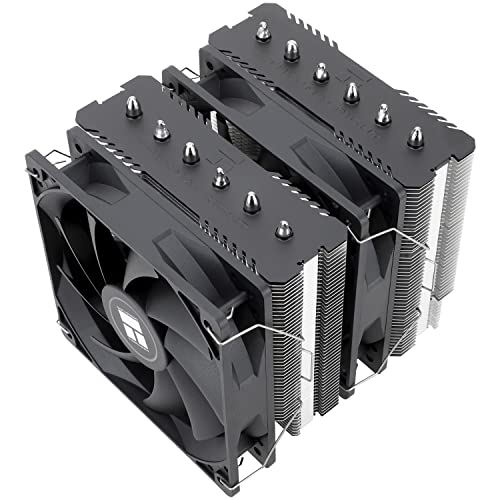
Specs
Type | Dual-tower air |
Height | 155mm |
Heat pipes | 6x, AGHP |
Fans | 2x 120mm PWM, 1550 RPM |
Sockets | AM5/AM4, LGA1700/1200/115x/1851 |
Type
Dual-tower air
Height
155mm
Heat pipes
6x, AGHP
Fans
2x 120mm PWM, 1550 RPM
Sockets
AM5/AM4, LGA1700/1200/115x/1851
What it does well
Six heat pipes and two PWM fans put this within a degree or two of the Phantom Spirit for gaming and light multi-core work, which means a 9950X3D gaming build gets cooled well for the least money of anything here.
Installation is the same tool-light AM5 mount, it runs quiet, and there is no pump to fail. For a builder who spent up on the chip and GPU, this keeps the cooler line honest without leaving the CPU cooked.
What you give up
It has less all-core ceiling than the seven-pipe Phantom Spirit, so under a long AVX render the 9950X3D sits a notch warmer and can flirt with the throttle point.
The bundled fans are good but not the quietest at full tilt, and the base version has no A-RGB if lighting matters to the build.
Who it's for
The value builder who wants the 9950X3D cooled competently for gaming at the lowest sensible price and does not run sustained all-core workloads.
Editor's Pick: Corsair iCUE Link Titan 360 RX

Specs
Type | 360mm AIO liquid |
Radiator | 360mm (3x120mm) |
Fans | 3x RX120 RGB (magnetic dome bearing) |
Pump | FlowDrive low-noise engine |
Connectivity | iCUE Link single-cable System Hub (included) |
Sockets | AM5/AM4, LGA1851/1700 |
Type
360mm AIO liquid
Radiator
360mm (3x120mm)
Fans
3x RX120 RGB (magnetic dome bearing)
Pump
FlowDrive low-noise engine
Connectivity
iCUE Link single-cable System Hub (included)
Sockets
AM5/AM4, LGA1851/1700
What it does well
The iCUE Link system daisy-chains the pump and all three RX120 fans onto one cable back to the System Hub, which turns the usual AIO cable tangle into a single run. That is the reason to pick it over a cheaper 360.
Cooling is genuinely strong, holding the 9950X3D in the low-to-mid 70s under sustained all-core load, just behind the Arctic. The FlowDrive pump is quiet and the RX120 fans are among Corsair's best, so for an all-Corsair build already running iCUE it is the tidiest way to cool 16 cores.
What you give up
You pay a premium over the Arctic for the ecosystem, and that premium buys cable tidiness and software, not lower temperatures. The Arctic Pro still edges it on raw thermals for the money.
The System Hub is one more component to place, full control assumes you live in the iCUE software, and like any AIO the pump is a wear part. Buy the RX fan version, not an LCD-screen variant, because the screen is jewelry, not cooling.
Who it's for
The builder already in the Corsair iCUE ecosystem who wants a single-cable 360 for a clean 9950X3D build and will pay for the tidiness.
Bottom line
If you mostly game on the 9950X3D, buy the Thermalright Phantom Spirit 120 SE and put the savings toward storage or a better monitor. If you run heavy all-core work, the Arctic Liquid Freezer III Pro 360 holds the most headroom for the money. If silence is a hard requirement, the Noctua NH-D15 G2 is the endgame on air. On a tight budget, the Peerless Assassin 120 SE cools a gaming build well for the least money. If you want a clean single-cable loop in a Corsair build, the iCUE Link Titan 360 RX is the one to get. Pair whichever you choose with the right DDR5 for the 9950X3D, and if you are on Intel's flagship instead, see our Core Ultra 9 285K cooler guide.
FAQ
Does the Ryzen 9 9950X3D need a 360mm AIO?
Not strictly. For gaming, a strong air cooler or a 240mm to 280mm AIO keeps the 9950X3D well off its 95C throttle point, because games only load a handful of cores. A 360mm AIO matters when you run sustained all-core work like rendering or compiling, where it holds several degrees more headroom and lets the chip boost longer. Buy the 360 for the workload, not for the chip's name.
Can an air cooler handle the Ryzen 9 9950X3D?
Yes. A top dual-tower cooler like the Phantom Spirit 120 SE or the Noctua NH-D15 G2 holds gaming loads in the 60s Celsius and sustained all-core loads in the mid-to-high 80s. The 9950X3D runs warm because its V-cache die concentrates heat, so those numbers are normal and safe. Air gives up a little all-core margin versus a 360, and nothing else.
Is a 240mm AIO enough for the 9950X3D?
For gaming and light multi-core work, a good 240mm AIO is enough and stays quiet. Under a long all-core render it sits warmer than a 360 and can climb into the high 80s or near 90C, which is safe but leaves less boost headroom. If your case only fits a 240, pair it with a strong fan curve and you will be fine for a gaming-first build.
What temperature is normal for the Ryzen 9 9950X3D under load?
Idle sits around the high 30s to mid 40s Celsius. Gaming usually lands in the 60s to low 70s on a capable cooler. Sustained all-core workloads push into the mid 80s and, on air or smaller AIOs, the low 90s. The chip's limit is 95C, where it eases back boost to protect itself, so seeing high 80s under a Cinebench run is expected, not a sign your cooler is failing.
Does the 9950X3D run hotter than the 9950X?
It reads hotter under the same cooler. The 3D V-cache sits on top of one core die, which adds a layer between the hottest cores and the cooler and concentrates heat in a smaller area. Package power is similar to the non-3D 9950X, but the core temperature climbs faster. That is why cooling advice for the X3D leans toward more radiator or a stronger air tower than the plain 9950X needs.
Is a thermal paste upgrade like PTM7950 worth it on the 9950X3D?
On a chip this hot, it is one of the few upgrades worth the small cost. PTM7950 is a phase-change pad that holds a degree or two better than top pastes after it beds in, and it will not dry out or pump away over the years. The stock paste that ships with these coolers is fine, so treat PTM7950 as a nice-to-have rather than a requirement. Skip liquid metal unless you fully understand the risks.
Related Articles

Best CPU Coolers for the Ryzen 7 9800X3D (2026)
Pick the right cooler for the Ryzen 7 9800X3D. Air, AIO, and SFF picks for the chip's actual gaming thermal envelope, not the SERP's biggest cooler defaults.
May 13, 2026

Best CPU Coolers for the Intel Core Ultra 9 285K (2026)
The best CPU cooler for the Core Ultra 9 285K depends on your workload. A 360mm AIO earns its keep under all-core load; here is where air still holds up.
Jul 11, 2026

Best DDR5 RAM for Ryzen 9 9950X3D (2026)
The best DDR5 RAM for the Ryzen 9 9950X3D in 2026: DDR5-6000 CL30 kits across 32GB, 64GB and 96GB, plus why the dual-CCD chip wants capacity, not a faster kit.
Jun 28, 2026

Best Motherboards for Ryzen 9 9950X3D (2026): B850 or X870E
Best motherboard for the 9950X3D in 2026: five AM5 picks ranked by VRM headroom for a 170W 16-core X3D, not by chipset tier. Where to spend and where to stop.
Jul 21, 2026

How to Choose a PSU, Cooler, and Case
A builder's framework for the chassis side of a PC: size the PSU with sane headroom, match the cooler to the chip, and pick a case that fits and breathes.
Jun 29, 2026