Affiliate Disclosure: As an Amazon Associate we earn from qualifying purchases. Some links may earn us a commission at no cost to you.

Best Gaming Air CPU Coolers 2026: 5 Picks From SFF to 250W
For most gaming builds the best air CPU cooler is the Thermalright Phantom Spirit 120 SE ARGB: dual-tower cooling that stays quiet under a real gaming load and carries 200W of sustained headroom. The number that should decide your pick is not the CPU's rated TDP but its sustained draw while you are actually playing, which sits in the 120 to 160 watt range for most gaming chips. The five picks below span that whole range, from a 37mm low-profile cooler for AM5 mITX builds to a 250W-class flagship for sustained all-core work.
Our top pick: Thermalright Phantom Spirit 120 SE ARGB
The Thermalright Phantom Spirit 120 SE ARGB delivers dual-tower thermal performance that trades within 2°C of coolers costing three times as much, all while staying genuinely quiet at gaming loads. It is the reason liquid cooling is not the obvious default for most builds.
Quick picks
Pick | Product | Best for | Buy |
|---|---|---|---|
Best Overall | Most gaming builds at any budget | Check Price | |
Best Value | Budget to mid-range CPUs, quiet operation | Check Price | |
Best Premium | Audio/WFH builds where noise is a hard requirement | Check Price | |
Best Budget | Maximum performance per dollar | Check Price | |
Editor's Pick (SFF) | AM5 mITX and low-profile builds | Check Price |
Best Overall
- Product
- Best for
Most gaming builds at any budget
- Buy
- Check Price
Best Value
- Product
- Best for
Budget to mid-range CPUs, quiet operation
- Buy
- Check Price
Best Premium
- Product
- Best for
Audio/WFH builds where noise is a hard requirement
- Buy
- Check Price
Best Budget
- Product
- Best for
Maximum performance per dollar
- Buy
- Check Price
Editor's Pick (SFF)
- Product
- Best for
AM5 mITX and low-profile builds
- Buy
- Check Price
Specs at a glance
Pick | Product | Height | TDP Range | Socket |
|---|---|---|---|---|
Best Overall | 154mm | 200W+ sustained | AM4/AM5, LGA1700/1851 | |
Best Value | 150mm | 150W+ | AM4/AM5, LGA1700/1851 | |
Best Premium | 168mm | 250W+ sustained | AM4/AM5, LGA1700/1851 | |
Best Budget | 155mm | 150W+ | AM4/AM5, LGA1700/1851 | |
Editor's Pick (SFF) | 37mm | 65W (eco mode) | AM5 only |
Best Overall
- Product
- Height
154mm
- TDP Range
200W+ sustained
- Socket
AM4/AM5, LGA1700/1851
Best Value
- Product
- Height
150mm
- TDP Range
150W+
- Socket
AM4/AM5, LGA1700/1851
Best Premium
- Product
- Height
168mm
- TDP Range
250W+ sustained
- Socket
AM4/AM5, LGA1700/1851
Best Budget
- Product
- Height
155mm
- TDP Range
150W+
- Socket
AM4/AM5, LGA1700/1851
Editor's Pick (SFF)
- Product
- Height
37mm
- TDP Range
65W (eco mode)
- Socket
AM5 only
Why Air Cooling Still Makes Sense for Most Gaming PCs
The AIO pump narrative has been running for a decade: liquid equals better, air equals compromise. That framing holds up on paper but breaks down at the product level.
A good dual-tower air cooler has no moving parts other than the fans. Those fans are replaceable, field-serviceable, and run at much lower RPM than an AIO pump. The Thermalright and Arctic picks on this list keep a 12900K and 9800X3D under control at gaming loads while staying quiet enough to notice. The thermal ceiling is real, but for the CPUs that power gaming PCs in 2026, the ceiling is high enough.
For context: the Phantom Spirit 120 SE tested within 2°C of the NH-D15 G2 on sustained 125W loads. The NH-D15 G2 is a 168mm dual-tower that costs more than the best-reviewed 240mm AIO on the market. Air is not a compromise for most buyers. It is the right choice.
Where air cooling genuinely loses: 250W-class CPUs running sustained multi-threaded workloads (a 9950X at full cinebench, a 285K at all-core load), builds in cases with very limited clearance where a 155mm tower becomes physically impossible, or buyers who genuinely require the lowest noise floor achievable. For those use cases, see our air cooler versus AIO comparison.
Match Your Cooler to Your CPU's Gaming Wattage
Rated TDP is a purchasing label, not a thermal load. What actually decides which cooler on this list you need is the wattage your CPU pulls while it is running, and for gaming that number is far below the box figure. Where the ceiling matters is sustained all-core work, which is the one place air cooling asks you to buy up. At the 65 watt end of that range, the best CPU cooler for the Ryzen 5 7600 shows how little a stock-cooled six-core really asks for.
Your CPU's sustained load | What to buy |
|---|---|
Up to 65W (AM5 eco mode, low-profile builds) | Noctua NH-L9a-AM5 |
Up to 150W (mainstream gaming CPUs during gameplay) | Arctic Freezer 36 or Thermalright Peerless Assassin 120 SE |
Up to 200W (high-end gaming plus light all-core work) | Thermalright Phantom Spirit 120 SE ARGB |
250W+ sustained all-core (9950X or 285K at full multi-threaded load) | Noctua NH-D15 G2 |
Up to 65W (AM5 eco mode, low-profile builds)
- What to buy
Noctua NH-L9a-AM5
Up to 150W (mainstream gaming CPUs during gameplay)
- What to buy
Arctic Freezer 36 or Thermalright Peerless Assassin 120 SE
Up to 200W (high-end gaming plus light all-core work)
- What to buy
Thermalright Phantom Spirit 120 SE ARGB
250W+ sustained all-core (9950X or 285K at full multi-threaded load)
- What to buy
Noctua NH-D15 G2
Read the left column as sustained draw, not peak boost. A gaming CPU spiking to 200W for two seconds in a benchmark run does not need the cooler that a chip holding 200W for twenty minutes needs. If your build is gaming first with occasional rendering or compile work, size for the gaming number and accept slightly higher temperatures on the rare all-core day. For a worked example at the bottom of that table, the best CPU cooler for the Ryzen 5 9600X is sized against an 88 watt package ceiling rather than a marketing TDP.
Best Overall: Thermalright Phantom Spirit 120 SE ARGB

Specs
Spec | Value |
|---|---|
Design | Dual-tower, 7 copper heatpipes (AGHP 4.0) |
Fans | Two 120mm TL-C12B-S V2 PWM |
Height | 154mm |
Base | Nickel-plated |
Sockets | AM4/AM5, LGA1700/1850/1851 |
Sustained rating | 200W+ |
In the box | Thermalright TF7 thermal compound |
Design
- Value
Dual-tower, 7 copper heatpipes (AGHP 4.0)
Fans
- Value
Two 120mm TL-C12B-S V2 PWM
Height
- Value
154mm
Base
- Value
Nickel-plated
Sockets
- Value
AM4/AM5, LGA1700/1850/1851
Sustained rating
- Value
200W+
In the box
- Value
Thermalright TF7 thermal compound
What it does well
Seven heatpipes in a dual-tower configuration at this price tier is not normal. The Phantom Spirit 120 SE ARGB uses Thermalright's AGHP (Advanced Gas-Filled Heat Pipe) technology to pull heat away from the CPU die faster than conventional copper pipes at equivalent costs, and the S-FDB bearing fans stay genuinely quiet at the RPMs required for gaming loads.
Tom's Hardware called the original Phantom Spirit 120 (non-ARGB) "simply the best" value air cooler they had tested. The EVO variant drew "peak of air cooling performance" from TechPowerUp. The SE ARGB variant on this list adds the ARGB fans without changing the heatsink geometry or thermal characteristics.
At 125W class workloads (7800X3D, 9800X3D, 13600K, 9600X), the Phantom Spirit 120 SE lands within 2°C of the Noctua NH-D15 G2 in back-to-back comparisons. That gap is irrelevant for gaming. The practical difference between these two coolers, for a gaming PC, is entirely price. The 7800X3D makes that convergence clearest, which is why our cooler picks for the 7800X3D rank on sustained clock and noise rather than peak temperature.
The 154mm height is a meaningful practical advantage. It clears every mainstream ATX mid-tower without drama, including the Lian Li Lancool 216 (practical max ~165mm with the panel on). Check specific case compatibility before ordering, but the vast majority of builds will not hit a clearance issue.
What you give up
RAM clearance requires a look. The dual-tower configuration can overhang the DIMM slots depending on the board layout. Tall DDR5 kits (over 42mm) have caused contact issues on some boards. Lower-profile DDR5 sticks (32mm, available from G.Skill and Corsair on most tiers) clear it without problems.
Stock is the one real flag at time of writing. This pick was showing 6 units available at brief time, which passes the threshold for listing but warrants a stock check before buying. The Peerless Assassin 120 SE is a direct fallback if the Phantom Spirit is out of stock.
The ARGB ecosystem is Thermalright's own controller or 3-pin ARGB header. If you are not running a motherboard with an ARGB header and you care about the lighting, factor that in.
Who it's for
This is the pick for builders who want to solve cooling completely without thinking about it again. You get dual-tower performance that covers the CPUs most gaming builds use, a height that fits most cases, a seven-year product track record, and quiet fans. Whether you are building a mid-range Ryzen 5 system or a high-end Intel rig, this cooler covers it.
Best Value: Arctic Freezer 36

Specs
Spec | Value |
|---|---|
Design | Single-tower, 4 heatpipes |
Fans | Two 120mm P-fan PWM in push-pull, Fluid Dynamic Bearing |
Height | 150mm |
Sockets | AM4/AM5, LGA1700/1851 |
Sustained rating | 150W+ |
In the box | Arctic MX-6 thermal compound |
Design
- Value
Single-tower, 4 heatpipes
Fans
- Value
Two 120mm P-fan PWM in push-pull, Fluid Dynamic Bearing
Height
- Value
150mm
Sockets
- Value
AM4/AM5, LGA1700/1851
Sustained rating
- Value
150W+
In the box
- Value
Arctic MX-6 thermal compound
What it does well
The Freezer 36 is a single-tower cooler with a push-pull fan configuration, and that configuration matters. Two fans through one heatsink produces meaningfully better airflow than a single-fan single-tower at the same cost. GamersNexus put it at the top of its class for value at launch.
The noise story is the headline. Tom's Hardware recorded 40.3 dBA under load, which is quieter than most 240mm AIOs and significantly quieter than budget single-tower alternatives. On a Ryzen 5 9600X under extended gaming and blended workloads, temperatures stayed at or below 72°C. That is genuine headroom on a platform where efficient CPUs dominate gaming builds.
For builds using a mid-range gaming CPU at stock settings, the Freezer 36 is the answer. It includes Arctic's MX-6 paste, which is a genuine step above what ships with most budget coolers.
What you give up
Single-tower limits on high-TDP applications. The Freezer 36 handles 125W-class CPUs cleanly, but an unlocked Core i9 or a Ryzen 9 9950X running at full load will exceed its comfortable operating range. If you are building around a 200W-class CPU, look at the Phantom Spirit 120 SE instead.
The push-pull fan configuration adds about 30mm to the front-to-back depth vs a single fan. Most ATX cases accommodate it, but mITX and compact mATX cases may not. Check that both fans clear any front-panel objects in your case.
Who it's for
The Freezer 36 is for builders who need a no-fuss cooler for a mid-range system: Ryzen 5 or 7, Core i5 or i7 at stock, builds where noise matters and the budget for a dual-tower is going elsewhere. It is also a strong pick for first-time builders who want a quality install experience without complicated mounting hardware.
Best Premium Air Cooler: Noctua NH-D15 G2

Specs
Spec | Value |
|---|---|
Design | Dual-tower, 8 heatpipes |
Fans | Two 150mm NF-A15x25 G2 PWM |
Height | 168mm (HBC standard all-round version) |
Sockets | AM4/AM5, LGA1700/1851 (LBC variant for low-clearance AM5 boards) |
Sustained rating | 250W+ |
In the box | Noctua NT-H2 thermal compound |
Design
- Value
Dual-tower, 8 heatpipes
Fans
- Value
Two 150mm NF-A15x25 G2 PWM
Height
- Value
168mm (HBC standard all-round version)
Sockets
- Value
AM4/AM5, LGA1700/1851 (LBC variant for low-clearance AM5 boards)
Sustained rating
- Value
250W+
In the box
- Value
Noctua NT-H2 thermal compound
What it does well
The NH-D15 G2 is the thermal ceiling for air cooling on a consumer platform. GamersNexus measured 57.8°C over ambient on an Intel i9-14900KF at full load under the HBC configuration. In the context of air cooling, that is as far as physics currently allows without exotic solutions.
The two 150mm NF-A15x25 G2 fans are the reason Noctua commands the price it does. They move more air at lower RPM than 120mm fans, which means the cooler reaches its thermal ceiling with fan noise that smaller coolers cannot match. For a buyer in a room where the PC is audible, this is the product.
The 7-year warranty and Noctua's customer support are real differentiators. Noctua replaces damaged mounting hardware, supplies compatibility kits for new sockets, and has a track record of supporting products well past the typical product cycle. You buy this cooler once.
For the specific buyer profile this pick targets: audio production, work-from-home setups where the PC is 18 inches from your ears, documented noise sensitivity, or someone building the quietest possible PC as the goal, the NH-D15 G2 is the correct answer.
What you give up
Height and price. At 168mm, the NH-D15 G2 exceeds the practical clearance limit of some popular ATX cases. The Lian Li Lancool 216, advertised at 180mm clearance, has a practical maximum of around 165mm with the panel installed and ARGB fan tops in place. The NH-D15 G2 at 168mm is too tight for some builds. Verify your specific case before ordering. The Corsair 4000D is the tight-but-workable case: the NH-D15 G2 in a Corsair 4000D clears the side panel by 2mm, and that margin caps memory height at 32mm.
Tom's Hardware headlined their review around whether the cooler is worth its asking price, and their skepticism is fair for most buyers. The Phantom Spirit 120 SE covers 95% of the use case at a fraction of the cost. The NH-D15 G2 premium is real, but narrow. If you are not running a build where fan noise is a hard daily concern, the money is better spent on more GPU or more SSD. That is the honest call. If you are still weighing it, our breakdown of whether the Noctua NH-D15 G2 is worth it sorts buyers by CPU load and noise tolerance.
The standard HBC version is recommended for most AM5 builds. An LBC (Low Clearance Base) variant exists for boards with components close to the CPU socket that may conflict with the larger baseplate.
Who it's for
Buyers who work at a desk next to their PC all day and have measured the noise floor. Builders with tinnitus or genuine audio work requirements. Anyone who values Noctua's warranty and long-term support as part of the purchase. Not for: buyers who wear headphones while gaming, budget-first builders, or anyone whose case caps below 165mm clearance.
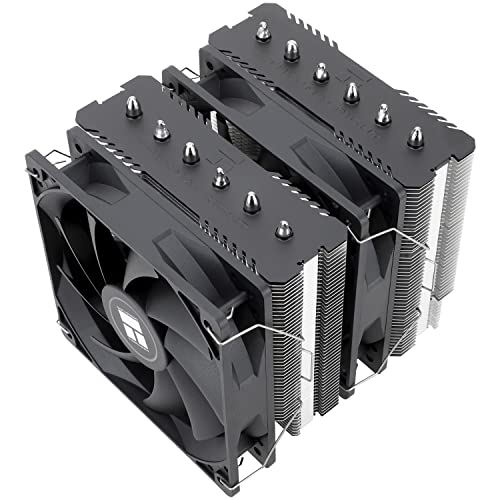
Best Budget: Thermalright Peerless Assassin 120 SE
Specs
Spec | Value |
|---|---|
Design | Dual-tower, 6 copper heatpipes with AGHP |
Fans | Two 120mm TL-C12 PWM at 1550 RPM |
Height | 155mm |
Sockets | AM4/AM5, LGA1700/1850/1851 |
Sustained rating | 150W+ |
In the box | Thermal compound included |
Design
- Value
Dual-tower, 6 copper heatpipes with AGHP
Fans
- Value
Two 120mm TL-C12 PWM at 1550 RPM
Height
- Value
155mm
Sockets
- Value
AM4/AM5, LGA1700/1850/1851
Sustained rating
- Value
150W+
In the box
- Value
Thermal compound included
What it does well
Tom's Hardware called the Peerless Assassin 120 SE the best-performing air cooler they had tested at any price, running 56.4°C over ambient at 35 dBA. That result on a dual-tower with 6 heatpipes drew the "incredible, affordable" headline from their review team.
GamersNexus reviewed the standard Peerless Assassin at launch with a "the champ" designation. The SE variant tightened the packaging, updated the fans, and brought the price down from the original model.
For a gaming build where performance per dollar is the only metric, the Peerless Assassin 120 SE has no competition. It handles 125W-class gaming CPUs, fits most mainstream ATX cases at 155mm, and ships ready to install.
What you give up
The difference between the Peerless Assassin 120 SE and the Phantom Spirit 120 SE ARGB is 1 heatpipe, a slightly different fan profile, and the ARGB on the Phantom Spirit. In back-to-back thermal testing the Phantom Spirit runs slightly cooler. For buyers where a few dollars matter, the Peerless Assassin is the pick. For buyers where it doesn't, the Phantom Spirit is worth the difference.
RAM clearance applies here too. Dual-tower configuration, same overhang risk with tall DDR5 sticks. Low-profile DDR5 resolves it.
The fans on the Peerless Assassin are good but not exceptional. At maximum RPM under full load they are audible. At typical gaming RPMs (1200-1400 RPM range) the noise is reasonable. If low noise is the priority, the Arctic Freezer 36 or the NH-D15 G2 is a better fit.
Who it's for
This is the pick for budget-first builders who refuse to compromise on thermals. If you're pairing this with a Ryzen 5, Core i5, or mid-range gaming platform and every dollar of the build budget matters, the Peerless Assassin 120 SE delivers dual-tower performance at a price most coolers can't match. It is also the right fallback if the Phantom Spirit 120 SE is out of stock.
Best for SFF and Low-Profile Builds: Noctua NH-L9a-AM5

Specs
Spec | Value |
|---|---|
Design | Low-profile single-tower |
Fan | One 92mm NF-A9x14 PWM |
Height | 37mm total |
Sockets | AM5 only |
Sustained rating | 65W (eco mode) |
In the box | Noctua NT-H1 thermal compound |
Design
- Value
Low-profile single-tower
Fan
- Value
One 92mm NF-A9x14 PWM
Height
- Value
37mm total
Sockets
- Value
AM5 only
Sustained rating
- Value
65W (eco mode)
In the box
- Value
Noctua NT-H1 thermal compound
What it does well
At 37mm tall, the NH-L9a-AM5 fits in cases that no other cooler on this list can enter. The narrowest mITX cases cap cooler height at 37-57mm. Sandwich-style cases like the Sliger SM550 and some SilverStone form factors operate at exactly this height. The NH-L9a-AM5 is one of very few premium coolers built specifically for this constraint.
Noctua built the NH-L9a-AM5 around AM5 geometry specifically, matching the Ryzen 7000 and 9000 series socket dimensions with a purpose-fitted mounting solution. For an AM5 mITX build using a Ryzen 5 or Ryzen 7 in eco mode (65W TDP), it manages temperatures cleanly. At 65W eco, a Ryzen 9 7900 tested at 75°C under blended workloads, which is well within operating range. That same 65W eco behaviour is what drives cooler choice across AMD's non-X3D parts, and the best CPU coolers for the Ryzen 7 9700X are picked by TDP mode for that reason.
The NF-A9x14 fan is 14mm thin, which is part of how the 37mm total height works. At 2500 RPM it moves credible airflow for its size, and at gaming-typical RPMs it is near-silent.
For mITX builds where cooler height is the constraint, there is no serious competition from reputable brands at this size and performance level for AM5.
What you give up
Platform exclusivity: this cooler is AM5 only. Intel LGA1700 and LGA1851 builds need a different solution. If you are building Intel SFF, look at the NH-L9i-17xx series instead.
TDP ceiling: the NH-L9a-AM5 is not a high-TDP cooler. It handles AM5 CPUs at stock in their efficient range (65W eco) or low-power profile. Running a Ryzen 9 9950X at full tilt with this cooler will cause thermal throttling. The design point is efficiency-tier CPUs: 9600X, 7700, 9700X in eco or PBO with a temperature limit, not maximum performance.
mITX builds introduce their own challenges beyond the cooler. Small cases trap heat from the GPU, run fans at higher RPM to compensate, and are harder to build in. Before committing to mITX, check the SFF build considerations first.
Who it's for
The NH-L9a-AM5 is for experienced builders who have committed to an AM5 mITX build and need a cooler that physically fits. If your case has a 37mm height limit, this is the pick. If your case goes to 57-67mm, there are better-performing slim towers available. For a first-time builder, mITX itself is the harder question than the cooler choice.
How to Choose the Right Air Cooler for Your PC
Match TDP headroom, not just support. Manufacturers list supported TDP at their highest fan speed, not necessarily at comfortable sustained load. For a CPU rated at 125W, pick a cooler rated for 150W or more. Gaming loads are typically below the CPU's TDP ceiling, but give yourself margin.
Measure your case before ordering. CPU cooler height is listed on every product page, but your case's "max CPU cooler height" spec has asterisks. Accounts on Reddit for specific build combinations (case + motherboard + cooler) are more reliable than spec sheets. The Lancool 216 example above illustrates the gap between advertised and practical clearance. Noctua measured more than a hundred cases and found over half of them misstate that figure, which is where our CPU cooler clearance guide starts.
Check RAM height. Dual-tower coolers can overhang DIMM slots. If you are running or planning tall DDR5 with heatspreaders above 42mm, check the specific board and cooler combination. Low-profile DDR5 (32mm variants from G.Skill and Corsair) resolves most conflicts without performance impact.
Socket compatibility matters on mITX. The NH-L9a-AM5 is AM5 only. Intel LGA1851 builds need different solutions. AM4 boards are still valid in 2026 for budget builds, and all picks on this list except the NH-L9a-AM5 support AM4. Anyone moving an existing cooler from AM4 to AM5 has one more check to run first: whether your AM4 cooler fits AM5 turns on the backplate, not the socket.
Thermal paste: use what ships in the box. Thermalright's TF7, Arctic MX-6, and Noctua NT-H2 are all quality compounds. The gains from aftermarket paste on a well-mounted cooler are within the variance of mounting pressure. The exception is PTM7950 phase-change pad, which provides a consistent 1-3°C improvement on high-TDP chips (9950X, 14900K, Core Ultra 285K) and lasts the life of the build. For gaming CPUs under 150W, skip the upgrade. See our thermal paste guide for more.
Building in a new case? The cooler selection pairs with case airflow. A good dual-tower in a case with a mesh front and two intake fans performs better than the same cooler in a glass-front case with restricted intake. Prioritize a mesh front panel and at least two intake fans when you choose the case, whatever your budget tier.
The bottom line
The Thermalright Phantom Spirit 120 SE ARGB is the pick for most builds: dual-tower thermal performance, fits mainstream cases, and costs a fraction of what premium liquid or premium air coolers charge. The Arctic Freezer 36 is the honest budget choice if the Phantom Spirit is more than you need. The NH-D15 G2 is the correct answer only if noise is a documented daily problem. The Peerless Assassin 120 SE is the fallback when price is the binding constraint. The NH-L9a-AM5 exists for the one use case where it is the only option: AM5 mITX at 37mm height.
FAQ
Is an air cooler good enough for gaming in 2026?
For almost every gaming CPU on the market, yes. The 9800X3D, 9600X, 14700K, Core Ultra 9 285K at gaming loads, and the entire mid-range AMD and Intel stack run inside the thermal ceiling of a quality dual-tower air cooler. The edge cases are 250W-class CPUs at sustained all-core load (Cinebench, rendering, encoding) and sandwich-style mITX cases with sub-40mm clearance. If neither of those applies to your build, a dual-tower air cooler is the better choice: more reliable, quieter, cheaper.
What is the best air cooler for AMD AM5 (Ryzen 7000 / 9000)?
For most AM5 builds, the Thermalright Phantom Spirit 120 SE ARGB. It handles the platform's full gaming range with quiet operation and fits standard ATX and mATX cases. The Arctic Freezer 36 is the pick for budget AM5 systems (Ryzen 5, Ryzen 7 at stock). The Noctua NH-D15 G2 is the correct answer if you need the absolute lowest fan noise at sustained loads. For AM5 mITX builds with a hard height constraint, the Noctua NH-L9a-AM5 is the only viable premium option.
Can an air cooler handle a 150W TDP CPU without throttling?
Yes, any of the dual-tower picks on this list (Phantom Spirit 120 SE ARGB, Peerless Assassin 120 SE, NH-D15 G2) handle 150W-class loads without throttling at stock fan speeds. The Arctic Freezer 36 can sustain 150W in shorter runs but may see temperatures climb above 80°C under extended all-core load. For gaming workloads, which rarely sustain full TDP for long, all five picks clear the threshold comfortably.
Are dual-tower air coolers better than single-tower coolers?
For sustained loads above 100W, yes. A dual-tower design adds a second fin stack that roughly doubles the heat dissipation surface area and allows two fans in a push-pull arrangement at lower individual RPM. The noise and thermal advantages are measurable. The trade-off is height (155-170mm vs 130-150mm for single towers) and RAM clearance. For CPUs at or below 65W, a single-tower is sufficient and often quieter.
What air cooler fits in a small form factor or mITX case?
The answer depends on your specific case clearance. Most mITX cases with 37mm cooler height limits accept the Noctua NH-L9a-AM5 (AM5 only). Cases with 47-57mm clearance expand options to thin towers. Cases with 67-72mm clearance can accommodate AIO radiators or the Noctua NH-L9i series. Check the seven mITX build constraints before finalizing your cooler choice, particularly GPU clearance and case height.
Related Articles

Best CPUs for Gaming in 2026: Top Picks for Every Budget
The best gaming CPUs for 2026 across every budget, from the Ryzen 5 7600X to the Ryzen 9 9950X3D, with full specs and clear buying advice for every tier.
Jul 8, 2026

Best GPU for Black Myth: Wukong (2026): FPS From 1080p to 4K
The best GPU for Black Myth: Wukong is the RTX 5070 Ti: 96 FPS at 1440p Full RT with DLSS 4 MFG. FPS charts for five RTX 50 cards, 1080p to 4K, and VRAM floors.
Oct 20, 2026

Best GPU for God of War Ragnarok PC (2026): 5 Picks by Tier
The best GPU for God of War Ragnarok PC is a raster call, not a ray tracing one. Five picks from 1080p to 4K and ultrawide, with measured FPS and VRAM advice.
Oct 21, 2026

Best GPUs for Starfield (2026): 5 Picks, 1080p to 4K
The best GPU for Starfield in 2026: five picks from 1080p to native 4K with measured Ultra frame rates, plus when a CPU upgrade beats a GPU in the cities.
Oct 20, 2026

Best GPUs for Baldur's Gate 3 (2026): 5 Picks by Resolution
Best GPU for Baldur's Gate 3 by resolution, with measured Ultra FPS for all 5 picks, the VRAM you need, and why Act 3's Lower City is a CPU problem first.
Oct 22, 2026