Affiliate Disclosure: As an Amazon Associate we earn from qualifying purchases. Some links may earn us a commission at no cost to you.

Best Gaming Laptops Under $1,200 (2026): TGP-First Picks
A laptop GPU is not one product. The same chip name ships across a wide power band, and the distance between the bottom of that band and the top of it is worth more frame rates than moving up a whole tier. A laptop RTX 5060 held near its floor in a thin single-fan chassis can lose outright to a laptop RTX 5050 fed near its ceiling in a proper dual-fan 16-inch body.
So these five picks are ranked by total graphics power and sustained thermal behaviour first, panel second, and upgradeability third. The badge on the lid comes last.
Our top pick: GIGABYTE Gaming A16
The GIGABYTE Gaming A16 wins on this article's own terms: a 16-inch dual-fan body that holds the RTX 5060's power envelope through hour two rather than collapsing to a low-power floor, and it arrives with 1 TB of storage and a 165 Hz 16:10 panel already fitted.
Quick picks
Slot | Pick | GPU | Display | Storage | Buy |
|---|---|---|---|---|---|
Best Overall | RTX 5060, 8 GB GDDR7 | 16-inch WUXGA, 165 Hz | 1 TB Gen4 | ||
Best Value | RTX 5050, 8 GB GDDR7 | 16-inch WUXGA, 180 Hz | 1 TB Gen4 | ||
Best Premium | RTX 5060, 8 GB GDDR7 | 15.6-inch FHD, 144 Hz | 512 GB | ||
Best Budget | RTX 5050, 8 GB GDDR7 | 15.6-inch FHD, 165 Hz | 512 GB | ||
Editor's Pick | RTX 5050, 8 GB GDDR7 | 16-inch WUXGA, 165 Hz, 100% sRGB | 512 GB |
Best Overall
- Pick
- GPU
RTX 5060, 8 GB GDDR7
- Display
16-inch WUXGA, 165 Hz
- Storage
1 TB Gen4
- Buy
Best Value
- Pick
- GPU
RTX 5050, 8 GB GDDR7
- Display
16-inch WUXGA, 180 Hz
- Storage
1 TB Gen4
- Buy
Best Premium
- Pick
- GPU
RTX 5060, 8 GB GDDR7
- Display
15.6-inch FHD, 144 Hz
- Storage
512 GB
- Buy
Best Budget
- Pick
- GPU
RTX 5050, 8 GB GDDR7
- Display
15.6-inch FHD, 165 Hz
- Storage
512 GB
- Buy
Editor's Pick
- Pick
- GPU
RTX 5050, 8 GB GDDR7
- Display
16-inch WUXGA, 165 Hz, 100% sRGB
- Storage
512 GB
- Buy
Specs at a glance
Pick | GPU + VRAM | CPU | RAM | Storage | Display | Upgrade slots |
|---|---|---|---|---|---|---|
RTX 5060 Laptop, 8 GB GDDR7 | Intel Core i7-13620H, 10 cores / 16 threads | 16 GB DDR5 | 1 TB NVMe Gen4 | 16-inch 1920x1200 IPS, 165 Hz | Two SO-DIMM slots, spare M.2 | |
RTX 5050 Laptop, 8 GB GDDR7 | Intel Core 7 Processor 240H | 16 GB DDR5 | 1 TB Gen4 NVMe | 16-inch WUXGA IPS, 180 Hz | Two SO-DIMM slots, accessible bottom panel | |
RTX 5060 Laptop, 8 GB GDDR7 | AMD Ryzen 7 250, 8 cores / 16 threads | 16 GB DDR5 | 512 GB NVMe | 15.6-inch FHD IPS, 144 Hz | Two SO-DIMM slots, spare M.2 | |
RTX 5050 Laptop, 8 GB GDDR7 | Intel Core i5-13420H, 8 cores / 12 threads | 16 GB DDR5 | 512 GB PCIe NVMe | 15.6-inch FHD IPS, 165 Hz | Two SO-DIMM slots, spare M.2 | |
RTX 5050 Laptop, 8 GB GDDR7 | Intel Core i5-13450HX, 10 cores / 16 threads | 16 GB | 512 GB NVMe | 16-inch WUXGA IPS, 165 Hz, 100% sRGB | Two SO-DIMM slots, spare M.2 |
- GPU + VRAM
RTX 5060 Laptop, 8 GB GDDR7
- CPU
Intel Core i7-13620H, 10 cores / 16 threads
- RAM
16 GB DDR5
- Storage
1 TB NVMe Gen4
- Display
16-inch 1920x1200 IPS, 165 Hz
- Upgrade slots
Two SO-DIMM slots, spare M.2
- GPU + VRAM
RTX 5050 Laptop, 8 GB GDDR7
- CPU
Intel Core 7 Processor 240H
- RAM
16 GB DDR5
- Storage
1 TB Gen4 NVMe
- Display
16-inch WUXGA IPS, 180 Hz
- Upgrade slots
Two SO-DIMM slots, accessible bottom panel
- GPU + VRAM
RTX 5060 Laptop, 8 GB GDDR7
- CPU
AMD Ryzen 7 250, 8 cores / 16 threads
- RAM
16 GB DDR5
- Storage
512 GB NVMe
- Display
15.6-inch FHD IPS, 144 Hz
- Upgrade slots
Two SO-DIMM slots, spare M.2
- GPU + VRAM
RTX 5050 Laptop, 8 GB GDDR7
- CPU
Intel Core i5-13420H, 8 cores / 12 threads
- RAM
16 GB DDR5
- Storage
512 GB PCIe NVMe
- Display
15.6-inch FHD IPS, 165 Hz
- Upgrade slots
Two SO-DIMM slots, spare M.2
- GPU + VRAM
RTX 5050 Laptop, 8 GB GDDR7
- CPU
Intel Core i5-13450HX, 10 cores / 16 threads
- RAM
16 GB
- Storage
512 GB NVMe
- Display
16-inch WUXGA IPS, 165 Hz, 100% sRGB
- Upgrade slots
Two SO-DIMM slots, spare M.2
How we picked
Total graphics power is the spec that changes frame rates
NVIDIA specifies each laptop GPU across a power band rather than at a single number, and Dynamic Boost adds more on top when the CPU is quiet enough to hand power back. Two machines can carry the same GPU name and differ by tens of watts of sustained power. That gap is worth more frame rates than moving up a tier.
The mechanism is physical, not marketing. Chassis volume sets how much air a fan can move, fan count sets how much of the heatsink gets swept, and the heat pipe path sets how fast heat leaves the die at all. A thin single-fan 15-inch body runs out of all three at once, so its firmware caps the GPU low and holds it there. Reviewers have measured thin single-fan designs holding a laptop RTX 5060 to roughly half its rated ceiling, which puts it behind a 16-inch chassis running a laptop RTX 5050 near the top of its own range.
Where the RTX 5070 sits at this budget
The honest answer to the most common question at this budget: there is no shipping RTX 5070 laptop under this cap. The machines carrying that chip start above it, and any configuration squeezed underneath would be a low-power one, which defeats the reason for paying up a tier. A starved RTX 5070 lands roughly where a well-fed RTX 5060 already lands, for more money.
If the RTX 5070 is a requirement rather than a preference, the next budget tier is where it becomes reachable inside a chassis that can feed it, and our picks one tier up start there. At this budget, buying a well-fed lower tier beats buying a starved higher one every time.
Panel tier: refresh, resolution, and colour
A 16:10 WUXGA panel at 165 to 180 Hz is the sweet spot in this band. The extra vertical pixels are useful every day, the refresh rate is inside what these GPUs can genuinely feed at the settings they run, and the resolution does not ask more of an 8 GB frame buffer than it can give.
Three things to skip. A 60 Hz panel throws away the high-refresh advantage of the GPU you just paid for. A dim, low-gamut panel makes every game look flat regardless of the silicon. Refresh rates far beyond what the GPU can feed are a spec-sheet number rather than a felt improvement.
Colour coverage is either stated in the listing or it is not there, and silence is the answer. Our GPU and display framework goes deeper on picking panel and GPU tier together.
RAM and SSD upgradeability decides year three
Two SO-DIMM slots and a spare M.2 turn a 16 GB and 512 GB machine into a 32 GB and 2 TB machine for the cost of parts. That is worth more over three years than one GPU tier, because memory and storage pressure are what make an ageing laptop feel slow long before the GPU runs out of frames.
Soldered memory is the single worst trait a budget gaming laptop can have. It converts a cheap, reversible upgrade into a reason to replace the whole machine. Check the bottom panel and the slot count before you buy, because the listing rarely volunteers it.
All five picks here carry two memory slots, and four of the five carry a spare M.2. That was a filter, not a coincidence.
What sustained load feels like
Every machine in this class posts a good first ten minutes. The heatsink is still cold and the GPU is running at whatever its short-duration limit allows. Nothing separates that early.
The separation happens in hour two, when the fan ceiling and the power budget settle into steady state. That is when a 16-inch dual-fan design keeps its clocks and a thin single-fan design gives up tiers of performance. It is also when fan noise stops being a spec and starts being a fact of the room.
Desk airflow is a real lever here rather than an accessory upsell. Lifting the chassis so the intake is not breathing its own exhaust is worth measurable degrees, and a cooling pad is the cheapest performance upgrade any of these machines will take.
Where the budget is better spent elsewhere
At this tier, storage, a second memory stick, and an external monitor all return more day-to-day value than one GPU tier. A 512 GB machine with a second drive added feels newer in year two than the same machine with slightly more frames.
If the laptop is never leaving the desk, the honest comparison is a desktop instead, which buys more sustained performance for the same outlay. Portability is what you are paying for, so it should be something you use.
And if the budget is tighter than it looks, the tier below this one still gets you a current-generation machine with a proper panel.
Best Overall: GIGABYTE Gaming A16
Specs
GPU | GeForce RTX 5060 Laptop, 8 GB GDDR7 |
GPU power class | Upper tier for a 16-inch mainstream chassis, well clear of the sub-60 W thin-and-light configs |
CPU | Intel Core i7-13620H, 10 cores / 16 threads |
Memory | 16 GB DDR5, two SO-DIMM slots |
Storage | 1 TB NVMe Gen4 M.2, spare M.2 slot |
Display | 16-inch 1920x1200 WUXGA IPS, 165 Hz, 16:10 |
Chassis | 16-inch dual-fan, Windows 11 Home |
GPU
GeForce RTX 5060 Laptop, 8 GB GDDR7
GPU power class
Upper tier for a 16-inch mainstream chassis, well clear of the sub-60 W thin-and-light configs
CPU
Intel Core i7-13620H, 10 cores / 16 threads
Memory
16 GB DDR5, two SO-DIMM slots
Storage
1 TB NVMe Gen4 M.2, spare M.2 slot
Display
16-inch 1920x1200 WUXGA IPS, 165 Hz, 16:10
Chassis
16-inch dual-fan, Windows 11 Home
What it does well
The 16-inch body is the reason to buy it. A larger chassis carries a longer heat pipe path and two fans, so the RTX 5060 inside it holds its clocks deep into a session instead of settling onto the floor the thin 15-inch designs live on.
The i7-13620H has the thread count to keep the GPU fed in CPU-heavy titles. The 1920x1200 panel earns its keep too: the extra vertical pixels help in strategy games and in anything with a toolbar, and 165 Hz is enough refresh for the settings this GPU genuinely runs.
A full 1 TB of Gen4 storage out of the box is rare here and it removes the first upgrade most buyers otherwise face inside six months. Two SO-DIMM slots and a spare M.2 give the machine a real second life later as a 32 GB, 3 TB workhorse.
What you give up
GIGABYTE's service network is thinner than Lenovo's or ASUS's, and warranty turnaround is the honest risk you take here. The panel is a competent IPS but it is not wide-gamut and it is not OLED, so colour work wants something else.
Battery life is ordinary for a 16-inch gaming chassis, which is another way of saying this is a desk machine with a power brick, not a commuter laptop. The build is plastic-heavy and the lid flexes more than the metal-lidded Lenovo. Fan noise under sustained load is audible, so headphones are part of the deal.
One buying trap worth naming: buyers have flagged that GIGABYTE ships the Gaming A16 under near-identical model codes where the alternate variant drops to an RTX 5050 and 512 GB of storage. The unit linked here is the RTX 5060 with 1 TB. Confirm the model code, not just the chassis name.
Who it's for
The buyer who wants one machine to last three years at 1080p high moving to 1440p medium, who values screen area and storage headroom over thinness, and who is content to keep it plugged in at a desk most of the time.
Best Value: Acer Nitro V 16

Specs
GPU | GeForce RTX 5050 Laptop, 8 GB GDDR7 |
GPU power class | Acer publishes RTX 5050 configurations up to the 100 W tier; the 16-inch Nitro V sits at the top of that range, not the floor |
CPU | Intel Core 7 Processor 240H |
Memory | 16 GB DDR5, two SO-DIMM slots |
Storage | 1 TB Gen4 NVMe M.2 |
Display | 16-inch WUXGA IPS, 180 Hz |
Connectivity | Wi-Fi 6, backlit keyboard |
GPU
GeForce RTX 5050 Laptop, 8 GB GDDR7
GPU power class
Acer publishes RTX 5050 configurations up to the 100 W tier; the 16-inch Nitro V sits at the top of that range, not the floor
CPU
Intel Core 7 Processor 240H
Memory
16 GB DDR5, two SO-DIMM slots
Storage
1 TB Gen4 NVMe M.2
Display
16-inch WUXGA IPS, 180 Hz
Connectivity
Wi-Fi 6, backlit keyboard
What it does well
This is the 16-inch Nitro V, not the 15-inch one further down the list. The distinction matters more than the shared name suggests, because the larger body is what lets Acer run the RTX 5050 toward the top of its published power range rather than parked at the floor. Same chip, different machine.
The 180 Hz WUXGA panel is the fastest here, and the 16:10 shape gives the same vertical-space benefit as the GIGABYTE. A full 1 TB of Gen4 storage at this price is unusual. The Core 7 240H is a current-generation part that does not hold this class of GPU back.
Two memory slots and an accessible bottom panel make the upgrade path straightforward, which is the biggest lever on how long a budget gaming laptop stays useful.
What you give up
It is an RTX 5050, so ray tracing at native resolution is off the table and 1440p is a DLSS-assisted target rather than a native one. VRAM is 8 GB, which is fine today at 1080p and is the spec most likely to constrain this machine in three years.
Build quality at this tier is functional plastic with visible flex around the keyboard deck. The panel is standard-gamut IPS, so it is bright and fast without being colour-accurate. Stock on this exact configuration is thin at the moment.
Acer rotates SKU codes inside the Nitro V line frequently, and buyers have flagged that the same chassis name ships at lower GPU wattages in some regions. Check the power configuration stated in the listing detail rather than assuming the top of the band.
Who it's for
The buyer who plays mostly competitive titles at 1080p, wants every hertz of refresh available, and would rather have storage and a fast 16-inch panel than a GPU badge one tier up that runs starved.
Best Premium: Lenovo LOQ 15
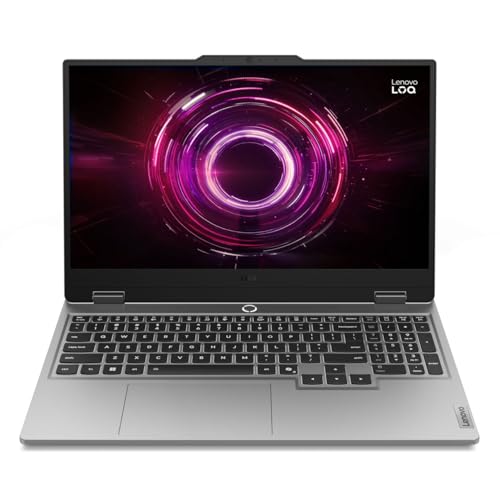
Specs
GPU | GeForce RTX 5060 Laptop, 8 GB GDDR7 |
GPU power class | Legion-derived cooling stack, mid-to-upper band for a 15-inch chassis |
CPU | AMD Ryzen 7 250, 8 cores / 16 threads |
Memory | 16 GB DDR5, two SO-DIMM slots |
Storage | 512 GB NVMe M.2, spare M.2 slot |
Display | 15.6-inch FHD IPS, 144 Hz |
Chassis | Luna Grey, metal lid, Lenovo Vantage power profiles |
GPU
GeForce RTX 5060 Laptop, 8 GB GDDR7
GPU power class
Legion-derived cooling stack, mid-to-upper band for a 15-inch chassis
CPU
AMD Ryzen 7 250, 8 cores / 16 threads
Memory
16 GB DDR5, two SO-DIMM slots
Storage
512 GB NVMe M.2, spare M.2 slot
Display
15.6-inch FHD IPS, 144 Hz
Chassis
Luna Grey, metal lid, Lenovo Vantage power profiles
What it does well
The LOQ line inherits its thermal design from the Legion chassis above it, and that shows in how the fan curve behaves across a long session. It ramps early and then holds a steady clock, rather than spiking late and throttling hard. Smooth is the word for this machine.
The Ryzen 7 250 is an eight-core part with good efficiency, which helps twice: it leaves more of the shared power budget for the GPU, and it behaves better away from the wall. The keyboard is the best in this group by a clear margin, which matters if the machine doubles as a work laptop.
Lenovo Vantage exposes real performance and thermal profiles, so you can choose between a quiet mode and a full-power mode instead of living with one fixed fan curve. Warranty coverage and parts availability are the strongest here.
What you give up
Storage is 512 GB, which is roughly three modern installs before you start managing a library. The spare M.2 slot makes that solvable, but it is a cost to plan for on day one rather than a problem to discover in month two.
The panel is a 15.6-inch 16:9 FHD IPS at 144 Hz, so it trails both 16:10 picks on screen area and on refresh. The 15-inch body also caps how much power the RTX 5060 can sustain relative to a 16-inch design, so this is the most polished machine here rather than the fastest one.
It sits at the very top of the budget, which leaves nothing in the same purchase for the SSD upgrade it wants. Lenovo also runs several sub-lines under one chassis name with different CPUs and GPUs, so a listing that does not state the panel and the GPU explicitly should be treated as the lower tier.
Who it's for
The buyer who wants the machine that feels the most finished, who types on it as much as they game on it, and who will happily add a second SSD later rather than pay for one up front.
Best Budget: Acer Nitro V 15

Specs
GPU | GeForce RTX 5050 Laptop, 8 GB GDDR7 |
GPU power class | Mid band for a 15-inch dual-fan chassis, below the 16-inch Nitro V's ceiling |
CPU | Intel Core i5-13420H, 8 cores / 12 threads |
Memory | 16 GB DDR5, two SO-DIMM slots |
Storage | 512 GB PCIe NVMe M.2, spare M.2 slot |
Display | 15.6-inch FHD IPS, 165 Hz |
Chassis | Obsidian Black, backlit keyboard, Windows 11 Home |
GPU
GeForce RTX 5050 Laptop, 8 GB GDDR7
GPU power class
Mid band for a 15-inch dual-fan chassis, below the 16-inch Nitro V's ceiling
CPU
Intel Core i5-13420H, 8 cores / 12 threads
Memory
16 GB DDR5, two SO-DIMM slots
Storage
512 GB PCIe NVMe M.2, spare M.2 slot
Display
15.6-inch FHD IPS, 165 Hz
Chassis
Obsidian Black, backlit keyboard, Windows 11 Home
What it does well
This is the 15-inch Nitro V, the smaller sibling of the Best Value pick. It runs the same RTX 5050 silicon in a smaller body, which means less sustained power and a lower price, and for a lot of buyers that is the right trade.
Buying at the bottom of this band and spending the difference on storage is frequently the better decision, and this is the machine that makes it possible. The RTX 5050 with GDDR7 is a current-generation part rather than a leftover, so it gets DLSS 4 and the current feature set instead of a legacy driver path.
16 GB of DDR5 across two slots is the correct baseline and it is not soldered. The 165 Hz panel is faster than the Lenovo's. The chassis is a known quantity with a dual-fan layout, an accessible bottom panel, and good parts availability.
What you give up
This is the lowest sustained performance in the lineup. The 15-inch body means the GPU never reaches the ceiling the 16-inch Nitro V does, and the i5-13420H is the weakest CPU here, which shows up in simulation and strategy titles that lean on single-thread speed.
Storage is 512 GB, and the box ships with a mouse pad rather than anything more useful. Build quality is entry-level plastic with real deck flex. Ray tracing and native 1440p are both out of scope; this is a 1080p machine with upscaling switched on.
Buyers have flagged that multiple sellers list this chassis with different bundled accessories at different prices for effectively the same machine, some of them third-party fulfilled. There is also an 8 GB memory variant in the same body, and that is the one configuration to avoid.
Who it's for
The student or first-time buyer who needs a current-generation gaming laptop at the lowest credible price and would rather bank the difference toward a second SSD, a cooling pad, and a monitor than stretch to the top of the budget. If that is the brief, our picks for college students cover the same buyer from the campus angle.
Editor's Pick: ASUS TUF F16

Specs
GPU | GeForce RTX 5050 Laptop, 8 GB GDDR7 |
GPU power class | TUF chassis is built for the upper RTX 5050 band |
CPU | Intel Core i5-13450HX, 10 cores / 16 threads |
Memory | 16 GB, two SO-DIMM slots |
Storage | 512 GB NVMe M.2, spare M.2 slot |
Display | 16-inch WUXGA IPS, 165 Hz, 100% sRGB |
Ports | Thunderbolt, RGB backlit keyboard |
GPU
GeForce RTX 5050 Laptop, 8 GB GDDR7
GPU power class
TUF chassis is built for the upper RTX 5050 band
CPU
Intel Core i5-13450HX, 10 cores / 16 threads
Memory
16 GB, two SO-DIMM slots
Storage
512 GB NVMe M.2, spare M.2 slot
Display
16-inch WUXGA IPS, 165 Hz, 100% sRGB
Ports
Thunderbolt, RGB backlit keyboard
What it does well
The panel is the differentiator, and the 100% sRGB figure is stated in the listing rather than inferred from a chassis name. Most displays at this price cover somewhere in the low-to-mid sixties of sRGB and look visibly washed out next to a desktop monitor. This one does not.
Thunderbolt is the other reason to look at it. One cable to a dock carries display, power delivery, and peripherals, which is a genuinely different ownership experience at a desk than plugging in four things every morning.
The i5-13450HX is an HX-class chip, with more cores and more sustained headroom than the H-class parts in the cheaper picks. The TUF chassis is the sturdiest build here, and two memory slots plus a spare M.2 keep the upgrade path open.
What you give up
It is an RTX 5050 sitting at a price where RTX 5060 machines exist, so you are explicitly paying for the panel, the ports, and the chassis rather than for frames. If frame rate is the only metric, two picks above this one are the better buy.
Storage is 512 GB. The HX-class CPU runs hotter than the H-class parts, so fan noise under combined load is the highest in this group. Weight is near the top of the segment, which rules it out if the machine travels daily. The RGB keyboard is single-zone rather than per-key.
ASUS ships near-identical TUF F16 listings that differ only in Windows edition and GPU tier at overlapping prices, and an older F16 from a prior generation is a different, slower machine despite the shared name. The unit linked here is the current RTX 5050 with the 100% sRGB panel.
Who it's for
The buyer whose laptop has to do two jobs, gaming in the evening and colour-sensitive or docked desk work during the day, and who will accept one GPU tier less to get a panel and a port set that nothing else at this budget offers.
Bottom line
If you want one machine to last three years and you value screen area and storage headroom, buy the GIGABYTE Gaming A16. If you want the most performance per dollar and the fastest panel here, buy the Acer Nitro V 16. If you want the most finished machine, the best keyboard, and the strongest service network, buy the Lenovo LOQ 15.
If you need the lowest credible entry price so you can bank the difference toward storage and a monitor, buy the Acer Nitro V 15. And if the laptop has two jobs, gaming at night and colour-sensitive or docked work by day, buy the ASUS TUF F16. Rank the chassis before the chip and this decision gets much easier.
FAQ
What is TGP on a gaming laptop, and why does it matter more than the GPU name?
Total graphics power is how many watts the laptop actually allows its GPU to draw, and NVIDIA specifies each laptop chip across a range rather than at one fixed number. Two laptops with the same GPU name can sit at opposite ends of that range, and the machine at the top can beat the machine at the bottom by more than a full GPU tier. Chassis size, fan count, and heat pipe path decide where a design lands, which is why every pick here is described by the power class its body can feed.
Can you get an RTX 5070 gaming laptop under $1,200 in 2026?
Not right now. The shipping RTX 5070 laptops sit above this budget, and any configuration that could be squeezed underneath would be a low-power one, which removes the reason to buy the higher tier at all. A starved RTX 5070 performs roughly like a well-fed RTX 5060 while costing more, which is why the GIGABYTE Gaming A16 leads this list. The next budget tier up is where a well-cooled RTX 5070 becomes realistic.
Is an RTX 5060 laptop worth it over an RTX 5050 at this budget?
Only when the chassis can feed it. An RTX 5060 in a 16-inch dual-fan body like the GIGABYTE Gaming A16 is a clear step up and worth the money. An RTX 5060 in a thin single-fan design held near the bottom of its power band is not, and it will lose to the Acer Nitro V 16 running an RTX 5050 near its ceiling. Judge the pairing of chip and chassis rather than the chip alone, and buy the tier the body can support.
Is 8 GB of VRAM enough for a gaming laptop in 2026?
At 1080p, yes, with settings chosen sensibly and upscaling available when a title asks for more. Every pick here carries 8 GB of GDDR7, which is the standard allocation in this class. It is also the specification most likely to become the limit before anything else does, particularly at high texture settings and at 1440p. If a machine has to last past three years at high settings, that constraint is the reason to look at a higher tier rather than a faster CPU.
Can a gaming laptop under $1,200 handle 1440p gaming?
As an upscaled target, yes. As a native one, not comfortably. Every pick here is a 1080p machine first, and 1440p is reachable with DLSS doing part of the work and settings dialled back from ultra. The Lenovo LOQ 15 and the GIGABYTE Gaming A16 have the most headroom for it thanks to their RTX 5060 silicon. Plan around 1080p high with upscaling on for current AAA titles, and treat 1440p as a bonus on lighter or older games.
Can you upgrade the RAM and SSD in these gaming laptops?
Yes, and that was a selection filter. All five picks carry two SO-DIMM memory slots rather than soldered memory, and four of the five ship with a spare M.2 slot alongside the drive already fitted. The Lenovo LOQ 15 and the ASUS TUF F16 benefit most, since both ship with 512 GB and both have room for a second drive.
Related Articles

Best Gaming Laptops Under $1,000 (2026): 1080p Budget Picks
Five sub-$1K gaming laptops that survive sustained load, by chassis-line profile not spec sheet. Four RTX 4060 picks plus a newest-arch RTX 5050.
May 17, 2026

Best Gaming Laptops Under $1500 (2026): RTX 5060 vs 5070
Best gaming laptops under $1500 for 2026: five picks with RTX 5060 and RTX 5070, OLED vs QHD screens, and which GPU tier is worth it on the built-in display.
Oct 10, 2026

Best Cooling Pads for Gaming Laptops (2026 Buyer Guide)
The best cooling pad for gaming laptops hinges on one fork: sealed-chamber turbofans that stop throttling, or quiet open-fan pads. Five picks by size.
Jul 15, 2026

Gaming Laptop vs Desktop 2026: Value Math and 4 Picks
Gaming laptop vs desktop in 2026: desktops deliver about 30-40% more frames per dollar, laptops deliver portability. See which fits you, plus 4 picks.
Sep 2, 2026

How to Choose a GPU (and a Monitor That Matches)
A buyer's framework for picking a GPU and the monitor that pairs with it. Start with the panel and work the card back.
May 17, 2026