Affiliate Disclosure: As an Amazon Associate we earn from qualifying purchases. Some links may earn us a commission at no cost to you.

Best Cooling Pads for Gaming Laptops (2026 Buyer Guide)
Your gaming laptop is quiet at idle and a jet engine under load, and somewhere in a long session it starts to stutter. The clocks drop, the frame rate sags, and if the room is warm enough the machine shuts off to save itself. That is thermal throttling, and a cooling pad is the cheapest thing you can slide under the laptop to fight it.
Not every pad fights it, though. Some pull real heat out of a laptop that is cooking. Most just lift the chassis, add a breeze, and make your lap more comfortable. This guide sorts the two apart and gives you five picks by size and by how hard they cool.
Our top pick: IETS GT600 Turbo-Fan Cooler
The IETS GT600 is the one pad here that reliably drags a throttling laptop back from the edge. A sealed foam frame plus a 5.5 inch industrial turbofan force air straight into the intake vents, and that is the only mechanism that consistently stops sustained shutdowns on an RTX-class machine.

Do cooling pads actually work?
Yes, but the honest answer depends on what is wrong with your laptop. If your machine is genuinely throttling, hitting the low 90s in Celsius and clocking down or shutting off, a sealed-chamber turbofan can pull real heat out. Owners of Legion, MSI Raider, and Alienware laptops regularly report drops in the range of 15 to 20 C with a pad like the GT600, enough to end the shutdowns.
If your laptop just runs warm and stays there, the story is smaller. An open-fan pad moves ambient air across the underside and buys you a handful of degrees, often single digits to low double digits. That is real, but it will not rescue a laptop that is already hard-throttling. It mostly protects headroom and keeps the keyboard comfortable.
So a cooling pad is not a placebo, and it is not a miracle either. The size of the win depends entirely on the mechanism you buy and the problem you have. Match one to the other and the money is well spent.
Sealed-chamber vs open-fan: the fork that decides everything
Every pad in this guide falls into one of two camps, and picking the camp matters more than picking the brand. A sealed-chamber turbofan uses a foam gasket to seal against the bottom of your laptop, then a high-pressure blower forces air through the intake grilles. It is active, forced cooling, and it is the only kind that meaningfully changes a throttling laptop's temperature.
An open-fan pad is a tilted platform with one or more fans blowing upward. There is no seal. Air washes over the underside of the chassis and some of it reaches the vents. It helps a little, it runs off USB, it stays quiet, and it doubles as an ergonomic stand. What it does not do is force cold air into a laptop that is choking on its own heat.
The trade is straightforward. Turbofans, the IETS GT600 and Llano V12 here, need their own wall adapter, take up a fixed spot on your desk, and get loud near full speed. Open fans, the KLIM, havit, and Thermaltake, are quieter, USB-powered, and portable, but they cool modestly. Decide whether you are solving a throttling problem or just want a cooler, comfier setup, and the rest of this list narrows itself.
Compare the pads
Cooling pad | Type | Max laptop size | Fan / speed | Noise | Buy |
|---|---|---|---|---|---|
Sealed-chamber turbofan | 19.3 in | 5.5 in turbofan, ~400 to 2600 RPM | Quiet low, up to 65 dB max | ||
Sealed-chamber turbofan | 19 in | 5.5 in turbofan, adjustable | Moderate to high at max | ||
Open 200mm fan | 17.3 in | 200 mm, 750 RPM | Near-silent | ||
Open 3-fan | 17 in | 3 fans, fixed | Quiet | ||
Open 200mm fan | 19 in | 200 mm, 600 to 800 RPM | Quiet |
- Type
Sealed-chamber turbofan
- Max laptop size
19.3 in
- Fan / speed
5.5 in turbofan, ~400 to 2600 RPM
- Noise
Quiet low, up to 65 dB max
- Buy
- Type
Sealed-chamber turbofan
- Max laptop size
19 in
- Fan / speed
5.5 in turbofan, adjustable
- Noise
Moderate to high at max
- Buy
- Type
Open 200mm fan
- Max laptop size
17.3 in
- Fan / speed
200 mm, 750 RPM
- Noise
Near-silent
- Buy
- Type
Open 3-fan
- Max laptop size
17 in
- Fan / speed
3 fans, fixed
- Noise
Quiet
- Buy
- Type
Open 200mm fan
- Max laptop size
19 in
- Fan / speed
200 mm, 600 to 800 RPM
- Noise
Quiet
- Buy
How we picked
Cooling pads live or die on airflow mechanism, not fan count or lighting. We split the field into two lanes. Sealed-chamber turbofans force air through a foam seal into the laptop's intake, which is the only design that reliably stops sustained throttling. Open-fan pads push ambient air upward for ergonomics and modest cooling. Then we picked the strongest option in each lane at each price and size point.
Fit came before anything cosmetic. A pad has to seal against or support your laptop, so we noted the real maximum size each one handles rather than the optimistic number on the box. We weighed noise honestly too, judging pads by how they behave at the mid fan speeds most people run, not the peak-RPM figure used in marketing.
We leaned on pads with deep, current review bases and Amazon-fulfilled stock, so the thing you order is the thing that shows up. No pad earned a spot for its lights alone. If you are still choosing the laptop that will sit on top, our guide to gaming laptops for students is a good companion read.
Best Overall: IETS GT600 Turbo-Fan Cooler
The GT600 is the reference sealed-chamber cooler, and it is the pad we reach for when a laptop is shutting down. It does not rely on a gentle breeze. A magnetic foam frame seals against the underside and a 5.5 inch turbofan force-feeds air into the intake, which is the mechanism that separates a real fix from a comfort accessory.
Specs
Type | Sealed-chamber turbofan |
Fan | 5.5 in turbofan (71.9 MmH2O) |
Fits | 14.1 to 19.3 in |
Fan speed | ~400 to 2600 RPM |
Noise | Quiet low, up to 65 dB max |
Power | 12V DC wall adapter |
Ports | 3-port USB hub |
Body | Metal, dust filter, 7 height brackets |
Type
Sealed-chamber turbofan
Fan
5.5 in turbofan (71.9 MmH2O)
Fits
14.1 to 19.3 in
Fan speed
~400 to 2600 RPM
Noise
Quiet low, up to 65 dB max
Power
12V DC wall adapter
Ports
3-port USB hub
Body
Metal, dust filter, 7 height brackets
What it does well
This is the pad that ends throttling shutdowns. Owners of Legion, MSI Raider, and Alienware machines report drops of roughly 15 to 20 C once the seal is good, and that is the difference between a laptop that clocks down mid-match and one that holds its boost. The bottom-intake design suits rear-exhaust gaming laptops, and the fit range is wide, covering everything from a 14 inch ultraportable to a 19 inch desktop replacement. If you want a midrange machine to pair it with, our midrange gaming laptop picks cover the ones that run hot enough to need it.
It is also quieter than its reputation across most of its range. The turbofan spins from about 400 to 2600 RPM, and in the 400 to 1000 RPM band most people use, it is unobtrusive. A metal body, a dust filter, seven height brackets, and a 3-port USB hub round it out, so it earns its footprint on a desk.
What you give up
It needs its own wall adapter, not USB, so this is a desk fixture and not something you throw in a bag. Near maximum RPM it gets loud, up to around 65 dB, and the honest sweet spot is a mid fan setting rather than full blast.
The seal is also conditional. The GT600 only delivers its full effect when the laptop's bottom vents sit far enough from the edges for the foam to close around them. Buyers have flagged that some machines with vents right at the edge, a few MSI models among them, seal poorly and see a smaller benefit. Check where your intakes sit before you count on the biggest numbers.
Who it's for
This is for the gamer or student whose RTX laptop hits the 90s and throttles or shuts down under load, and who runs it plugged in at one spot. If your laptop is genuinely cooking, this is the pad that fixes it.
Best Value: Llano V12 RGB Turbofan Cooler
The Llano V12 runs the same sealed-turbofan playbook as the GT600 for less money. If you want throttle-killing forced cooling and do not need the flagship's metal build or its widest fit range, this is the value way into the category.

Specs
Type | Sealed-chamber turbofan |
Fan | 5.5 in turbofan |
Fits | 15.6 to 19 in |
Power | 36W DC wall adapter |
Ports | 3-port USB hub |
Seal | Memory-foam seal, dustproof |
Lighting | RGB light bar |
Control | Adjustable speed, touch |
Type
Sealed-chamber turbofan
Fan
5.5 in turbofan
Fits
15.6 to 19 in
Power
36W DC wall adapter
Ports
3-port USB hub
Seal
Memory-foam seal, dustproof
Lighting
RGB light bar
Control
Adjustable speed, touch
What it does well
It force-feeds sealed air the same way the GT600 does, and on a hot gaming laptop that translates to meaningful CPU and GPU temperature drops rather than the token relief an open fan gives. It carries a huge review base, so you are not gambling on an unknown. Adjustable speed lets you trade noise for cooling, and the 3-port USB hub gives back the ports the pad's own cabling eats.
The memory-foam seal is dustproof, and there is an RGB light bar if you want the look to match the rest of the desk. For the buyer who wants sealed performance without paying up, it hits the mark.
What you give up
The 15.6 inch minimum footprint is the catch. It will not seal well on a 14 inch laptop, so smaller machines should look at the GT600 instead. Like any turbofan, it needs a wall adapter, so it stays on the desk.
The RGB is fine rather than special, and volume climbs at high RPM the same way the GT600's does. The seal foam can also shift if you nudge the laptop rather than lifting it clear, which quietly costs you cooling until you reseat it. None of that undoes the value, but it is worth knowing.
Who it's for
This is for the 15.6 to 17 inch gaming-laptop owner who wants sealed-turbofan cooling on a value budget and keeps the pad in one place. If the GT600 is more pad than you want to pay for, this does the same job.
Best Premium: KLIM Ultimate RGB Cooling Pad
The KLIM Ultimate is the pick for the buyer who wants a quiet, well-made, ergonomic pad and does not have a throttling emergency to solve. It is an open-fan design, so it is honest about being a comfort-and-headroom tool rather than a forced-cooling one, and it does that job beautifully.

Specs
Type | Open single 200mm fan |
Fan | 200 mm at 750 RPM |
Fits | 10 to 17.3 in |
Noise | Near-silent |
Power | USB (2 ports) |
Build | ABS with metal grid |
Angles | 4 inclination levels |
Warranty | 5 years |
Type
Open single 200mm fan
Fan
200 mm at 750 RPM
Fits
10 to 17.3 in
Noise
Near-silent
Power
USB (2 ports)
Build
ABS with metal grid
Angles
4 inclination levels
Warranty
5 years
What it does well
A single large 200 mm fan moves a real volume of air while staying close to silent even at full speed, which is the whole appeal of a big slow fan over several small fast ones. The build is sturdy, an ABS frame over a metal grid, and KLIM backs it with a 5-year warranty that few pads match. Four height levels let it double as an ergonomic laptop stand.
It runs off USB, so there is no wall brick to find room for, and it stays cool and quiet enough that you forget it is on. As a premium open-fan pad, it is about as good as the format gets.
What you give up
It uses two USB-A ports, one for the fan and one for the lighting, which can be a squeeze on a laptop that is already short on ports. It tops out at 17.3 inches, so an 18 inch machine is out.
And as an open-fan pad, the cooling is modest next to a sealed turbofan. On a laptop that is truly throttling, it will not deliver the swing of 15 to 20 C the GT600 can. The front stopper tab that keeps the laptop from sliding is also thin plastic. This is a pad for a laptop that runs warm, not one that is shutting down.
Who it's for
This is for the 15 to 17 inch laptop owner who values silence, build quality, and ergonomics over raw cooling, and whose machine runs warm rather than throttling. If you want the nicest open-fan pad and will keep it for years, this is it.
Best Budget: havit HV-F2056 Cooling Pad
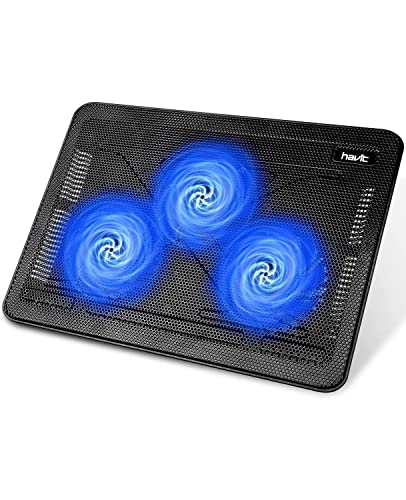
The havit HV-F2056 is the default budget pad, and it earns the spot. It is cheap, slim, quiet, and portable, aimed squarely at the buyer who wants ergonomics and a few degrees of headroom rather than a throttle fix.
Specs
Type | Open 3-fan pad |
Fans | 3 quiet fans |
Fits | 15.6 to 17 in |
Noise | Quiet |
Power | USB |
Ports | 2-USB hub |
Profile | Slim, portable |
Control | Single on/off switch |
Type
Open 3-fan pad
Fans
3 quiet fans
Fits
15.6 to 17 in
Noise
Quiet
Power
USB
Ports
2-USB hub
Profile
Slim, portable
Control
Single on/off switch
What it does well
It is the best-selling laptop cooling pad on Amazon, and the reasons are easy to see. It is slim enough to slide into a bag, it runs three quiet fans, the surface is metal mesh, there are two height settings, and it includes a pass-through USB hub so it does not cost you a port. All of that at an entry price.
For a student who wants a portable pad that lifts the laptop, adds a breeze, and does not announce itself, it covers the basics without fuss.
What you give up
The airflow is light, so the temperature drops are modest. There is one switch and no fan-speed control, so you take the airflow it gives you. It will not rescue a laptop that is throttling hard, and it caps at 17 inches.
You are buying ergonomics and a small thermal margin here, not a rescue. Set expectations there and it is a lot of pad for the money. If you are still shopping for the machine itself, our affordable gaming laptop picks are a sensible place to start.
Who it's for
This is for the budget buyer or student who wants a portable pad for comfort and a few degrees of headroom on a laptop that runs warm but does not shut down. If you are not fighting real throttling, you do not need to spend more than this.
Editor's Pick: Thermaltake Massive 20 RGB
The Thermaltake Massive 20 is here for one specific buyer: the owner of an oversized desktop-replacement laptop. Its 10 to 19 inch steel-mesh deck is one of the few pads that holds a 17 or 18 inch machine with room to spare, instead of leaving it hanging off the edge.

Specs
Type | Open single 200mm fan |
Fan | 200 mm at 600 to 800 RPM |
Airflow | 64 CFM |
Fits | 10 to 19 in |
Noise | Quiet |
Power | USB (2 ports) |
Surface | Steel mesh |
Lighting | 256-color RGB |
Type
Open single 200mm fan
Fan
200 mm at 600 to 800 RPM
Airflow
64 CFM
Fits
10 to 19 in
Noise
Quiet
Power
USB (2 ports)
Surface
Steel mesh
Lighting
256-color RGB
What it does well
The large steel-mesh surface fully supports a 17 to 18 inch gaming laptop, which is exactly the problem most pads fail to solve for big machines. A single 200 mm fan pushes 64 CFM while staying quiet, three height angles handle ergonomics, and there is 256-color RGB if you want it. It ships and is sold by Amazon, so stock and returns are simple.
For a desktop-replacement laptop that needs a stable, airy platform more than a forced-air rescue, it is a well-judged fit.
What you give up
As an open-fan pad, the cooling is moderate, a handful of degrees rather than the swing a sealed turbofan delivers. It draws two USB ports and the cable is short, which can force you into a USB hub depending on where your ports sit.
It is large and heavy rather than portable, so it lives on the desk. The height legs also feel flimsier than the rest of the build. And a big surface is not the same as big cooling: this is about supporting and gently cooling a large laptop, not dropping its temperature dramatically.
Who it's for
This is for the owner of a 17 to 18 inch desktop-replacement gaming laptop who needs a pad big enough to hold the machine and wants quiet, ergonomic airflow on a desk. If your laptop is oversized and runs warm rather than throttling, this is the one that fits it.
Bottom line
If your gaming laptop is genuinely throttling, buy the IETS GT600 Turbo-Fan Cooler. Its sealed turbofan is the only mechanism here that reliably ends shutdowns, and it fits almost any size.
If you want that same forced cooling for less, the Llano V12 RGB is the value call for a 15.6 inch or larger machine. If your laptop only runs warm and you care about silence and build, the KLIM Ultimate RGB is the premium open-fan pick. The havit HV-F2056 is the cheap, portable pad for ergonomics and a small thermal margin. And if you own a 17 or 18 inch desktop replacement, the Thermaltake Massive 20 RGB is the one big enough to hold it.
The single thing to get right is the mechanism. A turbofan fixes throttling and needs a wall socket. An open fan buys comfort and a few degrees off USB. Decide which problem you have, and every other choice on this list falls into place.
FAQ
Do laptop cooling pads actually work?
Yes, with a caveat about how much. On a laptop that is genuinely throttling, a sealed-chamber turbofan like the IETS GT600 can pull real heat out, with owners reporting drops around 15 to 20 C and an end to thermal shutdowns. On a laptop that just runs warm, an open-fan pad buys a smaller margin, usually single digits to low double digits in Celsius, plus better ergonomics. So they work, but the size of the win depends on the mechanism you buy and whether your laptop is throttling or just running hot.
Are sealed-chamber turbofan coolers better than open-fan pads?
For raw cooling, yes. A sealed-chamber turbofan seals against the laptop and forces air into the intake, which is the only approach that reliably stops sustained throttling. That is why the GT600 and Llano V12 are the picks for a machine that shuts down under load. Open-fan pads like the KLIM, havit, and Thermaltake are quieter, run off USB, and double as ergonomic stands, but they cool modestly. Better depends on your problem: turbofans for throttling, open fans for comfort and a warm laptop that stays stable.
How much can a cooling pad lower my gaming laptop's temperature?
It ranges widely. A sealed turbofan with a good seal can drop temperatures by roughly 15 to 20 C on a hot, throttling laptop, which is enough to keep clocks up and stop shutdowns. An open-fan pad typically manages a handful of degrees, from low single digits to low double digits, depending on how open the laptop's underside is. Your results hinge on the pad's mechanism, the quality of the seal or airflow, and how hard the laptop was throttling to begin with. Do not expect turbofan numbers from an open-fan pad.
Are laptop cooling pads loud?
It depends on the type and the speed. Open-fan pads like the KLIM Ultimate and Thermaltake Massive 20 are quiet to near-silent because a large fan moves air slowly. Sealed turbofans are quiet at low and mid speeds but get loud near maximum, with the GT600 rated up to about 65 dB at full tilt. The honest way to run a turbofan is at a mid fan setting, which stays reasonably quiet while still cooling hard. If silence is your top priority, an open-fan pad is the safer choice.
What size cooling pad do I need for a 17 or 18 inch laptop?
Look at the pad's maximum supported size and make sure your laptop fits with margin, not right at the edge. For a 17 or 18 inch machine, the Thermaltake Massive 20 handles 10 to 19 inches and is one of the few that truly supports a big laptop. The IETS GT600 covers up to 19.3 inches and adds sealed cooling if you also need to fix throttling. Avoid pads that top out at 17 inches, like the KLIM Ultimate and havit HV-F2056, for an 18 inch laptop, since the machine will overhang and the airflow or seal suffers.
Do cooling pads run off USB or need their own power adapter?
It splits by type. Open-fan pads run off USB, so the KLIM Ultimate, havit HV-F2056, and Thermaltake Massive 20 just plug into a port, though the KLIM and Thermaltake each use two. Sealed-chamber turbofans need more power than USB provides, so the IETS GT600 and Llano V12 come with their own wall adapters. That is part of why turbofans are desk fixtures rather than travel pads. If you want something you can power from the laptop alone and carry around, choose an open-fan pad.
Related Articles

Best GPU for Core Ultra 7 265K (2026): 5 Picks by Resolution
The best GPU for Core Ultra 7 265K builds by resolution: RX 9060 XT at 1080p, RTX 5070 Ti at 1440p, RTX 5080 at 4K, and where the 265K starts to cap frames.
Oct 11, 2026

Best Gaming Mouse for Medium Hands 2026: 5 Picks, Size Chart
Best gaming mouse for medium hands (17-19cm): the Razer Viper V3 Pro for claw grip, Basilisk V3 Pro for palm grip, 3 more picks, and a hand-size chart by grip.
Oct 11, 2026

Is DDR5 Worth It in 2026? Upgrade Only in These 2 Cases
Is DDR5 worth it in 2026? For most AM4 owners, no: it forces a new board and CPU while RAM prices spike. See when the swap pays off and when a GPU wins instead.
Oct 11, 2026

Best Prebuilt PC for Gears of War: E-Day (2026): 5 Picks
The best prebuilt PC for Gears of War: E-Day, matched to its 1080p, 1440p and 4K tiers: 5 ray tracing-ready systems with the memory and SSD space it needs.
Oct 12, 2026

Best Prebuilt PC for Modern Warfare 4 (2026): 5 Picks
The best prebuilt PC for Modern Warfare 4, matched to 90, 144 and 240 fps targets: 5 TPM 2.0-ready systems from a 16 GB RX 9060 XT box to an RTX 5080 X3D.
Oct 11, 2026