Affiliate Disclosure: As an Amazon Associate we earn from qualifying purchases. Some links may earn us a commission at no cost to you.

Best CPU Cooler for 7800X3D (2026): 5 Picks by Tier
Search for a CPU cooler for the Ryzen 7 7800X3D and you get charts ranking coolers by peak temperature. Then you notice the numbers barely move. A budget tower and a 240 mm AIO land within a few degrees of each other, and the chart tells you nothing about which one to buy.
There is a reason for that. AMD rates the 7800X3D to 89 C, and the chip boosts until it finds that ceiling. Peak temperature is fixed by design, so it cannot separate coolers. What separates them is the clock they hold there, the noise they make holding it, and whether they fit around your RAM.
Our top pick: Thermalright Phantom Spirit 120 SE
Seven heat pipes across two fin stacks is more heatsink than a 120 W chip can saturate. That surplus is the point. The fans sit at low RPM and stay there, so the build stays quiet while the chip runs at its ceiling.

Quick picks
Pick | Cooler | Type | Best for | Buy |
|---|---|---|---|---|
Best Overall | Dual-tower air | Quiet ATX builds with 160 mm clearance | ||
Best Value | Dual-tower air | The default 7800X3D cooler | ||
Best Premium | Single-tower air | Noise-sensitive desks and tall RAM | ||
Best Budget | Single-tower air | Tight budgets and shorter cases | ||
Editor's Pick | 240 mm AIO | Clearance-constrained or liquid-look builds |
Best Overall
- Cooler
- Type
Dual-tower air
- Best for
Quiet ATX builds with 160 mm clearance
- Buy
Best Value
- Cooler
- Type
Dual-tower air
- Best for
The default 7800X3D cooler
- Buy
Best Premium
- Cooler
- Type
Single-tower air
- Best for
Noise-sensitive desks and tall RAM
- Buy
Best Budget
- Cooler
- Type
Single-tower air
- Best for
Tight budgets and shorter cases
- Buy
Editor's Pick
- Cooler
- Type
240 mm AIO
- Best for
Clearance-constrained or liquid-look builds
- Buy
Specs at a glance
Cooler | Type | Height or radiator | Fans | RAM clearance | Warranty |
|---|---|---|---|---|---|
Dual-tower air, 7 pipes | 154 mm | 2 x 120 mm PWM | Front fan slides up | 3 years | |
Dual-tower air, 6 pipes | 155 mm | 2 x 120 mm PWM, 1550 RPM | Front fan slides up | 3 years | |
Single-tower air, 7 pipes | 158 mm | 2 x NF-A12x25 PWM | No DIMM overhang | 6 years | |
Single-tower air, 4 pipes | 148 mm | 1 x 120 mm PWM | No DIMM overhang | 3 years | |
240 mm AIO | 240 x 38 mm radiator | 2 x P12 PWM, 200 to 1800 RPM | Socket area clear | 6 years |
- Type
Dual-tower air, 7 pipes
- Height or radiator
154 mm
- Fans
2 x 120 mm PWM
- RAM clearance
Front fan slides up
- Warranty
3 years
- Type
Dual-tower air, 6 pipes
- Height or radiator
155 mm
- Fans
2 x 120 mm PWM, 1550 RPM
- RAM clearance
Front fan slides up
- Warranty
3 years
- Type
Single-tower air, 7 pipes
- Height or radiator
158 mm
- Fans
2 x NF-A12x25 PWM
- RAM clearance
No DIMM overhang
- Warranty
6 years
- Type
Single-tower air, 4 pipes
- Height or radiator
148 mm
- Fans
1 x 120 mm PWM
- RAM clearance
No DIMM overhang
- Warranty
3 years
- Type
240 mm AIO
- Height or radiator
240 x 38 mm radiator
- Fans
2 x P12 PWM, 200 to 1800 RPM
- RAM clearance
Socket area clear
- Warranty
6 years
How we picked these 7800X3D coolers
AMD specifies 89 C as the maximum operating temperature for the 7800X3D, and the chip is built to run there. Package power sits at 120 W base with a 162 W ceiling, modest next to the 250 W parts that genuinely need liquid. Give this chip a bigger heatsink and it does not run cooler for long. It boosts harder until it finds 89 C again.
So the axis that matters is what happens at that ceiling. More surface area means a higher sustained all-core clock at a lower fan speed. That shows up as a quieter room, not a lower number on the readout. Both halves of the trade are worth paying for, and neither one appears on a peak-temperature chart.
This is also why cooler advice does not carry between the two X3D generations. Zen 4 stacks the 96 MB of V-Cache above the compute die, so heat travels through the cache to reach the heat spreader. Zen 5 flipped that stack on the 9800X3D and put the compute die nearer the surface, which is why the 9800X3D cooler picks scale with better cooling in a way this chip does not. If you are still choosing between the chips themselves, how the two X3D parts differ covers that ground.
Clearance is what eliminates coolers here. A 155 mm dual tower needs a case that genuinely offers 160 mm, and advertised figures run optimistic. Buyers have flagged cases rated at 180 mm that come in nearer 165 mm once the side panel and lit fan tops are accounted for. Tall memory is the second constraint. Sizing all three parts together is the subject of how to choose a cooler, PSU and case.
Best Overall: Thermalright Phantom Spirit 120 SE
Specs
Type | Dual-tower air |
Height | 154 mm |
Heat pipes | 7 |
Fans | 2 x 120 mm PWM |
Sockets | AM5, AM4, LGA1700, LGA1200, LGA115x |
RAM clearance | Front fan slides up for tall kits |
Case requirement | 160 mm cooler clearance |
Type
Dual-tower air
Height
154 mm
Heat pipes
7
Fans
2 x 120 mm PWM
Sockets
AM5, AM4, LGA1700, LGA1200, LGA115x
RAM clearance
Front fan slides up for tall kits
Case requirement
160 mm cooler clearance
What it does well
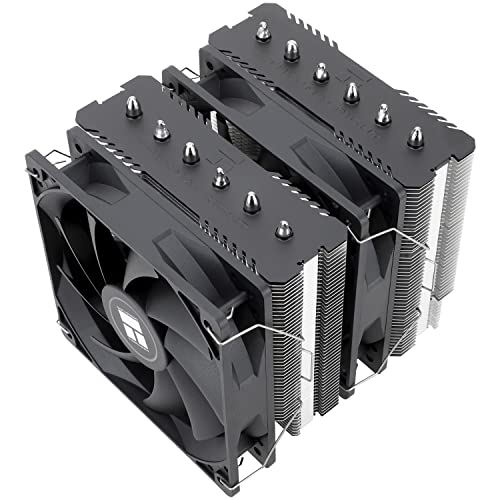
The Phantom Spirit runs seven heat pipes through two fin stacks with a 120 mm fan on each side. On a chip that tops out at 162 W, that is enough thermal mass that the fan curve never has to react. Set a flat, low profile in BIOS and it stays there through a long session. Nothing ramps when a level loads.
Mounting is the other quiet win. Thermalright's AM5 bracket screws into the stock backplate mounts and tightens to a stop, so there is no torque guess and no uneven-mount risk. That matters more than it sounds on an X3D part, where a poor mount surfaces as throttling rather than a couple of degrees.
What you give up
Height. At 154 mm this is a full-size tower, and the lit fan tops add millimetres the plain SE does not. Measure the case before ordering, and treat the advertised figure as optimistic rather than exact.
The other cost is headroom the 7800X3D cannot use. Against the cheaper sibling below it, the extra heat pipe buys margin that shows up on a 250 W chip and stays invisible here. Buy this one for the acoustic ceiling, not for degrees.
Who it's for
Anyone putting a 7800X3D in a mid-tower with real cooler clearance. If the case takes a 160 mm tower and you want one cooling decision that lasts the life of the build, this is it.
Best Value: Thermalright Peerless Assassin 120 SE
Specs
Type | Dual-tower air |
Height | 155 mm |
Heat pipes | 6 |
Fans | 2 x 120 mm PWM |
Fan speed | Up to 1550 RPM |
Sockets | AM5, AM4, LGA1851, LGA1700, LGA1200, LGA115x |
RAM clearance | Front fan slides up |
Type
Dual-tower air
Height
155 mm
Heat pipes
6
Fans
2 x 120 mm PWM
Fan speed
Up to 1550 RPM
Sockets
AM5, AM4, LGA1851, LGA1700, LGA1200, LGA115x
RAM clearance
Front fan slides up
What it does well
Six heat pipes instead of seven, and a fan ceiling of 1550 RPM. On a 120 W chip neither difference has anywhere to go. The Peerless Assassin holds the same boost behaviour, on the same mounting hardware, in the same dual-tower shape.
That fan ceiling is quietly the best feature. A cooler that physically cannot spin past 1550 RPM cannot produce the whine that sends people back into their fan curves at midnight. It is a hardware guarantee rather than a software setting.
What you give up
Margin on hardware you do not own. Put this on a 14900K and the missing heat pipe shows. On this chip it does not, which is exactly why it sits in the value slot rather than the top one.
Presentation, too. Plain black fans, no lighting header, no lit tops. In a glass-side build it looks like what it is, a working part rather than a display piece.
One buying note. Amazon carries typo-brand listings that reuse Thermalright's product photos under a slightly misspelled brand field. Check that the brand reads Thermalright before ordering.
Who it's for
The builder who would rather put the difference into the GPU or a second NVMe drive. That is most 7800X3D buyers, and it is the honest default for this chip.
Best Premium: Noctua NH-U12A chromax.black

Specs
Type | Single-tower air |
Height | 158 mm |
Footprint | 125 x 112 mm |
Heat pipes | 7 |
Fans | 2 x NF-A12x25 PWM |
RAM clearance | No DIMM overhang on AM5 |
Warranty | 6 years |
Type
Single-tower air
Height
158 mm
Footprint
125 x 112 mm
Heat pipes
7
Fans
2 x NF-A12x25 PWM
RAM clearance
No DIMM overhang on AM5
Warranty
6 years
What it does well
The NH-U12A is a single 120 mm tower that does not overhang the DIMM slots on AM5. Tall memory with heat spreaders fits under it without sliding a fan up the stack, and kits over 42 mm can push the rear fan upward where the case allows more than 158 mm. Pairing it with the DDR5 kits we run on this chip is a non-event.
The NF-A12x25 fans are the reason people pay. They are the reference point for quiet at a given airflow, and the package carries a six-year warranty with the support record behind it. If you want the 7800X3D board picks and the cooler to both be parts you never touch again, this is that pairing.
What you give up
Money, for thermal parity. A dual tower at a fraction of the cost holds the same clocks on this chip. What the premium buys is acoustics and clearance. Both are real, and both are narrow.
Narrow enough to name the failure case. If you game in headphones, case noise never reaches you and the upcharge buys nothing you will perceive. I have watched that specific overspend happen often enough to say it plainly: the money does more sitting in the GPU.
Who it's for
Buyers with a genuine noise requirement. A recording or streaming setup where the noise floor is measurable, a tower that sits on the desk beside your head all day, or documented noise sensitivity. Those are the profiles where the premium pays.
Best Budget: Thermalright Assassin X120 Refined SE

Specs
Type | Single-tower air |
Height | 148 mm |
Heat pipes | 4 |
Fans | 1 x 120 mm TL-C12C PWM |
Sockets | AM5, AM4, LGA1851, LGA1700, LGA1200, LGA115x |
RAM clearance | No DIMM overhang |
Base | AGHP direct-touch |
Type
Single-tower air
Height
148 mm
Heat pipes
4
Fans
1 x 120 mm TL-C12C PWM
Sockets
AM5, AM4, LGA1851, LGA1700, LGA1200, LGA115x
RAM clearance
No DIMM overhang
Base
AGHP direct-touch
What it does well
Four heat pipes, one fan, 148 mm tall. On a chip that pulls 120 W under sustained load, that is a working cooler rather than a compromise. It clears cases that reject a 155 mm dual tower, it does not overhang the DIMM slots, and it occupies one PWM header.
It also proves the point the rest of this page is making. The gap between this and the top pick on a 7800X3D is smaller than the gap between their box sizes suggests, because the chip is the limiter in both cases.
What you give up
Acoustic headroom. One 120 mm fan on four pipes has to spin faster to move the same heat, so in a warm room with PBO enabled you will hear it work where a dual tower stays flat. The chip still holds its clocks. You just listen to it happen.
There is also no upgrade path inside the cooler. A second fan does not fix a four-pipe stack. If this chip later moves into a hotter or smaller case, you are buying again, and the air coolers we pick across the wider TDP range covers where to go next.
Who it's for
Tight budgets, shorter cases, and second builds. If the cooler is the last line item and the case will not take a full tower, this is the floor that still does the job properly.
Editor's Pick: ARCTIC Liquid Freezer III 240 A-RGB
Specs
Type | 240 mm AIO |
Radiator | 240 x 38 mm |
Fans | 2 x P12 PWM PST A-RGB, 200 to 1800 RPM |
VRM fan | 60 mm, PWM controlled |
Sockets | AM5, AM4, LGA1851, LGA1700 |
Contact plate | Offset for the AM5 hotspot |
Warranty | 6 years |
Type
240 mm AIO
Radiator
240 x 38 mm
Fans
2 x P12 PWM PST A-RGB, 200 to 1800 RPM
VRM fan
60 mm, PWM controlled
Sockets
AM5, AM4, LGA1851, LGA1700
Contact plate
Offset for the AM5 hotspot
Warranty
6 years
What it does well
This is the AIO on the list, and it earns the slot on clearance rather than temperature. Moving the heatsink out to a front or top radiator mount empties the whole area above the socket. Tall memory, a wide GPU backplate and an awkward top panel all stop being constraints.
ARCTIC's execution is why this is the one. The radiator is 38 mm thick rather than the usual slim stack, the contact plate is offset toward the AM5 hotspot, and a 60 mm fan on the pump block moves air across the VRM area that a tower fan would otherwise handle. Six years of warranty on a pump is unusual.
What you give up
A moving part. Pumps have a service life, and when one fails the coolant it was moving sits above everything else in the case. Enough of the builds I helped spec between 2020 and 2022 came back with dead pumps that air became my default, and on a 120 W chip that default is easy to hold.
You are also paying for clearance and looks rather than performance. Reports put a quality dual tower within a couple of degrees of a 240 mm unit on this chip. If the case takes a tower and the memory fits under it, the tower is the better engineering answer.
Who it's for
Builders whose case will not take a 155 mm tower, whose memory needs the space, or who want the liquid look and accept the trade honestly. That is a real set of buyers, and this is the unit to hand them.
Bottom line
If the case clears 160 mm, buy the Phantom Spirit and stop thinking about it. If you would rather move the difference into the GPU, the Peerless Assassin is the same cooler on this chip. If your desk is quiet and you notice fan noise, the NH-U12A earns its premium. If the budget is tight or the case is short, the Assassin X120 still does the job. If a tower will not fit at all, take the Liquid Freezer III and accept the pump.
Still weighing the chip itself? Whether the 7800X3D is still the buy is the prior question.
FAQ
Does the 7800X3D need an AIO, or is a tower cooler enough?
A tower is enough. The chip runs 120 W of package power against a 162 W ceiling, which any competent dual-tower air cooler absorbs without effort. Liquid becomes the right answer when the case will not fit a 155 mm tower, when tall memory needs the space above the socket, or when you want the look and accept that a pump is a wearing part. None of those are thermal reasons. On temperatures alone, air wins the value argument on this chip every time.
Why does my 7800X3D sit at 89 C under load?
Because that is where AMD designed it to sit. 89 C is the rated maximum operating temperature, not a warning line, and the boost algorithm pushes clocks until it reaches that number. A better cooler does not lower the temperature for long. It lets the chip hold a higher clock at the same 89 C, at a lower fan speed. If you want a lower number on the readout rather than more performance, a negative curve offset through PBO does that. The stock behaviour is not a fault.
Is a budget tower really as good as a 240 mm AIO on this chip?
Close enough that the difference is hard to justify on thermals alone. Reports put a quality dual tower within a couple of degrees of a 240 mm unit on the 7800X3D, and both hold the chip at its ceiling either way. Where the AIO genuinely wins is clearance. It frees the space above the socket for tall memory and fits cases that reject a full tower. Buy the AIO for the physical constraint, not for the chart.
Does a better cooler raise 7800X3D gaming FPS?
Barely, and not in a way you will feel. Games rarely load all eight cores hard enough to pin the chip against its thermal limit, so most of the time the cooler is not the constraint at all. In the sessions where it is, a larger heatsink buys a slightly higher sustained clock, which lands as a small improvement in 1 percent lows rather than a higher average. The bigger return from a better cooler is a quieter room.
Will a tower cooler clear tall RAM on my AM5 board?
Usually, with a caveat. The dual-tower Thermalright coolers here let you slide the front fan up the fin stack to clear tall heat spreaders, which costs a little airflow and needs the case to have the extra height. The NH-U12A avoids the problem entirely by not overhanging the DIMM slots on AM5. If the memory has tall lit spreaders and the case is short, that is the cooler to pick, or move to the AIO and take the socket area back completely.
Related Articles

Best CPU Coolers for the Ryzen 7 9800X3D (2026)
Pick the right cooler for the Ryzen 7 9800X3D. Air, AIO, and SFF picks for the chip's actual gaming thermal envelope, not the SERP's biggest cooler defaults.
May 13, 2026

Best Motherboard for 7800X3D in 2026: 6 Picks by Tier
The best motherboard for the 7800X3D is usually a B650, not an X870E. We rank 6 AM5 boards by VRM, PCIe, M.2 and Wi-Fi, and say when 800-series actually pays.
Aug 7, 2026

Best DDR5 RAM for the Ryzen 7 7800X3D (2026): 5 Picks
Best DDR5 RAM for the Ryzen 7 7800X3D: five DDR5-6000 CL30 EXPO kits ranked by tier, plus why the chip's 96MB cache makes paying up for faster memory a waste.
Aug 17, 2026

9800X3D vs 7800X3D (2026): 11% Average, 25% Where It Counts
9800X3D vs 7800X3D in 2026: an 11% average uplift, 25% in cache-heavy games, and which of four buyer profiles should actually pay the upgrade premium.
Sep 13, 2026

Best Gaming Air CPU Coolers 2026: 5 Picks From SFF to 250W
Best air CPU coolers for gaming in 2026: match your cooler to your CPU's real gaming wattage, with picks from low-profile SFF builds to 250W flagships.
Aug 22, 2026