Affiliate Disclosure: As an Amazon Associate we earn from qualifying purchases. Some links may earn us a commission at no cost to you.

Best CPU Coolers for the Ryzen 7 9700X: 5 Picks (2026)
The Ryzen 7 9700X ships in 65W TDP mode and carries an officially warranted 105W toggle in BIOS. Those are two different cooling problems wearing the same part number, and which one you have decides which cooler you should buy.
At stock the chip runs an 88W package power limit. Flip the toggle and it runs 142W. Below are five picks split by mode and by case class, with the clearance number that kills installs listed for each one.
Our top pick: Thermalright Phantom Spirit 120 SE ARGB
Seven heat pipes and two towers cover the 9700X in either mode without the fans ever needing to work for it, at a price much closer to the budget tier than the premium one.

Which mode are you running?
Mode | Package power | What to buy |
|---|---|---|
65W (stock default) | 88W PPT | Any four-pipe single tower. The budget pick clears it. |
105W (BIOS toggle) | 142W PPT | A six or seven pipe dual tower, or a 240mm AIO if height is capped. |
65W (stock default)
- Package power
88W PPT
- What to buy
Any four-pipe single tower. The budget pick clears it.
105W (BIOS toggle)
- Package power
142W PPT
- What to buy
A six or seven pipe dual tower, or a 240mm AIO if height is capped.
Quick picks
Pick | Cooler | Best for | Buy |
|---|---|---|---|
Best Overall | Covers both TDP modes | ||
Best Value | Stock 65W gaming builds | ||
Best Premium | Desk-side quiet builds | ||
Best Budget | Tight budgets, tight cases | ||
Editor's Pick | Cases capped under 150mm |
Best Overall
- Cooler
- Best for
Covers both TDP modes
- Buy
Best Value
- Cooler
- Best for
Stock 65W gaming builds
- Buy
Best Premium
- Cooler
- Best for
Desk-side quiet builds
- Buy
Best Budget
- Cooler
- Best for
Tight budgets, tight cases
- Buy
Editor's Pick
- Cooler
- Best for
Cases capped under 150mm
- Buy
Specs at a glance
Cooler | Type | Height | Fans | Rated noise |
|---|---|---|---|---|
Dual-tower air | 154 mm | 2 x 120mm PWM ARGB | 25.6 dBA | |
Dual-tower air | 155 mm | 2 x 120mm PWM | 25.6 dBA class | |
Single-tower air | 158 mm | 2 x NF-A12x25 PWM, push-pull | 22.6 dBA at low duty | |
Single-tower air | 148 mm | 1 x TL-C12C 120mm PWM | 25.6 dBA | |
240mm AIO liquid | 240 mm, 27 mm thick | 2 x 120mm PWM ARGB | Pump plus 2 fans |
- Type
Dual-tower air
- Height
154 mm
- Fans
2 x 120mm PWM ARGB
- Rated noise
25.6 dBA
- Type
Dual-tower air
- Height
155 mm
- Fans
2 x 120mm PWM
- Rated noise
25.6 dBA class
- Type
Single-tower air
- Height
158 mm
- Fans
2 x NF-A12x25 PWM, push-pull
- Rated noise
22.6 dBA at low duty
- Type
Single-tower air
- Height
148 mm
- Fans
1 x TL-C12C 120mm PWM
- Rated noise
25.6 dBA
- Type
240mm AIO liquid
- Height
240 mm, 27 mm thick
- Fans
2 x 120mm PWM ARGB
- Rated noise
Pump plus 2 fans
Benchmarks
Lower is better. Both coolers were measured on the same class of eight-core part under an extended gaming session.
- Phantom Spirit 120 SE63 degrees C
- Peerless Assassin 120 SE65 degrees C
The other three picks have no directly comparable published figure at this load, so they are not charted here. Their thermal behaviour is covered in the sections below rather than estimated into a graph.
How we picked
Mode came first. A cooler recommendation for this chip that does not ask which TDP mode you are running is answering a question you did not ask. Everything below is sorted by the power limit it needs to absorb, not by a generic performance ranking.
Clearance came second. Cooler height is the single most common reason a build stalls at the side panel, and the numbers on case spec sheets are optimistic. Every tower here lists its real height, and the shortest one is called out specifically because that six millimetre gap decides more builds than the thermal difference does.
Noise came third, and it is where most of the overspending in this category happens. The premium-quiet upcharge is real, but it is narrow: it buys a lower noise floor and a longer warranty, not lower temperatures. If you game in headphones it buys you nothing at all, and that money belongs in the GPU or the SSD.
Everything here mounts on AM5 with the hardware in the box, and every one ships with usable paste. The paste brand debates sit inside mounting-pressure variance on a chip this size, so the tube in the box is the right answer.
Best Overall: Thermalright Phantom Spirit 120 SE ARGB
Specs
Type | Dual-tower air |
Heat pipes | 7 x 6mm |
Fans | 2 x 120mm PWM ARGB |
Height | 154 mm |
Rated noise | 25.6 dBA |
Sockets | AM5 / AM4 / LGA1700 / LGA1851 |
Mounting | Backplate, paste included |
Type
Dual-tower air
Heat pipes
7 x 6mm
Fans
2 x 120mm PWM ARGB
Height
154 mm
Rated noise
25.6 dBA
Sockets
AM5 / AM4 / LGA1700 / LGA1851
Mounting
Backplate, paste included
What it does well
Seven heat pipes across two towers is more metal than a 142W part needs, and that is the point. The fans never have to ramp into the range where you notice them, because the stack absorbs the load first. Under a sustained gaming session it holds a couple of degrees under the Peerless Assassin, and the gap widens once an all-core render starts.
The mounting kit ships with everything AM5 needs, and the bundled paste is good enough that buying a tube alongside it is wasted money. Two 120mm PWM fans sit around 25.6 dBA at the duty cycles this chip asks for.
What you give up
At 154mm it is a tall cooler in a category where case makers round their clearance numbers up. Cases advertising 165mm to 180mm often land closer to 165mm once the side panel and ARGB fan tops are installed, and buyers have flagged that gap repeatedly on specific board and case combinations. Measure before you commit.
The ARGB runs off a hub rather than per-fan addressable headers, so if your board software is the centre of your lighting setup, this one sits slightly outside it.
Who it's for
Anyone who has flipped 105W mode on in BIOS, or expects to once they start rendering or compiling. It is also the right buy if you want to decide the mode question later and not revisit the cooler.
Best Value: Thermalright Peerless Assassin 120 SE
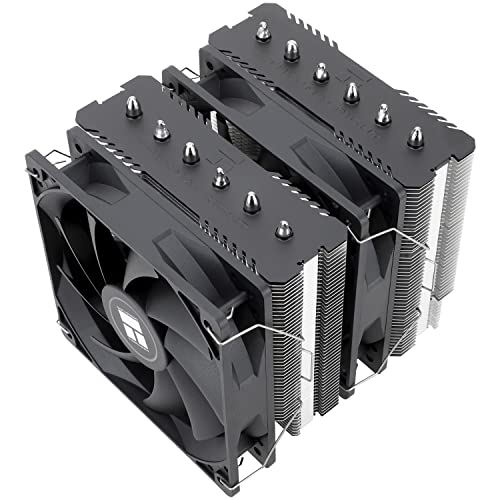
Specs
Type | Dual-tower air |
Heat pipes | 6 x 6mm |
Fans | 2 x 120mm PWM |
Fan speed | 1550 RPM |
Height | 155 mm |
Lighting | None |
Sockets | AM5 / AM4 / LGA1700 / LGA1851 |
Type
Dual-tower air
Heat pipes
6 x 6mm
Fans
2 x 120mm PWM
Fan speed
1550 RPM
Height
155 mm
Lighting
None
Sockets
AM5 / AM4 / LGA1700 / LGA1851
What it does well
Six heat pipes instead of seven, and on a chip running 88W PPT that difference is mostly theoretical. Reviewers put it in the low-to-mid 60s under extended gaming load, which is a long way from anything that throttles.
There is no lighting, no hub, and no software. For a build where the cooler is supposed to be invisible, that absence is a feature. The 1550 RPM fans stay well back from their ceiling at stock power.
What you give up
The seventh pipe the Phantom Spirit carries shows up the moment you enable 105W mode and run a sustained all-core workload. If you plan to do that regularly, you are buying the wrong one of these two.
It is also a 155mm-class cooler, so it solves no clearance problem that the Phantom Spirit does not also solve. You are trading thermal headroom for money, not for space.
Who it's for
Pure gaming builds staying at stock. The 9700X in 65W mode is one of the easier chips of its generation to cool, and this is where the savings should go to the GPU instead.
Best Premium: Noctua NH-U12A chromax.Black

Specs
Type | Single-tower air |
Heat pipes | 7 nickel-plated copper |
Fans | 2 x NF-A12x25 PWM, push-pull |
Height | 158 mm |
Rated noise | 22.6 dBA at low duty |
Warranty | 6 years |
Sockets | AM5 / AM4 / LGA1700 |
Type
Single-tower air
Heat pipes
7 nickel-plated copper
Fans
2 x NF-A12x25 PWM, push-pull
Height
158 mm
Rated noise
22.6 dBA at low duty
Warranty
6 years
Sockets
AM5 / AM4 / LGA1700
What it does well
Two NF-A12x25 fans in push-pull on a single tower is the quietest configuration in this roundup by a real margin. At low duty it sits around 22.6 dBA, which on a 65W chip is most of the time.
The single-tower width also clears tall memory that dual-tower coolers fight with, and the six-year warranty comes attached to the best replacement-parts support in the category. If a fan dies in year four, you can get one.
What you give up
It costs several times what the Phantom Spirit does for a thermal result within a couple of degrees on a chip this size. The premium is real, but it buys noise floor and warranty, not temperatures, and on a 65W-mode 9700X most of that headroom is simply never used.
At 158mm it is the tallest pick here. The quiet-build buyer who does not check clearance first ends up returning it.
Who it's for
Builds where the case sits next to your head for eight hours a day, audio work with a real noise floor, or documented noise sensitivity. If you game in headphones, case noise never reaches you and this upcharge buys you nothing.
Best Budget: Thermalright Assassin X120 Refined SE

Specs
Type | Single-tower air |
Heat pipes | 4 x 6mm |
Fans | 1 x TL-C12C 120mm PWM |
Height | 148 mm |
Airflow | 66.17 CFM |
Rated noise | 25.6 dBA |
Sockets | AM5 / AM4 / LGA1700 / LGA1851 |
Type
Single-tower air
Heat pipes
4 x 6mm
Fans
1 x TL-C12C 120mm PWM
Height
148 mm
Airflow
66.17 CFM
Rated noise
25.6 dBA
Sockets
AM5 / AM4 / LGA1700 / LGA1851
What it does well
Four heat pipes, one fan, and a rating that covers the 65W to 105W band the 9700X lives in. At stock power it clears 88W PPT without complaint, pushing 66.17 CFM at about 25.6 dBA.
At 148mm it is the shortest tower in this list, which matters more often than buyers expect. Six millimetres is the difference between a clean install and a side panel that will not close.
What you give up
One fan and four pipes means 105W mode moves it into audible territory under sustained all-core load. It does not fail, it just stops being quiet, and the fan curve is what pays for the shortfall.
There is no lighting and the heatsink cover is plain aluminium. Nothing here is trying to look like anything.
Who it's for
Stock-mode gaming builds on a tight budget, and compact cases where clearance decides the build. If you have been wondering whether a cheap tower is genuinely enough for this chip, this is the pick that says yes.
Editor's Pick: Thermalright Frozen Notte 240 ARGB

Specs
Type | 240mm AIO liquid |
Radiator | 240 mm, 27 mm thick |
Fans | 2 x 120mm PWM ARGB |
Pump bearing | S-FDB |
Tubing | Sleeved, top or front mount |
Block height | Clears 150mm-capped cases |
Sockets | AM5 / AM4 / LGA1700 / LGA1200 |
Type
240mm AIO liquid
Radiator
240 mm, 27 mm thick
Fans
2 x 120mm PWM ARGB
Pump bearing
S-FDB
Tubing
Sleeved, top or front mount
Block height
Clears 150mm-capped cases
Sockets
AM5 / AM4 / LGA1700 / LGA1200
What it does well
A 240mm radiator is the correct size for a part that tops out at 142W PPT. It clears the constraint that drives most AIO purchases on this chip, which is a case that caps cooler height below 150mm.
Dual 120mm PWM ARGB fans, an S-FDB pump bearing, and sleeved tubing long enough to reach either a top or a front mount without tension on the fittings.
What you give up
A pump is a moving part with a failure mode a tower cooler does not have, and reports suggest AIO pumps in this class can start degrading around year four. On a build you expect to keep for five years, that is a real line item.
It also does not beat the Phantom Spirit thermally on this chip. You are buying clearance and appearance, and it is worth being honest that those are the reasons.
Who it's for
Buyers whose case caps cooler height under 150mm, and buyers who want the AIO look and accept the trade that comes with it. On a 65W-mode 9700X, liquid is a fitment and aesthetics decision rather than a thermal one.
Bottom line
If you are running stock 65W and want the cooler to disappear, buy the Peerless Assassin 120 SE. If your budget is genuinely tight, the Assassin X120 Refined SE clears the same job for less, and our stock-cooler explainer covers why that is enough.
If you have flipped 105W mode on, or think you might, buy the Phantom Spirit 120 SE ARGB and stop thinking about it. If your case caps cooler height under 150mm, the Frozen Notte 240 is the fitment answer, and the liquid versus air trade is covered separately.
If quiet is a hard requirement rather than a preference, the NH-U12A earns its premium. For everyone else it does not, and that is the most common stealth overspend in this whole category.
FAQ
Does the Ryzen 7 9700X need an AIO?
No. At its stock 65W TDP mode the chip runs an 88W package power limit, and a sub-twenty-dollar single-tower air cooler covers that. Even in 105W mode at 142W PPT, a good dual-tower like the Phantom Spirit 120 SE handles it with fan headroom to spare. An AIO on this chip is a case-clearance or appearance decision, not a thermal necessity.
Does the Ryzen 7 9700X come with a stock cooler?
No. The 9700X ships without a bundled cooler, so a cooler is a mandatory line item in the build rather than an upgrade. That is good news for the budget: because the chip is easy to cool, the cheapest pick on this list is a legitimate answer rather than a compromise.
Is a cheap air cooler enough for the Ryzen 7 9700X?
In 65W mode, yes, comfortably. A four-pipe single-tower rated for the 65W to 105W band clears an 88W package limit and stays quiet doing it. The cheap tower stops being enough only when you enable 105W mode and run sustained all-core workloads, and even then it keeps the chip in spec. It just gets loud.
What changes when you enable 105W mode on the 9700X?
Package power goes from 88W to 142W, and multi-threaded throughput climbs by roughly thirteen percent in Cinebench R20 and Handbrake H264, with about nine percent in Cinebench 2024 multi-thread and five percent single-thread. Gaming barely moves. If your workload is games, leaving it at stock costs you almost nothing and keeps the build quiet.
How much CPU cooler clearance do you need for these picks?
The picks here span 148mm to 158mm. Check your case's stated maximum, then subtract a little: advertised clearance is usually measured without the side panel bulge or tall fan tops, and buyers regularly find the practical ceiling lands below the number on the box. If your case caps out under 150mm, the 240mm AIO is the cleaner route.
Is the 9700X harder to cool than the 9800X3D?
No, it is easier in stock configuration. The 9700X defaults to a lower package power limit, and its heat is spread across a single compute die without the stacked cache layer sitting between the cores and the heatspreader. Coolers that are marginal on an X3D part have margin to spare here.
Related Articles

Best CPU Coolers for the Ryzen 7 9800X3D (2026)
Pick the right cooler for the Ryzen 7 9800X3D. Air, AIO, and SFF picks for the chip's actual gaming thermal envelope, not the SERP's biggest cooler defaults.
May 13, 2026

Best CPU Coolers for the Ryzen 5 9600X: 5 Picks (2026)
The best CPU cooler for the Ryzen 5 9600X costs less than most builders expect: the chip ships with none and peaks near 88 watts. Five picks, one step-up.
Aug 26, 2026

Best Motherboards for Ryzen 7 9700X (2026): B650 vs B850
The best motherboard for the 9700X is not an X870. Five B650, B850 and X870 picks matched to real build profiles, plus the AGESA BIOS caveat nobody flags.
Jul 21, 2026

Air Cooler vs AIO for Gaming (2026): Skip It Below 150W
Air cooler vs AIO for gaming: under 150W a dual-tower matches a 240mm AIO for less money and less noise. 2026 picks for both paths, plus a TDP decision matrix.
Aug 19, 2026

Best Gaming Air CPU Coolers 2026: 5 Picks From SFF to 250W
Best air CPU coolers for gaming in 2026: match your cooler to your CPU's real gaming wattage, with picks from low-profile SFF builds to 250W flagships.
Aug 22, 2026