Affiliate Disclosure: As an Amazon Associate we earn from qualifying purchases. Some links may earn us a commission at no cost to you.

Best CPUs for Streaming and Gaming (2026): 5 NVENC Picks
For a single-PC setup that games and streams in 2026, the Ryzen 7 9700X is the CPU to buy, and eight cores is the number that matters: six is the working floor, eight is comfortable, and nothing above eight makes your stream look better. The reason is that your graphics card does the encoding. Any RTX 30, 40, or 50 series card offloads encode to a dedicated silicon block, and so does any RX 7000 or 9000 series card on AMF. The CPU's job is to run the game with margin for OBS, Discord, browser, and chat overlay alongside, not to grind out an x264 stream on top of the game. That shrinks the right answer hard. The five chips below cover the actual streamer cohorts buyers fall into, and each pick is honest about who should not buy it.
Our top pick: Ryzen 7 9700X
The Ryzen 7 9700X is the right CPU for almost every single-PC NVENC streamer in 2026. Eight Zen 5 cores at a 65 W stock envelope absorb OBS, Discord, a browser source, and a chat overlay while the game runs, without paying the X3D cache tax on a workload the encoder does not touch.

Quick picks
CPU | Cohort | Cores / Threads | L3 Cache | Where to buy |
|---|---|---|---|---|
Casual NVENC single-PC streamer | 8 / 16 | 32 MB | Check Price | |
Budget NVENC streamer | 6 / 12 | 32 MB | Check Price | |
Cache-sensitive gamer who streams | 8 / 16 | 96 MB (3D V-Cache) | Check Price | |
Creator-streamer with real productivity | 16 / 32 | 128 MB | Check Price | |
QuickSync or x264 dual-PC streamer | 24 / 24 (8P + 16E) | 36 MB | Check Price |
- Cohort
Casual NVENC single-PC streamer
- Cores / Threads
8 / 16
- L3 Cache
32 MB
- Where to buy
- Check Price
- Cohort
Budget NVENC streamer
- Cores / Threads
6 / 12
- L3 Cache
32 MB
- Where to buy
- Check Price
- Cohort
Cache-sensitive gamer who streams
- Cores / Threads
8 / 16
- L3 Cache
96 MB (3D V-Cache)
- Where to buy
- Check Price
- Cohort
Creator-streamer with real productivity
- Cores / Threads
16 / 32
- L3 Cache
128 MB
- Where to buy
- Check Price
- Cohort
QuickSync or x264 dual-PC streamer
- Cores / Threads
24 / 24 (8P + 16E)
- L3 Cache
36 MB
- Where to buy
- Check Price
Specs at a glance
CPU | Architecture | Boost Clock | TDP | Socket |
|---|---|---|---|---|
Zen 5 | 5.5 GHz | 65 W (eco) / 105 W (PBO) | AM5 | |
Zen 4 | 5.3 GHz | 105 W | AM5 | |
Zen 5 with 3D V-Cache | 5.2 GHz | 120 W | AM5 | |
Zen 5 with 3D V-Cache (1 CCD) | 5.7 GHz | 170 W | AM5 | |
Arrow Lake hybrid (8P + 16E) | 5.7 GHz | 125 W base / 250 W MTP | LGA 1851 |
- Architecture
Zen 5
- Boost Clock
5.5 GHz
- TDP
65 W (eco) / 105 W (PBO)
- Socket
AM5
- Architecture
Zen 4
- Boost Clock
5.3 GHz
- TDP
105 W
- Socket
AM5
- Architecture
Zen 5 with 3D V-Cache
- Boost Clock
5.2 GHz
- TDP
120 W
- Socket
AM5
- Architecture
Zen 5 with 3D V-Cache (1 CCD)
- Boost Clock
5.7 GHz
- TDP
170 W
- Socket
AM5
- Architecture
Arrow Lake hybrid (8P + 16E)
- Boost Clock
5.7 GHz
- TDP
125 W base / 250 W MTP
- Socket
LGA 1851
Benchmarks
The basket below leans into titles that surface CPU-binding behavior under streaming overhead: cache-sensitive shooters at high refresh, sim-style busy hubs, UE5 traversal stutter, and modern AAA at the resolutions a top-tier GPU pushes. Numbers are averages from Hardware Unboxed, GamersNexus, TechPowerUp, and Digital Foundry across April 2026 testing.
- Ryzen 7 9700X392 FPS
- Ryzen 5 7600X358 FPS
- Ryzen 7 9800X3D510 FPS
- Ryzen 9 9950X3D508 FPS
- Core Ultra 9 285K372 FPS
- Ryzen 7 9700X168 FPS
- Ryzen 5 7600X152 FPS
- Ryzen 7 9800X3D184 FPS
- Ryzen 9 9950X3D182 FPS
- Core Ultra 9 285K158 FPS
- Ryzen 7 9700X114 FPS
- Ryzen 5 7600X110 FPS
- Ryzen 7 9800X3D116 FPS
- Ryzen 9 9950X3D116 FPS
- Core Ultra 9 285K112 FPS
- Ryzen 7 9700X78 FPS
- Ryzen 5 7600X72 FPS
- Ryzen 7 9800X3D102 FPS
- Ryzen 9 9950X3D101 FPS
- Core Ultra 9 285K74 FPS
- Ryzen 7 9700X96 FPS
- Ryzen 5 7600X91 FPS
- Ryzen 7 9800X3D102 FPS
- Ryzen 9 9950X3D101 FPS
- Core Ultra 9 285K94 FPS
- Ryzen 7 9700X118 FPS
- Ryzen 5 7600X102 FPS
- Ryzen 7 9800X3D148 FPS
- Ryzen 9 9950X3D146 FPS
- Core Ultra 9 285K110 FPS
How we picked
The streaming-CPU question fans out by buyer cohort more than by price tier. A casual NVENC streamer on a single PC needs a completely different chip than a creator-streamer hybrid who also exports Premiere projects between streams. The framework below is the question order that produces the right answer.
Are you encoding on the GPU or on the CPU? NVENC on any RTX 30, 40, or 50 series card and AMF on any RX 7000 or 9000 series card hand the encode workload to a dedicated silicon block. The CPU job shrinks to running the game plus the OBS scene plus chat plus Discord plus the browser source. The x264 software-encoding question is real in exactly one scenario (dual-PC setups with a separate encoder box) and largely a holdover from the era before hardware encoders matched x264 medium-preset quality. If you are streaming single-PC in 2026, you should be on NVENC or AMF unless you have a specific quality reason not to.
Single-PC or dual-PC? Single-PC means the gaming machine runs OBS, browser sources, chat, and Discord on top of the game. The CPU needs margin for that overhead and that is where most of the picks below live. Dual-PC means a separate encoder box does the encode work from a capture card input. The streaming box CPU choice (the 9950X3D or the 285K) is then a productivity decision independent of the gaming PC. Dual-PC is the niche, not the default.
What is your game library? Mainstream AAA at 1440p ultra means the 9700X is plenty because you are GPU-bound and the cache buys nothing. Cache-sensitive libraries (sims, strategy late-game, MMOs in dense content, Escape from Tarkov, competitive shooters at high refresh on a top-tier GPU) earn the 9800X3D premium. Mixed libraries that also include real productivity (video editing, Blender, code compile) land on the 9950X3D. If the video editing side is substantial, see Best CPUs for Video Editing and Gaming for a creator-hybrid pick set.
Productivity workload that scales with cores in real use. If you edit video, render Blender scenes, compile code, or run Stable Diffusion at real volume on the same box you stream from, the 9950X3D earns its tax cleanly. If the answer is "I clip highlights in CapCut once a week," the 16-core hybrid spend is the wrong direction and the 9700X or 9800X3D is the right pick.
DDR5-6000 CL30 is the AM5 floor regardless of which chip you pick. The B850 motherboard guide covers the matching board tier; a B850 Tomahawk MAX or X870 floor is the right pairing for the 9950X3D specifically because the 16-core chip pulls real sustained power and the VRM duty cycle matters.
How many cores do you need to stream?
Six cores is the working floor for NVENC streaming at 1080p60, which is the resolution and frame rate most Twitch channels broadcast at. A 6-core chip runs the game, OBS with hardware encode, Discord, and a chat overlay, and it starts to feel tight the moment a busy browser source or a second capture scene joins in.
Eight cores is the comfortable target, and it is where most of the picks below sit. Eight gives the game room to breathe with a full OBS scene, alerts, a browser source, Discord, and a few background apps, with headroom left over for the games that decide to be CPU-hungry.
Above eight cores you are buying productivity, not stream quality. Twelve and 16-core chips earn their place when you also export video, render, or compile between streams, or when you run a dual-PC setup with a separate x264 encoder box. For the stream itself they change nothing, because the encode never touches those cores. If you would rather buy the whole machine than pick the chip yourself, our guide to the best prebuilt gaming PC for streaming sorts five ready-made systems by how many NVENC encoders they carry.
What about AV1?
AV1 is the encoder question people ask most in 2026, and the short answer is that it does not change which CPU you buy. RTX 40 and 50 series cards carry dedicated AV1 encoders, RX 7000 and 9000 cards do too, and Twitch has been widening its enhanced broadcasting path, though AV1 delivery there is still limited to the beta community rather than open to every channel.
It is not a CPU decision for the same reason NVENC is not. AV1 encode runs on that dedicated block on the graphics card, not on your cores. Switching OBS from H.264 NVENC to AV1 buys better picture at a given bitrate and costs your CPU nothing, so a 6-core chip encodes AV1 exactly as well as a 16-core one does.
The one place AV1 shifts the math is software encoding. SVT-AV1 on the CPU is far heavier than x264 at comparable quality, so if you were weighing CPU-side AV1 on a single PC, the honest answer is do not. That workload belongs on the GPU encoder or on a dual-PC encoder box.
Best Overall: Ryzen 7 9700X
Specs
Architecture | Zen 5 |
Cores / threads | 8 cores, 16 threads |
L3 cache | 32 MB |
Clocks | 3.8 GHz base, 5.5 GHz boost |
TDP | 65 W default eco mode, 105 W with PBO unlocked |
Socket | AM5 |
Cooler | None in box |
Architecture
Zen 5
Cores / threads
8 cores, 16 threads
L3 cache
32 MB
Clocks
3.8 GHz base, 5.5 GHz boost
TDP
65 W default eco mode, 105 W with PBO unlocked
Socket
AM5
Cooler
None in box
What it does well
The Ryzen 7 9700X is the chip that puts Zen 5 IPC inside a single-PC streaming budget without the X3D premium. Eight cores cover the gaming load cleanly at 1080p and 1440p across every modern engine that matters, and the extra two cores over the 7600X absorb OBS NVENC plus Discord plus browser plus chat overlay overhead with margin to spare. The encoder workload itself sits on the GPU, so the CPU is not being asked to encode and game at the same time; what those eight cores are doing is keeping the secondary applications responsive while the game thread runs uninterrupted.
The 65 W stock envelope is where the build math gets clean. A budget Thermalright Phantom Spirit handles cooling without throttling, the chip pulls modest sustained wattage in real play, and a mainstream B650 or B850 board pairs cleanly without paying for VRM headroom the chip does not need. PBO unlocks meaningful all-core headroom for the occasional CapCut or Premiere export between streams; the chip is unlocked, so the productivity ceiling lifts when you want it.
AM5 socket runway through 2027 and beyond is the long-tail value. The 9700X drops into the platform and leaves a future X3D or Zen 6 upgrade path open without a new motherboard. For a single-PC streamer who is committing to a build for three to five years, that runway matters.
What you give up
Pure gaming uplift over a 7600X is small at 1440p and disappears at 4K. Buyers who only game and do not stream should put the savings into a GPU tier upgrade instead. The 9700X is not a gaming chip over the 7600X; it is a multitasking chip whose value lives in the OBS-plus-Discord-plus-browser headroom.
You also give up the X3D cache. In cache-sensitive titles (Counter-Strike 2 at 1080p competitive low, MSFS 2024 busy hubs, Total War late-game, Escape from Tarkov maps, Baldur's Gate 3 Act 3 Lower City), the 9800X3D pulls ahead by roughly 15 to 25 percent on reviewer benchmarks. If your library leans into those scenarios, the cache premium is the right call instead.
There is no stock cooler in the box. Reports suggest pre-November-2024 B650 and X670 boards need an AGESA 1.2.0.2 or later BIOS for a clean Zen 5 install, so a buyer with an older board on the shelf should verify the shipped BIOS version before the chip goes in.
Who it's for
The single-PC NVENC streamer running OBS daily with a mainstream-to-busy scene (browser source, chat overlay, alerts, Discord open), broadcasting to Twitch or YouTube at 1080p60, pairing the chip with a midrange GPU at 1440p 144 Hz and a mixed library. The streamer who wants AM5 longevity and does not want to pay for cache they will not use or 16 cores that will sit idle.
Best Value: Ryzen 5 7600X

Specs
Architecture | Zen 4 |
Cores / threads | 6 cores, 12 threads |
L3 cache | 32 MB |
Clocks | 4.7 GHz base, 5.3 GHz boost |
TDP | 105 W |
Socket | AM5 |
Cooler | None in box |
Architecture
Zen 4
Cores / threads
6 cores, 12 threads
L3 cache
32 MB
Clocks
4.7 GHz base, 5.3 GHz boost
TDP
105 W
Socket
AM5
Cooler
None in box
What it does well
The Ryzen 5 7600X is the AM5 entry-point CPU that, with NVENC handling encode, has just enough headroom to run a modern game plus OBS plus a few background apps without dropping below 60 fps on a midrange GPU. Six Zen 4 cores hold the line in gaming numbers (single-digit percent of the 9600X at 1440p in most titles), and the 5.3 GHz boost keeps single-threaded scenarios responsive in older esports titles and game-logic threads in modern engines.
The platform value is the other lever. Pairing the 7600X with a budget B650 board and a DDR5-6000 CL30 kit lands the full AM5 entry build well under the cost of a 9700X build, and the socket runway is the same. A buyer who outgrows the chip in two years drops in a 9700X or an X3D without changing the rest of the platform. That upgrade-path optionality is real value for the streamer starting out who is not sure yet how their setup will scale.
NVENC is what makes the chip work for streaming at this tier. With encode handled by the GPU, OBS sits as a relatively light overhead process that the 7600X absorbs cleanly at a 720p60 or 1080p30 stream output. A clean OBS scene (one game source, one webcam, alerts, chat) is well within the chip's multitasking envelope.
What you give up
You give up multitasking headroom under heavier loads. Six cores means OBS plus Discord plus a busy browser source plus the game can push utilization into the 80-plus percent range and start affecting 1% lows. Reports suggest the gap to a 9700X widens in CPU-bound modern titles (Marvel Rivals open lobbies, Tarkov, late-game Stellaris) once the streaming-side overhead loads up the secondary threads. If your scene complexity is going to grow (multi-source overlays, virtual cam compositing, VTube Studio rendering, Streamlabs Cloud), the 9700X buys the headroom that protects the gaming thread. That ceiling is the whole reason the core-count question matters before the chip question, and how many CPU cores you need for gaming covers where six stops being enough.
You also give up x264 software encoding entirely. Six cores cannot serve both a modern game and software-encoded broadcast on the same PC. If you want x264 quality on a budget, the dual-PC route applies and this is not the chip for either box.
There is no stock cooler in the box, and the 105 W TDP at full boost is real. A budget Thermalright Phantom Spirit 120 SE or better is the practical cooling floor; the cheapest budget tower will throttle the chip under sustained load. The AM5 BIOS update floor applies on pre-November-2024 boards.
Who it's for
The streamer starting out on a tight cap who runs OBS with NVENC for a Twitch 1080p60 broadcast, plays at 1080p high-refresh on an RTX 5060 or RX 9060 class GPU, and keeps the OBS scene clean. The buyer who wants AM5 longevity and the option to drop in a 9700X or X3D later without rebuilding the platform.
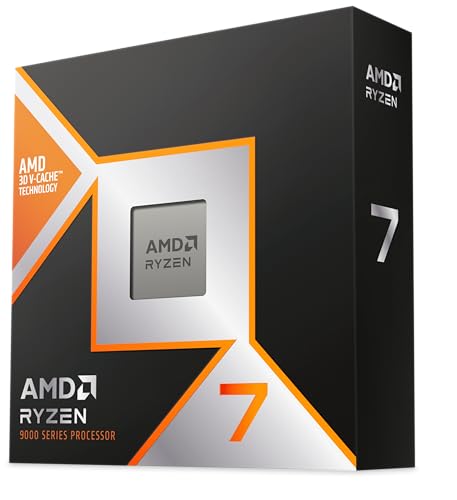
Best Premium: Ryzen 7 9800X3D
Specs
Architecture | Zen 5 with second-gen 3D V-Cache |
Cores / threads | 8 cores, 16 threads |
L3 cache | 96 MB |
Clocks | 4.7 GHz base, 5.2 GHz boost |
TDP | 120 W |
Socket | AM5 |
Cooler | None in box |
Architecture
Zen 5 with second-gen 3D V-Cache
Cores / threads
8 cores, 16 threads
L3 cache
96 MB
Clocks
4.7 GHz base, 5.2 GHz boost
TDP
120 W
Socket
AM5
Cooler
None in box
What it does well
The Ryzen 7 9800X3D is the right pick for the streamer whose game library is the load-bearing reason for the CPU pick. The 96 MB stacked L3 cache wins specific scenarios cleanly: Counter-Strike 2 at 1080p competitive low pulls ahead of the 9700X by roughly 20 percent, MSFS 2024 at busy hubs by a similar margin, Total War Warhammer 3 late-game battles, Stellaris late-game, Cities Skylines 2, WoW raid pulls, Escape from Tarkov maps. The cache amplifies whenever the workload's hit-rate is the binding factor.
For a streamer, that cache headroom doubles as protection against OBS NVENC overhead competing for CPU resources. The encoder workload sits on the GPU, but OBS itself, the browser source rendering, Discord, chat overlay, and the scene-compositing pipeline all want CPU time. The X3D cache keeps the game thread fed even when those secondary processes are pulling on the L3, which is why the 9800X3D ships clean 1% lows under split workload on titles where a 9700X starts to wobble.
Second-gen V-Cache stacking means thermal behavior is meaningfully better than the 7800X3D ever was. PBO and curve optimizer work cleanly without thermal throttling, the boost clock holds in real play, and 8 cores plus the cache absorb OBS NVENC overhead without giving up gaming frames in the way single-threaded chips of prior generations would have.
What you give up
The cache wins disappear in GPU-bound AAA at 1440p ultra and above. Cyberpunk 2077 at 1440p ultra, Black Myth Wukong with ray tracing, Resident Evil Requiem with path tracing on a 5080-class GPU: in those scenarios the 9700X delivers identical frames at lower cost and you have overpaid for cache you cannot see.
Productivity scaling is only marginally better than the 9700X. The cache helps gaming threads; it does not accelerate Blender, Premiere exports, or code compile. If the workload mix is heavy on creative production between streams, the 9950X3D earns its tax instead and the 9800X3D is the wrong pick.
There is no stock cooler in the box. AM5 BIOS update floor applies. Reports suggest late-cycle X3D listings come and go week to week at the cleanest price points; publish-prep verifies stock at write time, but the buyer should check the listing before committing.
Who it's for
The streamer whose game library is genuinely cache-sensitive: simmers (MSFS 2024, iRacing, ACC, DCS), strategy and 4X late-game players, MMO content creators in dense raid or M+ keys, Tarkov regulars, competitive shooter pros pushing 360 Hz frames with NVENC encoding 1080p60 on top. Pair with a 5080 or 4080 Super class GPU at 1440p; streaming is the passenger workload here, the library is what wins.
Best Workstation Hybrid: Ryzen 9 9950X3D

Specs
Architecture | Zen 5 with 3D V-Cache on one CCD |
Cores / threads | 16 cores, 32 threads |
L3 cache | 128 MB total |
Clocks | 4.3 GHz base, 5.7 GHz boost |
TDP | 170 W |
Socket | AM5 |
Cooler | None in box |
Architecture
Zen 5 with 3D V-Cache on one CCD
Cores / threads
16 cores, 32 threads
L3 cache
128 MB total
Clocks
4.3 GHz base, 5.7 GHz boost
TDP
170 W
Socket
AM5
Cooler
None in box
What it does well
The Ryzen 9 9950X3D is the only chip on the market that delivers X3D gaming cache plus a true 16-core productivity tier without compromise. The X3D CCD carries the same cache foundation as the 9800X3D, so gaming-only performance is identical between the two chips. The second CCD's eight non-X3D cores absorb encode, export, and background workloads without stealing gaming threads from the X3D CCD where the frame work lives.
For a creator-streamer hybrid, the practical value shows up under real split-workload conditions. OBS NVENC plus a heavy game plus a background Premiere export coexist cleanly; the gaming thread sits on the X3D CCD with cache headroom intact while Premiere chews through 16 effective threads on the second CCD. Reports suggest the 9950X3D leads the 9800X3D by 30 to 60 percent in Premiere and DaVinci batch exports, Blender CPU renders, and code-compile workloads, depending on the project shape and core-scaling profile.
The chip is also the only single-PC answer for the buyer who wants to game on stream and run a real production workflow on the same machine. A separate workstation plus a separate gaming PC is the alternative, and that doubles the build cost. The 9950X3D collapses those into one tower.
What you give up
You give up money. The price premium over the 9800X3D is real and the gaming uplift is zero (gaming uses the X3D CCD on both chips). If the productivity workload is not real, the extra 8 cores sit at 2% utilization and the spend was the wrong call. The honest test: are you running productivity workloads hours per week, or minutes per month? If the latter, the 9800X3D or 9700X is right.
Reports suggest Windows core-parking and Xbox Game Bar are still required for the chip to route gaming threads to the X3D CCD reliably, and serious users still verify the scheduler behavior after each major Windows update. That friction is real and the 9800X3D does not have it. Buyers should be ready for the occasional post-update verification pass.
The 170 W TDP demands serious cooling. A 360 mm AIO or a Noctua D15 G2 air tower is the practical floor under sustained all-core load. The motherboard floor steps up too: a B850 Tomahawk MAX or an X870 board is the right pairing because the 16-core chip pulls real sustained power and the VRM duty cycle matters under productivity loops. No stock cooler in the box. The AM5 BIOS update floor applies.
Who it's for
The creator-streamer hybrid whose productivity workload is real. Video editors exporting 4K H.265 Premiere or DaVinci projects between streams, photographers running Lightroom batches alongside streaming, Blender artists running CPU renders overnight, ML hobbyists with Stable Diffusion or training workloads on the same box. The buyer building a single-PC rig where the CPU has to serve both gaming on stream and a genuine production workflow.
Editor's Pick: Intel Core Ultra 9 285K

Specs
Architecture | Arrow Lake hybrid, 8 P-cores and 16 E-cores |
Cores / threads | 24 cores, 24 threads |
L3 cache | 36 MB |
Clocks | Up to 5.7 GHz P-core boost |
TDP | 125 W base, 250 W maximum turbo power |
Socket | LGA 1851 |
Integrated graphics | Xe iGPU with QuickSync hardware encode |
Cooler | None in box |
Architecture
Arrow Lake hybrid, 8 P-cores and 16 E-cores
Cores / threads
24 cores, 24 threads
L3 cache
36 MB
Clocks
Up to 5.7 GHz P-core boost
TDP
125 W base, 250 W maximum turbo power
Socket
LGA 1851
Integrated graphics
Xe iGPU with QuickSync hardware encode
Cooler
None in box
What it does well
The Intel Core Ultra 9 285K earns the slot for two specific buyer paths and one ecosystem reality. The first is the QuickSync-dependent creator-streamer running Adobe Premiere or DaVinci with hardware H.264 or H.265 export at real volume; QuickSync remains the cleanest and fastest hardware encoder in market for Adobe timeline exports, and the time savings versus a software pipeline are not marginal. The second is the x264 dual-PC streamer whose encoder box (separate from the gaming PC) software-encodes 1080p60 medium or slow x264 from a capture card input; the 24-thread hybrid layout absorbs that workload cleanly on a dedicated machine that does not also have to game.
For Intel-loyal buyers who refuse to switch ecosystems, the 285K is the current flagship and ships clean Wi-Fi 7 plus Thunderbolt 4 baseline on most Z890 boards. Thermal behavior at idle is meaningfully better than 14th-gen Raptor Lake, and the platform broadly delivers what Intel marketing promised on the efficiency side once early BIOS issues settled. If games matter more than encode speed, the refreshed Core Ultra 200S Plus parts in our guide to the best Intel CPUs for gaming are the cheaper Intel route.
In GPU-bound AAA at 1440p ultra, the 285K lands in the same fps neighborhood as the 9700X. The convergence is real at the resolutions a top-tier GPU pushes the binding factor onto the card.
What you give up
You give up the gaming win against the AM5 lineup. Arrow Lake's launch had real regressions versus 14th-gen Raptor Lake in a chunk of titles, and reports suggest the rebench updates moved the needle some without closing the gap entirely. The chip trails the 9700X by roughly 5 to 10 percent in cache-heavy and CPU-binding workloads, and trails the 9800X3D by significantly more in cache-sensitive scenarios. Our Core Ultra 9 285K vs Ryzen 9 9950X3D head-to-head covers the per-scenario picture against the closest AMD alternative.
The platform cost adds friction. LGA 1851 is a new socket with no announced upgrade runway, so the platform is one-and-done. A Z890 board floor is real because the chip's 250 W maximum turbo transient behavior punishes weak VRMs. Reports suggest a 360 mm AIO is the practical sustained-load cooling floor. No stock cooler.
Do not buy this chip for a pure single-PC NVENC streaming rig. AM5 wins the gaming side at lower total platform cost, and the encode goes through NVENC on the GPU regardless of which CPU is in the socket.
Who it's for
Three buyers exactly: the QuickSync-heavy Adobe Premiere or DaVinci creator-streamer where hardware H.264 or H.265 export is the daily workload, the x264 dual-PC streamer whose encoder box does sustained software encoding from a capture card, and the Intel-loyal buyer who accepts the gaming compromise to stay in the Intel ecosystem. If you do not fit one of those three, AM5 is the right answer.
Bottom line
If you are a single-PC NVENC streamer building a 1440p rig on AM5, buy the Ryzen 7 9700X. It covers 95% of streamers in 2026 and the eight cores absorb OBS plus Discord plus browser plus chat without breaking the gaming thread.
If you are starting out on a tight cap and willing to keep your OBS scene clean, the Ryzen 5 7600X is the AM5 entry point. Plan the upgrade path through the 9700X or an X3D drop-in later.
If your library is cache-sensitive (sims, strategy late-game, MMOs, Tarkov, competitive at high refresh on a top-tier GPU), the Ryzen 7 9800X3D earns the premium. Streaming is the passenger workload; the library is what wins the CPU choice.
If you run a real productivity workflow alongside streaming (video editing, Blender, Lightroom batches, code compile, ML), the Ryzen 9 9950X3D is the single-PC answer that does not force a separate workstation build.
If you specifically need QuickSync for Adobe workflows or you are running a dual-PC x264 encoder box, the Intel Core Ultra 9 285K is the answer. Otherwise AM5 wins the gaming-plus-streaming math at a lower platform cost.
FAQ
Do I need a 16-core CPU like the Ryzen 9 9950X3D for streaming and gaming?
No, not for streaming alone. The 9950X3D's 16-core advantage shows up in productivity workloads (Premiere and DaVinci exports, Blender renders, code compile, Stable Diffusion), not in OBS NVENC overhead. NVENC offloads encode to the GPU's dedicated silicon, so the CPU job during streaming is running the game plus secondary apps. An 8-core 9700X covers that cleanly at 1440p. The 9950X3D is the right pick only if you also run a real productivity workflow on the same machine; if you do not, the chip's extra eight cores sit idle and the money was better spent on GPU, RAM, or storage.
NVENC or x264, which encoder should I use in 2026, and how does that change my CPU pick?
Use NVENC on any RTX 30, 40, or 50 series card, or AMF on any RX 7000 or 9000 series card, unless you have a specific quality reason to pick x264. Modern hardware encoders match x264 medium-preset quality at most stream bitrates, and the encode workload moves to a dedicated silicon block on the GPU instead of competing with the game thread on the CPU. That collapses the CPU requirement: a 7600X or 9700X handles the secondary-app overhead and the gaming thread runs uninterrupted. The CPU question only blows up if you are CPU-encoding (single-PC x264 needs a 9950X-class chip and quickly stops being viable on top of a modern AAA game), and that is the niche older guidance still assumes is the default.
Is the Ryzen 7 9700X enough for streaming and gaming, or should I step up to the Ryzen 7 9800X3D?
For the casual NVENC streamer running OBS daily with a mainstream scene at 1440p on a midrange GPU, the 9700X is enough and the X3D step buys nothing visible. Step up to the 9800X3D if your library is cache-sensitive (sims like MSFS or DCS, strategy late-game, MMOs in dense content, Tarkov, competitive shooters at 1080p high-refresh on a top-tier GPU). The cache wins specific scenarios cleanly and protects 1% lows under split workload, but in GPU-bound AAA at 1440p ultra the two chips deliver identical frames and the X3D premium pays for nothing you can see.
What's the difference between single-PC and dual-PC streaming, and which CPU do I need for each?
Single-PC means the gaming machine also runs OBS, browser sources, chat overlay, and Discord on top of the game. The CPU needs margin for that combined load, which is where the 9700X or 9800X3D land. Dual-PC means a separate encoder box does the encode work from a capture card input, and the gaming PC just sends a clean video signal out. The streaming box CPU becomes a productivity decision (x264 medium-preset or NDI on the 285K or 9950X) and the gaming box CPU is picked purely on the library. Dual-PC is the niche, mostly used by pros chasing maximum quality with x264 software encoding; for the typical streamer in 2026, single-PC NVENC on a 9700X is the right answer.
Is the Intel Core Ultra 9 285K a better streaming CPU than AMD's X3D chips?
For NVENC single-PC streaming, no. AMD's 9700X and 9800X3D win the gaming side at lower total platform cost. The 285K wins only in two specific scenarios: QuickSync-dependent Adobe Premiere or DaVinci workflows where the hardware H.264 or H.265 encoder is the daily workload, and dual-PC streaming setups where the 24-thread hybrid layout absorbs sustained x264 medium-preset software encoding cleanly on the encoder box. Outside those two cases, AM5 is the right answer, and reports suggest the chip still trails the 9700X by 5 to 10 percent in cache-heavy and CPU-binding titles despite the post-launch rebench updates.
How much CPU headroom do I actually need for OBS, Discord, and a browser overlay alongside the game?
For a clean NVENC scene (one game source, one webcam, alerts, chat, Discord running) at 1080p60 stream output, 8 cores is the comfortable floor and 6 cores works with margin if the scene stays simple. The overhead from OBS itself is modest with NVENC handling encode; what eats CPU is the secondary-application stack (browser source rendering a chat overlay, Streamlabs alerts pulling on JavaScript, multiple Discord servers, virtual cameras compositing VTuber rigs). The 7600X holds the line on a clean scene; the 9700X is the right pick if your scene complexity is going to grow or if you want headroom for occasional background workloads (a Premiere export queued up between streams, a code compile, a Lightroom batch). The 9800X3D and 9950X3D both have cache headroom that protects 1% lows when secondary processes are pulling hard, but they are not the answer just for streaming overhead alone.
Related Articles

How to Choose a CPU and Motherboard
The buyer's framework for picking a CPU and motherboard pair: use case first, socket second, chip tier third, then the board class that matches.
May 17, 2026

Best PC Builds for Streaming, Gaming & Creators (2026)
The best custom PC builds for streaming, gaming, and content creation in 2026 — upgradeable setups across every budget, with live US pricing.
Aug 3, 2025

Best CPUs for Gaming in 2026: Top Picks for Every Budget
The best gaming CPUs for 2026 across every budget, from the Ryzen 5 7600X to the Ryzen 9 9950X3D, with full specs and clear buying advice for every tier.
Jul 8, 2026

Core Ultra 9 285K vs Ryzen 9 9950X3D: Which Flagship Wins?
Intel's 24-core Arrow Lake flagship versus AMD's 16-core X3D flagship, by workload. Pick by gaming, productivity, platform longevity, or QuickSync need.
May 17, 2026

Ryzen 7 9700X Vs 9800X3D (2026): 8 Games, 6 Buyer Profiles
Ryzen 7 9700X vs 9800X3D in 2026: 8 game benchmarks and 6 buyer profiles show when the X3D cache pays back, and when the 9700X plus a better GPU wins instead.
Aug 24, 2026