Affiliate Disclosure: As an Amazon Associate we earn from qualifying purchases. Some links may earn us a commission at no cost to you.

Best Fans for the Lian Li Lancool 207: 5 Picks for 2026
The Lancool 207 arrives with four fans already spinning, and every one is an intake. Two 140mm units pull through the front mesh. Two 120mm units sit above the power supply shroud and blow straight up into the graphics card. That is more air than most cases at this price move on day one.
What it does not arrive with is an exhaust. The rear 120mm mount is empty, and it is the only slot with nothing competing for it. That single fan is the upgrade worth making. The front mount carries a thickness rule that catches people, and it decides which fans are even an option there.
Our top pick: ARCTIC P12 PWM PST
The rear grille is a restricted opening, so the fan that belongs there needs static pressure more than a headline airflow number. The ARCTIC P12 PWM PST has both, and nothing else in the 120mm class does it for less.

Quick picks
Pick | Fan | Size | Best slot | Buy |
|---|---|---|---|---|
Best Overall | 120 x 25mm | Rear exhaust | ||
Best Value | 120 x 25mm | Rear plus top | ||
Best Premium | 120 x 25mm | Rear exhaust | ||
Best Quiet | 120 x 25mm | Rear exhaust | ||
Editor's Pick | 140 x 25mm | Front intake swap |
Best Overall
- Fan
- Size
120 x 25mm
- Best slot
Rear exhaust
- Buy
Best Value
- Fan
- Size
120 x 25mm
- Best slot
Rear plus top
- Buy
Best Premium
- Fan
- Size
120 x 25mm
- Best slot
Rear exhaust
- Buy
Best Quiet
- Fan
- Size
120 x 25mm
- Best slot
Rear exhaust
- Buy
Editor's Pick
- Fan
- Size
140 x 25mm
- Best slot
Front intake swap
- Buy
Specs at a glance
Fan | Size | Max RPM | Bearing | Lighting | Fits which mount |
|---|---|---|---|---|---|
120 x 120 x 25mm | 1800 | Fluid dynamic | None | Rear, top, shroud | |
120 x 120 x 25mm | 1550 | S-FDB | ARGB 5V | Rear, top, shroud | |
120 x 120 x 25mm | 2000 | SSO2 | None | Rear, top, shroud | |
120 x 120 x 25mm | 1600 | Fluid dynamic | None | Rear, top, shroud | |
140 x 140 x 25mm | 1500 | S-FDB | ARGB 5V | Front, top |
- Size
120 x 120 x 25mm
- Max RPM
1800
- Bearing
Fluid dynamic
- Lighting
None
- Fits which mount
Rear, top, shroud
- Size
120 x 120 x 25mm
- Max RPM
1550
- Bearing
S-FDB
- Lighting
ARGB 5V
- Fits which mount
Rear, top, shroud
- Size
120 x 120 x 25mm
- Max RPM
2000
- Bearing
SSO2
- Lighting
None
- Fits which mount
Rear, top, shroud
- Size
120 x 120 x 25mm
- Max RPM
1600
- Bearing
Fluid dynamic
- Lighting
None
- Fits which mount
Rear, top, shroud
- Size
140 x 140 x 25mm
- Max RPM
1500
- Bearing
S-FDB
- Lighting
ARGB 5V
- Fits which mount
Front, top
What the Lancool 207 ships with
Four fans, all pulling in. The front pair are 140mm ARGB units, 30mm thick, rated to 1900 RPM and 109.3 CFM. The shroud pair are 120mm PWM fans rated to 1950 RPM and 71.1 CFM, angled up at the graphics card. The rear takes one 120mm fan and ships empty. The top takes three 120mm or two 140mm and is the only radiator position, rated to 360mm. GPU clearance is 375mm, cooler height 180mm. That layout is unusual for the price band, and it is why this chassis keeps turning up in our budget airflow case picks.
Reviewers who benched this case found the stock setup already moving air well, including through the empty rear grille. The rear exhaust is a real gain, not a rescue, and a build with a top radiator exhausting upward can skip it.
The 30mm fan trap
The front mount takes 140mm fans and nothing wider, so the 180mm and 200mm high-airflow fans people reach for are off the table here.
The bigger catch is thickness. The stock front fans are 30mm deep rather than the standard 25mm, held in with radiator-length screws. Fit a normal 25mm fan on those same screws and the threads run past the frame. Lian Li knew this and put 16 shorter screws in the box, 6#32 thread at 28mm, sized for the swap. Find that bag before you order anything. Our general 120mm fan shortlist applies once mounting is settled.
The rear and top mounts have no such quirk. Both take ordinary 25mm fans on ordinary screws, which is another reason the rear exhaust is the easy first move.
How we picked
Slot first. The case has one empty mount, so the question is what belongs in a rear 120mm exhaust on a chassis that is already intake-heavy. That favours static pressure and a low noise floor over raw airflow.
Lighting second. The stock front fans run 5V ARGB, so there is a pick here that matches them and a cheaper pick that ignores them.
Stock fans stay unless there is a reason. Replace case fans when they buzz, when they run fixed-RPM with no per-fan control, or when the case ships with too few. These are PWM, quiet enough, and there are four. Pulling them for a colour scheme is a downgrade dressed as an upgrade. The wider framework lives in our power, cooling and case guide.
Best Overall: ARCTIC P12 PWM PST
Specs
Size | 120 x 120 x 25 mm |
Speed | 200 to 1800 RPM (PWM) |
Airflow | 56.3 CFM |
Static pressure | 2.2 mm H2O |
Noise | 0.3 Sone |
Bearing | Fluid dynamic |
Connector | 4-pin PWM with PST daisy-chain |
Size
120 x 120 x 25 mm
Speed
200 to 1800 RPM (PWM)
Airflow
56.3 CFM
Static pressure
2.2 mm H2O
Noise
0.3 Sone
Bearing
Fluid dynamic
Connector
4-pin PWM with PST daisy-chain
What it does well
The blade profile is pressure-optimised, which matters here. A rear exhaust does not pull through open air. It pulls through a stamped grille with an I/O shield and a CPU cooler in front of it, and fans tuned for free airflow lose a lot to that restriction.
The range runs 200 to 1800 RPM, moving 56.3 CFM at 2.2 mm H2O flat out. The PST connector passes PWM through, so a second fan daisy-chains off the first without a splitter. Same logic we applied to the Corsair 4000D fan slots.
What you give up
No lighting. The stock front fans glow and this one does not, so an ARGB build behind a glass panel will show the gap. The rear is the least visible position in the case, which softens it.
It is neither the quietest fan here nor the strongest. It is the one that costs the least to be good.
Check the listing. ARCTIC also sells a P12 Pro PST that spins to 3000 RPM under a near-identical title. The Pro is a radiator fan, and in a rear case slot it buys noise rather than temperature.
Who it's for
Anyone who owns a Lancool 207, has left the rear mount empty, and wants to stop thinking about it.
Best Value: Thermalright TL-C12C-S ARGB (3-pack)
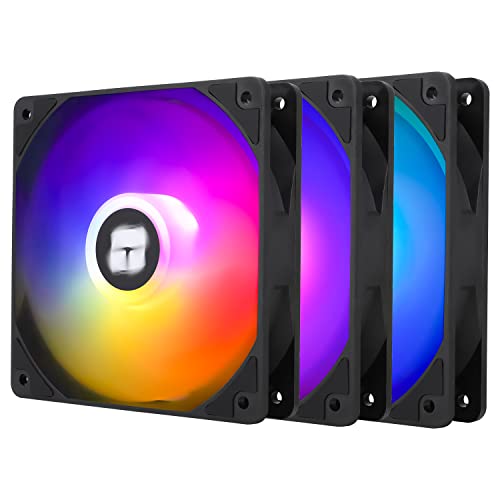
Specs
Size | 120 x 120 x 25 mm |
Speed | up to 1550 RPM (PWM) |
Bearing | S-FDB |
Lighting | ARGB, 5V 3-pin |
Connector | 4-pin PWM |
Included | 3 fans |
Size
120 x 120 x 25 mm
Speed
up to 1550 RPM (PWM)
Bearing
S-FDB
Lighting
ARGB, 5V 3-pin
Connector
4-pin PWM
Included
3 fans
What it does well
Three fans arrive for roughly what one premium unit costs, and that matches how this case gets built out. One goes in the rear now, the other two go in the top later if a top exhaust pair ever makes sense. Nothing is wasted, it is staged.
The 1550 RPM ceiling keeps them civil, with no setting that produces the whine that makes people pull fans back out. Lighting is standard 5V ARGB, so they join the stock front pair's chain instead of needing a second controller.
What you give up
Static pressure is unremarkable. These are open-mount case fans. If a 240mm or 360mm radiator goes in the top later, these are not the fans for it. Before you plan for that, check whether a 360mm AIO fits the Lancool 207 at all, because the ceiling has a hard stack limit.
Three fans for one empty slot is an odd purchase, and two sit in a drawer until the top gets used. The cables are short, so an extension may be needed up there.
Watch the listing. Thermalright ships a near-identical TL-C12C alongside the TL-C12C-S, and the non-S version is the one without lighting.
Who it's for
The builder who wants the rear exhaust today, knows a top pair is coming, and wants the lighting to match.
Best Premium: Noctua NF-A12x25 PWM

Specs
Size | 120 x 120 x 25 mm |
Speed | up to 2000 RPM (PWM) |
Airflow | 102.1 m3/h |
Static pressure | 2.34 mm H2O |
Noise | 22.6 dB(A) |
Bearing | SSO2 |
Warranty | 6 years |
Size
120 x 120 x 25 mm
Speed
up to 2000 RPM (PWM)
Airflow
102.1 m3/h
Static pressure
2.34 mm H2O
Noise
22.6 dB(A)
Bearing
SSO2
Warranty
6 years
What it does well
The engineering claim is the sub-millimetre gap between blade tip and frame. The effect is that it holds airflow at low RPM where cheaper fans stall, and a rear exhaust spends most of its life at low RPM.
The peak numbers are good anyway: 102.1 m3/h and 2.34 mm H2O at 2000 RPM, at 22.6 dB(A), with six years of warranty behind it. The same reasoning put it near the top of our small-form-factor fan picks.
What you give up
The price. For one rear slot in a case that already moves air well, the temperature gap against the ARCTIC pick is small. This is a noise and build-quality purchase.
The colour. Brown and beige against black steel looks like a mistake even when it is not. The chromax.Black.swap version costs the same and fixes it.
The honest version of the premium-quiet argument is that it is real but narrow. If you game in headphones, the upcharge buys nothing you will ever hear.
Who it's for
Someone with a documented noise requirement or an all-Noctua build in progress. Not the default choice here.
Best Quiet: be quiet! Silent Wings 4 120mm

Specs
Size | 120 x 120 x 25 mm |
Speed | up to 1600 RPM (PWM) |
Airflow | 50.5 CFM |
Noise | 18.9 dB(A) |
Bearing | Fluid dynamic |
Connector | 4-pin PWM |
Model code | BL093 |
Size
120 x 120 x 25 mm
Speed
up to 1600 RPM (PWM)
Airflow
50.5 CFM
Noise
18.9 dB(A)
Bearing
Fluid dynamic
Connector
4-pin PWM
Model code
BL093
What it does well
The 1600 RPM ceiling is the feature. A fan that cannot spin fast enough to whine is the cheapest guarantee of a quiet exhaust, and 50.5 CFM is more than this rear grille can use anyway.
18.9 dB(A) at maximum is the lowest figure in this group. The funnel-shaped frame and rubber corner pads are why it stays there: rear panels on budget cases are thin steel, and vibration through the mounting points turns a quiet fan into a buzzing one.
What you give up
The weakest airflow number here. If the plan involves a top radiator, this is the wrong fan and the Noctua or the ARCTIC is the right one.
No lighting, the same mismatch as the ARCTIC pick against the stock ARGB front pair.
Buyers have flagged the naming as a trap. Silent Wings 4 ships at 1600 RPM as BL093 and at 2500 RPM as the High Speed BL094, and a Silent Wings Pro 4 runs 3000 RPM as BL098. The faster versions are radiator fans, so check the model code.
Who it's for
Desk-adjacent builds, work-from-home machines, and anyone who has decided noise is the constraint they are solving.
Editor's Pick: Thermalright TL-C14C-S ARGB (140mm)

Specs
Size | 140 x 140 x 25 mm |
Speed | up to 1500 RPM (PWM) |
Bearing | S-FDB |
Lighting | ARGB, 5V 3-pin |
Connector | 4-pin PWM |
Included | 3 fans |
Size
140 x 140 x 25 mm
Speed
up to 1500 RPM (PWM)
Bearing
S-FDB
Lighting
ARGB, 5V 3-pin
Connector
4-pin PWM
Included
3 fans
What it does well
This is the fan the case's spare screw bag exists for. 140 x 25mm is the standard those 16 long screws accommodate, so the swap is supported hardware rather than an improvisation. Two go in the front, the third is a spare.
ARGB on the same 5V standard as the stock front pair keeps the lighting chain intact. The 1500 RPM ceiling keeps front intake quiet behind an open mesh panel, where a faster fan mostly generates noise.
What you give up
Airflow. The stock 140 x 30mm Lian Li fans are rated higher, so dropping to 25mm trades measurable intake for whatever you are solving. If the answer is a different colour, this is a downgrade.
Three fans for two slots again, on a standard 140mm bolt pattern that does not reuse the radiator-length screws already in the case.
Reports suggest the screw swap catches people out. The long screws from the stock 30mm fans bottom out or run past the frame on a 25mm fan, so find the shorter set first. The sibling chassis has its own fitment quirk, covered in our Lancool 216 radiator piece.
Who it's for
The owner with a stock front fan that rattles or runs fixed-speed, or someone committing to a full lighting rebuild.
Bottom line
If you own this case and the rear mount is empty, buy the ARCTIC P12 PWM PST and stop there. If a top exhaust pair is coming, the Thermalright TL-C12C-S three-pack covers all three open slots and matches the front lighting.
If the machine sits on your desk, the be quiet! Silent Wings 4 is the quietest option here. If you want the strongest 120mm fan made, and you accept you are buying acoustics rather than degrees, that is the Noctua NF-A12x25 PWM. If a stock front fan rattles, the Thermalright TL-C14C-S is the supported 140mm swap. This case does not need seven fans. It needs one.
FAQ
Does the Lian Li Lancool 207 come with a rear exhaust fan?
No. The Lancool 207 ships with four fans and every one is an intake: two 140mm in the front and two 120mm above the power supply shroud. The rear 120mm mount is there but empty. That is deliberate, since the case is built around pushing cold air at the graphics card, but it makes the rear the one slot where a fan changes the airflow pattern rather than adding more of the same.
What size fan fits the rear of the Lancool 207?
One 120mm fan at standard 25mm thickness, on standard case-fan screws. There is no 140mm option at the rear. The thickness quirk that applies to the front mount does not apply here, so any ordinary 120mm case fan bolts straight in. That is why the rear is the easiest upgrade in the chassis: no adapter, no special screws, no measuring.
Can you replace the Lancool 207's front fans with standard 25mm fans?
Yes, and Lian Li supplies the hardware. The stock front fans are 140 x 30mm on radiator-length screws, and the box includes 16 shorter screws, 6#32 thread at 28mm, sized for standard 25mm fans. Use those for the swap, because reusing the long screws on a thinner fan is how the threads end up running past the frame. The front mount takes 140mm and nothing wider.
How many fans can the Lancool 207 hold in total?
Seven. Two 140mm in the front, two 120mm above the power supply shroud, three 120mm or two 140mm in the top, and one 120mm in the rear. Four of those arrive filled from the factory. The top is also the only radiator mount, rated for 360mm, 280mm and 240mm, so populating it with fans and fitting a radiator later are the same decision.
Do you actually need to add fans to the Lancool 207?
Not strictly. Reviewers testing the stock configuration found it moving air well, including through the empty rear grille, and a build with a top radiator exhausting upward is fine with nothing in the rear. The rear exhaust is the highest-value single addition, not a fix for a problem. On a tower air cooler it gives that cooler a clear path out, which is the build where it matters most.
Related Articles

Best PC Case Fans 2026: 5 Picks for 120mm and 140mm
The best PC case fans for 2026: five 120mm and 140mm picks by mount position, so you know exactly which fan to buy for intake, exhaust and a radiator.
Aug 17, 2026

Best Fans for the Corsair 4000D Airflow (2026): 5 Picks
The best fans for the Corsair 4000D Airflow, matched to its six mounts: five picks from budget to premium, plus a mount, size, and radiator clearance guide.
Aug 18, 2026

Best NR200 Fans (2026): 5 Picks + the Right Airflow Setup
Best fans for NR200 builds, by slot: 25mm top exhaust, slim 120mm bottom intake for thick GPUs, a 92mm rear upgrade, and the airflow setup that beats PSU heat.
Oct 13, 2026

Best Airflow PC Cases Under $100 (2026): 5 Fan-Ready Picks
The best PC cases for airflow under $100, ranked by stock fan quality so you hit good temps without buying fans. Five picks, plus the mesh-front traps to skip.
Aug 11, 2026

Will a 360mm AIO Fit in a Lian Li Lancool 216? (2026)
Yes, a 360mm AIO fits the Lian Li Lancool 216, but radiator thickness decides where. Here is the top and front clearance math, plus three AIOs that fit.
Aug 16, 2026