Affiliate Disclosure: As an Amazon Associate we earn from qualifying purchases. Some links may earn us a commission at no cost to you.

Best Fans for the Corsair 4000D Airflow (2026): 5 Picks
The Corsair 4000D Airflow has six 120mm fan mounts and ships with two fans. That gap is the whole reason this page exists.
The mesh front already breathes. What changes temperatures in this case is not a higher pressure rating, it is filling the four empty positions with fans you can drive from one header. So the picks below are sorted by where the fan goes and how many you need to buy, and the mount table gives you the numbers to order the right count the first time.
Our top pick: Arctic P12 PWM PST
The Arctic P12 PWM PST is the fan to buy for a 4000D Airflow because its PST pass-through chains a full set off a single motherboard header, which is the limit most ATX boards hit long before the case runs out of mounts.

Quick picks
Pick | Fan | Best mount | Buy |
|---|---|---|---|
Best Overall | Front trio or top pair | ||
Best Value | Front trio | ||
Best Premium | Any position, desk-side builds | ||
Best Budget | Top pair and rear | ||
Editor's Pick | Front, behind a 360 mm radiator |
Best Overall
- Fan
- Best mount
Front trio or top pair
- Buy
Best Value
- Fan
- Best mount
Front trio
- Buy
Best Premium
- Fan
- Best mount
Any position, desk-side builds
- Buy
Best Budget
- Fan
- Best mount
Top pair and rear
- Buy
Editor's Pick
- Fan
- Best mount
Front, behind a 360 mm radiator
- Buy
Specs at a glance
Fan | Size | Max RPM | Rated airflow | Static pressure | Rated noise |
|---|---|---|---|---|---|
120 x 25 mm | 1800 | 56.3 CFM | 2.20 mmH2O | 0.3 sone | |
120 x 25 mm | 1550 | 66.17 CFM | 1.53 mmH2O | 25.6 dBA | |
120 x 25 mm | 2000 | 60.1 CFM | 2.34 mmH2O | 22.6 dBA | |
120 x 25 mm | 1350 | 53 CFM | 1.0 mmH2O | 0.3 sone | |
120 x 30 mm | 3000 | 100.9 CFM | 7.37 mmH2O | 39.7 dBA |
- Size
120 x 25 mm
- Max RPM
1800
- Rated airflow
56.3 CFM
- Static pressure
2.20 mmH2O
- Rated noise
0.3 sone
- Size
120 x 25 mm
- Max RPM
1550
- Rated airflow
66.17 CFM
- Static pressure
1.53 mmH2O
- Rated noise
25.6 dBA
- Size
120 x 25 mm
- Max RPM
2000
- Rated airflow
60.1 CFM
- Static pressure
2.34 mmH2O
- Rated noise
22.6 dBA
- Size
120 x 25 mm
- Max RPM
1350
- Rated airflow
53 CFM
- Static pressure
1.0 mmH2O
- Rated noise
0.3 sone
- Size
120 x 30 mm
- Max RPM
3000
- Rated airflow
100.9 CFM
- Static pressure
7.37 mmH2O
- Rated noise
39.7 dBA
Where the fans go in the 4000D Airflow
Position | Fan sizes | Radiator support | Ships with |
|---|---|---|---|
Front | 3 x 120 mm or 2 x 140 mm | Up to 360 mm or 280 mm | 1 x 120 mm AirGuide |
Top | 2 x 120 mm or 2 x 140 mm | Up to 240 mm, or 280 mm with low-profile memory | None |
Rear | 1 x 120 mm | 120 mm | 1 x 120 mm AirGuide |
Front
- Fan sizes
3 x 120 mm or 2 x 140 mm
- Radiator support
Up to 360 mm or 280 mm
- Ships with
1 x 120 mm AirGuide
Top
- Fan sizes
2 x 120 mm or 2 x 140 mm
- Radiator support
Up to 240 mm, or 280 mm with low-profile memory
- Ships with
None
Rear
- Fan sizes
1 x 120 mm
- Radiator support
120 mm
- Ships with
1 x 120 mm AirGuide
Six mounts, four of them empty. The front takes three 120mm fans or two 140mm, the top takes two of either, and the rear takes one 120mm. Corsair ships one 120mm AirGuide in the front and one in the rear, so a stock case runs a third of its intake capacity. That is normal for the class, which is why fan count belongs in any comparison of mid-tower cases built around airflow.
Radiators change the count rather than the plan. A 360mm unit in the front consumes all three front positions, a 240mm on top consumes both top positions, and 280mm up there needs low-profile memory to clear. Building air-cooled, buy four fans and the case is full. Expecting a front radiator, buy three that suit one and leave the top to whatever you already own. Cooler clearance in the same case is a separate measurement worth checking before you commit to a tower cooler alongside them.
One naming check before ordering. Corsair sells the 4000D in Airflow and non-Airflow trims under nearly the same name, the same way the 5000D and 5000T split. The mesh front is the whole basis for the advice here, so confirm the word Airflow appears on the case you own. The same naming problem bites on the graphics-card side, where will an RTX 5090 fit in a Corsair 4000D comes down to which of the three chassis you actually own.
Benchmarks
Rated free-air delivery at each fan's top speed. Not noise-normalised, so read it as a sizing guide rather than a head-to-head test.
- 56.3 CFM
- 66.17 CFM
- 60.1 CFM
- 53 CFM
- 100.9 CFM
Higher pressure only pays behind a radiator or a loaded dust filter, not behind an open mesh panel.
- 2.2 mmH2O
- 1.53 mmH2O
- 2.34 mmH2O
- 1 mmH2O
- 7.37 mmH2O
How we picked
Fan choice for this case starts with a number, not a spec sheet. The 4000D Airflow has six 120mm mounts and arrives with two fans, so the first decision is how many to buy and the second is whether one motherboard header can drive them. The same arithmetic runs across cheaper fan-ready cases, which tend to ship even less populated than this one.
Static pressure matters less here than the packaging suggests. Reviewers measured the 4000D Airflow with and without its front panel and found no meaningful thermal difference, which tells you the mesh and filter are not the restriction. Pressure ratings start to pay only when a radiator or a loaded dust filter sits in the path. That is why an airflow-optimised fan stays on this list, and why the pressure specialist earns its slot only in the radiator scenario. The same reasoning has to be redone chassis by chassis, which is why the best fans for the Lancool 207 land on a different shortlist to this one.
We counted the fans into the price of the case. A chassis that ships one intake and one exhaust is not finished, and the honest comparison against a rival adds the missing four fans before anything else. Our general 120mm and 140mm fan picks apply the same rule across every case, and the shortlist here is the subset that suits this one.
Quiet was scored against a real profile rather than a preference. A machine on the desk beside your head, or a documented noise sensitivity, justifies the premium tier. Headphones do not.
Best Overall: Arctic P12 PWM PST
Specs
Size | 120 x 120 x 25 mm |
Speed | 200 to 1800 RPM (PWM) |
Rated airflow | 56.3 CFM |
Static pressure | 2.20 mmH2O |
Rated noise | 0.3 sone |
Bearing | Fluid dynamic |
Connector | 4-pin PWM with PST pass-through |
Warranty | 6 years |
Size
120 x 120 x 25 mm
Speed
200 to 1800 RPM (PWM)
Rated airflow
56.3 CFM
Static pressure
2.20 mmH2O
Rated noise
0.3 sone
Bearing
Fluid dynamic
Connector
4-pin PWM with PST pass-through
Warranty
6 years
What it does well
The P12 runs a pressure-optimised blade profile, so the same part works behind the mesh front and behind a radiator. Rated airflow is 56.3 CFM against 2.20 mmH2O of static pressure, which puts it in the middle of this group on air moved and near the top on pressure.
The PST pass-through is why it takes the top slot. Every fan carries a 4-pin socket next to its plug, so a set of five chains into a single chassis header and shares one curve. Most ATX boards expose three or four chassis headers. The 4000D holds six fans. That mismatch is a real problem and this fan solves it for the price of a cable.
It also idles down to 200 RPM. A fully populated 4000D on a gentle curve is close to inaudible at the desktop, which is not something a stock two-fan configuration manages once the GPU warms up.
What you give up
There is no lighting on this fan and no version of it that adds lighting. A tempered-glass build with an ARGB theme needs a different part.
Above roughly 1500 RPM the blade edges pick up an audible tone. A curve that ramps hard under GPU load will find it. Capping the top of the curve near 1200 RPM removes the problem, and the open mesh front makes that cap cheap in temperature terms.
Who it's for
Anyone filling the four empty mounts on a stock 4000D Airflow who wants one part number, one header, and no software. Four fans fill the case. A fifth lets you retire the stock rear fan as well. Running the same exercise on a different chassis? The best fans for the Fractal Design North maps that case position by position, including the 120mm-only rear mount that catches matched 140mm orders.
Best Value: Thermalright TL-C12C-S 3-pack
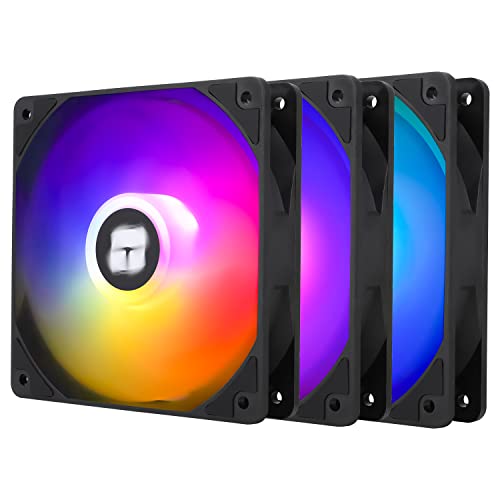
Specs
Size | 120 x 120 x 25 mm |
Speed | Up to 1550 RPM (PWM) |
Rated airflow | 66.17 CFM |
Static pressure | 1.53 mmH2O |
Rated noise | 25.6 dBA max |
Bearing | S-FDB |
Lighting | ARGB, 3-pin 5V |
Pack size | 3 fans |
Size
120 x 120 x 25 mm
Speed
Up to 1550 RPM (PWM)
Rated airflow
66.17 CFM
Static pressure
1.53 mmH2O
Rated noise
25.6 dBA max
Bearing
S-FDB
Lighting
ARGB, 3-pin 5V
Pack size
3 fans
What it does well
Three fans in one box lines up exactly with the 4000D's front wall. That is the position doing the most work in this case, and the one the stock configuration leaves two thirds empty.
Rated airflow is 66.17 CFM, the highest of the four 25mm fans here, and it gets there at 1550 RPM rather than by spinning harder. Lighting is addressable and included rather than sold as a tier above.
What you give up
Static pressure is 1.53 mmH2O, the lowest of the pressure-rated picks. Behind a front radiator it gives up ground to the P12 and the Noctua. In front of open mesh that gap barely registers.
The lighting needs a spare 3-pin 5V addressable header on the motherboard, because the plain 4000D Airflow ships without a lighting controller. There is no PST chaining either, so three fans want three headers or a splitter. Reports suggest the addressable cable run is short for a top-mount installation in a full-size mid-tower.
Who it's for
A 4000D Airflow owner who wants the front wall populated and lit in a single purchase, with an addressable header already free on the board.
Best Premium: Noctua NF-A12x25 chromax.Black

Specs
Size | 120 x 120 x 25 mm |
Speed | Up to 2000 RPM (1700 with low-noise adaptor) |
Rated airflow | 60.1 CFM |
Static pressure | 2.34 mmH2O |
Rated noise | 22.6 dBA max |
Bearing | SSO2 |
Warranty | 6 years |
Size
120 x 120 x 25 mm
Speed
Up to 2000 RPM (1700 with low-noise adaptor)
Rated airflow
60.1 CFM
Static pressure
2.34 mmH2O
Rated noise
22.6 dBA max
Bearing
SSO2
Warranty
6 years
What it does well
The A12x25 holds the tightest blade-to-frame clearance of any 25mm 120mm fan. That geometry, not a bigger motor, is what lets it post 2.34 mmH2O of static pressure while staying under 23 dBA at its 2000 RPM ceiling. Every other fan here trades one of those two away.
The chromax.Black finish matters in this specific case. The 4000D Airflow is a black chassis behind glass, and the standard Noctua colourway fights that. Swappable anti-vibration pads let a builder add an accent colour without adding a lighting ecosystem.
What you give up
Cost per fan is the steepest here by a wide margin, and filling a 4000D needs four of them. That is a meaningful fraction of what the case itself costs.
There is no lighting. And on a mesh-front case with no radiator, the pressure advantage that justifies the price is mostly sitting idle. Noctua has also released a G2 revision of this fan, so cross-shopping listings means checking which generation is in the cart.
Who it's for
Someone whose 4000D sits on the desk next to their head all day, or who has a documented noise sensitivity. A gamer in a headset gets nothing measurable from this upgrade and should put the difference into storage.
Best Budget: Arctic F12 PWM PST

Specs
Size | 120 x 120 x 25 mm |
Speed | 230 to 1350 RPM (PWM) |
Rated airflow | 53 CFM |
Static pressure | 1.0 mmH2O |
Rated noise | 0.3 sone |
Bearing | Fluid dynamic |
Connector | 4-pin PWM with PST pass-through |
Cable | 400 mm |
Size
120 x 120 x 25 mm
Speed
230 to 1350 RPM (PWM)
Rated airflow
53 CFM
Static pressure
1.0 mmH2O
Rated noise
0.3 sone
Bearing
Fluid dynamic
Connector
4-pin PWM with PST pass-through
Cable
400 mm
What it does well
The F12 is the airflow-optimised sibling of the P12, and behind an unobstructed mesh panel that trade costs almost nothing. It carries the same PST chaining and the same fluid dynamic bearing at the lowest price in this roundup.
The 1350 RPM ceiling is a feature rather than a limit. A fan that cannot spin past 1350 cannot get loud, even on a badly tuned curve that someone set once and forgot.
What you give up
Static pressure is 1.0 mmH2O, roughly a tenth of what the T30 manages and less than half the P12. Put one behind a radiator or a clogged filter and it stalls out.
The lower ceiling also means less headroom later. If a hotter GPU arrives in two years, the F12 has nowhere left to go, whereas the P12 still has 450 RPM in reserve.
Who it's for
A stock 4000D Airflow with no radiator and a tight budget, filling the top pair and the remaining front slots for the smallest possible outlay.
Editor's Pick: Phanteks T30-120

Specs
Size | 120 x 120 x 30 mm |
Modes | Hybrid 1200, Performance 2000, Advanced 3000 RPM |
Rated airflow | 40.3 / 67.0 / 100.9 CFM by mode |
Static pressure | 1.27 to 7.37 mmH2O |
Rated noise | 11.1 to 39.7 dBA |
Bearing | Dual VAPO maglev |
Motor | 3-phase |
Size
120 x 120 x 30 mm
Modes
Hybrid 1200, Performance 2000, Advanced 3000 RPM
Rated airflow
40.3 / 67.0 / 100.9 CFM by mode
Static pressure
1.27 to 7.37 mmH2O
Rated noise
11.1 to 39.7 dBA
Bearing
Dual VAPO maglev
Motor
3-phase
What it does well
7.37 mmH2O in Advanced mode is roughly triple anything else in this roundup. That number only means something behind a radiator, which is precisely the 4000D configuration nothing else here serves well.
A physical switch on the fan selects Hybrid, Performance, or Advanced, which sets the RPM ceiling in hardware. It lets one part behave like a silent fan in a quiet build and a radiator fan in a hot one without touching a curve in the BIOS. Hybrid mode is rated at 11.1 dBA, quieter than most fans manage at idle.
What you give up
The frame is 30mm thick rather than 25mm. In the 4000D's front bay, with a radiator behind it, that extra 5mm per fan is depth you may not have. Buyers have flagged exactly that clearance conflict in mid-towers, so measure before ordering.
It costs several times what the Arctic picks do, and Advanced mode at 39.7 dBA is genuinely loud. Most 4000D builds will never leave Hybrid, which means most are paying for headroom they will not use.
Who it's for
A 4000D Airflow with a 360mm radiator in the front, where fan pressure is the actual constraint and a standard 25mm fan runs out of it.
Bottom line
If you want the case full and quiet, buy four Arctic P12 PWM PST and chain them off one header. If you want the front wall lit without a second purchase, the Thermalright TL-C12C-S 3-pack covers it. If the machine lives beside your head, the Noctua NF-A12x25 chromax.Black earns its price and nothing else here does. If budget is the binding constraint, the Arctic F12 PWM PST does the job behind an open mesh panel. If the build is moving to a dual-chamber showcase chassis instead, the O11 Dynamic EVO fan guide assigns picks to that case's three brackets the same way.
And if a 360mm radiator is going in the front, the Phanteks T30-120 is the only pick here built for that job. For the wider decision about how the case, cooler, and power supply fit together, start with how to choose a PSU, cooler, and case.
FAQ
Does the Corsair 4000D Airflow come with fans?
Yes, but only two. The standard 4000D Airflow ships with a single 120mm AirGuide intake at the front and a single 120mm AirGuide exhaust at the rear. The chassis has six 120mm mounts, so four sit empty out of the box. Treat those four fans as part of the cost of the case rather than an optional extra. A lone front intake feeding a full ATX build is what most owners end up fixing.
How many fans fit in a Corsair 4000D Airflow?
Six 120mm fans, or four 140mm fans. The front takes three 120mm or two 140mm, the top takes two of either size, and the rear takes one 120mm. Sizes cannot be mixed within a single position, so reaching the four-fan 140mm configuration means a 140mm pair up front and a 140mm pair on top. Most builds land on five or six 120mm fans because the parts are cheaper and the chassis was laid out around them.
Should you use 120mm or 140mm fans in the 4000D Airflow?
120mm in almost every build. The front supports three 120mm fans against two 140mm, and three smaller fans move more total air at a lower per-fan speed than two larger ones in this frame. 140mm makes sense if you already own a set, or if you want the lowest possible RPM for a quiet build and accept losing the third front position.
Are the stock 4000D Airflow fans good enough?
Adequate, not good. The AirGuide fans move enough air for a mid-range build with a modest GPU, and reviewer testing found the mesh front panel itself is not restricting them. The problem is count, not quality. One intake and one exhaust leaves the top of the case with no path out and the GPU drawing from a single source. Adding two more front fans changes temperatures more than swapping the two that came in the box.
What is the best fan setup for the Corsair 4000D Airflow?
Three 120mm intakes across the front, two 120mm exhausts in the top, and the stock 120mm exhaust at the rear. That gives slight positive pressure at the front, so dust arrives through the filter rather than through the seams, and it gives hot air a clear path out above the GPU. With a front-mounted radiator, keep the front as intake so it sees room-temperature air.
Can you fit a 360mm radiator in the 4000D Airflow?
Yes, in the front. The 4000D Airflow front bay supports 360mm and 280mm radiators, the top supports 240mm with most memory and 280mm only with low-profile modules, and the rear takes a 120mm. A front 360mm consumes all three front fan mounts, so the radiator fans become your intake set. Check total depth if you are running 30mm-thick fans, because the front bay was measured around standard 25mm parts.
Related Articles

Best PC Case Fans 2026: 5 Picks for 120mm and 140mm
The best PC case fans for 2026: five 120mm and 140mm picks by mount position, so you know exactly which fan to buy for intake, exhaust and a radiator.
Aug 17, 2026

Will a Noctua NH-D15 G2 Fit in a Corsair 4000D? (2026)
Yes, the Noctua NH-D15 G2 will fit a Corsair 4000D by 2mm. The real gate is RAM height: 32mm in dual-fan mode. Here are the kits and coolers that clear it.
Aug 10, 2026

Best ATX Mid-Tower Cases for Airflow (2026): Five Picks
RTX 5090 and 9950X3D builds need real airflow, not 2022 thinking. Five ATX mid-tower cases by build tier, from budget mesh to fan-forward thermal monster.
May 13, 2026

Best Airflow PC Cases Under $100 (2026): 5 Fan-Ready Picks
The best PC cases for airflow under $100, ranked by stock fan quality so you hit good temps without buying fans. Five picks, plus the mesh-front traps to skip.
Aug 11, 2026

How to Choose a PSU, Cooler, and Case
A builder's framework for the chassis side of a PC: size the PSU with sane headroom, match the cooler to the chip, and pick a case that fits and breathes.
Jun 29, 2026