Affiliate Disclosure: As an Amazon Associate we earn from qualifying purchases. Some links may earn us a commission at no cost to you.

Best GPU For A 650W Or 550W PSU (2026): 5 No-Swap Picks
On a quality 650 W power supply, the ASUS Prime RTX 5070 OC is the most graphics card you can add without touching the PSU. Drop to a 550 W unit and the answer becomes the RTX 5060 Ti 16 GB. Neither one forces the second purchase that turns a simple drop-in upgrade into a cable-management project, and plenty of good GPUs never trigger that problem in the first place.
This guide is organized the way the constraint actually works: by how much power headroom your existing supply has. Every pick here is an efficient, current-generation card that a quality 550 W to 650 W unit can run without a swap. Match the GPU to your PSU headroom and the upgrade stays a ten-minute job.
Our top pick: ASUS Prime RTX 5070 OC
On a good-quality 650 W supply, the ASUS Prime RTX 5070 OC is the most performance you can add without a PSU swap. At 250 W board power it leaves real headroom on a Tier-A 650 W unit, and DLSS 4 stretches its 12 GB well past its raster weight at 1440p.

Quick picks
Slot | GPU | Fits (quality PSU) | Best for | Buy |
|---|---|---|---|---|
Best Overall | quality 650 W | Most GPU a solid 650 W unit will take | ||
Best for a 550 W PSU | 550 W | 16 GB VRAM that fits a 550 W unit easily | ||
Best AMD | 550 W | Lowest-draw 16 GB card for 1440p value | ||
Best Budget / Lowest Draw | 450-500 W | The lowest-power modern GPU, fits almost anything | ||
Editor's Pick | 600 W | 12 GB and a wide bus at a value 1440p price |
Best Overall
- GPU
- Fits (quality PSU)
quality 650 W
- Best for
Most GPU a solid 650 W unit will take
- Buy
Best for a 550 W PSU
- GPU
- Fits (quality PSU)
550 W
- Best for
16 GB VRAM that fits a 550 W unit easily
- Buy
Best AMD
- GPU
- Fits (quality PSU)
550 W
- Best for
Lowest-draw 16 GB card for 1440p value
- Buy
Best Budget / Lowest Draw
- GPU
- Fits (quality PSU)
450-500 W
- Best for
The lowest-power modern GPU, fits almost anything
- Buy
Editor's Pick
- GPU
- Fits (quality PSU)
600 W
- Best for
12 GB and a wide bus at a value 1440p price
- Buy
Specs at a glance
GPU | VRAM | Board power | Connector | Rec. PSU |
|---|---|---|---|---|
12 GB GDDR7 192-bit | 250 W | 1x 12V-2x6 (2x 8-pin adapter) | 650 W | |
16 GB GDDR7 128-bit | 180 W | 1x 8-pin | 450 W | |
16 GB GDDR6 128-bit | 160 W | 1x 8-pin | 550 W | |
8 GB GDDR7 128-bit | 145 W | 1x 8-pin | 450 W | |
12 GB GDDR6 192-bit | 190 W | 1x 8-pin | 600 W |
- VRAM
12 GB GDDR7 192-bit
- Board power
250 W
- Connector
1x 12V-2x6 (2x 8-pin adapter)
- Rec. PSU
650 W
- VRAM
16 GB GDDR7 128-bit
- Board power
180 W
- Connector
1x 8-pin
- Rec. PSU
450 W
- VRAM
16 GB GDDR6 128-bit
- Board power
160 W
- Connector
1x 8-pin
- Rec. PSU
550 W
- VRAM
8 GB GDDR7 128-bit
- Board power
145 W
- Connector
1x 8-pin
- Rec. PSU
450 W
- VRAM
12 GB GDDR6 192-bit
- Board power
190 W
- Connector
1x 8-pin
- Rec. PSU
600 W
Match the GPU to your PSU headroom
The number that matters is not your PSU's rated wattage on the sticker. It is the quality of the unit and the headroom left after your CPU and the rest of the system take their share. A mainstream gaming CPU pulls 65 to 120 W under load; add drives, fans, and board overhead, and roughly 120 to 150 W is spoken for before the GPU draws a watt. Everything below assumes a decent 80 Plus Bronze-or-better modern supply, not a decade-old bargain unit.
Find your supply on the left, match it to the resolution you actually play at, and the right-fit card is the one that leaves comfortable transient headroom. None of these force a new power supply on a quality unit at the stated wattage.
Your PSU (quality unit) | Resolution target | Best-fit GPU | Buy |
|---|---|---|---|
450-500 W | 1080p high | ||
550 W | 1080p to entry 1440p | ||
550 W | 1440p value (AMD) | ||
600 W | 1440p value | ||
Quality 650 W | 1440p high |
450-500 W
- Resolution target
1080p high
- Best-fit GPU
- Buy
550 W
- Resolution target
1080p to entry 1440p
- Best-fit GPU
- Buy
550 W
- Resolution target
1440p value (AMD)
- Best-fit GPU
- Buy
600 W
- Resolution target
1440p value
- Best-fit GPU
- Buy
Quality 650 W
- Resolution target
1440p high
- Best-fit GPU
- Buy
Why transient spikes matter less than they used to
The reason PSU headroom got a scary reputation was a specific era of hardware. The RTX 30-series could spike to nearly double its rated board power for a few milliseconds, and those spikes tripped the over-current protection on undersized or low-quality supplies, causing sudden shutdowns even when the average draw looked safe on paper. That history is why 3080 owners still ask about their supply, and the RTX 3080 to RTX 5070 Ti upgrade verdict works through it: the newer card is rated below the 3080, so a quality 750 W unit usually stays.
The cards in this guide are a different story. Blackwell and RDNA 4 both manage transients far more tightly, and at 145 to 250 W board power the spikes are modest in absolute terms. A quality modern supply with the headroom described above absorbs them without noticing. The old advice to buy a wildly oversized PSU was a workaround for a problem these efficient cards mostly do not have.
The caveat is the word quality. A good 550 W unit from a reputable OEM handles a 180 W card with ease; a no-name 550 W unit with inflated ratings and weak protection is a different object entirely. If your supply is old, unbranded, or was the cheapest option at the time, that is the real reason to consider replacing it, not the wattage number itself.
Benchmarks
Approximate reviewer-aggregate raster performance at 1440p high settings, indexed to the RTX 5070.
- 100 index
- 72 index
- 70 index
- 67 index
- 58 index
Whole-system draw at the wall with a mainstream 65 to 105 W CPU under a gaming load. Your supply needs comfortable headroom above these figures, not a match to them.
- 410 W
- 350 W
- 325 W
- 310 W
- 285 W
How we picked
Power headroom was the organizing axis, not an afterthought. Every card here was chosen because a quality supply at the stated wattage runs it with real transient headroom, so the upgrade stays a drop-in job and nothing about your power delivery has to change.
We weighted efficiency and VRAM together. A card that sips power but ships with too little memory ages badly, so the 16 GB picks earned their spots for holding value over time. If you want the wider framework behind these calls, our guide to choosing a GPU walks through the whole decision.
We ranked by real gaming performance per watt, not headline specs. For the broader value picture across the whole market, see our best GPU for the money roundup, which ranks purely on price-to-performance.
And we were honest about the constraint itself. If you are weighing a GPU upgrade against other parts of the build, our take on whether to upgrade the GPU or CPU first is the place to start before you buy anything.
Best Overall: ASUS Prime RTX 5070 OC
Specs
Chip | RTX 5070 (Blackwell GB205) |
VRAM | 12 GB GDDR7 192-bit |
Boost clock | 2.54 GHz |
Board power (TGP) | 250 W |
Power connector | 1x 12V-2x6 (2x 8-pin adapter) |
Slots / length | 2.5-slot, 269 mm |
Nvidia rec. PSU | 650 W |
Chip
RTX 5070 (Blackwell GB205)
VRAM
12 GB GDDR7 192-bit
Boost clock
2.54 GHz
Board power (TGP)
250 W
Power connector
1x 12V-2x6 (2x 8-pin adapter)
Slots / length
2.5-slot, 269 mm
Nvidia rec. PSU
650 W
What it does well
The RTX 5070 is the ceiling for a non-swap upgrade on a good-quality 650 W supply. At a 250 W board power, a mainstream Ryzen or Core build pulls roughly 400 to 430 W total under a gaming load, which leaves a real 200 W-plus cushion on a 650 W Tier-A unit. That cushion is what absorbs transient spikes without tripping over-current protection.
DLSS 4 with Multi Frame Generation is the lever that makes 12 GB and 250 W punch above its raster weight at 1440p, and the 192-bit GDDR7 pool holds up at high settings in current titles. This is the pick when you want the most frames you can add without buying a new power supply.
ASUS Prime trim keeps the card to a 2.5-slot cooler that fits most mid-towers, and it feeds from a single 12V-2x6 connector, so you are not scrambling for extra PCIe leads on an older modular supply.
What you give up
Twelve gigabytes of VRAM is the honest ceiling here. It is enough for 1440p today, but it is the first spec that will feel tight if you push 4K textures or hold the card for four years. If VRAM headroom matters more than frame rate, the 16 GB picks below are the smarter long hold.
It is also the one card in this roundup that genuinely needs a good 650 W unit, not just any 650 W unit. A no-name or decade-old 650 W supply is exactly the case where you should not stretch to a 5070.
Who it's for
The 1440p 144 Hz player on a quality 650 W PSU who wants the maximum frame rate they can add without touching the power supply, and who leans on DLSS 4 to stretch a 12 GB card.
Best for a 550 W PSU: ASUS TUF RTX 5060 Ti 16GB OC

Specs
Chip | RTX 5060 Ti (Blackwell GB206) |
VRAM | 16 GB GDDR7 128-bit |
Boost clock | 2.57 GHz |
Board power (TGP) | 180 W |
Power connector | 1x 8-pin |
Slots / length | 2.5-slot, 301 mm |
Nvidia rec. PSU | 450 W |
Chip
RTX 5060 Ti (Blackwell GB206)
VRAM
16 GB GDDR7 128-bit
Boost clock
2.57 GHz
Board power (TGP)
180 W
Power connector
1x 8-pin
Slots / length
2.5-slot, 301 mm
Nvidia rec. PSU
450 W
What it does well
At 180 W board power and a single 8-pin connector, the RTX 5060 Ti 16 GB is the comfortable answer for a 550 W supply. Total system draw lands near 320 to 340 W under load, so even a modest 550 W unit sits at a relaxed load with plenty of transient headroom. Nvidia's own recommended supply is just 450 W.
The 16 GB frame buffer is the reason to take this over the 8 GB version. It is the cheapest way to get a genuinely future-proof VRAM pool that will not stutter in texture-heavy 1440p titles, and it does it inside a power envelope that never forces a PSU conversation.
DLSS 4 support means the card comfortably clears 1440p high in most games with upscaling on, and the ASUS TUF cooler runs quiet at this wattage.
What you give up
The 128-bit memory bus is the trade for that big VRAM pool. Raw bandwidth is modest, so in a handful of bandwidth-heavy scenes the 5060 Ti will not scale the way a wider-bus card does. In practice DLSS 4 hides most of it at 1440p.
Raster performance is a clear step below the 5070. This is a 1080p-to-1440p card, not a 1440p-ultra-everything card, and pretending otherwise sets the wrong expectation.
Who it's for
The buyer on a 550 W supply who wants 16 GB of VRAM and a long hold at 1080p or entry 1440p, without spending a cent on a new power supply.
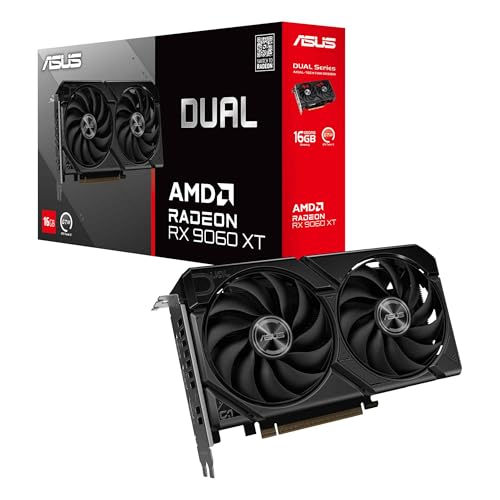
Best AMD: ASUS Dual RX 9060 XT 16 GB
Specs
Chip | RX 9060 XT (RDNA 4 Navi 44) |
VRAM | 16 GB GDDR6 128-bit |
Boost clock | 3.13 GHz |
Board power | 160 W |
Power connector | 1x 8-pin |
Slots / length | 2.5-slot, 269 mm |
AMD rec. PSU | 550 W |
Chip
RX 9060 XT (RDNA 4 Navi 44)
VRAM
16 GB GDDR6 128-bit
Boost clock
3.13 GHz
Board power
160 W
Power connector
1x 8-pin
Slots / length
2.5-slot, 269 mm
AMD rec. PSU
550 W
What it does well
RDNA 4 is genuinely efficient, and the RX 9060 XT 16 GB is the standout for anyone who wants 16 GB of VRAM on the least power. At roughly 160 W board power it draws around 310 W at the wall in a mainstream build, which is a featherweight load for any 550 W unit and comfortable even on a good 500 W.
In pure raster it trades blows with the 5060 Ti and often edges ahead, and FSR 4 has closed most of the upscaling-quality gap that used to be AMD's weak spot. For a 1440p value build that never touches the PSU, this is the efficiency champion.
A single 8-pin connector and a compact 2.5-slot cooler make it one of the easiest drop-in upgrades in the roundup.
What you give up
No DLSS 4 Multi Frame Generation and no CUDA. If you lean on Nvidia's frame-gen or do any CUDA-accelerated creative work, that is the specific reason to pay the Nvidia tax instead.
Ray-tracing performance, while much improved on RDNA 4, still sits a notch behind the Nvidia cards in the heaviest RT titles. For raster-first players that gap rarely matters.
Who it's for
The raster-first 1440p player on a 550 W or good 500 W supply who wants 16 GB of VRAM on the lowest possible power draw and is happy with FSR 4 over DLSS.
Best Budget / Lowest Draw: ASUS Dual RTX 5060 OC

Specs
Chip | RTX 5060 (Blackwell GB206) |
VRAM | 8 GB GDDR7 128-bit |
Boost clock | 2.50 GHz |
Board power (TGP) | 145 W |
Power connector | 1x 8-pin |
Slots / length | 2-slot, 227 mm |
Nvidia rec. PSU | 450 W |
Chip
RTX 5060 (Blackwell GB206)
VRAM
8 GB GDDR7 128-bit
Boost clock
2.50 GHz
Board power (TGP)
145 W
Power connector
1x 8-pin
Slots / length
2-slot, 227 mm
Nvidia rec. PSU
450 W
What it does well
At 145 W board power the RTX 5060 is the lowest-draw current-generation GPU here, and it is the card to reach for when your supply is a 450 to 500 W unit you would rather not replace. Total system draw stays near 285 W under load, so it is happy on supplies that would be marginal for anything faster.
It still carries DLSS 4 with Multi Frame Generation, which is what lets a 145 W card deliver a genuinely smooth 1080p high experience in modern titles. The ASUS Dual is short at 227 mm and a true 2-slot, so it drops into compact and older cases without a fight.
For a straightforward 1080p upgrade that asks nothing of your power supply, nothing in the current generation is easier to fit. One group has an extra step before any of this applies. Owners of slot-powered cards with no PCIe cable at all should read the GTX 1650 to RTX 5050 connector problem first, because that swap needs a connector their build has never had.
What you give up
Eight gigabytes of VRAM is the real limitation. It is fine at 1080p today, but it is the spec most likely to force settings compromises in the newest texture-heavy games, and it is not the card for 1440p ultra.
Raster performance is entry-level. This is a considered 1080p pick, not a 1440p card, and the 8 GB buffer means it will age faster than the 16 GB options above.
Who it's for
The 1080p player on a 450 to 500 W supply who wants the safest possible drop-in upgrade and does not want to think about power delivery at all.
Editor's Pick: ASRock Arc B580 Challenger OC 12 GB
Specs
Chip | Arc B580 (Battlemage BMG-G21) |
VRAM | 12 GB GDDR6 192-bit |
Boost clock | 2.67 GHz |
Board power (TBP) | 190 W |
Power connector | 1x 8-pin |
Slots / length | 2-slot, 269 mm |
Intel rec. PSU | 600 W |
Chip
Arc B580 (Battlemage BMG-G21)
VRAM
12 GB GDDR6 192-bit
Boost clock
2.67 GHz
Board power (TBP)
190 W
Power connector
1x 8-pin
Slots / length
2-slot, 269 mm
Intel rec. PSU
600 W
What it does well
The Arc B580 is the value surprise of the roundup: 12 GB of GDDR6 on a wide 192-bit bus at a price that undercuts the Nvidia and AMD 1440p cards. At 190 W board power a mainstream build pulls around 350 W at the wall, which a good 600 W or a strong 550 W unit handles without drama.
That 192-bit bus is the difference-maker. It gives the B580 more usable bandwidth than the 128-bit 5060 Ti in the scenes that stress memory, and the 12 GB buffer is a comfortable middle ground between 8 and 16 GB. XeSS 2 with frame generation rounds out the feature set.
For a budget 1440p build where you want VRAM and bandwidth over brand, it is the most card per dollar here.
What you give up
Intel's driver story has improved enormously, but it is still the least mature of the three. Day-one support for brand-new releases and older DirectX 9 and 11 titles can be uneven in a way the Nvidia and AMD cards are not.
Intel's official recommendation is a 600 W supply, which is more conservative than the real 190 W draw suggests. On a marginal or older 550 W unit, this is the one pick where you should check your supply's quality before dropping it in.
Who it's for
The value-focused 1440p builder on a 600 W (or good 550 W) supply who wants maximum VRAM and bandwidth per dollar and is comfortable with Intel's still-maturing drivers.
What to skip
Skip the reflex to buy a 1000 W supply for a 200 W card. The efficient GPUs in this guide do not need it, and the money is far better spent on the card itself or on more VRAM. Oversizing a supply by that much just means running it well outside its efficient load band.
Skip the 8 GB versions of these cards if you are choosing between them and a 16 GB option at a similar power draw. The VRAM, not the wattage, is what will date the card. If budget is the hard constraint, our best budget GPUs guide covers the trade-offs in detail.
And skip any upgrade to a card that genuinely does need more power if your current supply is old, unbranded, or of unknown quality. In that specific case the right move is a new quality supply first, then whatever GPU you actually want, rather than stretching a suspect unit to its limit. If you are upgrading from an RTX 3060 specifically, our guide to the best GPU upgrade from an RTX 3060 ranks the current field by real frame-rate gain and flags which picks stay inside the supply you already own.
Bottom line
If you run a quality 650 W supply and want the most frames you can add without a swap, the ASUS Prime RTX 5070 OC is the pick. On a 550 W unit, the ASUS TUF RTX 5060 Ti 16GB OC gives you 16 GB of VRAM with room to spare, and the ASUS Dual RX 9060 XT 16 GB does the same on the lowest power draw here if you are happy with FSR 4.
For a 450 to 500 W supply the ASUS Dual RTX 5060 OC is the safe 1080p drop-in, and the ASRock Arc B580 Challenger OC 12 GB is the value play if you want VRAM and bandwidth per dollar and can live with maturing drivers. None of them ask you to open your wallet twice.
FAQ
What is the best GPU that won't need a new power supply?
On a quality 650 W supply, the ASUS Prime RTX 5070 OC is the most powerful drop-in you can add, since its 250 W board power leaves real headroom on a Tier-A unit. On a 550 W supply, the ASUS TUF RTX 5060 Ti 16GB OC or the ASUS Dual RX 9060 XT 16 GB are the picks, both with 16 GB of VRAM at well under 200 W. The right answer depends on your supply's wattage and quality, not just the sticker rating.
Can I run an RTX 5070 on a 650W power supply?
Yes, on a good-quality 650 W unit. The RTX 5070 draws 250 W of board power, and a mainstream build tops out near 400 to 430 W total under load, which leaves a comfortable cushion on a Tier-A 650 W supply. The caveat is quality: a reputable modern 650 W handles it easily, but an old or no-name 650 W unit is exactly where you should not stretch.
How much PSU headroom do I actually need for a modern GPU?
Aim for your total system draw under load to sit around 60 to 70 percent of your supply's rating on a quality unit. That band keeps the PSU in its efficient range and leaves room for transient spikes. For the efficient cards in this guide, that means a 145 to 190 W card is comfortable on a 550 W supply, and a 250 W card wants a good 650 W.
Do transient spikes still trip power supplies like they used to?
Far less than they did on the RTX 30-series, which could spike to nearly double its board power. Blackwell and RDNA 4 manage transients much more tightly, so at 145 to 250 W the spikes are modest and a quality supply with normal headroom absorbs them. The real risk today is an old or low-quality unit with weak protection, not the wattage number itself.
Which of these GPUs draws the least power?
The ASUS Dual RTX 5060 OC at 145 W board power is the lowest-draw current-generation card here, pulling around 285 W at the wall in a mainstream build. The ASUS Dual RX 9060 XT 16 GB at roughly 160 W is the lowest-draw option that still ships with 16 GB of VRAM, which makes it the efficiency pick for a 1440p value build.
Is a 550W power supply enough for a 1440p gaming GPU?
On a quality unit, yes. The ASUS TUF RTX 5060 Ti 16GB OC, ASUS Dual RX 9060 XT 16 GB, and even the ASRock Arc B580 Challenger OC 12 GB all run comfortably on a good 550 W supply for 1440p value gaming, since none exceed 190 W of board power. Step up to a 650 W unit only if you want the extra performance of the ASUS Prime RTX 5070 OC.
Related Articles

How to Choose a GPU (and a Monitor That Matches)
A buyer's framework for picking a GPU and the monitor that pairs with it. Start with the panel and work the card back.
May 17, 2026

Best GPU for the Money 2026: 5 Picks by Frames Per Dollar
The best GPU for the money in 2026, ranked by frames per dollar. Five value picks from strict-budget 1080p to 1440p ultra, and what each one gives up.
Aug 16, 2026

Should You Upgrade Your GPU or CPU First for Gaming?
Should you upgrade your GPU or CPU first for gaming? Read your own usage data, then match your current GPU tier to the right upgrade. Clear 2026 picks for both.
Jun 26, 2026

Monitor Specs Explained (2026): Response Time, HDR, Sync
Monitor specs explained: which spec sheet numbers to trust, why HDR400 is not real HDR, how GtG differs from MPRT, and the sync tier you actually need in 2026.
Oct 5, 2026

Do CUDIMMs Work on AM5? Ryzen 7000, 8000 and 9000 Explained
Do CUDIMMs work on AM5? Ryzen 7000 will not POST with one, and Ryzen 8000 and 9000 only run them in bypass mode. Here is what to buy for your build instead.
Oct 6, 2026