Affiliate Disclosure: As an Amazon Associate we earn from qualifying purchases. Some links may earn us a commission at no cost to you.

Best GPUs for 007 First Light (2026): DLSS 4.5 Picks
007 First Light is the first game to ship with NVIDIA DLSS 4.5, and the official spec sheet leans on it hard: the headline 4K 200-plus FPS only shows up with DLSS 4.5 Super Resolution and Multi-Frame Generation switched on. That makes the GPU question here a two-layer one. What does the card do at native resolution for your monitor, and how much frame-gen headroom does it have on top?
Pick by the panel in front of you. Treat the 8GB cards as a 1080p ceiling, and read the big frame-gen numbers as a smoothness multiplier on an already-playable base, not as a raw performance level. Here is how the tiers shake out.
Our top pick: MSI Ventus RTX 5070 Ti OC
The RTX 5070 Ti runs 007 First Light maxed at 1440p without upscaling, then keeps DLSS 4.5 in reserve for whatever you play next.

Quick picks
Pick | Card | Monitor tier | Where to buy |
|---|---|---|---|
Best Overall | 1440p 144-165 Hz | ||
Best Value | 1440p raster | ||
Best Premium | 4K 120-144 Hz | ||
Best Budget | 1080p 60-100 Hz | ||
Editor's Pick | 1440p, DLSS 4.5 entry |
Best Overall
- Card
- Monitor tier
1440p 144-165 Hz
- Where to buy
Best Value
- Card
- Monitor tier
1440p raster
- Where to buy
Best Premium
- Card
- Monitor tier
4K 120-144 Hz
- Where to buy
Best Budget
- Card
- Monitor tier
1080p 60-100 Hz
- Where to buy
Editor's Pick
- Card
- Monitor tier
1440p, DLSS 4.5 entry
- Where to buy
Specs at a glance
Card | VRAM | Bus | Upscaling | Best resolution |
|---|---|---|---|---|
16 GB GDDR7 | 256-bit | DLSS 4.5 | 1440p native, 4K with DLSS | |
16 GB GDDR6 | 256-bit | FSR 4 | 1440p native | |
16 GB GDDR7 | 256-bit | DLSS 4.5 | 4K | |
16 GB GDDR6 | 128-bit | FSR 4 | 1080p native | |
12 GB GDDR7 | 192-bit | DLSS 4.5 | 1440p |
- VRAM
16 GB GDDR7
- Bus
256-bit
- Upscaling
DLSS 4.5
- Best resolution
1440p native, 4K with DLSS
- VRAM
16 GB GDDR6
- Bus
256-bit
- Upscaling
FSR 4
- Best resolution
1440p native
- VRAM
16 GB GDDR7
- Bus
256-bit
- Upscaling
DLSS 4.5
- Best resolution
4K
- VRAM
16 GB GDDR6
- Bus
128-bit
- Upscaling
FSR 4
- Best resolution
1080p native
- VRAM
12 GB GDDR7
- Bus
192-bit
- Upscaling
DLSS 4.5
- Best resolution
1440p
Benchmarks
These are native-resolution numbers at High or Ultra, no upscaling, drawn from launch-window testing at TechPowerUp, gamegpu, and DSOGaming. DLSS 4.5 frame-gen figures are discussed in the prose below rather than mixed into the native charts, since interpolated frames and rendered frames are not the same measurement.
- 130 FPS
- 110 FPS
- 108 FPS
- 92 FPS
- 79 FPS
- 110 FPS
- 92 FPS
- 90 FPS
- 74 FPS
- 56 FPS
- RTX 508060 FPS
- RTX 5070 Ti54 FPS
- RTX 507042 FPS
How we picked
GPU choice for one specific game comes down to matching the card to your monitor first, then deciding how much you care about the feature the game was built to show off. 007 First Light launched as the DLSS 4.5 flagship, so the framing here is honest about what that buys you and what it does not.
We picked by resolution tier. A 1080p player and a 4K player are not shopping for the same card, and pretending otherwise is how people end up overpaying or under-buying. Each pick targets a panel: 1080p, the 1440p sweet spot, 1440p with DLSS 4.5 specifically, and 4K.
We treat 16GB of VRAM as the floor for a 2026 build. At 1080p and 1440p the gap between 8GB and 16GB cards is small in this game today, but at 4K the 8GB cards already drop double-digit percentages behind their 16GB siblings, and texture budgets only grow. None of the picks here ships with 8GB.
And we read frame generation the way it behaves in practice. DLSS 4.5 Multi-Frame Gen turns a 60 FPS base into a much higher number on a high-refresh panel, and it feels great when the base is already good. It does not turn an unplayable frame rate into a playable one. When you see a 200-plus or 300-plus figure in this guide, the native base is the real card and the frame gen is smoothness on top.
Best Overall: MSI Ventus RTX 5070 Ti OC
Specs
Chip | GeForce RTX 5070 Ti (Blackwell) |
VRAM | 16 GB GDDR7 |
Boost clock | 2482 MHz (OC) |
Memory bus | 256-bit |
Outputs | 3x DisplayPort 2.1a, 1x HDMI 2.1b |
Slots | ~2.5-slot |
Upscaling | DLSS 4.5 Super Resolution and Multi-Frame Gen |
Chip
GeForce RTX 5070 Ti (Blackwell)
VRAM
16 GB GDDR7
Boost clock
2482 MHz (OC)
Memory bus
256-bit
Outputs
3x DisplayPort 2.1a, 1x HDMI 2.1b
Slots
~2.5-slot
Upscaling
DLSS 4.5 Super Resolution and Multi-Frame Gen
What it does well
At 1440p the RTX 5070 Ti averages around 92 FPS native at Ultra, so you can max the game out and never touch an upscaler. Turn on DLSS 4.5 Quality and you have a comfortable buffer for a 165 Hz panel with room to spare. The 16GB GDDR7 framebuffer keeps it clear of the texture-streaming ceiling that bites 8GB cards as this game's assets load in.
It has full access to DLSS 4.5 Multi-Frame Gen, which is the feature 007 First Light was built around. At 4K it clears 320 FPS with DLSS 4.5 and 6x frame gen if you want to push a high-refresh 4K display, though the native base there sits in the mid-50s. Three DisplayPort 2.1a outputs handle a high-refresh main panel plus auxiliary displays.
What you give up
It costs more than the AMD card right below it that nearly matches it in raster, so a pure raster gamer is paying for the DLSS 4.5 access. At native 4K it lands in the mid-50s, which means 4K buyers lean on upscaling to hit high-refresh targets rather than running native. Ventus is MSI's value cooler line, so under sustained load it runs warmer and louder than a premium triple-fan SKU. None of that changes the core verdict at 1440p.
Who it's for
This is the card for the 1440p 144 to 165 Hz player who wants 007 First Light maxed at native, with DLSS 4.5 headroom for whatever comes next. If your monitor is a 1440p high-refresh panel, start here.
Best Value: Sapphire Pulse RX 9070 XT

Specs
Chip | Radeon RX 9070 XT (RDNA 4) |
VRAM | 16 GB GDDR6 |
Boost clock | up to ~2970 MHz |
Memory bus | 256-bit |
Outputs | 2x DisplayPort 2.1, 2x HDMI 2.1 |
Slots | ~2.5-slot |
Upscaling | FSR 4 (no DLSS 4.5) |
Chip
Radeon RX 9070 XT (RDNA 4)
VRAM
16 GB GDDR6
Boost clock
up to ~2970 MHz
Memory bus
256-bit
Outputs
2x DisplayPort 2.1, 2x HDMI 2.1
Slots
~2.5-slot
Upscaling
FSR 4 (no DLSS 4.5)
What it does well
In pure raster at 1440p the RX 9070 XT lands right alongside the RTX 5070 Ti, sometimes a hair ahead, for less money. It carries the same 16GB VRAM tier as the cards above it, so it has no framebuffer disadvantage at 1440p. FSR 4 has closed the gap enough that its Quality mode at 1440p is a genuine option in this game, not a fallback you settle for. The Pulse SKU is Sapphire's quiet value cooler, and it has a long track record of doing exactly what it says without drama.
What you give up
Here is the honest part for this article. 007 First Light is the DLSS 4.5 launch title, and this card does not run DLSS 4.5 at all. What you get is FSR 4, which is good in 2026, but it is still a step behind DLSS 4.5 Multi-Frame Gen, the exact feature the game's 4K marketing is built on. Ray tracing performance also trails the Nvidia card. If the DLSS 4.5 debut is the reason you are reading this guide, that is a real and specific reason to pay up for the Nvidia pick instead.
Who it's for
This is for the 1440p raster gamer who wants the most native frames per dollar and is genuinely fine with FSR 4 in place of DLSS 4.5. If you care about frame rate more than the upscaler brand, this is the value play.
Best Premium: ASUS TUF RTX 5080 OC

Specs
Chip | GeForce RTX 5080 (Blackwell) |
VRAM | 16 GB GDDR7 |
Boost clock | OC Edition |
Memory bus | 256-bit |
Outputs | HDMI 2.1, DisplayPort 2.1 |
Slots | ~3.1-slot |
Upscaling | DLSS 4.5 Super Resolution and Multi-Frame Gen |
Chip
GeForce RTX 5080 (Blackwell)
VRAM
16 GB GDDR7
Boost clock
OC Edition
Memory bus
256-bit
Outputs
HDMI 2.1, DisplayPort 2.1
Slots
~3.1-slot
Upscaling
DLSS 4.5 Super Resolution and Multi-Frame Gen
What it does well
This is the GPU IO Interactive and NVIDIA pointed at for 4K. Around 60 FPS at native 4K is already playable, and DLSS 4.5 Super Resolution plus Multi-Frame Gen pushes it well into triple digits on a 4K high-refresh panel, past 370 FPS with 6x frame gen in NVIDIA's own launch numbers. Paired with a fast CPU and 2x frame gen it sits around 92 FPS average at 4K with a 59 FPS 1 percent low, which is the more realistic everyday figure. The 16GB GDDR7 framebuffer holds up at 4K where 8GB cards fall apart. If the headline 4K experience is the goal, this is the most direct path to it.
What you give up
It is the most expensive pick here by a wide margin, and a gaming-only buyer below 4K is paying for resolution they will not use. The marquee 200-plus FPS figure leans on 6x frame gen, so the native base is closer to 60. Read it as smoothness layered on a playable frame rate, not as raw rendering speed. At roughly 3.1 slots it is a physically large card, so check your case clearance before you commit.
Who it's for
This is the card for the 4K 120 to 144 Hz buyer who wants 007 First Light at the resolution the spec sheet was written around, with DLSS 4.5 doing the heavy lifting up top. If your monitor is 4K, this is the pick that was designed for it.
Best Budget: ASUS Dual RX 9060 XT 16 GB
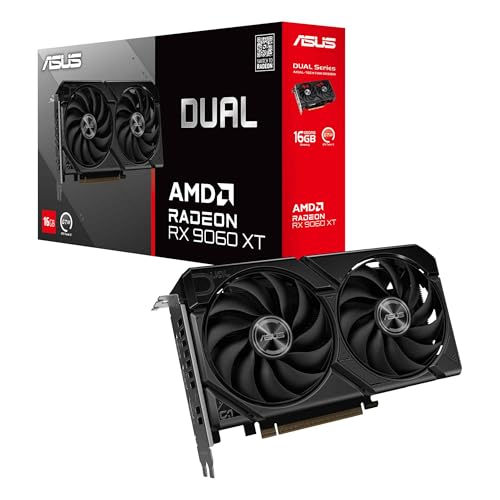
Specs
Chip | Radeon RX 9060 XT (RDNA 4) |
VRAM | 16 GB GDDR6 |
Boost clock | factory OC |
Memory bus | 128-bit |
Outputs | HDMI 2.1b, DisplayPort 2.1a |
Slots | 2.5-slot |
Upscaling | FSR 4 |
Chip
Radeon RX 9060 XT (RDNA 4)
VRAM
16 GB GDDR6
Boost clock
factory OC
Memory bus
128-bit
Outputs
HDMI 2.1b, DisplayPort 2.1a
Slots
2.5-slot
Upscaling
FSR 4
What it does well
At 1080p Ultra the RX 9060 XT 16GB runs around 79 FPS native, a comfortable margin over a 60 Hz target with room left for a 75 to 100 Hz panel. The 16GB framebuffer is the whole reason it is here. At the same price the 8GB cards run out of VRAM headroom as this game's textures scale, and the 16GB version keeps a 1080p build honest for years rather than months. FSR 4 makes 1440p reachable if you step up to a bigger panel later. The cooler idles silently with a 0dB fan mode.
What you give up
It is a 1080p card first. At 1440p native it drops to the mid-50s, so 1440p here means leaning on FSR 4 rather than running native. The 128-bit memory bus limits its headroom compared to the wider cards above it. And it has no DLSS 4.5, so the game's marquee feature is simply off the table at this tier. None of that is a knock for what it is: a clean 1080p card that refuses to cut the VRAM corner.
Who it's for
This is for the 1080p 60 to 100 Hz builder on a tight budget who, correctly, refuses to buy an 8GB card in 2026. If 1080p is your target and value matters, this is the floor done right.
Editor's Pick: ASUS TUF RTX 5070 OC

Specs
Chip | GeForce RTX 5070 (Blackwell) |
VRAM | 12 GB GDDR7 |
Boost clock | OC Edition |
Memory bus | 192-bit |
Outputs | HDMI 2.1, DisplayPort 2.1 |
Slots | ~3.1-slot |
Upscaling | DLSS 4.5 Super Resolution and Multi-Frame Gen |
Chip
GeForce RTX 5070 (Blackwell)
VRAM
12 GB GDDR7
Boost clock
OC Edition
Memory bus
192-bit
Outputs
HDMI 2.1, DisplayPort 2.1
Slots
~3.1-slot
Upscaling
DLSS 4.5 Super Resolution and Multi-Frame Gen
What it does well
The RTX 5070 runs 007 First Light at around 74 FPS native at 1440p and gives you full DLSS 4.5, including Multi-Frame Gen, at the lowest Nvidia tier where that combination makes sense. For a buyer who reads "DLSS 4.5 debut" and wants in without RTX 5070 Ti spend, this is the entry point. DLSS 4.5 Quality at 1440p extends that 74 FPS base into a comfortable high-refresh range.
What you give up
The 12GB framebuffer at this tier is the card's known weak spot, and it is the reason this is the Editor's Pick rather than the Best Value. It is fine for 007 First Light at 1440p today, but VRAM is the first thing that will age, and 12GB is light for the price. At native 4K it is a 40 to 45 FPS card that depends on upscaling to get to a playable high-refresh number. The AMD card one tier down gives you more VRAM for similar money if you do not specifically need DLSS 4.5.
Who it's for
This is for the 1440p player who specifically wants DLSS 4.5, is buying Nvidia for it, and cannot stretch to the RTX 5070 Ti. If the upscaler is the deciding factor and the budget is firm, this is the smallest ticket into it.
Bottom line
If you game at 1440p and want 007 First Light maxed without thinking about it, buy the MSI Ventus RTX 5070 Ti OC. If you game at 1440p, care about raster value, and do not need DLSS 4.5, the Sapphire Pulse RX 9070 XT gives you the same frame rate for less. If your monitor is 4K, the ASUS TUF RTX 5080 OC is the card the spec sheet was written for. If you are on a 1080p budget, the ASUS Dual RX 9060 XT 16 GB is the floor done right, with the VRAM the game demands. And if you want DLSS 4.5 at the lowest sensible Nvidia tier, the ASUS TUF RTX 5070 OC gets you in, with the 12GB caveat noted. Chasing another demanding single-player title? Our best GPUs for Resonance: A Plague Tale Legacy guide ranks the same tiers against the Zouna engine's appetite.
FAQ
What GPU do you need to run 007 First Light at 1440p?
At 1440p Ultra, an RTX 5070 Ti or RX 9070 XT runs the game at native without upscaling, both landing around 90 FPS. The RTX 5070 is a step down at roughly 74 FPS native but still very playable, and it adds DLSS 4.5. If your budget is tighter, the RX 9060 XT 16 GB reaches 1440p with FSR 4 Quality doing the lifting. For a 1440p high-refresh panel, the RTX 5070 Ti is the cleanest answer.
Does 007 First Light need DLSS 4.5, or can AMD cards run it well?
AMD cards run it well. The RX 9070 XT trades blows with the RTX 5070 Ti in native raster at 1440p, and it uses FSR 4, which is a solid upscaler in 2026. The catch is that DLSS 4.5 is the feature this game launched to showcase, and AMD cards do not support it. If you want the game's headline frame-gen experience specifically, you need an RTX 50-series card. If you just want high frame rates, the AMD pick is excellent value.
Is 8GB of VRAM enough for 007 First Light?
At 1080p you can get away with 8GB today, but it is not a purchase we would make in 2026. At 4K, 8GB cards already drop double-digit percentages behind their 16GB siblings in this game, and texture budgets only grow over time. Every pick in this guide ships with at least 12GB, and the budget pick is a 16GB card on purpose. Spend the small difference for the larger framebuffer.
What GPU hits the 4K 200+ FPS the spec sheet talks about?
That figure comes from an RTX 5080 with DLSS 4.5 Super Resolution and 6x Multi-Frame Generation enabled. The native 4K base on the RTX 5080 is around 60 FPS, and frame gen multiplies that into the triple digits and beyond. So the 200-plus number is real on the right hardware, but understand it as smoothness on a playable base rather than raw rendering. The RTX 5080 is the pick for that experience.
Will an RTX 5070 with 12GB be enough for 007 First Light long term?
For 007 First Light at 1440p today, yes, the 12GB RTX 5070 handles it at around 74 FPS native with DLSS 4.5 on top. The honest caveat is that 12GB is light for the tier, and VRAM is usually the first thing to limit a card as games get heavier. If you want more headroom for the years ahead and do not need DLSS 4.5, the RX 9070 XT gives you 16GB for similar money. Buy the 5070 for the upscaler, not for the framebuffer.
Related Articles

Best GPUs for 1440p Gaming (2026): 5 16GB Picks, 60-240Hz
The best GPUs for 1440p gaming in 2026: five 16GB picks matched to 60, 144, and 240 Hz targets, with real benchmarks, trade-offs, and who each card fits.
Aug 8, 2026

Best Mid-Range GPUs 2026: Ray Tracing at 1080p & 1440p
Mid-range GPUs for ray tracing at 1080p and 1440p in 2026 — AMD RDNA 4 vs NVIDIA Blackwell vs Intel Arc. RX 9070, RTX 5070, Arc B580 with live pricing.
Aug 7, 2025

How to Choose a GPU (and a Monitor That Matches)
A buyer's framework for picking a GPU and the monitor that pairs with it. Start with the panel and work the card back.
May 17, 2026

Best 4K 240Hz OLED Gaming Monitors 2026: 6 Picks Compared
The best 4K 240Hz OLED gaming monitors, ranked: which 27 and 32 inch QD-OLED and WOLED panels are worth buying, and which RTX 5090 pairing needs DP 2.1a.
Sep 13, 2026

Best Flight Yoke for MSFS 2024 (2026): 5 PC and Xbox Picks
The best flight yoke for MSFS 2024, picked by aircraft type and platform. Five options for PC and Xbox, plus the Honeycomb variant trap that catches buyers.
Sep 12, 2026