Affiliate Disclosure: As an Amazon Associate we earn from qualifying purchases. Some links may earn us a commission at no cost to you.

Best Mouse and Keyboard for Fortnite in 2026 (Picks)
Two things decide how your gear feels in Fortnite: a keyboard whose movement and build keys register the instant you hit them, and a mouse light enough to flick across a box fight without dragging. Everything else is preference.
The good news is you do not have to spend flagship money to get both. This guide picks the best keyboards and mice by budget, grip, and switch type, and it answers the question every Fortnite buyer asks: do you really need one of those analog boards?
Our top pick: SteelSeries Apex Pro TKL Gen 3
The Apex Pro TKL Gen 3 is the keyboard to beat because it lets you tune each key's actuation, which is the one feature that genuinely changes how Fortnite feels.

Do you actually need an analog keyboard for Fortnite?
Short answer: no. And it is worth saying that clearly before you spend anything.
Analog boards use magnetic or optical switches with adjustable actuation and rapid trigger. In practice that means you can set your movement keys deeper so you do not trigger stray inputs, then set your build and edit binds shallow so walls and ramps register almost the instant you touch the key. The very best players do get value from this at the margins, and for building and editing it is a real, if small, edge.
But most players are not losing games to their keyboard's actuation point. They are losing to aim, positioning, and decision speed. A fast, comfortable mechanical board and a mouse you can actually flick with will take you further than an analog board you buy and never bother to tune. If you know you will dig into per-key settings, buy analog. If you are not sure, you do not need it, and you can put that money toward a lighter mouse or a better monitor. For the full framework on picking input gear, see our guide to choosing a mouse and keyboard.
Best Fortnite keyboards
Four boards, from the tunable pro pick down to a budget mechanical that gets you most of the way there for a fraction of the cost.
Quick picks: keyboards
Keyboard | Best for | Switch type | Where to buy |
|---|---|---|---|
Overall | Magnetic, adjustable | ||
Analog alternative | Analog optical | ||
No-analog value | Low-profile mechanical | ||
Budget | Mechanical linear |
- Best for
Overall
- Switch type
Magnetic, adjustable
- Where to buy
- Best for
Analog alternative
- Switch type
Analog optical
- Where to buy
- Best for
No-analog value
- Switch type
Low-profile mechanical
- Where to buy
- Best for
Budget
- Switch type
Mechanical linear
- Where to buy
Best Overall keyboard: SteelSeries Apex Pro TKL Gen 3
Specs
Switches | OmniPoint 3.0 magnetic (Hall effect) |
Actuation | 0.1 to 4.0 mm, 40 levels |
Rapid Trigger | Yes |
Layout | TKL (tenkeyless) |
Connection | 2.4 GHz plus Bluetooth (dual wireless) |
Extras | OLED, Protection Mode, Rapid Tap/SOCD |
Keycaps | PBT |
Switches
OmniPoint 3.0 magnetic (Hall effect)
Actuation
0.1 to 4.0 mm, 40 levels
Rapid Trigger
Yes
Layout
TKL (tenkeyless)
Connection
2.4 GHz plus Bluetooth (dual wireless)
Extras
OLED, Protection Mode, Rapid Tap/SOCD
Keycaps
PBT
What it does well
The magnetic switches are the whole point. You can set WASD to actuate around 1.5 mm so a resting finger will not walk you off a ledge, then drop your build and edit binds down near 0.4 mm so walls and ramps go up almost the moment you press. Rapid Trigger resets the key the instant you lift, so repeated build inputs fire faster than they would on a normal mechanical board.
The rest of the package earns the top spot too. It is a tenkeyless layout, so it frees up desk room for low-sensitivity mouse swings. Dual wireless gives you lag-free 2.4 GHz for play and Bluetooth for everything else, and the OLED and per-game presets make it easy to save a Fortnite config and forget about it.
What you give up
Battery life is the honest weak point. Owners consistently report needing a charge every four or five days on wireless, well short of what Logitech's boards manage. The SteelSeries GG software can also be fussy, particularly on Windows 11, so expect some setup time.
It is also the most expensive keyboard here. If you are never going to sit down and tune per-key actuation, you are paying for a feature you will not use, and one of the cheaper picks below will serve you just as well.
Who it's for
The competitive or improving player who wants to tune movement and build keys separately and will spend the ten minutes in software to do it. If that is you, nothing else here matches it.
Best analog alternative: Razer Huntsman V3 TKL 8KHz
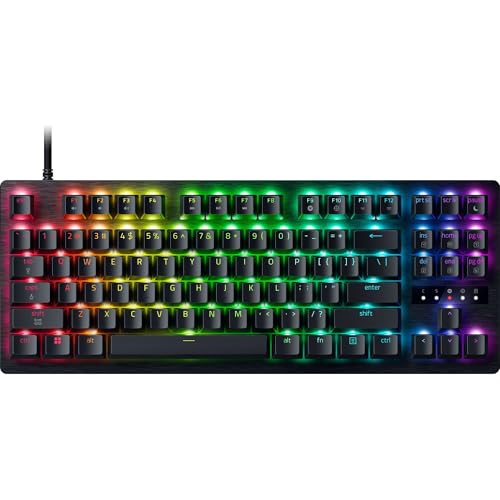
Specs
Switches | Razer Analog Optical Gen 2 |
Actuation | 0.1 to 4.0 mm adjustable |
Rapid Trigger | Yes |
Snap Tap | Yes |
Polling | 8000 Hz |
Layout | TKL |
Keycaps | Doubleshot PBT |
Switches
Razer Analog Optical Gen 2
Actuation
0.1 to 4.0 mm adjustable
Rapid Trigger
Yes
Snap Tap
Yes
Polling
8000 Hz
Layout
TKL
Keycaps
Doubleshot PBT
What it does well
If you want analog but prefer Razer's ecosystem, this is the board. The Gen 2 analog optical switches give you the same adjustable-actuation and rapid-trigger toolkit as the SteelSeries, so you can run deep movement keys and shallow build keys the same way. It adds Snap Tap, which prioritizes your most recent input between two bound keys for cleaner direction changes, and it polls at a true 8000 Hz with onboard memory so your settings travel with the board.
The doubleshot PBT keycaps hold up to heavy play, and the tenkeyless footprint keeps your mouse space open.
What you give up
It is wired only, so there is no cable-free desk here. Deep customization runs through Razer Synapse, which buyers have flagged as clunky, and a few report the board being read as a controller in specific games until they disable the Xbox controller device in Windows. As with any analog board, if you leave the actuation too shallow out of the box you will get stray inputs, so budget a little time to set it up properly.
Who it's for
The player who wants analog actuation and Snap Tap, is comfortable staying wired, and already lives in Razer's software.
Best no-analog value: Logitech G515 Lightspeed TKL

Specs
Switches | Low-profile GL mechanical (linear) |
Actuation | Fixed (no analog) |
Layout | TKL low-profile |
Connection | Lightspeed 2.4 GHz plus Bluetooth plus wired |
Height | 22 mm |
Battery | Up to 36 hr |
Keycaps | Double-shot PBT |
Switches
Low-profile GL mechanical (linear)
Actuation
Fixed (no analog)
Layout
TKL low-profile
Connection
Lightspeed 2.4 GHz plus Bluetooth plus wired
Height
22 mm
Battery
Up to 36 hr
Keycaps
Double-shot PBT
What it does well
This is the pick that proves the point of this whole guide. It has no analog switches and no rapid trigger, and it is still a fantastic Fortnite board. The low-profile linear switches are fast and consistent, Logitech's Lightspeed wireless is the reliability benchmark, and the short travel feels quick without any actuation tuning to learn. The thin tenkeyless chassis is comfortable and leaves plenty of mouse room.
Battery life also embarrasses the analog boards, so you are not charging it every few days.
What you give up
No adjustable actuation and no rapid trigger. If you are the kind of player chasing every last millisecond on build inputs, this cannot match the magnetic boards, and that is the trade. The low-profile switch feel is also polarizing. If you like a taller, more traditional mechanical feel, it may take adjustment.
Who it's for
The large majority of Fortnite players who want a clean, fast, wireless board and do not want to fuss with per-key settings. If you read the analog section above and thought it did not sound like you, buy this.
Best budget keyboard: HyperX Alloy Origins Core TKL

Specs
Switches | HyperX Red linear mechanical |
Actuation | Fixed (no analog) |
Layout | TKL |
Connection | Wired USB-C (detachable) |
Body | Full aluminum |
Extras | 3 tilt angles, onboard memory |
Switches
HyperX Red linear mechanical
Actuation
Fixed (no analog)
Layout
TKL
Connection
Wired USB-C (detachable)
Body
Full aluminum
Extras
3 tilt angles, onboard memory
What it does well
For the money, it is hard to fault. A full aluminum body means it stays planted when inputs are flying, the HyperX Red linear switches are fast and quiet enough, and the tenkeyless layout frees up mouse-swing room. The detachable USB-C cable makes it easy to move, and the build quality punches well above what you pay.
It is the clearest proof that a great Fortnite board does not need analog switches or a premium price tag.
What you give up
Wired only, no analog, no rapid trigger. The base model uses ABS keycaps rather than PBT, so they can pick up shine with heavy use, though a PBT version exists if that bothers you. There is no wireless and no OLED. This is a straightforward, durable mechanical board and nothing more, which for a lot of players is exactly right.
Who it's for
The budget-conscious or first-time buyer who wants a reliable tenkeyless mechanical board and does not care about analog features.
Best Fortnite mice
Fortnite rewards a mouse you can move fast. The premium picks here are light; the budget pick is heavier but gets the fundamentals right.
Quick picks: mice
Mouse | Best for | Weight | Where to buy |
|---|---|---|---|
Overall | 60 g | ||
Competitive play | 54 g | ||
Value | 58 g | ||
Budget | ~99 g |
- Best for
Overall
- Weight
60 g
- Where to buy
- Best for
Competitive play
- Weight
54 g
- Where to buy
- Best for
Value
- Weight
58 g
- Where to buy
- Best for
Budget
- Weight
~99 g
- Where to buy
Best overall mouse: Logitech G Pro X Superlight 2

Specs
Weight | 60 g |
Sensor | HERO 2, 44,000 DPI |
Polling | Up to 8 kHz |
Buttons | 5 programmable |
Shape | Symmetrical |
Connection | Lightspeed wireless, USB-C charging |
Battery | Up to 95 hr |
Weight
60 g
Sensor
HERO 2, 44,000 DPI
Polling
Up to 8 kHz
Buttons
5 programmable
Shape
Symmetrical
Connection
Lightspeed wireless, USB-C charging
Battery
Up to 95 hr
What it does well
This is the safe, do-everything answer. At 60 g with a symmetrical shape, it suits the widest range of hands and grips, so it is the mouse you can recommend without asking a dozen questions first. The HERO 2 sensor and 8 kHz polling are flawless in practice, and Logitech's Lightspeed wireless is about as reliable as it gets. You buy it, it works, and you stop thinking about your mouse.
What you give up
It is not the lightest option here, and the shell is fairly plain with no molded side grips. Because it has no cutouts, it is slightly heavier than the ultralight competition below, and for the fast flicks Fortnite rewards, that small weight difference is something aim-focused players notice. You also pay a premium for the name and the reliability.
Who it's for
Almost any Fortnite player who wants a proven, comfortable, medium-light wireless mouse and does not have a strong shape preference.
Best for competitive play: Razer Viper V3 Pro
Specs
Weight | 54 g |
Sensor | Focus Pro 35K |
Polling | 8 kHz |
Switches | Gen-3 optical |
Buttons | 8 programmable |
Shape | Symmetrical |
Connection | HyperSpeed wireless |
Battery | Up to 95 hr |
Weight
54 g
Sensor
Focus Pro 35K
Polling
8 kHz
Switches
Gen-3 optical
Buttons
8 programmable
Shape
Symmetrical
Connection
HyperSpeed wireless
Battery
Up to 95 hr
What it does well
It is the most-used mouse among tracked Fortnite pros, and the reason is weight. At 54 g it is noticeably lighter than the Superlight 2, and that pays off in the flicks and constant repositioning of box fights and edit-heavy fights. The Focus Pro sensor and 8 kHz polling are top tier, and the Gen-3 optical switches will not develop the double-click problems that plague mechanical switches over time.
What you give up
The ultralight shell can feel a little insubstantial if you prefer some heft to steady your hand, and the flatter symmetrical hump does not suit every palm-gripper. It is priced as a flagship, and to get the most out of the low weight you will want a decent mouse pad under it.
Who it's for
The competitive or aspiring-competitive player who wants the lightest proven wireless shell and does a lot of fast aim and repositioning. If you pair it with a high-refresh setup, our best GPUs for Fortnite guide covers the other half of that equation.
Best value mouse: Razer Viper V2 Pro

Specs
Weight | 58 g |
Sensor | Focus Pro 30K |
Polling | 1000 Hz |
Switches | Gen-3 optical |
Shape | Symmetrical |
Connection | HyperSpeed wireless |
Battery | Up to 90 hr |
Weight
58 g
Sensor
Focus Pro 30K
Polling
1000 Hz
Switches
Gen-3 optical
Shape
Symmetrical
Connection
HyperSpeed wireless
Battery
Up to 90 hr
What it does well
The Viper V2 Pro was the previous flagship, and now it is the value play. At 58 g it is still one of the lightest proven wireless mice you can buy, with the same clean symmetrical shape and a reliable Focus Pro sensor. For most players the drop from 8 kHz to 1 kHz polling is invisible in a real match, so you get flagship feel and weight for less.
What you give up
You are on 1 kHz polling instead of 8 kHz and an older sensor, so this is not the pick if you specifically want the highest polling rate available. There is no 8 kHz dongle in the box. Because it is a last-generation product, stock and pricing can be less consistent than the current flagship, so grab it when you see it.
Who it's for
The player who wants a genuinely lightweight, pro-proven wireless mouse without paying current-flagship money.
Best budget mouse: Logitech G305 Lightspeed

Specs
Weight | ~99 g |
Sensor | HERO, 12,000 DPI |
Polling | 1000 Hz |
Buttons | 6 programmable |
Connection | Lightspeed 2.4 GHz |
Battery | Up to 250 hr (1x AA) |
Weight
~99 g
Sensor
HERO, 12,000 DPI
Polling
1000 Hz
Buttons
6 programmable
Connection
Lightspeed 2.4 GHz
Battery
Up to 250 hr (1x AA)
What it does well
For the price, nothing else touches it. You get Logitech's HERO sensor and Lightspeed wireless in a cheap, reliable body that runs for 250 hours on a single AA. It tracks cleanly and clicks consistently, which is everything a newer player needs to be competitive in Fortnite without overspending on their first mouse.
What you give up
At roughly 99 g it is much heavier than the premium mice here, and weight genuinely matters for the fast flicks Fortnite rewards, so this is where you will feel the compromise. It uses a single AA battery rather than a rechargeable pack, the shape is on the smaller side, and the sensor is a step behind the flagships. It is a starter mouse you may outgrow, and that is fine.
Who it's for
The budget or first-time buyer who wants reliable wireless tracking and consistent clicks without spending flagship money, and does not mind a heavier mouse to start with.
Which combo should you get?
Match your scenario to a pairing rather than buying the most expensive of each.
Scenario | Keyboard | Mouse | Buy |
|---|---|---|---|
On a budget | Logitech G305 Lightspeed | ||
Improving competitive player | Razer Viper V3 Pro | ||
Wants wireless everything | Logitech G Pro X Superlight 2 | ||
Wants the analog build edge | Razer Viper V3 Pro | ||
Best all-round value | Razer Viper V2 Pro |
On a budget
- Keyboard
- Mouse
Logitech G305 Lightspeed
- Buy
Improving competitive player
- Keyboard
- Mouse
Razer Viper V3 Pro
- Buy
Wants wireless everything
- Keyboard
- Mouse
Logitech G Pro X Superlight 2
- Buy
Wants the analog build edge
- Keyboard
- Mouse
Razer Viper V3 Pro
- Buy
Best all-round value
- Keyboard
- Mouse
Razer Viper V2 Pro
- Buy
What to skip
A few things are easy to waste money on. Full-size keyboards are the first. The number pad does nothing for Fortnite and eats the desk space your mouse needs for low-sensitivity swings, which is why every pick here is tenkeyless.
Do not pay for analog switches you are not going to tune. An untouched analog board is just an expensive mechanical board, and the money is better spent on a lighter mouse or a better monitor. On the mouse side, avoid anything heavy if aim is your priority. Weight is the single trait that separates the premium picks from the budget one, and it is worth prioritizing over flashy sensor numbers you will never reach.
Finally, if a clean desk and no cable drag matter to you, do not settle for a wired board or mouse to save a little. The wireless picks here have latency you will not feel in game, so the only reason to go wired is preference or budget.
Bottom line
If you are on a budget, buy the HyperX Alloy Origins Core TKL and the Logitech G305 Lightspeed and spend the rest on practice. If you want the best all-round setup without overthinking it, the SteelSeries Apex Pro TKL Gen 3 and the Logitech G Pro X Superlight 2 cover it. If you are chasing competitive edge, pair a light mouse like the Razer Viper V3 Pro with whichever board you will sit down and tune. And if you want analog, buy it because you will use per-key actuation, not because it sounds fast. For most players, a great mechanical board and a light mouse is the honest answer.
FAQ
Do you need an analog or rapid-trigger keyboard to be good at Fortnite?
No. Analog boards let you set build and edit keys to a shallow actuation point so they register faster, which helps a little with building and editing. But the vast majority of players are limited by aim and decision-making, not their keyboard. A fast mechanical board you are comfortable with will serve you well. Buy analog only if you will actually tune the per-key settings.
Is a TKL keyboard better than full-size for Fortnite?
For most players, yes. A tenkeyless board drops the number pad, which you do not use in Fortnite, and frees up desk space so you can make big low-sensitivity mouse swings without hitting the keyboard. Every keyboard in this guide is tenkeyless for that reason. If you use the number pad for work, a full-size board is a fair compromise, just give yourself more mouse room.
Does mouse weight actually matter for Fortnite?
It does, more than most people expect. Fortnite involves constant fast flicks and repositioning in box fights and edit courses, and a lighter mouse is easier to move quickly and less tiring over long sessions. That is why the premium picks here sit between 54 and 60 grams. It is not the only thing that matters, but between two mice with good sensors, the lighter one usually wins for this game.
What DPI and sensitivity do Fortnite players use?
Most competitive players use a fairly low DPI, commonly in the 400 to 800 range, and adjust in-game sensitivity from there so a full mouse swing crosses the pad comfortably. Lower DPI with a larger arm motion tends to be more consistent for aim than a twitchy high-DPI setup. Start around 800 DPI and tune your in-game sensitivity until a build-and-turn feels natural.
Wired or wireless for Fortnite, does it make a difference?
In practice, no. Modern wireless from Logitech and Razer has latency you will not feel in a real match, and it clears cable drag off your desk, which helps mouse movement. The only reasons to choose wired are budget, since wired gear is often cheaper, or personal preference for never charging anything. Both wired and wireless picks in this guide are competitive-grade.
Related Articles

What Gear Do Fortnite Pros Use? 2026 Setup Breakdown
What gear Fortnite pros use in 2026: the monitors, mice, keyboards, and headsets behind Peterbot and Queasy, with real usage data and buyer-ready picks.
Jun 8, 2026

Best GPU for Fortnite 2026: 5 Picks From 240Hz to 4K Lumen
The best GPU for Fortnite depends on your render mode. Five tested picks for Performance Mode at 240Hz, 1440p Lumen and 4K, from the Arc B580 to the RTX 5080.
Sep 10, 2026

What PC Do Fortnite Pros Use in 2026? Full Specs Breakdown
The exact PC specs Fortnite pros use in 2026 — CPU, GPU, RAM, monitor, and storage across four competitive tiers. From entry competitive to the 540Hz Performance Mode ceiling, with named pro anchors and Buy links.
May 25, 2026

How to Choose a Mouse, Keyboard, and Headset
A builder's framework for gaming peripherals: start with the games you play, then match shape, switch, and sound to how you actually use them.
Jun 29, 2026

5 Best 1440p Gaming Monitors Under $300 (2026): Mini-LED HDR
The best 1440p gaming monitors under $300 for 2026: a 336-zone Mini-LED HDR upset, 180 to 210Hz IPS value picks, and the one tradeoff each panel asks of you.
Oct 2, 2026