Affiliate Disclosure: As an Amazon Associate we earn from qualifying purchases. Some links may earn us a commission at no cost to you.

Best NVMe SSD for Gaming in 2026: PCIe 4.0 Sweet Spot
A gaming SSD has one job: get you into the game fast and hold your library without filling up by spring. For that job, PCIe 4.0 is the sweet spot in 2026. A good Gen4 drive opens games as quickly as a Gen5 drive that costs more and runs hotter, so the smart money buys a fast Gen4 SSD and puts the difference toward the GPU.
Below are five Gen4 picks, sorted by capacity and budget, plus a plain answer on when Gen5 is worth the money.
Our top pick: WD Black SN850X (2TB)
The SN850X wins the most builds: top-tier Gen4 speed, a mature DRAM-backed controller, and 2TB of room so you stop deleting games to install new ones.

Quick picks
Pick | Drive | Best for | Where to buy |
|---|---|---|---|
Best Overall | The one-drive-does-everything build | ||
Best Value | Flagship-class speed, lower cost per TB | ||
Best Premium | The fastest Gen4 board on paper | ||
Best Budget | A fast, cheap boot-plus-games drive | ||
Editor's Pick | PS5 expansion or a hot M.2 slot |
Best Overall
- Drive
- Best for
The one-drive-does-everything build
- Where to buy
Best Value
- Drive
- Best for
Flagship-class speed, lower cost per TB
- Where to buy
Best Premium
- Drive
- Best for
The fastest Gen4 board on paper
- Where to buy
Best Budget
- Drive
- Best for
A fast, cheap boot-plus-games drive
- Where to buy
Editor's Pick
- Drive
- Best for
PS5 expansion or a hot M.2 slot
- Where to buy
Specs at a glance
Drive | Interface | Capacity | Seq. read | Seq. write | Controller |
|---|---|---|---|---|---|
PCIe 4.0 x4 | 2TB | 7,300 MB/s | 6,300 MB/s | DRAM-backed | |
PCIe 4.0 x4 | 2TB | 7,400 MB/s | 7,000 MB/s | Phison E25, DRAM | |
PCIe 4.0 x4 | 2TB | 7,450 MB/s | 6,900 MB/s | Samsung Pascal, DRAM | |
PCIe 4.0 x4 | 1TB | 5,150 MB/s | 4,900 MB/s | DRAM-less, HMB | |
PCIe 4.0 x4 | 2TB | 7,450 MB/s | 6,900 MB/s | Samsung Pascal, DRAM |
- Interface
PCIe 4.0 x4
- Capacity
2TB
- Seq. read
7,300 MB/s
- Seq. write
6,300 MB/s
- Controller
DRAM-backed
- Interface
PCIe 4.0 x4
- Capacity
2TB
- Seq. read
7,400 MB/s
- Seq. write
7,000 MB/s
- Controller
Phison E25, DRAM
- Interface
PCIe 4.0 x4
- Capacity
2TB
- Seq. read
7,450 MB/s
- Seq. write
6,900 MB/s
- Controller
Samsung Pascal, DRAM
- Interface
PCIe 4.0 x4
- Capacity
1TB
- Seq. read
5,150 MB/s
- Seq. write
4,900 MB/s
- Controller
DRAM-less, HMB
- Interface
PCIe 4.0 x4
- Capacity
2TB
- Seq. read
7,450 MB/s
- Seq. write
6,900 MB/s
- Controller
Samsung Pascal, DRAM
PCIe 4 vs 5 for gaming: what really matters
Here is the part most buyers get talked out of. Game load times are bound by how fast the drive answers thousands of small, random read requests, not by how high its sequential transfer number climbs. Past a certain point, a bigger sequential figure is a spec-sheet number that never reaches your loading screen.
Every drive on this list clears that point. In real games, a fast Gen4 SSD and a Gen5 SSD load the same level within a blink of each other. DirectStorage, the technology that is supposed to let games stream assets straight off the drive, is in a handful of titles and still does not turn Gen5's sequential headroom into frames you can feel. It will matter more over time. It does not justify the upgrade today for most libraries.
Gen5 drives also run hotter and need beefier cooling, and they cost more per terabyte. If you have money burning a hole and a board with a Gen5 slot, fine. If you are building to a budget, a Gen4 drive plus the cash you saved going into a better GPU is the upgrade you will actually notice. When you do want the Gen5 path, our PCIe 5.0 SSD guide covers the drives worth buying.
How we picked
Capacity came first. A 2TB drive is the floor for any real gaming build in 2026, because a 1TB drive fills up fast and you end up shuffling installs within a few months. Three of our five picks are 2TB for that reason.
Random performance mattered more than peak sequential. We weighted the access pattern games really use over the headline transfer number, which is why drives separated by hundreds of MB/s on the box land in a dead heat where it counts.
Controller maturity and thermals broke the ties. A proven DRAM-backed controller that runs cool in a bare M.2 slot is worth more than a fragile speed record. And we kept one honest budget pick and one console-friendly pick, because not every build is a mid-tower with great airflow.
Best Overall: WD Black SN850X (2TB)
Specs
Interface | PCIe 4.0 x4 NVMe |
Capacity | 2TB (1TB and 4TB also sold) |
Sequential read | Up to 7,300 MB/s |
Sequential write | Up to 6,300 MB/s |
Controller / DRAM | DRAM-backed, in-house WD controller |
Form factor | M.2 2280 |
Endurance | 1,200 TBW |
Warranty | 5-year limited |
Interface
PCIe 4.0 x4 NVMe
Capacity
2TB (1TB and 4TB also sold)
Sequential read
Up to 7,300 MB/s
Sequential write
Up to 6,300 MB/s
Controller / DRAM
DRAM-backed, in-house WD controller
Form factor
M.2 2280
Endurance
1,200 TBW
Warranty
5-year limited
What it does well
The SN850X is among the fastest Gen4 drives in random 4K reads, and that is the metric that moves game load times. Boot a level and the drive is fielding thousands of small requests; the SN850X answers them as quickly as anything in its class. Game Mode 2.0 keeps it in a low-latency state during long sessions so performance does not sag after hours of play.
It also runs cool enough for most motherboard M.2 slots without an aftermarket heatsink, and WD Dashboard handles firmware updates and health checks on Windows without fuss. At 2TB it has the room to be your only drive.
What you give up
The bare model ships without a heatsink, so a slot tucked directly under a hot GPU can throttle during marathon file transfers. Gaming loads rarely push it there, but it is worth knowing. RGB lives on the heatsink SKU only. And the SN850X is not the cheapest 2TB Gen4 drive on the shelf; you pay a small premium for the controller's track record.
Who it's for
The mainstream 1440p builder who wants one drive that does everything and never wants to think about storage again. Buy it, install it, forget it.
Best Value: Crucial T500 (2TB)

Specs
Interface | PCIe 4.0 x4 NVMe |
Capacity | 2TB (500GB, 1TB, 4TB also sold) |
Sequential read | Up to 7,400 MB/s |
Sequential write | Up to 7,000 MB/s |
Controller / DRAM | Phison E25, DRAM-backed |
Form factor | M.2 2280 |
Endurance | 1,200 TBW |
Warranty | 5-year limited |
Interface
PCIe 4.0 x4 NVMe
Capacity
2TB (500GB, 1TB, 4TB also sold)
Sequential read
Up to 7,400 MB/s
Sequential write
Up to 7,000 MB/s
Controller / DRAM
Phison E25, DRAM-backed
Form factor
M.2 2280
Endurance
1,200 TBW
Warranty
5-year limited
What it does well
The T500 posts near-flagship Gen4 numbers, and its sequential write even edges the SN850X on paper. In real game loading it is a dead heat with the pricier drives, which is exactly the point: you get the speed without paying for the badge. The Phison E25 controller is well understood and power-efficient, so the drive stays cool in a bare slot. If you want to consolidate later, the capacity ladder runs all the way to 4TB.
What you give up
Random performance trails the SN850X and 990 Pro by a small margin. You will see it in a synthetic benchmark and never in a game. The bundled Adobe trial and cloning software are nice-to-haves, not a real reason to buy.
Who it's for
The value-focused builder who has read the charts, knows Gen4 drives sit within a rounding error of each other for games, and wants the lowest cost-per-terabyte that does not cut corners.
The money you save here is money the GPU will thank you for.
Best Premium: Samsung 990 Pro (2TB)

Specs
Interface | PCIe 4.0 x4 NVMe |
Capacity | 2TB (1TB and 4TB also sold) |
Sequential read | Up to 7,450 MB/s |
Sequential write | Up to 6,900 MB/s |
Controller / DRAM | Samsung Pascal, DRAM-backed |
Form factor | M.2 2280 |
Endurance | 1,200 TBW |
Warranty | 5-year limited |
Interface
PCIe 4.0 x4 NVMe
Capacity
2TB (1TB and 4TB also sold)
Sequential read
Up to 7,450 MB/s
Sequential write
Up to 6,900 MB/s
Controller / DRAM
Samsung Pascal, DRAM-backed
Form factor
M.2 2280
Endurance
1,200 TBW
Warranty
5-year limited
What it does well
The 990 Pro is the performance ceiling of Gen4. It leads this group in random read and write IOPS, the figure closest to how games stream assets, and it does so as the most power-efficient drive here, which means it runs the coolest of the bare boards. Samsung Magician is the most polished management suite on the list, and the drive carries a long, proven reliability record.
What you give up
It is the highest price-per-terabyte of the group, and the real-world gaming gap over the Crucial T500 is single-digit percent at best. The non-heatsink version still wants some airflow under heavy sustained writes. You are buying the top of the tier, not a meaningful jump in frame times. If the Gen5 tier is still tempting, our WD Black SN8100 vs Samsung 990 Pro breakdown shows exactly where the extra bandwidth stops mattering for games.
Who it's for
The builder who wants the best Gen4 drive on paper and is honest that the upgrade over the value pick is about owning the ceiling, not about loading levels faster.
Best Budget: WD Black SN770 (1TB)
![WD_BLACK 1TB SN770 NVMe Internal Gaming SSD Solid State Drive - Gen4 PCIe, M.2 2280, Up to 5,150 MB/s - WDS100T3X0E - [Previous Generation]](https://m.media-amazon.com/images/I/41dOBI0lrHL._SL500_.jpg)
Specs
Interface | PCIe 4.0 x4 NVMe |
Capacity | 1TB (500GB and 2TB also sold) |
Sequential read | Up to 5,150 MB/s |
Sequential write | Up to 4,900 MB/s |
Controller / DRAM | DRAM-less, Host Memory Buffer |
Form factor | M.2 2280 |
Endurance | 600 TBW |
Warranty | 5-year limited |
Interface
PCIe 4.0 x4 NVMe
Capacity
1TB (500GB and 2TB also sold)
Sequential read
Up to 5,150 MB/s
Sequential write
Up to 4,900 MB/s
Controller / DRAM
DRAM-less, Host Memory Buffer
Form factor
M.2 2280
Endurance
600 TBW
Warranty
5-year limited
What it does well
This is the pick that proves the whole argument. The SN770 is DRAM-less and tops out around 5,150 MB/s sequential, well under the flagship drives, and it loads games right alongside them. The workload simply does not stress the ceiling. It is power-efficient, runs cool, and WD's controller tuning makes it one of the better DRAM-less drives for everyday use.
What you give up
DRAM-less means sustained large writes slow down once the cache fills, so moving a huge Steam library between drives takes longer than on a DRAM-backed drive. At 1TB it also fills fast with modern installs; treat it as a boot-plus-a-few-games drive, not your whole library. Endurance is rated lower than the 2TB picks. Buyers have flagged that one Amazon listing tags it "Previous Generation," but it is a current, fully supported drive.
Who it's for
The budget builder, or anyone adding a cheap, fast second drive, who already knows a Gen4 boot drive does not need to cost flagship money.
Editor's Pick: Samsung 990 Pro Heatsink (2TB)
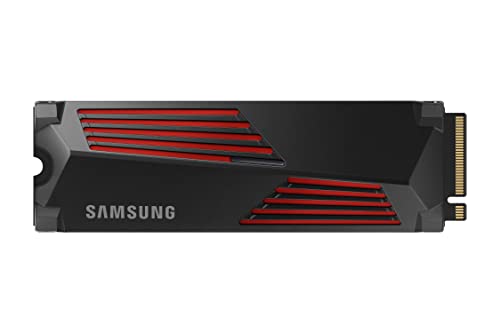
Specs
Interface | PCIe 4.0 x4 NVMe |
Capacity | 2TB (1TB and 4TB also sold) |
Sequential read | Up to 7,450 MB/s |
Sequential write | Up to 6,900 MB/s |
Cooling | Integrated low-profile heatsink |
Form factor | M.2 2280 (fits PS5 slot) |
Endurance | 1,200 TBW |
Warranty | 5-year limited |
Interface
PCIe 4.0 x4 NVMe
Capacity
2TB (1TB and 4TB also sold)
Sequential read
Up to 7,450 MB/s
Sequential write
Up to 6,900 MB/s
Cooling
Integrated low-profile heatsink
Form factor
M.2 2280 (fits PS5 slot)
Endurance
1,200 TBW
Warranty
5-year limited
What it does well
Gaming is not only a PC thing, and this is the pick that covers the rest. The 990 Pro Heatsink drops straight into a PlayStation 5 expansion slot with no aftermarket heatsink shopping, and its low-profile cooler keeps sustained transfers from throttling in airflow-starved slots. Under the hood it is the same top-tier Gen4 silicon as the bare 990 Pro, so you give up nothing on speed. Console storage has its own rulebook though, and our guide to the best SSDs for PS5 walks through Sony's read-speed floor and the 11.25mm height ceiling before it names a drive.
What you give up
The heatsink adds cost over the bare drive, and in a tight ATX case it can foul a tall motherboard heatspreader or the GPU backplate, so measure clearance first. In a well-ventilated desktop slot where the bare drive already runs cool, the cooler is overkill.
Who it's for
The PS5 owner expanding console storage, or the small-form-factor PC builder whose M.2 slot bakes under the GPU. If thermals or console fit are on your mind, this is the drive.
Bottom line
If you want one drive that handles everything, buy the WD Black SN850X (2TB). If you want the same real-world speed for less, buy the Crucial T500 (2TB) and spend the savings elsewhere. If you want the Gen4 ceiling and know what you are paying for, buy the Samsung 990 Pro (2TB). If you are on a budget or adding a second drive, the WD Black SN770 (1TB) loads games just as fast. And if you are expanding a PS5 or fighting a hot slot, the Samsung 990 Pro Heatsink (2TB) is the answer. For most builders, Gen4 is the finish line, not a compromise.
FAQ
Is PCIe 4.0 fast enough for gaming in 2026, or do I need PCIe 5.0?
PCIe 4.0 is more than enough for gaming in 2026. Game load times are limited by random read performance, not peak sequential speed, and every quality Gen4 drive clears that bar. A Gen5 drive loads the same level within a blink, costs more, and runs hotter. Buy Gen4 and put the savings toward your GPU.
Does a faster NVMe SSD actually increase FPS in games?
No. Your SSD affects how fast a game loads and how smoothly it streams assets, not your frame rate. FPS is set by your GPU and CPU. A faster drive can shorten loading screens and reduce texture pop-in, but it will not add frames. This is why a fast Gen4 drive is plenty and the money is better spent on the graphics card.
How much SSD storage do I need for a gaming PC?
2TB is the practical floor in 2026. Modern AAA installs routinely run 100GB or more, and a 1TB drive fills up within a few months, leaving you deleting games to install new ones. Three of our five picks are 2TB for exactly this reason. If 1TB is all the budget allows, the WD Black SN770 (1TB) is a fine boot-plus-a-few-games drive.
Does DirectStorage make a Gen5 SSD worth it for gaming?
Not yet for most buyers. DirectStorage is in only a handful of titles and does not currently turn Gen5's sequential headroom into a noticeable real-world advantage over a fast Gen4 drive. It should matter more as adoption grows, but today it does not justify the extra cost and heat. A good Gen4 SSD is the smarter buy.
Do I need a heatsink on my gaming NVMe SSD?
Usually not for gaming. Game loading is bursty, not sustained, so a bare Gen4 drive in a typical M.2 slot stays well within thermal limits. A heatsink helps in two cases: a slot baking directly under a hot GPU, or a PlayStation 5 expansion bay that requires one. For those, our Editor's Pick, the Samsung 990 Pro Heatsink (2TB), handles it out of the box.
Is a DRAM-less SSD like the SN770 bad for gaming?
No. DRAM-less drives like the WD Black SN770 (1TB) load games right alongside DRAM-backed flagships, because gaming does not stress the part of the drive DRAM accelerates. The tradeoff shows up in sustained large file writes, like moving a huge library between drives, which run slower. For booting and playing games, a good DRAM-less Gen4 drive is genuinely fine.
Related Articles

Best PCIe 5.0 SSDs for Gaming (2026): 5 Gen5 Picks by Tier
Best PCIe 5.0 SSD picks for gaming in 2026: five Gen5 drives that hold speed under sustained load, from the 2TB sweet spot to a 4TB game-library drive.
Aug 18, 2026

Best 2TB NVMe SSDs Under $150 (2026): DRAM vs HMB Picks by Use Case
The best 2TB NVMe SSD under $150 isn't one drive. It's five, keyed to use case. DRAM-versus-HMB tradeoffs, PS5 fitment, and an honest answer for each.
May 19, 2026

Best 4TB NVMe SSDs for Gaming (2026): 5 Picks, Gen4 First
The best 4TB NVMe SSDs for gaming in 2026: five picks that hold a full library. Why a fast Gen4 loads games quicker than any Gen5 drive at this capacity.
Aug 20, 2026

Best PCIe 5.0 SSD Heatsinks (2026): Five Picks for Gen5 Thermal Reality
PCIe 5.0 SSDs throttle hard without proper cooling. Five heatsink picks across passive and active tiers, plus the honest answer to whether your motherboard's built-in is enough.
May 14, 2026

Best NVMe SSDs for Gaming 2026: Five Picks by Use Case
Best NVMe SSDs for gaming in 2026 — load times plateau above 5,000 MB/s, so capacity beats Gen5 specs. Five picks: mainstream, value, Gen5, capacity, boot.
May 11, 2026