Affiliate Disclosure: As an Amazon Associate we earn from qualifying purchases. Some links may earn us a commission at no cost to you.

RTX 5060 vs RTX 4060: Is the Upgrade Worth It in 2026?
The RTX 5060 is the card NVIDIA wants you to buy, and the RTX 4060 is the one millions of people already own. Both are 8 GB cards built for 1080p, so the real question is not which one is faster on paper. It is whether the gap is worth paying for, either as a fresh purchase or as an upgrade from a 4060 sitting in your case right now.
Short version: the 5060 is roughly a quarter faster in raster and adds DLSS 4 with Multi-Frame Generation, which the 4060 cannot run. That matters more for some buyers than others. Here is how the two split, scenario by scenario.
At a glance
Card | VRAM | Architecture | Where to buy |
|---|---|---|---|
8 GB GDDR7, 128-bit | Blackwell, DLSS 4 plus MFG | ||
8 GB GDDR6, 128-bit | Ada Lovelace, DLSS 3 |
- VRAM
8 GB GDDR7, 128-bit
- Architecture
Blackwell, DLSS 4 plus MFG
- Where to buy
- VRAM
8 GB GDDR6, 128-bit
- Architecture
Ada Lovelace, DLSS 3
- Where to buy
Where each one wins
Your situation | The call | Buy |
|---|---|---|
New 1080p 144 Hz build | Take the 5060. The higher raster floor plus DLSS 4 and MFG feed a high-refresh panel, and you get the current feature set on a fresh build. | |
You already own a 4060, 60 Hz 1080p | Keep the 4060. A quarter more raster is invisible on a 60 Hz panel, so the upgrade money is better saved. Still shopping the tier? The 4060 is the value buy. | |
You already own a 4060, 144 Hz or faster | Lean 5060. MFG plus the raster bump turns more titles into a locked high-refresh experience the 4060 cannot reach. | |
Tightest budget, clearance 4060 in stock | Take the 4060. When the clearance price is genuinely low, it is the better performance per dollar at 1080p. | |
You are eyeing 1440p | Neither is a clean answer. Both are 8 GB and stumble at 1440p ultra. If forced, the 5060 is the less compromised pick, but a 16 GB card is the honest move. | |
Lowest power or smallest case | Take the 4060. At 115 watts and a compact 2.5-slot body, it fits tight builds and weaker power supplies with more headroom. |
New 1080p 144 Hz build
- The call
Take the 5060. The higher raster floor plus DLSS 4 and MFG feed a high-refresh panel, and you get the current feature set on a fresh build.
- Buy
You already own a 4060, 60 Hz 1080p
- The call
Keep the 4060. A quarter more raster is invisible on a 60 Hz panel, so the upgrade money is better saved. Still shopping the tier? The 4060 is the value buy.
- Buy
You already own a 4060, 144 Hz or faster
- The call
Lean 5060. MFG plus the raster bump turns more titles into a locked high-refresh experience the 4060 cannot reach.
- Buy
Tightest budget, clearance 4060 in stock
- The call
Take the 4060. When the clearance price is genuinely low, it is the better performance per dollar at 1080p.
- Buy
You are eyeing 1440p
- The call
Neither is a clean answer. Both are 8 GB and stumble at 1440p ultra. If forced, the 5060 is the less compromised pick, but a 16 GB card is the honest move.
- Buy
Lowest power or smallest case
- The call
Take the 4060. At 115 watts and a compact 2.5-slot body, it fits tight builds and weaker power supplies with more headroom.
- Buy
Benchmarks
These are representative reviewer averages at 1080p, the resolution both cards are built for. The pattern holds across testing: the 5060 leads everywhere, but the size of the lead swings hard by title. Bandwidth-heavy games stretch it wide, while esports titles that already run fast on both narrow it.
A bandwidth-bound AAA title where the 5060's GDDR7 stretches the gap the widest.
- RTX 506095 FPS
- RTX 406075 FPS
An esports title that already runs fast on both cards, so the 5060's lead is more modest.
- RTX 5060235 FPS
- RTX 4060190 FPS
Another competitive shooter where raw frames matter more than the absolute gap.
- RTX 5060190 FPS
- RTX 4060150 FPS
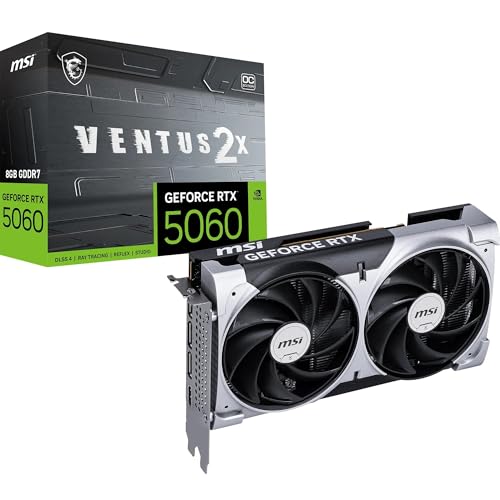
MSI Ventus RTX 5060 OC
The 5060 is the more complete card of the two. It pairs a faster Blackwell core with GDDR7 memory, and it brings the headline feature of the new generation that the 4060 simply does not have.
Specs
Chip | GeForce RTX 5060 (Blackwell) |
VRAM | 8 GB GDDR7 (28 Gbps) |
Memory bus | 128-bit |
Interface | PCIe 5.0 x8 |
Boost clock | 2.53 GHz (OC) |
Power | 145 W, single 8-pin, 550 W PSU |
Outputs | 3x DisplayPort 2.1b, 1x HDMI 2.1b |
Length | 197 mm, 2-slot |
Chip
GeForce RTX 5060 (Blackwell)
VRAM
8 GB GDDR7 (28 Gbps)
Memory bus
128-bit
Interface
PCIe 5.0 x8
Boost clock
2.53 GHz (OC)
Power
145 W, single 8-pin, 550 W PSU
Outputs
3x DisplayPort 2.1b, 1x HDMI 2.1b
Length
197 mm, 2-slot
What it does well
In raster, the 5060 runs roughly a quarter ahead of the 4060 on average. The gap is not uniform. In bandwidth-hungry games like Cyberpunk 2077 at ultra, the GDDR7 memory does real work and the lead stretches well past that average. In lighter esports titles, where both cards already push high frame rates, the margin shrinks.
The bigger story is the feature set. The 5060 runs DLSS 4 with the transformer upscaling model, which at 1080p and 1440p Quality holds up well, and it adds Multi-Frame Generation. On a high-refresh panel, with a base frame rate already in good shape, MFG can take a smooth 60 and make it feel like a locked 120. The 4060 cannot do any of this.
It is also a current-generation card with PCIe 5.0 and DisplayPort 2.1b, so it has more output headroom for high-refresh and high-resolution monitors down the line.
What you give up
It is still 8 GB on a 128-bit bus. That ceiling is the single biggest limiter at this tier, and it does not go away because the badge changed. Push texture-heavy games or Unreal Engine 5 titles to 1440p ultra and the buffer fills up, framerates fall off, and no amount of frame generation fixes a VRAM wall.
The raster jump over a 4060 is genuine, but it is not a tier change. You are not buying a 1440p card. And be careful with the marketing math: a number like 240 frames per second with MFG set to 4x comes from a base that is a quarter of that. Multi-Frame Generation is a smoothness multiplier on an already-playable base, not a way to leapfrog a performance class. Below a 60 frame base, the latency and artifacts show.
The card also runs on a PCIe 5.0 x8 link, so on an older PCIe 3.0 board you lose a little effective bandwidth.
Who it's for
New-build budget buyers at 1080p high refresh who want the current feature set and the better raster floor, and who would rather not hunt the clearance market for last generation. If you are buying a GPU today with no card to trade in, this is the default.
ASUS Dual RTX 4060 OC
The 4060 has been the budget default for years, and at the right clearance price it still makes sense. It is the most efficient of the two and one of the easiest cards to drop into any build.

Specs
Chip | GeForce RTX 4060 (Ada Lovelace) |
VRAM | 8 GB GDDR6 (17 Gbps) |
Memory bus | 128-bit |
Interface | PCIe 4.0 x8 |
Boost clock | 2.54 GHz (OC) |
Power | 115 W, single 8-pin, 550 W PSU |
Outputs | 3x DisplayPort 1.4a, 1x HDMI 2.1a |
Length | Compact 2.5-slot |
Chip
GeForce RTX 4060 (Ada Lovelace)
VRAM
8 GB GDDR6 (17 Gbps)
Memory bus
128-bit
Interface
PCIe 4.0 x8
Boost clock
2.54 GHz (OC)
Power
115 W, single 8-pin, 550 W PSU
Outputs
3x DisplayPort 1.4a, 1x HDMI 2.1a
Length
Compact 2.5-slot
What it does well
At 1080p, the 4060 still clears most modern games at high settings, and when it lands at a genuine clearance price it is hard to beat on value per dollar. It draws only 115 watts, the lowest of the two, which keeps it cool and quiet and lets it run on a modest power supply without a fuss.
The ASUS Dual is a small, light 2.5-slot card that fits nearly any case and needs no support bracket. It runs DLSS 3 with single-frame generation, the drivers are mature, and the installed base is enormous, so troubleshooting and resale are both easy. There is a useful 1440p guide if you are weighing whether this tier stretches that far, and the short answer is that it is a 1080p card first.
What you give up
It trails the 5060 by roughly a quarter in raster, and by more in bandwidth-bound titles. It also misses the headline feature of the new generation: there is no DLSS 4 transformer model and no Multi-Frame Generation here, only the older DLSS 3 path.
It shares the same 8 GB ceiling, so it is no more of a 1440p card than the 5060. And the practical catch in 2026 is supply. New-condition 4060 stock is thinning as the card clears out, and a lot of what is left skews toward marketplace and used listings. The buying window is narrowing, and that changes the math against a 5060 that sits close in price.
Who it's for
Budget buyers who find a genuinely cheap, in-stock, new-condition card and play mostly at 1080p, or anyone who already owns a 4060 and is weighing whether the 5060 jump is worth it. If the prices are close, the newer card wins. If the 4060 is meaningfully cheaper, it holds its ground.
Which one should you buy?
If you are building new at 1080p with a high-refresh panel, buy the MSI Ventus RTX 5060 OC. The current feature set and the better raster floor are worth the small premium on a fresh build. Shopping the same tier in a laptop is a different exercise, because the RTX 5060 Laptop ships anywhere from 85W to 115W depending on the chassis, and our best RTX 5060 gaming laptops ranking sorts the machines by that wattage.
If you already own a 4060 and game on a 60 Hz screen, keep what you have. The extra frames are invisible at 60 Hz, so there is nothing to buy.
If you own a 4060 and run a high-refresh monitor, the MSI Ventus RTX 5060 OC is a reasonable step up for MFG and a higher locked frame rate. Treat it as a refinement, not a transformation. Coming from something older changes the maths entirely: the GTX 1660 Super to RTX 5060 jump is a generational move rather than a refinement.
If your budget is at the floor and a new 4060 is genuinely cheap, the ASUS Dual RTX 4060 OC is the better value per dollar at 1080p. When the prices close in, take the newer card.
And if you are really aiming at 1440p, be honest with yourself: both of these are 8 GB cards. Step up to a 16 GB option instead. Our 1440p GPU guide walks through the tiers that actually hold up there.
Bottom line
The 5060 is the better card, and for a new build at 1080p high refresh it is the one to get. The 4060 is not beaten so much as priced into a corner: it only wins when the clearance price drops far enough to matter, and that stock is drying up. If you already own a 4060 on a 60 Hz panel, sit tight. If you own one on a fast panel, the 5060 is a sensible refinement rather than a leap. And whichever way you go, remember both cards are 8 GB, so 1440p ambitions belong on a different shelf. Worth watching the current GPU deals before you commit, since the gap between these two is mostly a price story.
FAQ
Is the RTX 5060 worth upgrading to from an RTX 4060?
It depends on your monitor. On a 60 Hz 1080p panel, the roughly one-quarter raster gain is hard to see, so the upgrade is hard to justify. On a high-refresh 1080p panel, the extra frames plus DLSS 4 and Multi-Frame Generation can turn more games into a locked high-refresh experience, which makes the jump reasonable. Treat it as a refinement, not a generational leap.
How much faster is the RTX 5060 than the RTX 4060?
Roughly a quarter faster on average in raster, but the gap swings hard by game. Bandwidth-heavy titles like Cyberpunk 2077 at ultra can stretch it much wider thanks to the 5060's GDDR7 memory, while esports games that already run fast on both cards narrow it to around 20 percent. With ray tracing on, the lead shrinks further.
Do the RTX 5060 and RTX 4060 both have 8GB of VRAM?
Yes. Both ship with 8 GB on a 128-bit bus. The 5060 uses faster GDDR7 and the 4060 uses GDDR6, so the 5060 has more memory bandwidth, but the capacity is identical. That shared 8 GB ceiling is the main reason neither card is a durable choice for 1440p ultra or texture-heavy Unreal Engine 5 titles.
Can the RTX 4060 run DLSS 4 and Multi-Frame Generation?
No. The 4060 runs DLSS 3 with single-frame generation, but Multi-Frame Generation and the DLSS 4 transformer model are limited to the RTX 50 series, which includes the 5060. If DLSS 4 and MFG are a priority for you, that is one of the clearest reasons to choose the 5060 over the 4060.
Is the RTX 5060 good for 1440p gaming?
It can play at 1440p, but it is not a card built for it. The 8 GB buffer fills quickly at 1440p ultra in demanding games, which causes frame rates to drop sharply. For occasional 1440p with tuned settings it is workable, but if 1440p is your main target, a 16 GB card is the honest recommendation over either of these two.
Should I buy a used or clearance RTX 4060 instead of a new RTX 5060?
Only if the price gap is large. A genuinely cheap, new-condition, in-stock 4060 is good value at 1080p. But new 4060 stock is thinning and many remaining listings are marketplace or used, so confirm the card is new and well-supported before buying. When the 4060 sits close in price to the 5060, the newer card is the better long-term choice.
Related Articles

Best GPUs for 1440p Gaming (2026): 5 16GB Picks, 60-240Hz
The best GPUs for 1440p gaming in 2026: five 16GB picks matched to 60, 144, and 240 Hz targets, with real benchmarks, trade-offs, and who each card fits.
Aug 8, 2026

Best GPU Deals for Amazon Prime Day 2026
The best GPU deals for Amazon Prime Day 2026: RTX 5060 Ti to RTX 5080 with honest discount checks and resolution pairing for every budget.
Jun 10, 2026

Best GPUs for Battlefield 6 (2026): 4 Picks, 1080p to 4K
Best GPU for Battlefield 6 in 2026, matched to your resolution: RTX 5070 Ti and RX 9070 XT for 1080p and 1440p, RTX 5080 and 5090 for native 4K ultra.
Aug 12, 2026

Best CPU for Cities: Skylines II (2026): 5 Picks by Tier
The best CPU for Cities: Skylines II is the one that holds full simulation speed as your city grows. Five picks ranked by the city size each sustains.
Sep 18, 2026

Best PC Cases for a 280mm AIO (2026): 5 Picks That Fit
The best PC cases for a 280mm AIO in 2026, ranked by where the radiator actually mounts, with the real clearance number and the condition attached to each pick.
Sep 17, 2026