Affiliate Disclosure: As an Amazon Associate we earn from qualifying purchases. Some links may earn us a commission at no cost to you.

SteelSeries Apex Pro TKL Gen 3 vs Wooting 80HE (2026)
The Apex Pro TKL Gen 3 and the Wooting 80HE are the two boards competitive players keep cross-shopping, and they split on a single axis. The Wooting is the sharper instrument, with a native 8 kHz analog scan and deeper tuning. The Apex Pro is the complete package around a fast switch, and it is on your desk this week instead of on a waiting list.
That availability gap is the whole story. Here is what separates them on rapid trigger, actuation, and polling, and why the one you can buy is the right answer for almost everyone.
At a glance
Keyboard | Switch | Standout | Buy |
|---|---|---|---|
OmniPoint 3.0 HyperMagnetic | In stock, OLED, wrist rest, quieter | ||
Lekker L60 V2, hot-swap | Native 8 kHz scan, deep Wootility tuning |
- Switch
OmniPoint 3.0 HyperMagnetic
- Standout
In stock, OLED, wrist rest, quieter
- Buy
- Switch
Lekker L60 V2, hot-swap
- Standout
Native 8 kHz scan, deep Wootility tuning
- Buy
Where each one wins
Scenario | Apex Pro TKL Gen 3 | Wooting 80HE | Our call | Buy the winner |
|---|---|---|---|---|
You need a board this week | In stock, ships today | Frequently out of stock | Apex Pro | |
Chasing the rapid-trigger ceiling | Excellent at 1000 Hz | Sharper native 8 kHz scan | Wooting, if in stock | |
Also a daily-driver typing board | OLED, roller, wrist rest, quieter | Utilitarian, no extras | Apex Pro | |
Deep per-key analog tuning | Friendly but shallower | Wootility goes deeper | Wooting, if in stock | |
You want hot-swappable switches | Fixed OmniPoint switches | Lekker L60 V2 hot-swap | Wooting, if in stock | |
One board, bought once, no waiting | The available all-rounder | Waiting-list risk | Apex Pro |
You need a board this week
- Apex Pro TKL Gen 3
In stock, ships today
- Wooting 80HE
Frequently out of stock
- Our call
Apex Pro
- Buy the winner
Chasing the rapid-trigger ceiling
- Apex Pro TKL Gen 3
Excellent at 1000 Hz
- Wooting 80HE
Sharper native 8 kHz scan
- Our call
Wooting, if in stock
- Buy the winner
Also a daily-driver typing board
- Apex Pro TKL Gen 3
OLED, roller, wrist rest, quieter
- Wooting 80HE
Utilitarian, no extras
- Our call
Apex Pro
- Buy the winner
Deep per-key analog tuning
- Apex Pro TKL Gen 3
Friendly but shallower
- Wooting 80HE
Wootility goes deeper
- Our call
Wooting, if in stock
- Buy the winner
You want hot-swappable switches
- Apex Pro TKL Gen 3
Fixed OmniPoint switches
- Wooting 80HE
Lekker L60 V2 hot-swap
- Our call
Wooting, if in stock
- Buy the winner
One board, bought once, no waiting
- Apex Pro TKL Gen 3
The available all-rounder
- Wooting 80HE
Waiting-list risk
- Our call
Apex Pro
- Buy the winner
Rapid trigger, actuation, and polling: what actually separates them
Both boards are magnetic Hall-effect keyboards with rapid trigger and per-key adjustable actuation, so on paper they land close. Rapid trigger resets a key the instant you lift, which is what makes counter-strafing and repeated taps feel instant, and both do it well. The Apex Pro pairs it with Rapid Tap and SOCD handling plus a Protection Mode that quiets the keys around the one you meant to press.
The headline separator is scan rate. The Wooting reads the full analog range natively at 8 kHz, a 0.125ms cadence, where the Apex Pro tops out around 1000 Hz. On a spec sheet that is a wide gap. In the hand it is narrower than the number suggests. The Wooting does feel a touch more alive at the very edge of a keypress, and a dedicated tuner will notice it, but for most players the jump from 1000 Hz to 8 kHz is the kind of difference you have to go looking for. Actuation resolution is effectively a tie, with the Apex Pro offering 40 levels from 0.1mm to 4.0mm and the Wooting adjusting in 0.1mm steps.
The availability problem nobody mentions
This is where the comparison stops being about switches. At the time of writing, the Apex Pro TKL Gen 3 is in stock on Amazon, Amazon-fulfilled, and ships in a couple of days. The Wooting 80HE is a different experience. Its Amazon listing reads currently unavailable, and Wooting's own batch updates document ongoing manufacturing delays and backorder queues where restocks sell out in minutes. The one Amazon review on the listing puts it plainly, noting it has not been in stock for a long time.
That matters more than any polling number. A keyboard you cannot buy is not a keyboard you can use, and the Wooting has spent long stretches out of reach through normal retail. If you happen to catch a restock and you want the highest ceiling, take it. But planning a build around the 80HE means planning around its availability, and for most buyers that tips the decision before the switches ever enter the conversation.
SteelSeries Apex Pro TKL Gen 3

Specs
Layout | TKL (tenkeyless, 87-key) |
Switches | OmniPoint 3.0 HyperMagnetic (Hall-effect) |
Actuation | 0.1mm to 4.0mm, 40 levels |
Rapid features | Rapid Trigger, Rapid Tap/SOCD, Protection Mode |
Polling rate | up to 1000 Hz |
Extras | OLED display, volume roller, magnetic wrist rest |
Keycaps / connection | PBT doubleshot, USB-C wired |
Software | SteelSeries GG (GG QuickSet) |
Layout
TKL (tenkeyless, 87-key)
Switches
OmniPoint 3.0 HyperMagnetic (Hall-effect)
Actuation
0.1mm to 4.0mm, 40 levels
Rapid features
Rapid Trigger, Rapid Tap/SOCD, Protection Mode
Polling rate
up to 1000 Hz
Extras
OLED display, volume roller, magnetic wrist rest
Keycaps / connection
PBT doubleshot, USB-C wired
Software
SteelSeries GG (GG QuickSet)
What it does well
The Apex Pro is the complete package built around a genuinely fast switch. OmniPoint 3.0 gives you 40 actuation levels from 0.1mm to 4.0mm, rapid trigger, and Rapid Tap with SOCD handling, so competitive inputs land as fast as you will realistically register. Then it adds everything a bare board leaves out. There is an OLED smart display for changing settings without leaving the game, a volume roller, a magnetic wrist rest, and PBT doubleshot keycaps, plus acoustic dampening inside the case that makes it noticeably quieter to type on.
GG QuickSet presets get a new buyer to a sensible per-game config in a couple of clicks, which lowers the learning curve that Hall-effect boards can carry. And the part that decides most purchases: it is in stock, Amazon-fulfilled, and ready to ship today.
What you give up
Ceiling. Polling tops out around 1000 Hz where the Wooting runs a native 8 kHz analog scan, and while the OmniPoint software is friendly, it does not expose the same depth of per-key analog tuning that Wootility does. A tuner who wants to feel the switch resolve at the very edge of travel will find the Wooting the sharper tool.
You are also paying, in part, for the OLED and the roller. A pure competitive player who only cares about the switch may never touch those features, and that portion of the price is not buying them speed.
Who it's for
The 1080p or 1440p competitive player who wants elite rapid-trigger performance without a waiting list, and who also values the quality-of-life touches that make this a genuine daily driver. If you want one board that games hard and types well, bought once and available now, this is it.
Wooting 80HE (Zinc Alloy)
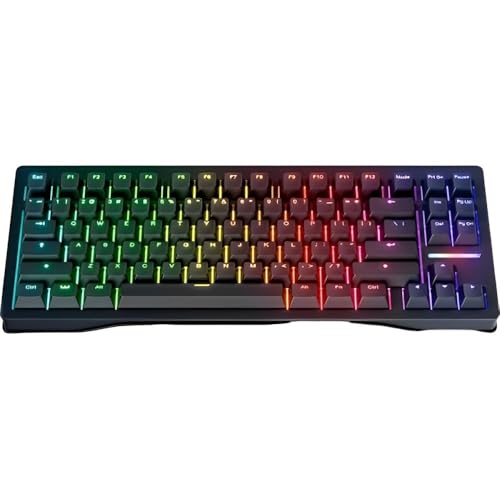
Specs
Layout | 80% (F-row + arrows, no numpad) |
Switches | Lekker L60 V2 (Hall-effect, hot-swappable) |
Actuation | adjustable in 0.1mm increments, rapid trigger |
Polling rate | native 8 kHz (0.125ms) |
Case / build | zinc alloy, screw-in stabilizers, PC plate, silicone dampening |
Keycaps / connection | doubleshot PBT, USB-C wired, travel case included |
Software | Wootility (browser-based) |
Availability | direct-first; Amazon listing frequently out of stock |
Layout
80% (F-row + arrows, no numpad)
Switches
Lekker L60 V2 (Hall-effect, hot-swappable)
Actuation
adjustable in 0.1mm increments, rapid trigger
Polling rate
native 8 kHz (0.125ms)
Case / build
zinc alloy, screw-in stabilizers, PC plate, silicone dampening
Keycaps / connection
doubleshot PBT, USB-C wired, travel case included
Software
Wootility (browser-based)
Availability
direct-first; Amazon listing frequently out of stock
What it does well
As a pure competitive tool, the 80HE is the sharper instrument. The board scans the full analog range natively at 8 kHz, so rapid trigger feels more granular and alive than on a 1000 Hz board, and Wootility exposes deeper per-key analog tuning than almost anything else in the category. If you enjoy dialing in actuation points key by key, this is the software that rewards it.
The hardware backs it up. Lekker L60 V2 switches are smooth and hot-swappable, the zinc-alloy case is dense and stable, and the 80% layout keeps the arrows and function row while cutting the numpad you probably were not using. For a rank-chaser who wants the highest ceiling and likes to tune, it is the better raw tool.
What you give up
Availability, first and above everything. Reports and Wooting's own batch updates describe long backorder queues and restocks that vanish within minutes, and at the time of writing the Amazon listing reads currently unavailable. If you need a keyboard soon, this is a real problem, not a footnote.
You also give up the Apex Pro's quality-of-life kit. There is no OLED, no volume roller, and no bundled wrist rest, and the whole design is more utilitarian. You are paying for the switch and the software rather than the extras, which is exactly the trade some buyers want and others will miss. Logitech's answer to that gap is the Pro X2 Rapid, which puts an OLED on the board and matches the 80HE at 8 kHz. Our Logitech Pro X2 Rapid vs Wooting 80HE comparison splits that matchup by scenario.
Who it's for
The dedicated competitive player, tuner, or enthusiast who wants the highest rapid-trigger ceiling and native 8 kHz scanning, is comfortable living in browser-based Wootility, and is willing to wait for stock or catch a restock. It is a specialist's board, not the one to recommend to someone who needs a keyboard on the desk this week.
Which one should you buy?
If you want the best competitive keyboard you can buy and use right now, get the Apex Pro TKL Gen 3. It delivers elite rapid trigger, adds an OLED, roller, and wrist rest that make it a great daily driver, and it ships today. That covers the vast majority of players.
If you chase every last millisecond, love tuning actuation key by key, and you can get one in stock, get the Wooting 80HE. Its native 8 kHz scan and Wootility depth give it the higher ceiling for a dedicated competitor.
If you also type all day and want the board to double as a work keyboard, the Apex Pro is the clear pick thanks to its quieter build and quality-of-life extras. And if you specifically want hot-swappable switches to experiment with feel, only the Wooting offers that, provided you can find one to buy.
Bottom line
For almost everyone, the answer is the SteelSeries Apex Pro TKL Gen 3. It brings elite rapid-trigger performance, real daily-driver polish, and the one thing the Wooting often cannot promise: you can buy it today. The Wooting 80HE is the sharper competitive instrument, with a native 8 kHz scan and deeper tuning, and it is the right call for the dedicated tuner who catches a restock. Match the board to how you actually buy, not just how it benchmarks, and the choice gets easy.
FAQ
Is the Wooting 80HE actually better than the SteelSeries Apex Pro TKL Gen 3?
On raw competitive tech, the Wooting has the edge. Its native 8 kHz analog scan and deeper Wootility tuning give it a higher ceiling for rapid trigger, and a dedicated tuner will feel it. But better depends on what you weigh. The Apex Pro matches it closely on actuation, adds an OLED, roller, and wrist rest, types more quietly, and is reliably in stock. For most players the Apex Pro is the better overall buy; for a rank-chasing tuner who can get one, the Wooting is the sharper tool.
Can you buy the Wooting 80HE on Amazon, or is it direct-only?
There is a Wooting 80HE listing on Amazon, but it is frequently out of stock, and at the time of writing it reads currently unavailable. Wooting sells primarily through its own store, and even there the board moves through backorder queues and restocks that sell out fast. The Apex Pro TKL Gen 3, by contrast, is a normal Amazon purchase that ships in a couple of days. If availability matters to your timeline, that gap is the deciding factor.
Does 8 kHz polling on the Wooting 80HE make a real difference over the Apex Pro's 1000 Hz?
On a spec sheet it looks huge, but in practice the difference is subtle. The Wooting's native 8 kHz scan does feel slightly more alive at the very edge of a keypress, and a dedicated competitor tuning for every advantage may notice it. For the majority of players, the jump from 1000 Hz to 8 kHz is something you have to actively look for rather than something that changes your results. It is a real advantage, just a narrow one.
Which keyboard has better rapid trigger for competitive gaming?
Both implement rapid trigger well, and the practical gap is small. The Wooting is marginally sharper because it scans the analog range natively at a higher rate, which is why enthusiasts lean toward it. The Apex Pro is right there with it and pairs rapid trigger with Rapid Tap, SOCD handling, and a Protection Mode that reduces accidental neighboring inputs. For a competitive player who wants the theoretical edge and can get one, the Wooting leads; for everyone else, the Apex Pro is more than fast enough.
Is the SteelSeries Apex Pro TKL Gen 3 good for typing as well as gaming?
Yes, and this is one of its real advantages over the Wooting. It has acoustic dampening inside the case that makes it noticeably quieter to type on, PBT doubleshot keycaps, a magnetic wrist rest, and a volume roller, all of which make it a comfortable daily driver as well as a game board. The Wooting is more utilitarian and built primarily as a competitive tool. If your keyboard does double duty for work and play, the Apex Pro is the friendlier all-rounder.
Are the switches hot-swappable on the Apex Pro or the Wooting 80HE?
The Wooting 80HE has hot-swappable Lekker L60 V2 switches, so you can pull and replace them without soldering to change the feel. The Apex Pro TKL Gen 3 uses fixed OmniPoint 3.0 switches that cannot be swapped out. If experimenting with different switches matters to you, the Wooting is the only one of the two that supports it, assuming you can find one in stock.
Related Articles

Best Gaming Keyboard 2026: Mechanical, Wireless, TKL
The best gaming keyboards of 2026 ranked by switch type, layout, and use case. From rapid-trigger Hall effect to hot-swap wireless, picks for every budget.
Jul 6, 2026

Best Hot-Swappable Gaming Keyboards (2026): 5 Top Picks
Five hot-swap gaming keyboards picked by form factor, budget, and switch philosophy. Covers wired budget, wireless value, Hall Effect premium, and full-size.
May 27, 2026

Best Valorant Keyboards & Mice 2026: Pro Picks & Specs
Best keyboard for Valorant in 2026, plus the mice that pair with it. The Hall-Effect and optical Rapid Trigger meta, framed for Amazon-stocked picks.
May 12, 2026

Best Headset for Helldivers 2 (2026): 5 Picks for PC and PS5
Best headset for Helldivers 2 in 2026: 5 picks that place bug flanks by ear and keep stratagem callouts clear on PC and PS5, from budget wired to planar.
Oct 5, 2026

9800X3D vs 285K (2026): 5 Benchmarks and a Verdict by Buyer
9800X3D vs 285K: the Ryzen wins cache-heavy games by up to 51% on roughly half the power; the 285K wins Blender and encodes by 25 to 40%. Pick yours in 2026.
Oct 5, 2026