Affiliate Disclosure: As an Amazon Associate we earn from qualifying purchases. Some links may earn us a commission at no cost to you.

8BitDo Ultimate 3E vs Ultimate 3 (2026): Modular or Not
Two Xbox-licensed 8BitDo pads landed weeks apart with the same sensor stack inside. The Ultimate 3E and the Ultimate 3 both run TMR analog sticks, Hall-effect impulse triggers with two stop positions, two rear paddles, extra L4 and R4 bumpers, and an integrated wireless charging dock.
The gap between them is not tracking accuracy. It is a magnetic faceplate and a bag of swappable parts. If you want to change how the face buttons and D-pad feel after a few hundred hours, the 3E earns the difference. If you do not, the cheaper pad is the same controller underneath.
At a glance
Controller | Sticks and triggers | Modularity | Buy |
|---|---|---|---|
TMR sticks with RGB Fire Ring, Hall-effect two-stop triggers | Magnetic faceplate, ABXY and D-pad modules, four stick options | ||
TMR sticks, Hall-effect two-stop triggers | Fixed faceplate and buttons |
- Sticks and triggers
TMR sticks with RGB Fire Ring, Hall-effect two-stop triggers
- Modularity
Magnetic faceplate, ABXY and D-pad modules, four stick options
- Buy
- Sticks and triggers
TMR sticks, Hall-effect two-stop triggers
- Modularity
Fixed faceplate and buttons
- Buy
Where each one wins
Scenario | Why | Winner |
|---|---|---|
Competitive PC shooters | Micro-switch ABXY module plus trigger stops tightens actuation | 8BitDo Ultimate 3E |
Fighting games and 2D platformers | The circular D-pad swap is the whole reason to pay up | 8BitDo Ultimate 3E |
Console-only Xbox play | Modules aside, the PC-only features are switched off on Xbox | 8BitDo Ultimate 3 |
Longest sessions between charges | Twenty quoted hours against eighteen, with no stick lighting to feed | 8BitDo Ultimate 3 |
Cheapest path to anti-drift sticks | Same TMR sensors, lower outlay | 8BitDo Ultimate 3 |
Replacing a worn premium pad | The parts bag is included rather than sold as a kit | 8BitDo Ultimate 3E |
Competitive PC shooters
- Why
Micro-switch ABXY module plus trigger stops tightens actuation
- Winner
8BitDo Ultimate 3E
Fighting games and 2D platformers
- Why
The circular D-pad swap is the whole reason to pay up
- Winner
8BitDo Ultimate 3E
Console-only Xbox play
- Why
Modules aside, the PC-only features are switched off on Xbox
- Winner
8BitDo Ultimate 3
Longest sessions between charges
- Why
Twenty quoted hours against eighteen, with no stick lighting to feed
- Winner
8BitDo Ultimate 3
Cheapest path to anti-drift sticks
- Why
Same TMR sensors, lower outlay
- Winner
8BitDo Ultimate 3
Replacing a worn premium pad
- Why
The parts bag is included rather than sold as a kit
- Winner
8BitDo Ultimate 3E
8BitDo Ultimate 3E

Specs
Sticks | TMR with 12-bit ADC, RGB Fire Ring |
Triggers | Hall-effect impulse, two trigger stops |
Extra inputs | 2 pro-level back buttons, L4 and R4 bumpers |
Battery | 1400 mAh Li-ion, 18 play hours |
Charging | Integrated wireless charging dock, 4 to 5 hours |
Polling rate | Up to 1000 Hz, PC only |
Modularity | Magnetic faceplate, silicone and micro-switch ABXY modules, two D-pads, four stick options |
Size and weight | 152.5 x 104 x 62 mm, 285 g |
Sticks
TMR with 12-bit ADC, RGB Fire Ring
Triggers
Hall-effect impulse, two trigger stops
Extra inputs
2 pro-level back buttons, L4 and R4 bumpers
Battery
1400 mAh Li-ion, 18 play hours
Charging
Integrated wireless charging dock, 4 to 5 hours
Polling rate
Up to 1000 Hz, PC only
Modularity
Magnetic faceplate, silicone and micro-switch ABXY modules, two D-pads, four stick options
Size and weight
152.5 x 104 x 62 mm, 285 g
What it does well
The accessory pack is in the box, not sold as a kit later. Alongside the stock silicone ABXY module there is a micro-switch module that clicks instead of squashing. Alongside the standard cross D-pad there is a circular one. Four stick options ship with it: two tall sticks, a dome, and a thick-neck stick with a metal ring that adds resistance. The faceplate lifts off magnetically, so changing any of it takes seconds, with no screwdriver and no software pass.
The sensor stack is the interesting part, because it is identical to the cheaper pad. TMR analog sticks behind a 12-bit ADC, Hall-effect impulse triggers with two stop positions, two rear paddles, and L4 and R4 bumpers that remap without the desktop app. Modularity costs nothing in tracking here. On PC the polling rate climbs to 1000 Hz wired or wireless, and 6-axis motion maps to either stick. On an Xbox console neither of those applies, which matters further down.
Battery is a 1400 mAh cell rated at 18 hours, charged through a magnetic dock with no contact pins. Connectivity covers 2.4G for Xbox and PC, Bluetooth for phones and Apple hardware, and wired USB when latency is the priority. The circular D-pad is the quiet win for anyone who drops into fighting games or 2D platformers between shooters, which is the same reason it shows up in our retro and emulation controllers picks. Note that this is the Gray Xbox-licensed SKU, not one of the limited colorways.
What you give up
The shell is bulkier than the standard pad, and it carries no Switch 2 optimization. RGB is thin as a feature: Fire Rings under both sticks, a dedicated button to cycle them, and not much reason to touch it. Reports suggest the USB-C port sits close enough to the shell edge that a stiff cable loads the connector during wired play. Buyers have flagged that stick lighting on earlier 8BitDo pads pulled real runtime out of wireless sessions, and the quoted 18 hours already sits two short of the cheaper model.
Turbo and rapid-fire are missing on PC as well as console, because Microsoft's Xbox licensing terms prohibit them on a licensed pad. That is not an 8BitDo decision, and it applies across the licensed category, including the pads in the DualSense Edge and Elite Series 2 comparison. Weight is also hard to compare across the two spec sheets: this one lists 285 g for the controller, while the cheaper one lists 466 g in a way that reads like controller plus dock.
Who it's for
A PC-first player who moves between genres and wants the face buttons and D-pad to move with them. Also anyone retiring a worn premium pad who would rather get the parts bag included than buy it separately. If you have never once wished your ABXY felt different, this is not your controller.
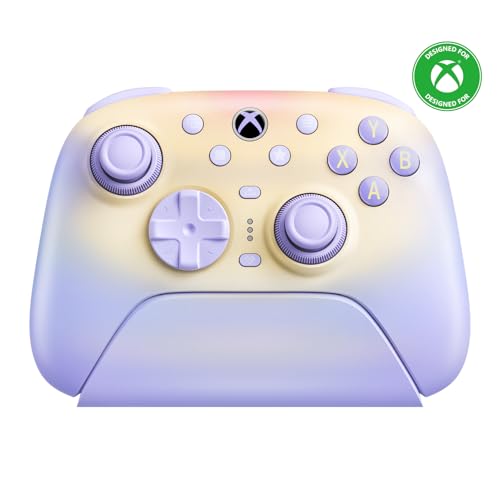
8BitDo Ultimate 3
Specs
Sticks | TMR with 12-bit ADC, 216 MHz processor |
Triggers | Hall-effect impulse, two trigger stops |
Extra inputs | 2 pro-level back buttons, L4 and R4 bumpers |
Battery | 1000 mAh Li-ion, 20 play hours |
Charging | Integrated wireless charging dock, 4 to 5 hours |
Polling rate | Up to 1000 Hz, PC only |
Modularity | None, fixed faceplate and buttons |
Platforms | Xbox Series X|S, Xbox One, Windows 10 and 11, Android 13 and up, Apple |
Sticks
TMR with 12-bit ADC, 216 MHz processor
Triggers
Hall-effect impulse, two trigger stops
Extra inputs
2 pro-level back buttons, L4 and R4 bumpers
Battery
1000 mAh Li-ion, 20 play hours
Charging
Integrated wireless charging dock, 4 to 5 hours
Polling rate
Up to 1000 Hz, PC only
Modularity
None, fixed faceplate and buttons
Platforms
Xbox Series X|S, Xbox One, Windows 10 and 11, Android 13 and up, Apple
What it does well
Every sensor that decides whether a pad still tracks straight in year three is here. TMR analog sticks behind a 12-bit ADC and a 216 MHz processor, Hall-effect impulse triggers with two stop positions, two rear paddles, and the same fast L4 and R4 bumpers. Remapping runs on the pad rather than through a required desktop app.
Quoted runtime is 20 hours off a 1000 mAh cell, which beats the larger battery in the 3E. The reason is straightforward: there is no stick lighting drawing current. Charging is the same magnetic dock with no contact pins, in the box, 4 to 5 hours to full. On PC the polling ceiling is the same 1000 Hz, motion control is the same 6-axis, and the 3.5 mm jack is the same.
Platform coverage matches too: Xbox Series X and S, Xbox One, Windows 10 and 11, Android 13 and up, and Apple devices. For a player whose pad lives next to a console rather than a keyboard, that list is the part of the spec sheet that matters, and the PC-only features on both pads are dead weight. The listing here is the Lavender Dusk colorway, currently the finish with stock.
What you give up
Nothing on the face of this controller changes. The silicone ABXY feel is the feel you keep for the life of the pad, and there is no circular D-pad option, which is the one swap most likely to matter if fighting games or platformers are in the rotation. No stick lighting either, if that counts as a loss.
The cell is smaller in absolute terms, so a heavier haptics profile or a future firmware change has less headroom to eat. Ship timing also varies by colorway, and one listing carries a date in late October, so a specific finish can be weeks away even while another sits in stock today. Buy the finish that ships now rather than holding out for the one you pictured.
Who it's for
A console-first Xbox player, or a PC player who already knows the stock button feel suits them and would rather put the difference toward a headset or a second dock. It is also the sane choice for a second pad that lives on the couch, where the PC-only extras never come into play. For handheld play instead, our Steam Deck controller picks cover a different shape of the problem.
Which one should you buy?
Competitive PC shooters. Buy the 8BitDo Ultimate 3E. The micro-switch ABXY module shortens actuation on the buttons you hit under pressure, the trigger stops cut travel on the ones you hold, and the 1000 Hz polling ceiling is live on PC. You will use the parts bag, and the sensor stack underneath is the same either way.
Console-only Xbox play. Buy the 8BitDo Ultimate 3. The polling headroom and motion control on both pads are PC-only, so a chunk of what you would pay extra for is switched off on an Xbox. The modules are the live difference, and a couch player rarely swaps them twice.
Fighters, platformers, and anything on a D-pad. Buy the 8BitDo Ultimate 3E. The circular D-pad swap is the single change that alters how a pad plays rather than how it looks, and no amount of remapping in software substitutes for it. Our Rocket League controller guide makes a related point about stick feel.
Replacing a stock pad that started drifting. Buy the 8BitDo Ultimate 3. TMR sticks are the fix you came for, and they are identical across both models. Put the difference toward a second dock or a headset. Our PC controller roundup covers where both land against the wider field.
Bottom line
The sensors are the same. The money buys a magnetic faceplate, a micro-switch ABXY module, a circular D-pad, and four stick options. If you will use those, the 8BitDo Ultimate 3E is the better pad and the extra is fair. If you will not, the 8BitDo Ultimate 3 is the same controller with a longer quoted runtime. Console-only players should take the cheaper one almost every time. Anyone still choosing between pad, mouse and keyboard should start with how to choose peripherals.
FAQ
Does the 8BitDo Ultimate 3E work on the Nintendo Switch 2?
It will pair over Bluetooth, but it is not a Switch 2 controller in any meaningful sense. The 3E is an Xbox-licensed pad, so its 2.4G mode targets Xbox and Windows, and it carries none of the Switch 2 specific behavior 8BitDo built into its Nintendo-facing pads, including console wake. If the Switch 2 is your primary console, buy from that side of 8BitDo's range instead.
Can you use the 8BitDo Ultimate 3E on a PS5?
Not natively. Sony blocks third-party pads from PS5 system menus and most games, and no Xbox-licensed controller gets around that. 8BitDo's own USB wireless adapter is the usual workaround and it does work, but it adds hardware and a setup step, and it is thin ground to plan a purchase on. If PlayStation is the main console, buy a PlayStation pad.
Is the 8BitDo Ultimate 3E better than the Xbox Elite Series 2?
On customization, yes. The 3E ships the faceplate, both ABXY modules, the second D-pad and the full stick set in the box, where the Elite Series 2 offers stick and paddle swaps and a shorter menu of them. The Elite still holds the stronger first-party integration and the longer track record on build. Pick the 3E if module choice is the point, the Elite if first-party polish is.
Do TMR sticks really stop stick drift?
They remove the wear mechanism behind most of it. A traditional stick reads position off a carbon-film potentiometer that physically abrades, and drift is that abrasion showing up as a false input. TMR sensors read a magnetic field instead, with nothing rubbing, and they resolve finer than the Hall-effect sensors that came before them. Drift from a knocked or contaminated module is still possible. Drift from normal use is not the risk it was.
Does the 8BitDo Ultimate 3 come with a charging dock?
Yes. Both pads include the integrated wireless charging dock with magnetic alignment and no contact pins, and both quote 4 to 5 hours to a full charge. Launch coverage often framed wireless charging as a 3E feature, but 8BitDo's own spec page lists it on the cheaper pad as well. It is not a reason to pay more.
Do the Ultimate 3E modules fit the Ultimate 3?
No. The module system depends on the magnetic faceplate, and the Ultimate 3 does not have one, so there is nothing to lift off and nothing to seat a module into. The stick caps, ABXY modules and second D-pad are specific to the 3E's shell. Buying the cheaper pad and adding parts later is not a path that exists.
Related Articles

Best Gaming Controllers for PC 2026: 5 Drift-Free Picks
Best gaming controllers for PC in 2026: five drift-free picks, compared on layout, Hall-Effect versus TMR sticks, paddles, remapping, and polling rate.
Aug 20, 2026

DualSense Edge vs Xbox Elite Series 2 Core (2026)
DualSense Edge vs Xbox Elite Series 2 Core: which premium pro controller wins on PC, paddles, stick longevity, battery, and price. An honest ecosystem verdict.
Jul 3, 2026

Best Controllers for Steam Deck and Handhelds (2026)
The best controller for Steam Deck comes down to how it connects, five picks ranked by 2.4GHz-vs-Bluetooth latency on SteamOS, gyro, and back buttons.
Jul 15, 2026

Best Controller for Emulation and Retro Gaming (2026)
The best controllers for emulation and retro gaming, ranked by d-pad accuracy, system-accurate layouts, and low-latency wireless. Our top picks for every setup.
Jul 10, 2026

How to Choose a Mouse, Keyboard, and Headset
A builder's framework for gaming peripherals: start with the games you play, then match shape, switch, and sound to how you actually use them.
Jun 29, 2026