Affiliate Disclosure: As an Amazon Associate we earn from qualifying purchases. Some links may earn us a commission at no cost to you.

Best Gaming Monitors for RTX 4070 and 4070 Super (2026)
The RTX 4070 lands around 80 to 140 FPS at 1440p in demanding AAA games and well past 300 FPS in esports titles, and the 4070 Super adds roughly 10 to 20 percent on top. That makes the best monitor for an RTX 4070 a 1440p panel between 180Hz and 240Hz, not a 4K 240Hz flagship the card cannot feed.
Below are five picks matched to those numbers: a 240Hz IPS all-rounder, a Mini-LED HDR value pick, a 240Hz QD-OLED, a budget 180Hz IPS and a 34-inch ultrawide. Every pick works on both cards.
Our top pick: LG UltraGear 27GR83Q-B
The LG UltraGear 27GR83Q-B pairs a 240Hz IPS panel with HDMI 2.1 and a full height, tilt and pivot stand, which covers both the 4070's esports headroom and its AAA frame rates on one screen.

Quick picks
Pick | Monitor | Best for | Buy |
|---|---|---|---|
Best Overall | Mixed library: 240Hz esports plus AAA | ||
Best Value | Real HDR on a mid budget | ||
Best Premium | OLED contrast and motion clarity | ||
Best Budget | Cheapest proper 1440p high refresh | ||
Editor's Pick | Immersive ultrawide AAA |
Best Overall
- Monitor
- Best for
Mixed library: 240Hz esports plus AAA
- Buy
Best Value
- Monitor
- Best for
Real HDR on a mid budget
- Buy
Best Premium
- Monitor
- Best for
OLED contrast and motion clarity
- Buy
Best Budget
- Monitor
- Best for
Cheapest proper 1440p high refresh
- Buy
Editor's Pick
- Monitor
- Best for
Immersive ultrawide AAA
- Buy
Specs at a glance
Pick | Monitor | Panel | Resolution | Refresh | HDR |
|---|---|---|---|---|---|
Best Overall | 27-inch IPS | 2560 x 1440 | 240Hz | DisplayHDR 400 | |
Best Value | 27-inch VA Mini-LED | 2560 x 1440 | 180Hz | DisplayHDR 1000 | |
Best Premium | 26.5-inch QD-OLED | 2560 x 1440 | 240Hz | True Black 400 | |
Best Budget | 27-inch Fast IPS | 2560 x 1440 | 180Hz | HDR10 (nominal) | |
Editor's Pick | 34-inch curved VA | 3440 x 1440 | 180Hz | DisplayHDR 400 |
Best Overall
- Monitor
- Panel
27-inch IPS
- Resolution
2560 x 1440
- Refresh
240Hz
- HDR
DisplayHDR 400
Best Value
- Monitor
- Panel
27-inch VA Mini-LED
- Resolution
2560 x 1440
- Refresh
180Hz
- HDR
DisplayHDR 1000
Best Premium
- Monitor
- Panel
26.5-inch QD-OLED
- Resolution
2560 x 1440
- Refresh
240Hz
- HDR
True Black 400
Best Budget
- Monitor
- Panel
27-inch Fast IPS
- Resolution
2560 x 1440
- Refresh
180Hz
- HDR
HDR10 (nominal)
Editor's Pick
- Monitor
- Panel
34-inch curved VA
- Resolution
3440 x 1440
- Refresh
180Hz
- HDR
DisplayHDR 400
How we picked the best monitor for an RTX 4070
Esports titles run far past any 240Hz panel on either card.
- 356 FPS
- 396 FPS
Well-optimized AAA lands in the 130 to 150 FPS band, the sweet spot for a 165Hz to 180Hz panel.
- 132 FPS
- 146 FPS
Heavy ray tracing at native 1440p needs DLSS on both cards.
- 39 FPS
- 44 FPS
Even a lighter AAA title drops under 110 FPS at 4K, far short of a 4K 240Hz panel.
- 89 FPS
- 109 FPS
Resolution comes first. The RTX 4070 and 4070 Super are 1440p cards. In the review data above, Forza Horizon 5 runs 132 FPS on the 4070 and 146 FPS on the 4070 Super at 1440p ultra, while Overwatch 2 clears 350 FPS on both. That spread is why every 27-inch pick here is 1440p. Our GPU and monitor matching guide walks through the same logic for other cards.
Refresh rate comes second. A 180Hz panel covers almost everything the 4070 renders in AAA games. A 240Hz panel earns its keep in esports titles, where both cards sit far above 240 FPS. Variable refresh smooths the frames in between, so a 240Hz panel never hurts a slower game.
4K is the mismatch. Forza Horizon 5 drops to 89 FPS on the 4070 at 4K ultra, and ray-traced games fall much further. Both cards output DisplayPort 1.4a, so 4K at 240Hz needs Display Stream Compression, and the 12 GB VRAM pool runs short at 4K texture settings in newer games. If you are weighing a GPU swap instead, our RTX 4070 upgrade breakdown covers where the 16 GB threshold starts to matter.
Ray tracing changes the math. Cyberpunk 2077 with RT Ultra at native 1440p runs 39 FPS on the 4070 and 44 FPS on the Super. DLSS upscaling plus Frame Generation pushes both cards past 120 FPS in the same review, which still lands inside a 180Hz to 240Hz window.
Panel type comes last: IPS for fast, consistent motion, VA Mini-LED for real HDR highlights on a budget, and QD-OLED for per-pixel contrast and near-instant response. Still choosing the card itself? Our RTX 5060 Ti vs RTX 4070 comparison covers which GPU wins at 1440p.
Best Overall: LG UltraGear 27GR83Q-B
Specs
Panel | 27-inch IPS |
Resolution | 2560 x 1440 |
Refresh rate | 240Hz |
Response time | 1ms GtG (rated) |
HDR | DisplayHDR 400 |
Sync | G-Sync Compatible, FreeSync Premium |
Inputs | HDMI 2.1, DisplayPort 1.4 |
Stand | Tilt, height, pivot |
Panel
27-inch IPS
Resolution
2560 x 1440
Refresh rate
240Hz
Response time
1ms GtG (rated)
HDR
DisplayHDR 400
Sync
G-Sync Compatible, FreeSync Premium
Inputs
HDMI 2.1, DisplayPort 1.4
Stand
Tilt, height, pivot
What it does well
The 27GR83Q-B is a 240Hz IPS panel at 2560 x 1440, which lines up with both halves of the RTX 4070's workload. In esports titles where the card renders 300 FPS or more, the panel shows 240 of them. In AAA games running 100 to 140 FPS, G-Sync Compatible variable refresh keeps frame pacing smooth without tearing.
Connectivity is the quiet win. HDMI 2.1 carries the full 240Hz at 1440p, so a console on the second input still gets 120Hz while the PC sits on DisplayPort. The stand adjusts for height, tilt and pivot out of the box, which many panels at this tier skip.
It is also the safest pick if a GPU upgrade is on the roadmap. A 240Hz 1440p panel stays matched from the 4070 up through an RTX 5070 Ti, the same pairing logic in our RTX 5070 monitor guide.
What you give up
HDR is a checkbox here. DisplayHDR 400 on an edge-lit IPS panel does not deliver bright highlights or deep blacks, and IPS contrast leaves dark scenes looking gray next to the AOC Mini-LED or the MSI QD-OLED.
Buyers have flagged unit-to-unit variance in backlight uniformity at this price tier, so check the panel against a dark background in the first days of ownership.
Who it's for
RTX 4070 and 4070 Super owners with a mixed library: Valorant, CS2 or Overwatch 2 on weeknights, Cyberpunk 2077 or Forza Horizon 5 on weekends. If you want one screen that fits both, this is it.
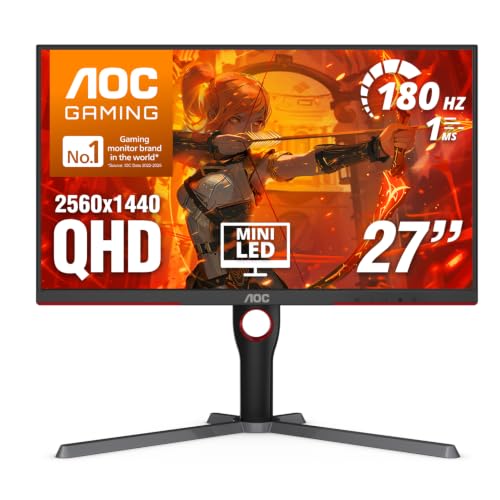
Best Value: AOC Q27G3XMN Mini-LED
Specs
Panel | 27-inch VA, Mini-LED backlight |
Dimming zones | 336 |
Resolution | 2560 x 1440 |
Refresh rate | 180Hz |
HDR | DisplayHDR 1000 |
Inputs | HDMI 2.1, DisplayPort 1.4 |
Stand | Height adjustable |
Panel
27-inch VA, Mini-LED backlight
Dimming zones
336
Resolution
2560 x 1440
Refresh rate
180Hz
HDR
DisplayHDR 1000
Inputs
HDMI 2.1, DisplayPort 1.4
Stand
Height adjustable
What it does well
The Q27G3XMN puts a 336-zone Mini-LED backlight behind a 1440p 180Hz VA panel and carries DisplayHDR 1000 certification. Reviewed.com measured roughly 1,200 nits on a full white window, a level of sustained brightness OLED panels cannot match. Highlights in Forza Horizon 5 or Cyberpunk 2077 read as light sources rather than gray patches.
The 180Hz ceiling suits the 4070's AAA numbers. Forza Horizon 5 at 1440p ultra lands around 132 FPS on the 4070 and 146 FPS on the Super, both inside the panel's range, so the money goes to HDR and contrast rather than refresh the card cannot use.
VA contrast helps in SDR too. A rated 4000:1 static contrast keeps night scenes from washing out the way IPS panels do.
What you give up
Mini-LED backlights bloom around small bright objects on dark backgrounds, and buyers have flagged visible halos on this model around white text and HUD elements on black. The dimming zones also take a moment to respond, which can show as a faint trail behind a bright cursor.
VA pixel response is slower in dark transitions than IPS, so fast esports play shows more smearing than on the LG. Also note that the Amazon listing title says 3440 x 1440; reports suggest the panel is the standard 2560 x 1440 27-inch screen and the listing text is a typo.
Who it's for
RTX 4070 owners who play mostly single-player AAA and want HDR that looks like HDR without paying OLED prices. If your library is mostly competitive shooters, the LG is the better fit.
Best Premium: MSI MAG 272QP QD-OLED X24

Specs
Panel | 26.5-inch QD-OLED |
Resolution | 2560 x 1440 |
Refresh rate | 240Hz |
Response time | 0.03ms GtG (rated) |
HDR | DisplayHDR True Black 400 |
Color | 99% DCI-P3 (rated) |
Inputs | 2x HDMI 2.1, DisplayPort 1.4a, USB-C (DP Alt, 15W) |
Stand | Tilt, height |
Panel
26.5-inch QD-OLED
Resolution
2560 x 1440
Refresh rate
240Hz
Response time
0.03ms GtG (rated)
HDR
DisplayHDR True Black 400
Color
99% DCI-P3 (rated)
Inputs
2x HDMI 2.1, DisplayPort 1.4a, USB-C (DP Alt, 15W)
Stand
Tilt, height
What it does well
QD-OLED gives every pixel its own light, so contrast is effectively infinite and response is rated at 0.03ms. At 240Hz, motion in fast shooters looks cleaner than on any LCD in this list, and the 4070 has the frames to drive it in esports titles.
The 272QP X24 brings that panel down to a mid-range price class. It carries two HDMI 2.1 ports, DisplayPort 1.4a and a USB-C input with DisplayPort Alt mode and 15W power delivery, so a laptop and a console can share the desk with the PC. MSI rates color coverage at 99 percent of DCI-P3.
In AAA games, OLED contrast does more for image quality than extra frames. A night drive in Cyberpunk 2077 looks like a different game next to an IPS panel, even at the 60 to 120 FPS the 4070 delivers with DLSS. Our 1440p OLED monitor guide covers the QD-OLED versus WOLED trade-offs in more depth.
What you give up
Burn-in is a real risk with static elements like taskbars and HUDs. Use the panel care features and a dark desktop theme if you work on this screen for hours.
Brightness is modest: around 200 nits full-screen in SDR and roughly 400 nits HDR peaks per MSI. This is also a newer model with few independent measured reviews, so most numbers here come from MSI's own spec sheet.
Who it's for
RTX 4070 Super owners, or 4070 owners with room in the budget, who want the best motion clarity and contrast at 1440p and can live with OLED care habits.
Best Budget: ASUS TUF VG27AQ3A

Specs
Panel | 27-inch Fast IPS |
Resolution | 2560 x 1440 |
Refresh rate | 180Hz |
Response time | 1ms GtG (rated) |
Motion | ELMB Sync |
Inputs | DisplayPort 1.4, 2x HDMI 2.0 |
Stand | Tilt and swivel, no height |
Panel
27-inch Fast IPS
Resolution
2560 x 1440
Refresh rate
180Hz
Response time
1ms GtG (rated)
Motion
ELMB Sync
Inputs
DisplayPort 1.4, 2x HDMI 2.0
Stand
Tilt and swivel, no height
What it does well
The VG27AQ3A is the cheapest route into a proper 1440p high-refresh IPS panel. Its 180Hz Fast IPS panel with 1ms rated response covers the 130 to 150 FPS the RTX 4070 family hits in Forza Horizon 5 without paying for refresh headroom it will not use.
ELMB Sync combines backlight strobing with variable refresh, which sharpens motion in fast games. G-Sync Compatible and FreeSync Premium support are both there, and DisplayPort 1.4 carries the full 180Hz.
For an RTX 4070 build where every line item matters, moving from a 1080p 75Hz screen to this panel is the largest visible upgrade available. Want more 27-inch options at the same resolution? See our 27-inch 1440p monitor roundup.
What you give up
The stand tilts and swivels but does not adjust for height, so plan on a monitor arm or a riser if eye level matters. HDR10 support is nominal; there is no real HDR brightness here.
HDMI is 2.0, so a console on HDMI tops out below the panel's full refresh. Contrast is typical IPS, so dark scenes look gray next to the AOC or the MSI.
Who it's for
Builders who stretched the budget for the RTX 4070 itself and need a 1440p screen that does not hold the card back. It also works as a second monitor next to an OLED. Coming from an older card? Our RTX 4060 Ti monitor guide covers the tier below.
Editor's Pick: ASUS TUF VG34VQ3B Ultrawide

Specs
Panel | 34-inch curved VA, 1500R |
Resolution | 3440 x 1440 |
Refresh rate | 180Hz (DisplayPort), 144Hz (HDMI) |
Contrast | 4000:1 (rated) |
HDR | DisplayHDR 400 |
Inputs | 2x DisplayPort 1.4, 2x HDMI 2.0 |
Sync | FreeSync Premium, ELMB Sync |
Panel
34-inch curved VA, 1500R
Resolution
3440 x 1440
Refresh rate
180Hz (DisplayPort), 144Hz (HDMI)
Contrast
4000:1 (rated)
HDR
DisplayHDR 400
Inputs
2x DisplayPort 1.4, 2x HDMI 2.0
Sync
FreeSync Premium, ELMB Sync
What it does well
3440 x 1440 has about 34 percent more pixels than 2560 x 1440, and the RTX 4070 handles that load in most AAA games with DLSS Quality. The 34-inch 1500R curve fills peripheral vision in racing games, flight sims and open-world titles in a way a 27-inch panel cannot.
The 180Hz VA panel with a rated 4000:1 contrast ratio gives deeper blacks than IPS ultrawides in this class, and ELMB Sync plus FreeSync Premium keep motion clean. The 4070 will rarely touch 180 FPS at this resolution in AAA games, but variable refresh keeps whatever it renders smooth.
What you give up
The full 180Hz works only over DisplayPort; HDMI tops out at 144Hz, which matters if a console shares the screen. HDR is DisplayHDR 400, so treat it as an SDR monitor.
VA dark-transition smearing shows in fast shooters, and some older games and cutscenes do not support 21:9, leaving black bars on the sides. The 4070's 12 GB of VRAM is also more of a limit at ultrawide than at 16:9 1440p in texture-heavy titles.
Who it's for
RTX 4070 and 4070 Super owners who play racing, simulation and story-driven AAA games and want immersion over esports refresh. Competitive players should stay on the 27-inch 240Hz LG.
Bottom line
If you want one monitor that fits both esports and AAA on an RTX 4070, buy the LG UltraGear 27GR83Q-B. If HDR matters more than refresh rate, buy the AOC Q27G3XMN. If you want OLED contrast and motion clarity, buy the MSI MAG 272QP QD-OLED X24. If budget is tight, the ASUS TUF VG27AQ3A gets you 1440p at 180Hz. If immersion beats competitive play, buy the ASUS TUF VG34VQ3B. Skip 4K 240Hz panels on this card.
FAQ
Is the RTX 4070 good for a 4K monitor?
It can drive one, but 4K is not the right primary target. In Dexerto's testing, Forza Horizon 5 at 4K ultra ran 89 FPS on the 4070 and 109 FPS on the 4070 Super, and ray-traced games fall far lower without DLSS. The 12 GB VRAM pool is tight for 4K textures in newer games, and the DisplayPort 1.4a output needs compression for 4K at high refresh. A 4K 144Hz panel works with DLSS Quality or Performance, but a 1440p panel is the better match.
Should I get a 165Hz or 240Hz 1440p monitor for an RTX 4070?
For a mostly AAA library, 165Hz to 180Hz is enough, since the RTX 4070 lands around 80 to 140 FPS at 1440p in demanding games. If you play esports titles like Overwatch 2, Valorant or CS2, buy 240Hz: both the 4070 and the 4070 Super render well above 240 FPS there, and the extra refresh is visible. Variable refresh smooths frame rates below the panel's maximum either way, so a 240Hz panel does not hurt slower games.
Is an OLED monitor worth it with an RTX 4070?
Yes, if you can live with burn-in care. A 1440p 240Hz QD-OLED like the MSI MAG 272QP QD-OLED X24 gives per-pixel contrast and near-instant response, which helps dark AAA scenes and fast shooters alike, and the RTX 4070 has the frames to use 240Hz in esports games. The downsides are lower full-screen brightness than Mini-LED and burn-in risk with static HUDs or desktop work. If static content sits on screen for hours a day, an IPS or Mini-LED panel is the safer pick.
Can an RTX 4070 run a 3440 x 1440 ultrawide monitor?
Yes. 3440 x 1440 has about 34 percent more pixels than standard 1440p, so expect frame rates to drop by roughly a quarter in GPU-bound games. With DLSS Quality, most AAA games stay comfortably above 60 FPS on the 4070 and higher on the 4070 Super. A 165Hz to 180Hz ultrawide like the ASUS TUF VG34VQ3B is a sensible ceiling; a 240Hz OLED ultrawide is more refresh than this card can use in AAA games.
Does the RTX 4070 Super change which monitor I should buy?
Not much. The 4070 Super runs about 10 to 20 percent faster than the 4070 in the review numbers above, for example 146 versus 132 FPS in Forza Horizon 5 at 1440p ultra. Both cards share the same 12 GB of VRAM and DisplayPort 1.4a output, so the same 1440p 180Hz to 240Hz panels fit both. The Super makes a 240Hz panel a little easier to justify in AAA games and gives a 3440 x 1440 ultrawide more headroom.
Related Articles

Best Gaming Monitors for the RTX 5070 (2026): 1440p to 4K OLED
Five monitors paired to the RTX 5070 by resolution tier: 1440p 240Hz IPS, 4K OLED, and ultrawide. Includes DLSS 4 reality check and pairing framework.
Jun 3, 2026

Best 1440p OLED Gaming Monitors (2026): QD-OLED vs WOLED Picks
The best 1440p OLED gaming monitors of 2026, from value-tier 360Hz QD-OLED to 480Hz WOLED flagship. With burn-in mitigation guidance.
May 14, 2026

Best 27-Inch Gaming Monitors (2026): 6 High-FPS Picks
The best 27-inch gaming monitors for 2026: six high-FPS picks from 180Hz IPS to 480Hz OLED, ranked by panel type, refresh rate, and what each one gives up.
Aug 4, 2026

RTX 4070 Upgrade in 2026: Worth It? The 16GB Threshold
Is upgrading from an RTX 4070 worth it in 2026? Mostly no. Here is the 16GB threshold that justifies a move, the card that clears it, and what to buy instead.
Sep 1, 2026

How to Choose a GPU (and a Monitor That Matches)
A buyer's framework for picking a GPU and the monitor that pairs with it. Start with the panel and work the card back.
May 17, 2026