Affiliate Disclosure: As an Amazon Associate we earn from qualifying purchases. Some links may earn us a commission at no cost to you.

Best Monitor Arms for Ultrawide and 32-Inch Monitors (2026)
Every monitor arm listing leads with one number, the maximum load, and that number alone will not tell you whether the arm holds your panel. Gas-spring arms have a minimum too, and the current crop of ultrawide and 32-inch OLEDs lands awkwardly between the two. Stand-removed, the panels most people are shopping weigh 11 to 21 lb. That sits under the floor of the heavy-duty tier and, at the top end, over the ceiling of the budget tier.
This guide runs the fit check in both directions: five arms with their full rated ranges, and a table matching those ranges against the real weights of panels we already recommend.
Our top pick: Ergotron HX Monitor Arm
The Ergotron HX is the only arm here rated to 42 lb at a 49-inch diagonal, which makes it the one option that holds a 45-inch 5K2K panel at full reach without the joint creeping. Confirm your panel clears 20 lb first, because that is where its range starts.

Quick picks
Pick | Arm | Rated load | Fits up to | Buy |
|---|---|---|---|---|
Best Overall | 20 to 42 lb | 49 in | ||
Best Value | Up to 33 lb | 49 in | ||
Best Premium | 6 to 28 lb | Weight rated | ||
Best Budget | Up to 37.4 lb | 49 in | ||
Editor's Pick | 7 to 25 lb | 34 in |
Best Overall
- Arm
- Rated load
20 to 42 lb
- Fits up to
49 in
- Buy
Best Value
- Arm
- Rated load
Up to 33 lb
- Fits up to
49 in
- Buy
Best Premium
- Arm
- Rated load
6 to 28 lb
- Fits up to
Weight rated
- Buy
Best Budget
- Arm
- Rated load
Up to 37.4 lb
- Fits up to
49 in
- Buy
Editor's Pick
- Arm
- Rated load
7 to 25 lb
- Fits up to
34 in
- Buy
Specs at a glance
Arm | Rated load | Max size | VESA | Mount |
|---|---|---|---|---|
20 to 42 lb | 49 in | 75x75, 100x100, 200x200 via kit | Two-piece clamp, grommet | |
Up to 33 lb | 49 in | 75x75, 100x100 max | Clamp, grommet | |
6 to 28 lb | Weight rated | 75x75, 100x100 | Two-piece clamp and base | |
Up to 37.4 lb | 49 in | 75x75, 100x100 | Dual C-clamp, grommet | |
7 to 25 lb | 34 in | 75x75, 100x100 | Clamp, grommet |
- Rated load
20 to 42 lb
- Max size
49 in
- VESA
75x75, 100x100, 200x200 via kit
- Mount
Two-piece clamp, grommet
- Rated load
Up to 33 lb
- Max size
49 in
- VESA
75x75, 100x100 max
- Mount
Clamp, grommet
- Rated load
6 to 28 lb
- Max size
Weight rated
- VESA
75x75, 100x100
- Mount
Two-piece clamp and base
- Rated load
Up to 37.4 lb
- Max size
49 in
- VESA
75x75, 100x100
- Mount
Dual C-clamp, grommet
- Rated load
7 to 25 lb
- Max size
34 in
- VESA
75x75, 100x100
- Mount
Clamp, grommet
Will your monitor fit?
Pull the stand-removed weight off the spec sheet, not the shipping weight and not the weight with the stand attached. Manufacturers publish all three, and the gap runs 4 to 6 lb on a 34-inch panel, which is enough to push a borderline pick over an arm's ceiling or under its floor. The figures below come from manufacturer sheets for panels in our 1440p ultrawide guide and the roundups linked in the table.
The other surprise here is how uniform the mounting pattern is. All seven of these panels use VESA 100x100, including the 45-inch. The pattern almost never decides the purchase. The rated range and the diagonal cap do.
Monitor | Weight, no stand | Arms that clear it | Our guide |
|---|---|---|---|
Alienware AW3425DW (34 in) | 11.2 lb | LX, V101G1, ErGear, M8.1 | |
Samsung Odyssey OLED G8 G85SD (34 in) | 12.1 lb | LX, V101G1, ErGear, M8.1 | |
ASUS ROG Swift PG32UCDM (32 in) | 13.2 lb | LX, V101G1, ErGear, M8.1 | |
ASUS ROG Strix XG34WCDG (34 in) | 13.7 lb | LX, V101G1, ErGear, M8.1 | |
LG UltraGear 39GX950B (39 in) | 15.0 lb | V101G1, ErGear, M8.1 | |
LG UltraGear 45GX950A (45 in) | 20.7 lb | HX, V101G1, ErGear, M8.1 | |
MSI MPG 321URX (32 in) | 21.2 lb | HX, V101G1, ErGear, M8.1 |
Alienware AW3425DW (34 in)
- Weight, no stand
11.2 lb
- Arms that clear it
LX, V101G1, ErGear, M8.1
- Our guide
Samsung Odyssey OLED G8 G85SD (34 in)
- Weight, no stand
12.1 lb
- Arms that clear it
LX, V101G1, ErGear, M8.1
- Our guide
ASUS ROG Swift PG32UCDM (32 in)
- Weight, no stand
13.2 lb
- Arms that clear it
LX, V101G1, ErGear, M8.1
- Our guide
ASUS ROG Strix XG34WCDG (34 in)
- Weight, no stand
13.7 lb
- Arms that clear it
LX, V101G1, ErGear, M8.1
- Our guide
LG UltraGear 39GX950B (39 in)
- Weight, no stand
15.0 lb
- Arms that clear it
V101G1, ErGear, M8.1
- Our guide
LG UltraGear 45GX950A (45 in)
- Weight, no stand
20.7 lb
- Arms that clear it
HX, V101G1, ErGear, M8.1
- Our guide
MSI MPG 321URX (32 in)
- Weight, no stand
21.2 lb
- Arms that clear it
HX, V101G1, ErGear, M8.1
- Our guide
How we picked
Weight first, and in the direction most buyers skip. An arm's range has two ends, and a panel below the minimum will not hold a low position: the cylinder cannot be de-tensioned far enough, so the arm creeps upward every time you push it down. Buyers who hit this end up bolting ballast plates to the back of the monitor, which is a workaround for having bought the wrong arm.
Diagonal second, as a separate gate. Weight and width are different loads. A 39-inch panel at 15 lb sits comfortably inside the Ergotron LX's 7 to 25 lb range and still fails its 34-inch rating, because the extra width multiplies the torque on the same joint. Both numbers have to pass independently.
VESA pattern third, and last for a reason. Nearly every ultrawide and 32-inch panel in our monitor coverage uses 100x100. Where it goes wrong is the recessed-mount case: buyers have flagged that some revisions of the 34-inch Samsung Odyssey OLED G8 want an adapter plate before a standard arm will bolt on, and a small aftermarket of model-specific brackets exists because of it.
Desk depth fourth, the constraint nobody reads until the clamp will not close. Ergotron clamps take desk tops from 0.4 to 2.4 inches; the ErGear C-clamp reaches 3.15 inches. Thin dorm desks and thick butcher-block tops both fall outside somebody's range, so measure before you order. If the desk is still undecided, our compact desk picks cover clamp depth and grommet placement.
Best Overall: Ergotron HX Monitor Arm
Specs
Rated load | 20 to 42 lb |
Max screen size | 49 inches |
VESA | 75x75, 100x100 (200x200 via adapter kit) |
Lift | 11.5 inches |
Extension | 23.6 inches |
Mount | Two-piece desk clamp, grommet |
Warranty | 10 years |
Rated load
20 to 42 lb
Max screen size
49 inches
VESA
75x75, 100x100 (200x200 via adapter kit)
Lift
11.5 inches
Extension
23.6 inches
Mount
Two-piece desk clamp, grommet
Warranty
10 years
What it does well
The ceiling is the headline and it earns the slot. A 42 lb rating is roughly double what the mid-tier offers, and the 49-inch diagonal rating means the arm is qualified for a super-ultrawide rather than merely willing to hold one. Construction is steel, and the two-piece desk clamp spreads the load along the desk edge instead of concentrating it under a single pad. That is what you want under 20 lb of glass hanging 20 inches out.
Reach and lift are generous for the class: 23.6 inches of horizontal travel, 11.5 inches of vertical. That covers a deep desk and the full height swing of a sit-stand setup without the panel drooping at the far end. Ergotron backs it for ten years.
The 200x200 adapter path matters for the small number of large-format panels that skip the 100x100 pattern. Most buyers never need it. The ones who do have no alternative in this price bracket.
What you give up
The 20 lb minimum is the catch, and it is not a formality. Five of the seven panels in the fit table above weigh less than that stand-removed. Hanging a 13 lb monitor on a spring calibrated for 20 to 42 lb gives you an arm that will not stay down, and no amount of tension adjustment recovers it. That is a mis-purchase, not a tuning problem.
It is also the priciest option here outside the Humanscale, and this listing ships the standard pivot rather than the HD pivot the tightly curved variant carries. If your panel is a 1000R curve, check which pivot you are buying.
Who it's for
Buy it if your panel is a 45 or 49-inch super-ultrawide, or a 32-inch at the heavy end like the MSI MPG 321URX. Confirm the stand-removed weight clears 20 lb before you order.
Best Value: VIVO STAND-V101G1 Monitor Arm

Specs
Rated load | Up to 33 lb |
Max screen size | 49 inches |
VESA | 75x75, 100x100 max |
Height | Pneumatic spring |
Mount | Desk clamp, grommet |
Extras | Quick-release VESA plate, cable routing |
Rated load
Up to 33 lb
Max screen size
49 inches
VESA
75x75, 100x100 max
Height
Pneumatic spring
Mount
Desk clamp, grommet
Extras
Quick-release VESA plate, cable routing
What it does well
Nothing else here covers the whole table. The 33 lb ceiling and the 49-inch diagonal rating together clear all seven panels in the fit check, from the 11.2 lb Alienware AW3425DW up to the 21.2 lb MSI MPG 321URX, at a small fraction of what the Ergotron costs.
The hardware is better than the price implies. Aluminum arm sections, a quick-release VESA plate so you are not holding a 20 lb panel one-handed while hunting for screws, and an elbow tension gauge that turns spring setup into a reading rather than a guess. Clamp and grommet hardware both come in the box.
What you give up
VIVO publishes no minimum rated load. On a 33 lb arm that omission bites hardest at the light end, and an 11 lb panel may want the tension backed all the way off before it holds position. The gauge helps. The missing spec still means you find out on your own desk.
VESA tops out at 100x100 with no larger adapter path, so a panel on a wider pattern is out. Aluminum joints do not have the decade-long damping record of the steel Ergotrons, and the warranty is shorter to match.
Who it's for
The default recommendation for a single 34 or 39-inch ultrawide, and for anyone who wants one arm that survives two monitors.
Best Premium: Humanscale M8.1 Monitor Arm

Specs
Rated load | 6 to 28 lb |
VESA | 75x75, 100x100 |
Mechanism | Weight-compensating mechanical spring |
Feature | Smart Stop travel limiter |
Mount | Two-piece clamp and base |
Build | Cast aluminum |
Rated load
6 to 28 lb
VESA
75x75, 100x100
Mechanism
Weight-compensating mechanical spring
Feature
Smart Stop travel limiter
Mount
Two-piece clamp and base
Build
Cast aluminum
What it does well
The mechanism is the reason to pay for it. Instead of a gas cylinder, the M8.1 runs a weight-compensating mechanical spring, so the failure mode this whole article circles does not apply. Its range starts at 6 lb, the lowest here by a wide margin, which puts an 11 lb 34-inch OLED comfortably inside the rating rather than scraping the bottom of it.
Mechanical counterbalance also ages differently. A gas cylinder loses pressure over years and the panel starts to sag; a spring has no equivalent mode. Smart Stop sets a travel limit so the monitor stops short of the desk surface instead of finding it.
Fit and finish are the best on this list by some distance, which is the other thing the price buys.
What you give up
It costs more than any other arm here, in a category where the option below it covers more panels. The 28 lb ceiling rules out the heaviest large-format displays, and Humanscale rates by weight without publishing a diagonal cap, so a 45-inch panel inside the weight range is still a judgment call you make alone.
Adjustment is deliberately firm. Repositioning takes a push rather than a nudge, which reads as solidity to some buyers and as stiffness to others.
Who it's for
For a light or mid-weight OLED ultrawide when you want the arm to outlast the panel, and for anyone who has already watched a gas spring sag.
Best Budget: ErGear Heavy Duty Monitor Arm
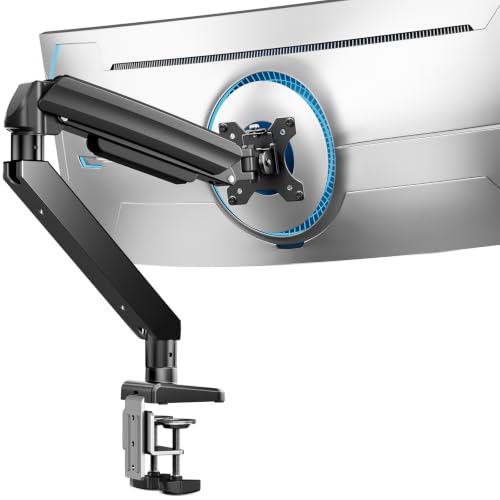
Specs
Rated load | Up to 37.4 lb |
Screen size | 13 to 49 inches |
VESA | 75x75, 100x100 |
Mount | Dual C-clamp, grommet |
Motion | Full motion, tilt, swivel, rotate |
Rated load
Up to 37.4 lb
Screen size
13 to 49 inches
VESA
75x75, 100x100
Mount
Dual C-clamp, grommet
Motion
Full motion, tilt, swivel, rotate
What it does well
The interesting number is 37.4 lb, because the entry tier normally stops at 19.8. That single spec separates this from the pile of near-identical gas-spring arms that cover a 34-inch OLED and quietly fail a 45-inch one. The 13 to 49-inch size rating is equally unusual at this price.
Both mounting options are included, and the C-clamp reaches 3.15 inches, deeper than either Ergotron, which makes it the easier fit on a thick desk top. Motion is the standard full range: tilt, swivel, and 360-degree rotation.
What you give up
The specs are a listing claim with no third-party load testing behind them, and ErGear publishes neither a minimum load nor lift and extension figures. Treat the 37.4 lb rating as nominal headroom rather than proven capacity, and treat the missing minimum the same way you treat VIVO's.
There is no long warranty to fall back on either. That is a reasonable trade under a mid-weight panel and a harder one to defend under a flagship OLED, where the arm is insurance for the most expensive thing on the desk.
Who it's for
A second desk, a temporary setup, or a build where the panel took the whole budget. Reasonable under a mid-weight ultrawide, harder to recommend under a 45-inch flagship.
Editor's Pick: Ergotron LX Monitor Arm

Specs
Rated load | 7 to 25 lb |
Max screen size | 34 inches |
VESA | 75x75, 100x100 |
Lift | 13 inches |
Extension | 25 inches |
Motion | 75 degree tilt, 360 pan, 360 rotate |
Warranty | 10 years |
Rated load
7 to 25 lb
Max screen size
34 inches
VESA
75x75, 100x100
Lift
13 inches
Extension
25 inches
Motion
75 degree tilt, 360 pan, 360 rotate
Warranty
10 years
What it does well
For most people reading this, the LX is the right Ergotron and the HX is the one the word heavy talked them into. Its 7 to 25 lb range brackets every 32 and 34-inch panel in the fit table with headroom at both ends, which is precisely what the HX cannot do.
It also moves further than its bigger sibling: 25 inches of extension and 13 inches of lift, against 23.6 and 11.5 on the HX, because it carries less. Same ten-year warranty, same clamp quality, considerably less money.
What you give up
The 34-inch diagonal cap is a hard wall, and it binds long before the weight rating does. A 39-inch LG UltraGear at 15 lb sits well inside the LX's weight range and is still out of spec, because width multiplies the torque on the joint even when the mass does not change. Do not talk yourself past that number.
This configuration is single-monitor only, so a two-panel desk means either a second arm or a different product entirely.
Who it's for
Anyone mounting one 32-inch 4K panel or one 34-inch ultrawide. If your shortlist came out of our 4K HDR panels roundup, this is almost certainly the arm.
Bottom line
If your panel is a 45 or 49-inch super-ultrawide over 20 lb, buy the Ergotron HX Monitor Arm. If it is a 34 or 39-inch OLED, buy the VIVO STAND-V101G1, the only arm here that covers the entire weight table. If you are mounting a single 32-inch 4K or 34-inch ultrawide and want it to last, buy the Ergotron LX. If the panel is light and the arm needs to outlive it, the Humanscale M8.1 has no gas cylinder to lose. And if the budget went into the monitor, the ErGear clears the 19.8 lb wall its price bracket usually does not. If the panel itself is still undecided, start with how to choose a gaming monitor.
FAQ
What weight monitor arm do I need for a 34-inch ultrawide?
Most 34-inch ultrawides weigh 11 to 14 lb with the stand removed, so you want an arm whose rated range covers that band at the bottom as well as the top. The Ergotron LX at 7 to 25 lb and the Humanscale M8.1 at 6 to 28 lb both do. A 20 to 42 lb heavy-duty arm does not, and it will drift upward under a panel that light.
Can a monitor arm hold a 49-inch super-ultrawide?
Yes, if it is rated for the diagonal as well as the weight. The Ergotron HX, the VIVO STAND-V101G1 and the ErGear all carry a 49-inch size rating. Arms rated to 34 or 38 inches do not, regardless of how much weight they claim, because a size rating is about leverage rather than mass. Check both numbers on the listing before you order.
Do ultrawide monitors use VESA 100x100 or 200x200?
Almost all of them use 100x100, including the 45-inch 5K2K panels. The 200x200 and 400x400 patterns turn up on large-format displays and TVs rather than desktop ultrawides. If a panel does use a wider pattern, the Ergotron HX takes an adapter kit; most arms in this bracket do not.
Why does my monitor arm keep drifting upward?
The panel is lighter than the arm's minimum rated load. A gas cylinder is calibrated for a weight band, and below the floor the monitor cannot compress it enough to hold a low position, so the arm rises whenever you push it down. Tension adjustment will not rescue a panel that is genuinely under the minimum. The fix is an arm whose range starts lower.
Is a gas spring or a mechanical spring arm better for a heavy OLED?
Gas springs are more common and adjust more easily, and a well-matched one is fine. Mechanical spring arms like the Humanscale M8.1 do not lose pressure over years, so they hold their set height further into the arm's life. If the monitor is expensive and the arm needs to survive two panels, the mechanical option is the safer long-run choice.
Do I need a dual monitor arm for two 32-inch monitors?
Two 32-inch panels at 13 to 21 lb each will exceed most dual-arm ratings, which are quoted per arm and often stop near 17 lb. Two separate single arms is the more reliable route at that weight, and it lets you position each panel independently. Check desk clamp spacing before you commit, since two clamps need room.
Related Articles

Best Curved Ultrawide Gaming Monitors (2026): 34 to 45 Inch
The best curved ultrawide gaming monitors for 2026, from a 34-inch QD-OLED value champion to 45-inch 5K2K immersion. Pick your size first, then your panel.
Jun 23, 2026

Best 1440p Ultrawide Gaming Monitors 2026: 5 OLED/IPS Picks
The best 1440p ultrawide gaming monitor in 2026 is the Alienware AW3425DW QD-OLED. Five 3440x1440 picks by curve, refresh, and the GPU each one needs.
Aug 5, 2026

Best 4K Gaming Monitor 2026: 5 OLED, Mini-LED and IPS Picks
Best 4K gaming monitor picks for 2026: OLED, Mini-LED and IPS compared from 144Hz to 240Hz, with the GPU each tier needs and a budget IPS entry point.
Aug 16, 2026

How to Choose a Gaming Monitor: 2026 Buyer's Guide
How to choose a gaming monitor in 2026: match resolution, refresh rate, and panel type to your GPU so you never overpay for pixels your card cannot push.
Jul 19, 2026

Best Compact Gaming Desks for Small Rooms and Dorms (2026)
The best compact gaming desks for small rooms and dorms, picked depth-first so your monitor sits at a comfortable distance without eating up your floor.
Jul 15, 2026