Affiliate Disclosure: As an Amazon Associate we earn from qualifying purchases. Some links may earn us a commission at no cost to you.

What Sim Rig Does Max Verstappen Use? F1 Pro Rigs 2026
Max Verstappen races sims between grands prix, and his sim rig is not one rig. Rig-profile sites document a Leo Bodnar base and Heusinkveld pedals in his Monaco setup, plus a separate Simucube rig that travels to race weekends with his team.
None of that hardware is sold on Amazon. So this breakdown does two jobs: it collects what F1 drivers are documented to run, then names the part you can order today that behaves the same way one tier down.
Our top pick: MOZA R12 V2 Wheelbase
The wheelbase decides whether a rig reads like a car or like a spring. 12 Nm is the first tier where a formula rim loads and unloads the way the pro bases do, and the MOZA R12 V2 is the version of that you can order today.

Quick picks
Part | Amazon pick | What the pros run | Buy |
|---|---|---|---|
Wheelbase | Leo Bodnar SimSteering2, Simucube 2 Pro | ||
Steering wheel | PSE LM-X, Ascher Racing Artura | ||
Pedals | Heusinkveld Ultimate+, Simucube ActivePedal | ||
Cockpit | Playseat F1 Ultimate, Sim-Lab P1-X | ||
Display | Triple 32-inch array |
Wheelbase
- Amazon pick
- What the pros run
Leo Bodnar SimSteering2, Simucube 2 Pro
- Buy
Steering wheel
- Amazon pick
- What the pros run
PSE LM-X, Ascher Racing Artura
- Buy
Pedals
- Amazon pick
- What the pros run
Heusinkveld Ultimate+, Simucube ActivePedal
- Buy
Cockpit
- Amazon pick
- What the pros run
Playseat F1 Ultimate, Sim-Lab P1-X
- Buy
Display
- Amazon pick
- What the pros run
Triple 32-inch array
- Buy
What Max Verstappen's sim rig actually runs
Driver | Wheelbase | Pedals | Cockpit |
|---|---|---|---|
Max Verstappen (home) | Leo Bodnar SimSteering2, about 26 Nm | Heusinkveld Sim Pedals Ultimate+ | Playseat F1 Ultimate |
Max Verstappen (travel) | Simucube 2 Pro, 25 Nm | Simucube ActivePedal | Sim-Lab P1-X |
Lando Norris | Leo Bodnar SimSteering2, 26 Nm | Cool Performance hydraulic | Cool Performance custom, triple 32-inch |
George Russell | Simucube 2 Ultimate | Heusinkveld Ultimate | Sim-Lab P1-X |
Charles Leclerc | Fanatec Podium | Fanatec ClubSport F1 | Playseat Formula Intelligence |
Max Verstappen (home)
- Wheelbase
Leo Bodnar SimSteering2, about 26 Nm
- Pedals
Heusinkveld Sim Pedals Ultimate+
- Cockpit
Playseat F1 Ultimate
Max Verstappen (travel)
- Wheelbase
Simucube 2 Pro, 25 Nm
- Pedals
Simucube ActivePedal
- Cockpit
Sim-Lab P1-X
Lando Norris
- Wheelbase
Leo Bodnar SimSteering2, 26 Nm
- Pedals
Cool Performance hydraulic
- Cockpit
Cool Performance custom, triple 32-inch
George Russell
- Wheelbase
Simucube 2 Ultimate
- Pedals
Heusinkveld Ultimate
- Cockpit
Sim-Lab P1-X
Charles Leclerc
- Wheelbase
Fanatec Podium
- Pedals
Fanatec ClubSport F1
- Cockpit
Playseat Formula Intelligence
Start with Verstappen, because the answer is two answers. The permanent setup in Monaco is reported to run a Leo Bodnar SimSteering2 wheelbase at around 26 Nm with Heusinkveld Sim Pedals Ultimate+ bolted into a Playseat F1 Ultimate. The rig that travels with the team is standardised on Simucube instead, a 2 Pro base with the ActivePedal brake in a Sim-Lab P1-X frame that reportedly breaks down and rebuilds in under an hour. Same driver, two philosophies: one built for feel, one built for a flight case.
Lando Norris went a different route and built the hardware. Cool Performance, the company he runs with his brother, made the cockpits in his home setup, including a single-seater frame and a GT variant, with hydraulic pedals of their own and a triple 32-inch screen array plus a fourth panel for timing. The wheelbase underneath is the same Leo Bodnar unit Verstappen uses at home.
George Russell's profile lists a Simucube 2 Ultimate with Heusinkveld Ultimate pedals in a Sim-Lab P1-X, which is close to Verstappen's travel spec at a higher torque tier. Charles Leclerc is the outlier: reports put him on Fanatec Podium hardware with a ClubSport F1 rim across two Playseat cockpits, one for open-wheel and one for rally and drifting, fed by a 49-inch Samsung panel.
Look past the brand names and the pattern is boring, which is the useful part. Every rig is high-torque direct drive, every brake reads pressure rather than travel, every cockpit is rigid enough that the base cannot twist it, and every screen setup is wide enough to see an apex you are not pointed at. The same four priorities show up in the rigs the top iRacing pros run, which is a decent sign they are the priorities and not a fashion.
How we picked the Amazon equivalents
The pro parts are direct-sale. Leo Bodnar, Heusinkveld, Simucube, PSE and Cool Performance do not sell through Amazon, so a shopping list of the same parts would be a shopping list you cannot use. Every pick below was chosen to reproduce a behaviour instead of a badge.
That means matching mechanism first. Direct drive stays direct drive rather than dropping to a belt base. A load-cell brake stays a load cell rather than a potentiometer. A rigid cockpit stays rigid enough for the torque in front of it. Where the pro tier wins is headroom, not category, and headroom is the cheapest thing to give up. If you want the wider field of candidates at each torque tier, our direct drive wheel picks for iRacing and Assetto Corsa covers the ladder below this one.
The order of spend matters more than any single part. Base first, because it is the only component that changes what the car tells you. Brake second, because braking is where consistency is won. Cockpit third, because the first two are wasted without it. Rim fourth, screen last.
What not to copy from a pro rig
Do not copy the torque number. A 26 Nm base bolted to a flexing desk delivers less usable feel than 12 Nm on a frame that holds still, because the flex arrives as delay and delay is what you cannot drive around. Rigidity is the multiplier on every Newton metre you buy.
Do not mix ecosystems either. Quick releases are proprietary, so a Fanatec formula rim does not mount to a MOZA base, and the replica ladder only assembles if you buy it inside one family. And do not start with the screen. A wide panel in front of a soft rig flatters nothing. If the cockpit is the weak link, fix that first with something from our sim racing cockpit picks.
Wheelbase: MOZA R12 V2 (12 Nm Direct Drive)
This is the part the whole pro-rig question is really about. The drivers run 25 to 26 Nm workshop-grade bases; this is the same motor type with the peak force scaled to a room you also sleep near.
Specs
Type | Direct drive servo |
Peak torque | 12 Nm |
Encoder | 21-bit magnetic |
Housing | Aviation-grade aluminum alloy |
Mounting | Bottom four-hole plus front-mount holes |
Quick release | MOZA QR |
Platform | PC |
Type
Direct drive servo
Peak torque
12 Nm
Encoder
21-bit magnetic
Housing
Aviation-grade aluminum alloy
Mounting
Bottom four-hole plus front-mount holes
Quick release
MOZA QR
Platform
PC
What it does well
12 Nm is enough torque to feel the front axle take load and then give it back, which is the signal that tells you where the grip went. Below roughly 8 Nm that transition gets smoothed into a general heaviness. Above 12 Nm you are mostly buying headroom you will clip anyway on a folding cockpit.
The 21-bit magnetic encoder is the less obvious half. It splits each rotation into over two million steps, so small corrections at the limit stay legible instead of blurring into the main force. MOZA's NexGen 4.0 force feedback runs iRacing's 360 Hz telemetry rate, and the aluminium housing with active temperature management keeps output steady through a long stint rather than fading as the motor heats.
What you give up
You are giving up roughly half the peak torque of the Leo Bodnar and Simucube bases in the driver rigs, and there is no honest way around that. In practice the ceiling you hit first is the mount, not the motor.
It is PC only, so console sim racers are out. The MOZA quick release also means your next rim is a MOZA rim, which is fine while you stay in the ecosystem and annoying the day you want something exotic.
Who it's for
The right base for a first direct-drive rig built around F1 and GT sims, for someone who wants the pro mechanism without pro-tier mounting hardware to hang it from.
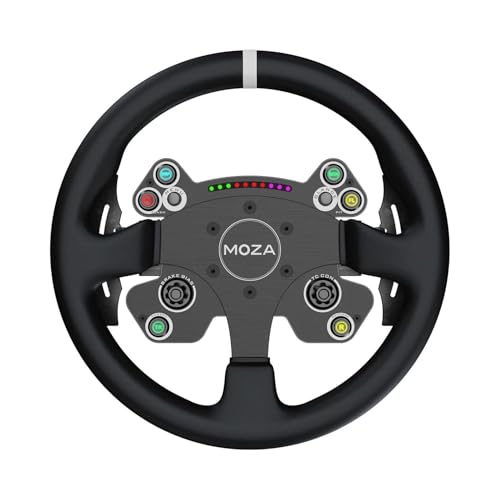
Steering wheel: MOZA CS V2P (13-inch)
The rims on the driver rigs come from PSE and Ascher Racing, formula wheels built in small batches. The Amazon-side equivalent is a compact flat rim with proper paddles.
Specs
Diameter | 13 inches |
Rim | Aviation-grade aluminum, microfiber leather grip |
Paddles | Forged carbon, contactless photoelectric |
Buttons | 6 programmable |
Joysticks | 2 |
Lighting | 10 RGB beads |
Mount | MOZA quick release |
Diameter
13 inches
Rim
Aviation-grade aluminum, microfiber leather grip
Paddles
Forged carbon, contactless photoelectric
Buttons
6 programmable
Joysticks
2
Lighting
10 RGB beads
Mount
MOZA quick release
What it does well
13 inches is the useful part. Single-seater steering is fast and small, and a 300 mm GT wheel makes fast corrections feel vague by comparison. The aluminium face and back plates keep the rim from flexing when you load it, which matters more at 12 Nm than most spec sheets admit.
The paddles are forged carbon on a contactless photoelectric sensor, so shifts register without the mushy overtravel of a cheap microswitch and there is no contact surface to wear out. Six programmable buttons, two joysticks and two rotary encoders cover pit limiter, brake bias and the rest without reaching for the keyboard. The 10 RGB beads run as shift lights once you configure them in MOZA Pit House.
What you give up
There is no screen and no dual clutch, so launch procedures stay manual. Button density is far below a real F1 wheel, which is a fair trade at this tier but worth knowing if you came here from photos of Verstappen's rim.
It mounts on the MOZA quick release and nothing else. Buy it as part of the ecosystem decision, not as a standalone rim.
Who it's for
Anyone pairing a MOZA base who wants a formula-shaped wheel they will not outgrow in a season of open-wheel racing.
Pedals: MOZA CRP2 (200 kg Load Cell)
If you copy one thing from these rigs, copy the brake. Heusinkveld Ultimate+ sits under both Verstappen's and Russell's setups, and the CRP2 uses the same working principle.

Specs
Set | Throttle plus brake |
Brake sensor | 200 kg load cell |
Angle sensor | 15-bit |
Brake feel | Damping blocks at 55, 70, 80 and 98 hardness |
Build | CNC aluminum with carbon fiber heel plate |
Adjustment | Tool-free |
Platform | PC and Xbox |
Set
Throttle plus brake
Brake sensor
200 kg load cell
Angle sensor
15-bit
Brake feel
Damping blocks at 55, 70, 80 and 98 hardness
Build
CNC aluminum with carbon fiber heel plate
Adjustment
Tool-free
Platform
PC and Xbox
What it does well
The brake reads pressure through a 200 kg load cell rather than measuring how far the pedal travelled. That is the whole difference: your leg reproduces force far more reliably than it reproduces distance, so threshold braking becomes repeatable instead of a guess that happens to work on lap three.
Four damping-block hardnesses at 55, 70, 80 and 98 let you set the pedal anywhere from road-car soft to formula stiff, and MOZA quotes 125 brake-feel combinations across the adjustment range. The frame is CNC aluminium with a carbon fibre heel plate, and adjustment is tool-free, which matters because you will move the brake stop three times in the first week.
What you give up
It is a two-pedal set. Throttle and brake only, so anything needing a clutch means adding one later. For F1 and most GT racing that is not a real loss.
You are not getting hydraulic damping, and you are certainly not getting the active force feedback brake Verstappen's team has run since 2024. A 200 kg load cell also needs a cockpit that will not slide, which is the next line item on this list.
Who it's for
The upgrade for a driver whose lap times are fine on one lap and scattered over ten, which is almost always a braking-consistency problem rather than a base problem.
Cockpit: Playseat Challenge (Foldable)
Playseat is the brand under both Verstappen's home rig and Leclerc's, just several tiers up. The Challenge is the version that fits a room you also live in.

Specs
Frame | Foldable tubular steel |
Storage | Folds or sets up in about 10 seconds |
Dimensions | 136 x 54 x 96 cm |
Weight | 9 kg |
Driver weight range | 20 to 122 kg |
Driver height range | 120 to 220 cm |
Compatibility | PC and console, most wheels and pedals |
Frame
Foldable tubular steel
Storage
Folds or sets up in about 10 seconds
Dimensions
136 x 54 x 96 cm
Weight
9 kg
Driver weight range
20 to 122 kg
Driver height range
120 to 220 cm
Compatibility
PC and console, most wheels and pedals
What it does well
It folds flat in about ten seconds with the wheel and pedals still attached, and the whole thing weighs 9 kg, so one person moves it without a plan. That is the difference between a rig you use and a rig you resent.
The seating position is low and reclined, closer to a single-seater than the chair-and-desk setup most people start on, which changes where your legs meet the pedals and how the brake loads. It takes drivers from 120 to 220 cm and 20 to 122 kg, so it fits households rather than one person, and the plates take most wheels and pedals on the market.
What you give up
A fabric sling seat flexes under 12 Nm in a way an aluminium profile rig does not. You will feel the frame move on heavy loads, and that movement is force you paid for and did not receive.
There is no triple-monitor mounting, and the pedal plate hangs rather than bolting to a rigid rail, so very hard braking can shift it. If your rig can live somewhere permanent, an aluminium profile frame is the better answer at the same wheel tier.
Who it's for
A rig that has to share a living room, bought by someone who would rather put the money into the base and the brake than into the frame around them.
Display: Samsung 49-inch Odyssey G9
Norris runs a triple 32-inch array with a fourth timing screen, and Leclerc is reported to use a 49-inch Samsung. One super-ultrawide is the single-screen version of that idea.

Specs
Panel | 49-inch DQHD ultrawide |
Curve | 1000R |
Refresh rate | 240 Hz |
Response | 1 ms GtG |
HDR | VESA DisplayHDR 1000 |
Adaptive sync | AMD FreeSync Premium Pro |
Stand | Height adjustable |
Panel
49-inch DQHD ultrawide
Curve
1000R
Refresh rate
240 Hz
Response
1 ms GtG
HDR
VESA DisplayHDR 1000
Adaptive sync
AMD FreeSync Premium Pro
Stand
Height adjustable
What it does well
The DQHD width gives back the peripheral vision a single 27-inch panel throws away, and peripheral vision is where braking references live. You see the apex before you are pointed at it, which is most of what triples buy you.
240 Hz keeps the image readable through fast direction changes rather than smearing them, and the 1 ms response and DisplayHDR 1000 rating hold up in the dark-cockpit, bright-track lighting sim racing throws at a panel. One display also means no bezel gaps down your sightline and no afternoon spent configuring surround.
What you give up
It is not a true triple array. The wrap angle is narrower, so hairpins still leave you looking at the edge of the panel rather than through the corner.
The 1000R curve exaggerates geometry in titles without proper ultrawide support, and the panel wants desk depth plus a rig that can sit behind it. On a folding cockpit that is a room-layout problem before it is a hardware one.
Who it's for
A single-screen rig where a triple mount is not practical, and a driver who would rather see the corner than own the last few degrees of wrap.
Bottom line
If you are building the rig from nothing, start with the MOZA R12 V2 Wheelbase and add the rest as you go. If your braking is inconsistent, the MOZA CRP2 Load Cell Pedals fix more lap time than any base upgrade will. If the rig has to fold away between sessions, the Playseat Challenge is the compromise worth making. If you already have a solid base and pedals, the Samsung 49-inch Odyssey G9 is the next thing you will notice.
What you cannot buy is the part that makes the driver rigs work, which is a frame rigid enough that nothing moves except the wheel. Spend there before you spend on torque.
FAQ
What sim rig does Max Verstappen use?
Two rigs, depending on where he is. Rig-profile sites document his Monaco setup as a Leo Bodnar SimSteering2 wheelbase of around 26 Nm, Heusinkveld Sim Pedals Ultimate+, and a Playseat F1 Ultimate cockpit. The rig he takes to race weekends is built on Simucube hardware instead, a 2 Pro base with the ActivePedal brake in a Sim-Lab P1-X frame. Both are reported to use formula rims from PSE and Ascher Racing. None of that hardware is sold through Amazon.
Do F1 drivers actually race on iRacing?
Yes, and competitively rather than casually. Verstappen has raced for years with the squad formerly known as Team Redline, renamed Verstappen Sim Racing in March 2026, in endurance events against full-time sim racers. Norris streams and races online through the season as well. That is why the hardware choices are worth copying: these are people whose real job depends on a brake pedal telling the truth, and they buy sim gear on that basis rather than on looks.
What wheelbase do F1 drivers use for sim racing?
High-torque direct drive, generally in the 20 to 30 Nm band. Leo Bodnar SimSteering2 and the Simucube 2 Pro and Ultimate come up repeatedly across driver profiles, and all of them are direct-sale units. The closest Amazon equivalent in behaviour is a 12 Nm direct drive base such as the MOZA R12 V2: same motor type, same detail resolution, less peak force. On a home cockpit that ceiling is usually the frame rather than the motor anyway.
Can you copy an F1 driver's sim rig on a normal budget?
You can copy the structure, not the parts. What transfers is the order of spend: direct drive base first, load-cell brake second, a cockpit rigid enough to hold both, then the rim, then the screen. A MOZA R12 V2 with MOZA CRP2 pedals in a Playseat Challenge reproduces that ladder in the same order, with a lower ceiling at every rung. What you cannot reproduce cheaply is the rigidity of an aluminium profile frame, so buy the sturdiest cockpit you have room for.
Do you need a direct drive wheelbase for sim racing?
Not to start, but it changes more than any other upgrade. A direct drive motor connects the rim to the physics without a belt or gearset in between, so the moment the front tyres let go arrives as a drop in weight instead of as a delay. Every driver rig covered here uses one. If you are choosing between more torque and a more rigid mount, take the mount first: flex eats force feedback detail faster than a lower torque rating does.
What pedals do professional sim racers use?
Load cell or hydraulic brakes, almost without exception. Heusinkveld Sim Pedals Ultimate+ appear on both the Verstappen and Russell profiles, and Verstappen's team has run the Simucube ActivePedal as its brake since 2024. The common thread is that the brake reads pressure rather than travel, which is what makes braking repeatable lap after lap. The MOZA CRP2 uses a 200 kg load cell for the same reason, with swappable damping blocks that set how stiff the pedal feels.
Related Articles

What Gear Do iRacing Pros Use in 2026? Full Rig Breakdown
The wheelbases, wheels, pedals, cockpits, and screens top iRacing pros actually run in 2026, plus the Amazon-buyable gear that gets you most of the way there.
Jul 17, 2026

Best Sim Racing Wheel for iRacing and Assetto Corsa (2026)
The best sim racing wheels for iRacing and Assetto Corsa, from the MOZA R5 direct drive bundle to the Logitech G Pro, matched to your torque and mounting.
Jul 3, 2026

Best Sim Racing Cockpits Under $1,000 (2026)
Five Amazon-available sim racing cockpits for every room size and wheel tier, from a foldable floor racer to a direct-drive-ready aluminum rig.
May 28, 2026

Best GPUs for Steam Frame (2026): 5 Picks by Refresh Tier
Best GPUs for Steam Frame in 2026: five picks tiered to 90Hz and 120Hz wireless PC VR streaming, with AV1 encode as a hard filter and real VRAM floors.
Sep 27, 2026

Best 4K 144Hz Gaming Monitors (2026): 5 Dual-Mode Picks
The best 4K 144Hz gaming monitors for 2026: 5 picks that clear 144Hz natively, plus the dual-mode FHD refresh, GPU pairing and exact cable each one needs.
Sep 26, 2026