Affiliate Disclosure: As an Amazon Associate we earn from qualifying purchases. Some links may earn us a commission at no cost to you.

Is the 9850X3D Worth It Over the 9800X3D? 2026 Verdict
If you already own a Ryzen 7 9800X3D, keep it. The 9850X3D is the same eight cores, the same 96 MB of second-generation 3D V-Cache and the same AM5 socket, with 400 MHz of extra boost clock on top. Reviewers measured that as roughly 2 to 3 percent more frames at 1080p and about 1.5 percent at 1440p.
If you are building fresh, buy whichever of the two is cheaper the day you check out. When they land close together, take the newer chip and accept that it runs warmer. Your board does not enter into it. Both chips drop into the same AM5 socket.
At a glance
Chip | Max boost | L3 cache | 1080p gap | Buy |
|---|---|---|---|---|
5.2 GHz | 96 MB | Baseline | ||
5.6 GHz | 96 MB | About 2 to 3 percent ahead |
- Max boost
5.2 GHz
- L3 cache
96 MB
- 1080p gap
Baseline
- Buy
- Max boost
5.6 GHz
- L3 cache
96 MB
- 1080p gap
About 2 to 3 percent ahead
- Buy
Where each one wins
Scenario | Why | Winner |
|---|---|---|
You already own a 9800X3D | The gap sits inside what most players can feel, and the swap costs a whole chip. | |
New 1080p high-refresh build | This is the one place the extra clock shows up on the frame counter. | |
New 1440p or 4K build | The gap falls to roughly 1.5 percent at 1440p and disappears at 4K. | |
Sim, strategy and MMO libraries | Cache does the work in these engines, and both chips carry the same 96 MB. | |
Gaming plus real production work | Core count is the ceiling here, not boost clock. |
You already own a 9800X3D
- Why
The gap sits inside what most players can feel, and the swap costs a whole chip.
- Winner
New 1080p high-refresh build
- Why
This is the one place the extra clock shows up on the frame counter.
- Winner
New 1440p or 4K build
- Why
The gap falls to roughly 1.5 percent at 1440p and disappears at 4K.
- Winner
Sim, strategy and MMO libraries
- Why
Cache does the work in these engines, and both chips carry the same 96 MB.
- Winner
Gaming plus real production work
- Why
Core count is the ceiling here, not boost clock.
- Winner
Benchmarks
A cache-bound engine, which is where the two chips are hardest to tell apart.
- 165 FPS
- 165 FPS
One of the wider gaps in the suite, and close to the best case for the clock bump.
- 316 FPS
- 328 FPS
Club386 measured the older chip ahead here, which is worth knowing before you pay for the newer one.
- 501 FPS
- 489 FPS
Frame ceiling territory. Both chips are far past what any monitor will show you.
- 511 FPS
- 513 FPS
What the extra clock buys
Both chips carry an identical 96 MB of second-generation 3D V-Cache. That cache is the reason an X3D part pulls ahead of a conventional chip in the first place, and the refresh does not touch it. What changed is 400 MHz of boost. So the 2026 part moves the half of the equation that matters least, which is exactly why the measured gap lands where it does. If you want the longer version of why the cache is the whole story, we covered when 3D V-Cache earns its tax separately.
The gap also shrinks the moment you raise the resolution. At 1080p the aggregate sits around 2 to 3 percent, with the most CPU-pinned titles stretching to 6 percent. At 1440p reviewers put it near 1.5 percent. At 4K the graphics card is the limit and the two chips report the same numbers. Most people reading this play at 1440p.
Then there is heat. GamersNexus logged the newer chip at 83 C under an all-core Blender load against 74 to 75 C for the older one, with package power at 164 W against 143 W. Club386 saw a narrower split, 78 C against 75 C and a 9 W difference in Cinebench. The outlets disagree on the size of the gap, but every one of them has the newer chip warmer. Plan for that with a cooler that keeps the package in check if you go that way.
The last piece is what makes this decision unusually clean. There is no platform cost. Same socket, same board with a current BIOS, same memory kit. Nothing else in the machine has to change, which means the entire question is the chip delta and nothing else. And if you are chasing frames on AM5, a DDR5-6000 CL30 kit moves the needle harder than this refresh does.
Best for almost everyone: AMD Ryzen 7 9800X3D
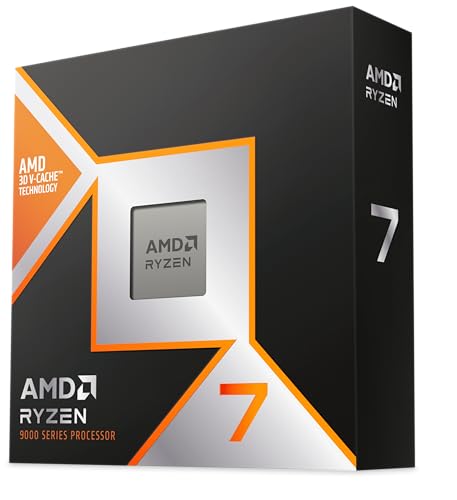
Specs
Cores / threads | 8 / 16 |
Base clock | 4.7 GHz |
Max boost | 5.2 GHz |
L3 cache | 96 MB (2nd-gen 3D V-Cache) |
TDP | 120 W |
Socket | AM5 |
All-core load temp | 74 to 75 C (GamersNexus, Blender) |
Launched | November 2024 |
Cores / threads
8 / 16
Base clock
4.7 GHz
Max boost
5.2 GHz
L3 cache
96 MB (2nd-gen 3D V-Cache)
TDP
120 W
Socket
AM5
All-core load temp
74 to 75 C (GamersNexus, Blender)
Launched
November 2024
What it does well
Three of the four paired results above are a tie or a win for this chip. Baldur's Gate 3 lands at 165 FPS on both parts in GamersNexus testing. Club386 measured Bannerlord faster here, 501 FPS against 489, and Siege X two frames apart at a frame rate past any panel most people own. The one clear loss, Kingdom Come: Deliverance II, is a 12 FPS gap on a 316 FPS baseline.
It also runs cooler and pulls less power while doing it, which shows up as a quieter fan curve rather than a number you brag about. And it drops into any B650, B650E, X670, X670E, B850 or X870 board you already own.
What you give up
You give up 400 MHz of boost on the spec sheet and roughly 2 to 3 percent of average frame rate at 1080p. In the handful of genuinely CPU-pinned titles, Tom's Hardware put Baldur's Gate 3 at 6 percent ahead on the newer part, so the gap is not always zero. If both chips ever sit at the same street price, there is no argument for choosing this one.
Who it's for
Anyone who already owns one and was about to swap. Also any new builder who finds this chip meaningfully cheaper than the refresh on the day the cart goes through.
The step up for a new build: AMD Ryzen 7 9850X3D

Specs
Cores / threads | 8 / 16 |
Base clock | 4.7 GHz |
Max boost | 5.6 GHz |
L3 cache | 96 MB (2nd-gen 3D V-Cache) |
TDP | 120 W |
Socket | AM5 |
All-core load temp | 83 C (GamersNexus, Blender) |
Launched | January 2026 |
Cores / threads
8 / 16
Base clock
4.7 GHz
Max boost
5.6 GHz
L3 cache
96 MB (2nd-gen 3D V-Cache)
TDP
120 W
Socket
AM5
All-core load temp
83 C (GamersNexus, Blender)
Launched
January 2026
What it does well
It is the faster chip, and better-binned silicon holds its boost more consistently. Kingdom Come: Deliverance II ran 328 FPS against 316 in GamersNexus testing, and Tom's Hardware measured Baldur's Gate 3 about 6 percent ahead on their rig. If your library leans on the titles that pin a CPU hardest, those are the wins you are paying for.
For a fresh build it is also the part the newest boards were validated against out of the box, which takes one BIOS flash out of your build day. Board picks for a fresh AM5 build are a separate question, and a cheaper one than most people assume.
What you give up
Heat and power, for very little frame rate. The measured all-core gap runs from 3 C on Club386's bench to 8 or 9 C on GamersNexus's, and package power followed in the same direction on both. At 1440p the performance gap falls to roughly 1.5 percent and at 4K it stops existing. You are paying a real thermal premium for a frame rate difference you will not see outside a benchmark overlay.
Who it's for
A new AM5 build where the two chips sit close on price, feeding a 1080p high-refresh panel with a top-tier graphics card already in the cart. If that is not your machine, the older chip is the smarter line item.
The swap that changes something: AMD Ryzen 9 9950X3D

Specs
Cores / threads | 16 / 32 |
Base clock | 4.3 GHz |
Max boost | 5.7 GHz |
L3 cache | 128 MB total |
TDP | 170 W |
Socket | AM5 |
Gaming cache | 3D V-Cache on one CCD |
Cores / threads
16 / 32
Base clock
4.3 GHz
Max boost
5.7 GHz
L3 cache
128 MB total
TDP
170 W
Socket
AM5
Gaming cache
3D V-Cache on one CCD
What it does well
If the real itch is to put a new chip in the socket, this is the only AM5 part that changes what the machine can do. Sixteen cores with the gaming cache intact means renders, exports and compiles finish in a different amount of time, not a rounding error. That is a change you feel every working day, which a 3 percent frame delta is not.
What you give up
Money, sustained power draw and cooling headroom that a 120 W eight-core never asked for. In pure gaming it is not meaningfully quicker than the chip already in your board. Buying it to game is the same mistake as buying the refresh to game, one rung further up the ladder.
Who it's for
The 9800X3D owner whose workload actually changed. Video work, Blender, heavy compiles, a local VM host. If your answer to what changed is nothing, this is not your chip either.
Bottom line
If you own a 9800X3D, keep it and spend nothing. If you are building fresh and the two chips sit close, take the 9850X3D and give it a real cooler. If the older chip is clearly cheaper on the day, take it and put the difference into memory or the graphics card. If your work moved past gaming, the 9950X3D is the only swap here that earns the downtime. Nobody needs to upgrade an eight-core X3D to another eight-core X3D in 2026.
FAQ
Is the 9850X3D worth the extra money over the 9800X3D?
Only for a new build, and only when the two chips sit close together on price. The measured gain is roughly 2 to 3 percent at 1080p and about 1.5 percent at 1440p, so the value of the swap is entirely a function of how small the price gap is that day. For someone who already owns the older chip, there is no version of this trade that pays off.
Will a 9850X3D work in my current 9800X3D motherboard?
Yes. Both chips use the AM5 socket, so any B650, B650E, X670, X670E, B850 or X870 board takes either one once the BIOS is current. Flash the latest BIOS before you swap, not after, because a board on an older AGESA release may not post with the newer chip. That is also why the upgrade carries no platform cost: the board, the cooler and the memory all carry over.
Is the 9850X3D the fastest gaming CPU you can buy right now?
On aggregate gaming benchmarks it sits at the top, yes. The margin over the chip it replaced is small enough that the title is more useful to AMD than to you. In the four paired results above it ties in one game, wins two and loses one. Treat the crown as a tiebreaker on a new build, not as a reason to replace working silicon.
Does the 9850X3D run hotter than the 9800X3D?
Every outlet measured it warmer, though they disagree on how much. GamersNexus logged 83 C against 74 to 75 C under an all-core Blender load, with package power at 164 W against 143 W. Club386 saw a narrower 78 C against 75 C in Cinebench and only a 9 W difference. Gaming temperatures are closer than all-core loads on both benches, but the direction is consistent.
Should I wait for Zen 6 instead of upgrading now?
If you already own a 9800X3D, waiting costs you nothing, because the refresh was never going to change your experience. For a new build, waiting for an unannounced part is the usual trap: your current machine stays slower for months to gain a margin you cannot predict. Buy the chip that fits the build now, on a socket that has already proven it takes a drop-in swap later.
Does the gap between the two chips shrink at 1440p and 4K?
Sharply. At 1080p the aggregate gap is roughly 2 to 3 percent because the processor is doing the limiting. At 1440p reviewers measured about 1.5 percent. At 4K the graphics card saturates first and the two chips return the same frame rate. If your panel is 1440p or larger, the choice between these two is effectively a coin flip on price.
Related Articles

Is the Ryzen 7 9800X3D Worth It in 2026? Buy or Skip
Buy the Ryzen 7 9800X3D for 360Hz shooters, sim racing and heavy strategy. Skip it at 1440p on a mid-tier GPU. Full 2026 verdict vs the 9600X and 9850X3D.
Aug 26, 2026

9800X3D vs 7800X3D (2026): 11% Average, 25% Where It Counts
9800X3D vs 7800X3D in 2026: an 11% average uplift, 25% in cache-heavy games, and which of four buyer profiles should actually pay the upgrade premium.
Sep 13, 2026

X3D vs Non-X3D for Gaming (2026): 3 Picks by Player Type
X3D vs non-X3D for gaming: which Ryzen earns the cache premium. One pick each for esports, AAA at 1440p/4K, and sim or strategy, plus when to skip X3D.
Sep 8, 2026

Best 16GB DDR5 RAM for Gaming (2026): 5 2x8GB Kits
The best 16GB DDR5 RAM for gaming in 2026: five 2x8GB dual-channel kits, who 16GB is genuinely enough for, and the upgrade trigger that says buy 32GB instead.
Sep 22, 2026

Best OLED Gaming Monitors Under $500: 5 Picks for 2026
The best OLED gaming monitors under $500 in 2026. Five 1440p QD-OLED and WOLED picks, what each one gave up to hit the price, and the burn-in warranty terms.
Sep 22, 2026