Affiliate Disclosure: As an Amazon Associate we earn from qualifying purchases. Some links may earn us a commission at no cost to you.

Logitech Pro X2 Rapid vs Wooting 80HE (2026 Verdict)
Logitech built the Pro X2 Rapid to take the Wooting 80HE's crown, and on the spec sheet it got most of the way there. Both boards now scan their magnetic switches and report to the PC at 8 kHz. Both tune actuation from a tenth of a millimetre to full travel, per key.
So the old argument, which board is faster, no longer decides anything. What decides it is how deep you want to tune, whether you would rather change settings on a screen or in software, and which of the two you can get delivered this month. Here is the split.
At a glance
Keyboard | Switches | Actuation range | Polling and scan | Buy |
|---|---|---|---|---|
KS-20 POM Hall-effect, 30g | 0.1mm to 4.0mm, 0.05mm steps | 8 kHz poll, 8 kHz scan | ||
Lekker Linear60 v2, hot-swap | 0.1mm to 4.0mm per key | 8 kHz poll, 8 kHz analog scan |
- Switches
KS-20 POM Hall-effect, 30g
- Actuation range
0.1mm to 4.0mm, 0.05mm steps
- Polling and scan
8 kHz poll, 8 kHz scan
- Buy
- Switches
Lekker Linear60 v2, hot-swap
- Actuation range
0.1mm to 4.0mm per key
- Polling and scan
8 kHz poll, 8 kHz analog scan
- Buy
Where each one wins
Scenario | Winner | Why |
|---|---|---|
Pure competitive FPS, counter-strafing is the whole game | Full-travel analog scanning plus Rappy Snappy resolve strafe reversals more predictably | |
You want it on your desk this week | Normal retail stock, normal warranty, normal return path | |
Re-tuning actuation game by game | Wootility exposes the deepest per-key analog behaviour of any mainstream board | |
Changing settings without opening software | The onboard OLED reaches actuation, rapid trigger, scan rate and report rate | |
One board for competitive play and all-day typing | Six dampening layers and the lighter 30g switch hold up over long typing sessions | |
Swapping switches later, or rebuilding the board over time | Hot-swappable Lekker sockets and a gasket mount | |
A second board for a LAN rig or a spare | Stocked and replaceable without waiting on a restock |
Pure competitive FPS, counter-strafing is the whole game
- Winner
- Why
Full-travel analog scanning plus Rappy Snappy resolve strafe reversals more predictably
You want it on your desk this week
- Winner
- Why
Normal retail stock, normal warranty, normal return path
Re-tuning actuation game by game
- Winner
- Why
Wootility exposes the deepest per-key analog behaviour of any mainstream board
Changing settings without opening software
- Winner
- Why
The onboard OLED reaches actuation, rapid trigger, scan rate and report rate
One board for competitive play and all-day typing
- Winner
- Why
Six dampening layers and the lighter 30g switch hold up over long typing sessions
Swapping switches later, or rebuilding the board over time
- Winner
- Why
Hot-swappable Lekker sockets and a gasket mount
A second board for a LAN rig or a spare
- Winner
- Why
Stocked and replaceable without waiting on a restock
Rapid trigger, actuation and scan rate: what separates them
Both boards use Hall-effect switches, so both know where every key sits rather than just whether it crossed a threshold. That is what makes rapid trigger possible on either one: the key resets the instant it starts travelling back up, so a repeated input lands sooner than a fixed reset point allows.
The difference is what each board does with that position data. Wooting reads the full analog travel at 8 kHz and acts on it, which is what feeds Rappy Snappy, its dynamic SOCD handling for counter-strafing. Logitech reads at 8 kHz too and gives you finer actuation steps, 0.05mm against Wooting's 0.1mm sensing resolution, but exposes a narrower set of behaviours on top of it. Finer steps, fewer things to do with them.
One caution on the headline number. Reviewers who have measured end-to-end keyboard latency keep landing in the same place: polling rate is a small slice of it, and firmware quality, sensing, and the rapid-trigger implementation matter more. Treat 8 kHz as table stakes on both boards rather than a reason to pick one. If you want the wider competitive context, our Valorant keyboard and mouse picks cover where the gains actually show up.
The availability gap
This is where the comparison stops being about switches. Logitech ships the Pro X2 Rapid through normal retail: in stock, warrantied, returnable. Wooting sells direct in batches, those batches sell out, and buyers who miss one wait or pay a reseller.
The Amazon listing for the 80HE is an import route rather than a first-party Amazon-fulfilled product, so stock and fulfilment are less predictable and the support path runs through a third party. That is a real cost, not a footnote. We said the same thing in the Apex Pro TKL Gen 3 comparison, and nothing has changed since: a keyboard you cannot get is not a keyboard you can buy.
Logitech G Pro X2 Rapid

Specs
Layout | Tenkeyless, wired |
Switches | Logitech KS-20 POM analog Hall-effect, factory lubed |
Actuation force | 30g, plus or minus 10g |
Actuation range | 0.1mm to 4.0mm in 0.05mm steps |
Polling and scan | 8 kHz USB report rate, 8 kHz key scan |
Rapid trigger | Per-key, adjustable sensitivity |
Onboard controls | OLED display, three onboard profiles |
Acoustics | Six layers of sound dampening, LIGHTSYNC RGB |
Layout
Tenkeyless, wired
Switches
Logitech KS-20 POM analog Hall-effect, factory lubed
Actuation force
30g, plus or minus 10g
Actuation range
0.1mm to 4.0mm in 0.05mm steps
Polling and scan
8 kHz USB report rate, 8 kHz key scan
Rapid trigger
Per-key, adjustable sensitivity
Onboard controls
OLED display, three onboard profiles
Acoustics
Six layers of sound dampening, LIGHTSYNC RGB
What it does well
The X2 Rapid closes the gap that left the 2024 Pro X TKL Rapid in second place. Scan rate and report rate both hit 8 kHz. Switch force dropped from 35g to 30g, which is the kind of change you feel within an hour rather than read on a chart. Actuation moves in 0.05mm increments, finer than the board it replaces.
The OLED is the part that changes how the board lives on a desk. Actuation point, rapid trigger, scan rate and report rate are all reachable from the screen, so you can retune between matches without alt-tabbing into G HUB, and you can set up the standard black model on a locked-down machine where installing software is not an option. Three onboard profiles travel with it.
Six layers of dampening material give it a deeper, fuller sound than the hollow plank most esports boards settle for. It types like something you would keep on a work desk, which is not a sentence that applies to many competitive keyboards. The switches arrive lubed from the factory, so there is no break-in period and no reason to open the board to improve the feel.
What you give up
Tuning depth. Logitech handles actuation and rapid trigger properly, but Wooting's analog feature set goes further, and the gap widens the more you care about SOCD behaviour and per-key logic. There is no analog movement mode here, so the keys stay binary inputs no matter how precisely the board senses them. G HUB is also the heavier piece of software of the two, with a long trail of user complaints behind it.
The switches are not hot-swappable, so the feel you buy is the feel you keep. There is no numpad and no wireless option, which catches out buyers coming from the wireless Pro X boards. Logitech also sells it under two names depending on the market, Pro X2 Rapid and Pro X Rapid 2. Same board.
Who it's for
The competitive player who wants a top-tier Hall-effect board on the desk this week, sets it up once, and would rather turn a dial on a screen than open an app. It is also the better pick if the same keyboard has to do an eight-hour workday, which puts it in the same conversation as the boards that game and type we recommend elsewhere.
Skip it if you are the sort of player who reads firmware changelogs, rebinds actuation per title, or wants analog steering in racing games. Those are the things Wooting does and Logitech does not, and no amount of onboard convenience substitutes for them.
Wooting 80HE (Aluminum)
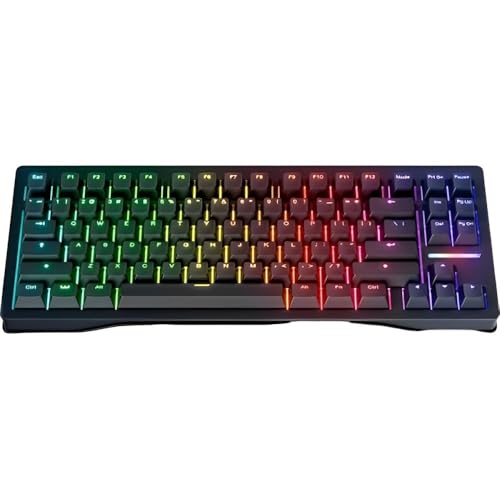
Specs
Layout | 80 percent tenkeyless, wired |
Switches | Lekker Linear60 v2 Hall-effect, hot-swappable |
Sensing resolution | 0.1mm across the full travel |
Actuation range | 0.1mm to 4.0mm, set per key |
Polling and scan | 8 kHz USB polling, 8 kHz analog scan, 0.125ms |
Rapid trigger | Per-key, plus Rappy Snappy dynamic SOCD |
Mount | Gasket mount, multi-layer acoustic foam |
Software | Wootility, web client or desktop |
Layout
80 percent tenkeyless, wired
Switches
Lekker Linear60 v2 Hall-effect, hot-swappable
Sensing resolution
0.1mm across the full travel
Actuation range
0.1mm to 4.0mm, set per key
Polling and scan
8 kHz USB polling, 8 kHz analog scan, 0.125ms
Rapid trigger
Per-key, plus Rappy Snappy dynamic SOCD
Mount
Gasket mount, multi-layer acoustic foam
Software
Wootility, web client or desktop
What it does well
Wooting invented rapid trigger and still ships the deepest version of it. The board reads the full analog position of every key at 8 kHz, not just the moment a key crosses an actuation point, and that distinction is what makes the behaviour feel different rather than merely quicker.
Rappy Snappy is the feature competitive players name when they justify the purchase. It resolves a counter-strafe cleanly when both direction keys are down, so the stop lands where you expect it to. Wootility backs it up: light, available in a browser, and more configurable per key than anything else at this tier.
The analog signal does more than tune actuation. Switch on analog movement in Wootility and the WASD block reports how far each key is pressed, not just that it is pressed, which turns it into something close to a controller stick. In racing and flight titles that means feathering throttle and brake off a keyboard. Logitech has no equivalent.
The hardware holds its end up. Lekker Linear60 v2 switches are smooth and hot-swappable, so the board can change character years from now, and the gasket mount with layered foam gives it a softer landing than most competitive keyboards manage. Actuation is set per key in 0.1mm steps across the full 4mm of travel, so a WASD block tuned for hair triggers can sit next to a spacebar tuned to avoid accidental jumps.
What you give up
Availability, first and by a distance. Direct batches sell out, restocks are irregular, and anyone buying outside Wooting's own store absorbs an import or reseller premium. What you are looking at here is the aluminum-case bundle, a different and pricier configuration from the base board most reviews cover, routed through a third-party seller rather than Amazon itself.
There is no onboard display, so every adjustment goes through software, and the web client is still a browser tab rather than a dial on the board. One note carries across from reviews of the standard board: its recycled-plastic case has been reported to flex when twisted. The aluminum shell here should change that, but it is a different SKU from the one those reviews measured, so treat the comparison as indicative.
The 80 percent layout is a smaller target than it looks: arrow cluster plus a trimmed navigation column, with spacing that takes about a week to stop fumbling. Anyone moving from a full-size board loses the numpad entirely.
Who it's for
The dedicated competitive player who tunes per game, wants the deepest analog feature set on the market, and will wait out a restock or absorb an import premium to get it. If rapid trigger behaviour is the thing you optimise, this is still the board that does it best.
Which one should you buy?
You play CS2 or Valorant seriously and counter-strafing is the mechanic you live in. Rappy Snappy and full-travel analog scanning are worth the acquisition hassle. Buy the Wooting 80HE, and start watching for a restock now rather than when you are ready.
You play competitively but you also work on this machine, and you want the keyboard this month. The Pro X2 Rapid gives you 8 kHz, finer actuation steps than Wooting's sensing resolution, and a typing feel that survives a full workday. Buy the Logitech, and if you want to see how it stacks against the wider field, check our wider keyboard picks.
You retune actuation for every game you install, you read patch notes for keyboard firmware, or you want analog throttle control in racing sims. That is Wootility's audience, and no onboard screen replaces what it gives you. Buy the Wooting, and accept that getting hold of one is part of the deal.
You are buying your first Hall-effect board and you are not sure how much tuning you will really do. Most people do less than they expect. Buy the Logitech, use the OLED to find an actuation point you like, and stop there.
Bottom line
For most buyers the answer is the Logitech G Pro X2 Rapid. It matches the 80HE on scan rate and report rate, beats it on actuation granularity and on-device control, types better, and you can have it this week. The Wooting 80HE keeps the crown for pure competitive depth, and if counter-strafe handling is the reason you are shopping, it is still the sharper tool. Just budget for the wait. If you are still working out which parts of a setup deserve the money, start with how to choose peripherals.
FAQ
Is the Logitech Pro X2 Rapid better than the Wooting 80HE?
For most buyers, yes. The Pro X2 Rapid matches the 80HE on 8 kHz scanning and polling, offers finer actuation steps at 0.05mm, adds an onboard OLED for tuning without software, and is in normal retail stock. The 80HE still wins on analog depth, particularly Rappy Snappy for counter-strafing, and on hot-swap switches. If competitive movement is the only thing you care about, the Wooting is the sharper board.
Does an 8000 Hz polling rate actually make you better at games?
Not on its own. Polling rate is one slice of total keyboard latency, and reviewers who measure it end to end consistently find that firmware quality, switch sensing and the rapid-trigger implementation account for more of the result. At 1000 Hz to 8000 Hz the differences are small enough that most players will not feel them in isolation. Both of these boards run 8 kHz, so it is not a tiebreaker here either way.
What is rapid trigger, and does it improve your aim?
Rapid trigger resets a key the moment it starts moving upward, rather than waiting for it to pass a fixed reset point. That makes repeated inputs land faster. It does not improve your aim directly. What it improves is movement: strafing and counter-strafing become more responsive, you stop more precisely, and better movement produces better shots. The gain is real but indirect, and it takes practice to use.
Can you buy a Wooting 80HE on Amazon?
There are Amazon listings, but they are third-party import routes rather than first-party Amazon-fulfilled stock. Wooting's primary channel is its own store, which sells in batches that run out. That means Amazon stock, pricing and fulfilment are less predictable than for a mainstream keyboard, and support runs through the seller rather than the brand. Factor that into the decision rather than treating it as a normal retail purchase.
What changed between the Logitech Pro X TKL Rapid and the Pro X2 Rapid?
Four things. Switch actuation force dropped from 35g to 30g. Actuation adjustment got finer, moving in 0.05mm steps. Key scanning moved up to 8 kHz to match the report rate. And the X2 added an onboard OLED display that reaches actuation, rapid trigger, scan rate and report rate without opening G HUB. The form factor and the competitive focus carried over unchanged.
Are Hall-effect keyboards worth it if you are not a competitive player?
Mostly no, at least not for the rapid-trigger features. The benefits concentrate in fast movement-heavy shooters, and a casual player will not recover the price premium in results. What does carry over is adjustable actuation, which lets you set a key depth that suits your typing, and the durability of a contactless switch. If you type more than you frag, a good mechanical board serves you better.
Related Articles

SteelSeries Apex Pro TKL Gen 3 vs Wooting 80HE (2026)
Apex Pro TKL Gen 3 vs Wooting 80HE: rapid-trigger depth, actuation, polling, build, and the one that you can actually buy today, so you pick the right board.
Jul 4, 2026

Best Gaming Keyboard 2026: Mechanical, Wireless, TKL
The best gaming keyboards of 2026 ranked by switch type, layout, and use case. From rapid-trigger Hall effect to hot-swap wireless, picks for every budget.
Jul 6, 2026

Best Hot-Swappable Gaming Keyboards (2026): 5 Top Picks
Five hot-swap gaming keyboards picked by form factor, budget, and switch philosophy. Covers wired budget, wireless value, Hall Effect premium, and full-size.
May 27, 2026

How to Choose a Mouse, Keyboard, and Headset
A builder's framework for gaming peripherals: start with the games you play, then match shape, switch, and sound to how you actually use them.
Jun 29, 2026

RTX 5070 Ti: Do You Need a Native 12V-2x6 Cable? (2026)
Do you need a native 12V-2x6 cable for an RTX 5070 Ti, or is the bundled adapter fine? The connector spec numbers, the real risk, and what to buy instead.
Oct 4, 2026