Affiliate Disclosure: As an Amazon Associate we earn from qualifying purchases. Some links may earn us a commission at no cost to you.

Will a 360mm AIO Fit in a Fractal Design North? (2026)
Yes. A 360mm AIO fits in a Fractal Design North, but only in the front, and it costs you graphics card length. The top of the case caps at 240mm, so the front is the only place a 360 goes.
Here is the number that decides your build. The North clears 355mm of card without a front radiator. Put a radiator there and the ceiling becomes 355mm minus that radiator's thickness. Measure your card before you order the cooler, not after.
At a glance
Spec | Fractal North | Fractal North XL |
|---|---|---|
Front radiator, max | 360 mm | 420 mm |
Top radiator, max | 240 mm | 360 mm |
Rear radiator | 120 mm | 120 mm |
Front radiator max width | 151 mm | Not published |
Top radiator max width | 122 mm | 137 mm for 360 mm radiators |
Max GPU length, no front radiator | 355 mm | 413 mm |
Max GPU length with a front radiator | 355 mm minus radiator thickness | 413 mm minus radiator thickness |
Worked example, 30 mm radiator | 325 mm | 383 mm |
Max CPU cooler height | 170 mm | Not published |
Front radiator, max
- Fractal North
360 mm
- Fractal North XL
420 mm
Top radiator, max
- Fractal North
240 mm
- Fractal North XL
360 mm
Rear radiator
- Fractal North
120 mm
- Fractal North XL
120 mm
Front radiator max width
- Fractal North
151 mm
- Fractal North XL
Not published
Top radiator max width
- Fractal North
122 mm
- Fractal North XL
137 mm for 360 mm radiators
Max GPU length, no front radiator
- Fractal North
355 mm
- Fractal North XL
413 mm
Max GPU length with a front radiator
- Fractal North
355 mm minus radiator thickness
- Fractal North XL
413 mm minus radiator thickness
Worked example, 30 mm radiator
- Fractal North
325 mm
- Fractal North XL
383 mm
Max CPU cooler height
- Fractal North
170 mm
- Fractal North XL
Not published
Where each mount wins
Your build | What to mount | What it costs you | Recommended cooler |
|---|---|---|---|
Card under 317 mm, high wattage chip | 360 mm in the front | 38 mm off the card ceiling | |
Card between 317 mm and 328 mm | 360 mm in the front, thin radiator | 27 mm off the card ceiling | |
Card over 328 mm | 240 mm on the top rail | Nothing, the ceiling stays at 355 mm | |
Mainstream chip, quiet build, any card | Air tower on the socket | Nothing, and no pump |
Card under 317 mm, high wattage chip
- What to mount
360 mm in the front
- What it costs you
38 mm off the card ceiling
- Recommended cooler
Card between 317 mm and 328 mm
- What to mount
360 mm in the front, thin radiator
- What it costs you
27 mm off the card ceiling
- Recommended cooler
Card over 328 mm
- What to mount
240 mm on the top rail
- What it costs you
Nothing, the ceiling stays at 355 mm
- Recommended cooler
Mainstream chip, quiet build, any card
- What to mount
Air tower on the socket
- What it costs you
Nothing, and no pump
- Recommended cooler
The clearance math
Fractal publishes the rule plainly. Subtract the radiator's thickness from 355mm and that is your card ceiling. Everything else here is that one subtraction applied to real coolers.
Three radiators, three answers. The Corsair Nautilus 360 RS runs a 27mm radiator, which leaves 328mm. The ARCTIC Liquid Freezer III Pro 360 runs 38mm, which leaves 317mm. A 45mm unit drops you to 310mm, which is under where a lot of current three-fan cards live.
Width is not the constraint people expect. The front position takes a radiator up to 151mm wide, and every 360 built on 120mm fans measures 120mm to 125mm across, so you will not fail on width down there. Up top is different. That position caps at 122mm wide and 240mm long, which means a 280mm radiator does not fit the top of a North at all. If you are still deciding between sizes rather than mounts, whether the size step buys you anything covers that separately.
Two smaller measurements decide whether the install goes cleanly. The North's manual asks for no more than 30mm between the tubeless end tank and the fan screw hole. Buyers have reported that Fractal's own Celsius+ S36 Dynamic overshoots that and ends up mounted with the bottom two front fan screws left out. Mount up top instead and you get 35mm of clearance for whatever sits under the radiator, which in practice means tall RAM heat spreaders are the first casualty.
One more thing worth saying out loud, because the forum threads treat it as a compromise. Moving the radiator to the top is not a downgrade. It pulls the radiator out of the intake path, so the three front fan slots go back to doing nothing but drawing cool air across the graphics card, and the card ceiling returns to the full 355mm.
Best 360 for most North builds: Corsair Nautilus 360 RS ARGB
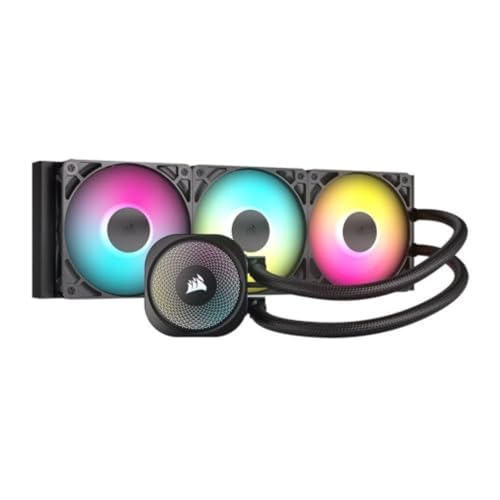
Specs
Radiator length | 396 mm |
Radiator thickness | 27 mm |
GPU budget in the North | 328 mm |
Mount position | Front only |
Fans | 3x RS120 ARGB, 120 mm |
Tubing | 400 mm sleeved rubber |
Sockets | AM5 / AM4 / LGA1851 / LGA1700 |
Radiator length
396 mm
Radiator thickness
27 mm
GPU budget in the North
328 mm
Mount position
Front only
Fans
3x RS120 ARGB, 120 mm
Tubing
400 mm sleeved rubber
Sockets
AM5 / AM4 / LGA1851 / LGA1700
What it does well
The Nautilus 360 RS runs the thinnest radiator here at 27mm, and in this case thin is the entire point. Take it off 355mm and you keep 328mm of card room, which covers most two-fan and three-fan designs short of the flagship tier.
The rest of it suits the North specifically. Fans daisy-chain and the pump connects straight to the motherboard, so the front of the case does not turn into a cable nest. That matters more here than in a mesh box, because the North's appeal is that it looks like furniture and you can see inside it. Fin density is loose enough that the fans do not need to spin hard on a mainstream chip. If you want the wider field at this size, the full 360mm shortlist has it.
What you give up
27mm of radiator is 27mm of radiator. Against a thicker unit it gives up real headroom once the chip pulls serious sustained wattage, and on a 9950X you will hear the fans work for it.
Corsair's RS-line fans are competent rather than special. There is also no VRM fan on the pump head, which is a genuine loss in a case where a front-mounted radiator leaves the socket area with no dedicated airflow.
Who it's for
The default North build. A mainstream AM5 or LGA1851 chip, a card under 328mm, and a builder who wants the 360 up front without doing clearance archaeology first.
Best 360 for maximum cooling: ARCTIC Liquid Freezer III Pro 360

Specs
Radiator | 398 x 120 x 38 mm |
Radiator thickness | 38 mm |
GPU budget in the North | 317 mm |
Mount position | Front only |
Fans | 3x 120 x 25 mm, up to 3000 RPM |
VRM fan | Integrated on the pump head |
Tubing | 450 mm |
Sockets | AM5 / AM4 / LGA1851 / LGA1700 |
Radiator
398 x 120 x 38 mm
Radiator thickness
38 mm
GPU budget in the North
317 mm
Mount position
Front only
Fans
3x 120 x 25 mm, up to 3000 RPM
VRM fan
Integrated on the pump head
Tubing
450 mm
Sockets
AM5 / AM4 / LGA1851 / LGA1700
What it does well
This is the most cooling capacity that still makes sense in a North. The radiator measures 398 by 120 by 38mm and the fans reach 3000 RPM, so on a chip that genuinely pulls sustained wattage it has somewhere to go that the thinner units do not.
The VRM fan on the pump head is the underrated part. A front-mounted radiator in this case means no top exhaust radiator and no dedicated air crossing the socket, so a small fan pushing air over the VRM area covers a real gap. ARCTIC backs it with a six-year warranty, which is unusual in a category where the pump is the part that fails.
What you give up
38mm instead of 27mm costs 11mm of card clearance, dropping the ceiling from 328mm to 317mm. Eleven millimetres sounds trivial until you measure your card and find it is 320mm. The same subtraction decides a different case in a different way. A 360mm AIO in a Lancool 216 is gated on radiator thickness rather than card length, because that case caps the top rail at 63mm.
It is also not quiet once you use the fan range. At the top of the RPM band it is clearly audible, and in a case people buy partly because it sits calmly on a desk, that is a real trade. How to choose a CPU cooler walks through where that line sits for your chip.
Who it's for
A high-wattage chip paired with a card under 317mm, and a builder who would rather bank thermal headroom than the last eleven millimetres of clearance.
Best if your GPU is over 328mm: Corsair Nautilus 240 RS ARGB
Specs
Radiator | 276 x 120 x 27 mm |
Mount position | Top |
GPU budget in the North | 355 mm |
Board component clearance needed | 35 mm |
Fans | 2x RS120 ARGB, 120 mm |
Tubing | 400 mm |
Sockets | AM5 / AM4 / LGA1851 / LGA1700 |
Radiator
276 x 120 x 27 mm
Mount position
Top
GPU budget in the North
355 mm
Board component clearance needed
35 mm
Fans
2x RS120 ARGB, 120 mm
Tubing
400 mm
Sockets
AM5 / AM4 / LGA1851 / LGA1700
What it does well
Putting a 240 on the top rail is the move the forum threads keep missing. The radiator comes out of the graphics card's path completely, so the ceiling goes back to the full 355mm and a long card stops being the problem.
The dimensions cooperate. At 276 by 120 by 27mm it clears the North's 122mm top width limit with room to spare, which not every 240 does. It also changes the thermal picture in the case's favour, because CPU heat exits through the top instead of being pushed through the front, so the card downstream gets cooler intake air. If the card is the reason you are reading this, cases built around long cards covers the other way out.
What you give up
Two fans instead of three is less surface area, and on a hot chip you will notice that before anything else on this list.
The top rail carries a 35mm ceiling for whatever sits underneath, which rules out tall RAM heat spreaders. And because the North's top position stops at 240mm, this is the end of the road up there. No upgrade to a 280 or a 360 later. The wider 240mm field has alternatives at this size.
Who it's for
Anyone running a card past 328mm, which covers most of the current flagship tier. It is also right for a builder who wants the front intake left alone to do nothing but move air.
Skip the AIO: Thermalright Phantom Spirit 120 SE

Specs
Height | 154 mm |
North max cooler height | 170 mm |
GPU budget in the North | 355 mm |
Heat pipes | 7 |
Towers | Dual |
Fans | 2x 120 mm PWM |
Sockets | AM5 / AM4 / LGA1851 / LGA1700 / 1200 / 115x |
Height
154 mm
North max cooler height
170 mm
GPU budget in the North
355 mm
Heat pipes
7
Towers
Dual
Fans
2x 120 mm PWM
Sockets
AM5 / AM4 / LGA1851 / LGA1700 / 1200 / 115x
What it does well
In this case the air cooler is the option that costs you nothing. The Phantom Spirit stands 154mm against the North's 170mm ceiling, the front stays empty, and the card ceiling stays at 355mm.
I reversed on AIOs a few years ago and this cooler is a large part of why. Dual tower, seven heat pipes, two 120mm fans, and it trades blows with 240mm units and thin 360s on any mainstream chip. There is no pump to fail in year four and dump warm coolant onto the graphics card sitting underneath it. The air versus liquid trade in a gaming build goes through that reasoning properly.
What you give up
It is a large block of metal in a case people buy because it looks like furniture. If the reason you wanted a 360 was the radiator and fans visible behind the front panel, this does not give you that, and no thermal argument changes it.
There is a ceiling too. On a chip genuinely pulling 250W sustained, the ARCTIC has road left where this runs out. And on the Mesh version of the North, mounting the side fan bracket in the top or middle position cuts cooler clearance to 145mm, at which point this cooler no longer fits at all.
Who it's for
A mainstream chip, a long card, and a builder who wants the North's front intake doing one job. It is also the honest default for a first build, because there is nothing to get wrong at install time.
Bottom line
Measure your graphics card first. Every answer here follows from that one number.
If the card is under 317mm and the chip runs hot, buy the ARCTIC Liquid Freezer III Pro 360. Between 317mm and 328mm, buy the Corsair Nautilus 360 RS ARGB. Over 328mm, put a Corsair Nautilus 240 RS ARGB on the top rail and keep the full 355mm. If the visible radiator was never the point, the Thermalright Phantom Spirit 120 SE costs you nothing in clearance and nothing in pump risk.
Still shopping for the case? The North XL makes the question go away with 413mm of card room and a 360 on top. Sizing an AIO to the chip and choosing a PSU, cooler, and case together cover the rest of the decision.
FAQ
Can you mount a 360mm AIO in the Fractal North with the tubes facing down?
Physically you can, but it is the wrong choice and the case makes it awkward. Fractal's manual asks for no more than 30mm between the tubeless end tank and the fan screw hole, and flipping the radiator changes which tank sits at the bottom, which is where the clearance runs out. The stronger reason is mechanical. With tubes at the bottom of a front radiator the pump sits high in the loop and collects air, which is the classic recipe for pump gurgle. Mount it tubes up.
Will a 360mm AIO fit in the Fractal North with an RTX 5090?
Almost certainly not. A front 360 leaves you 317mm to 328mm depending on radiator thickness, and most RTX 5090 partner cards run past 330mm. A few shorter designs squeak in, but you have to check the exact card rather than the chip. If you are set on both the 5090 and the North, put a 240 on the top rail and keep the full 355mm. The other option is the North XL, which clears 413mm before any radiator enters the picture.
Can the Fractal North take a 360mm radiator on top?
No. The top position caps at 240mm, and it also caps at 122mm of radiator width. That second number catches people out, because it rules out a 280mm radiator up there as well regardless of length. If you want a 360 on the top rail you need the North XL, which supports 360mm in that position at up to 137mm wide. On the standard North, a 360 goes in the front or it does not go in.
Does a front 360mm radiator block the North's intake fans?
It replaces them rather than blocking them. The front position takes up to three 120mm fans, and a 360 radiator uses all three slots with its own fans doing the intake. Air still comes through the front, it just passes through a radiator first, so the graphics card downstream receives air that has already picked up CPU heat. That is the real cost, and it is why a top-mounted 240 helps the card even though it is the smaller radiator.
Is the Fractal North XL worth it just for the extra radiator room?
If a long card is in your build, yes, and it is not close. The XL clears 413mm of graphics card against the North's 355mm, supports a 360 on the top rail, and takes up to a 420mm radiator in the front. That combination removes every constraint this article is about. If your card is under 328mm and you were never going to run a 360 on top, the extra size buys you nothing you will feel.
How thick a radiator can the Fractal North take in the front?
Fractal does not publish a thickness cap for the front position, which surprises people looking for a single number. The limit is indirect. Whatever thickness you choose comes straight off the 355mm card ceiling. A 27mm radiator leaves 328mm, a 38mm radiator leaves 317mm, and a 55mm unit would leave you around 300mm. The practical answer is that the thickness you can afford is set entirely by the card you are installing.
Related Articles

Best 360mm AIO Coolers 2026: Five Picks by Build Tier
Best 360mm AIO coolers for 2026 high-TDP gaming builds. Five picks segmented by chip pairing, case clearance, acoustic floor, LCD support, and budget tier.
May 12, 2026

Best 240mm AIO Coolers (2026): 5 Picks for 9800X3D and 285K
Best 240mm AIO coolers for 2026: five picks that cool the 9800X3D, 285K and most sub-250W chips, plus radiator thickness, case fitment and noise notes.
Aug 26, 2026

240mm vs 360mm AIO (2026): Which Size Does Your CPU Need?
240mm vs 360mm AIO: a 240mm is enough for a 9800X3D, a 360mm earns its price on a 9950X3D. Real load temps, case clearance limits, and noise compared.
Aug 7, 2026

Best PC Cases for RTX 5090 and 5080 (2026): 5 380mm+ Picks
The best PC case for an RTX 5090 or 5080 build needs 380mm of clearance. We rank 5 cases that fit a 575W card plus a 360mm AIO, with airflow to spare.
Aug 8, 2026

How to Choose a CPU Cooler (2026): Air vs. AIO Guide
How to choose a CPU cooler: match it to your chip's actual TDP, when air is enough, when an AIO earns its cost, and the clearance traps that catch builders.
Jul 25, 2026