Affiliate Disclosure: As an Amazon Associate we earn from qualifying purchases. Some links may earn us a commission at no cost to you.

Best Fans for the Lian Li O11 Dynamic EVO (2026): 5 Picks
The Lian Li O11 Dynamic EVO ships with no fans. Not a token rear exhaust, not one intake. You buy the case, open the box, and the entire airflow plan is yours to build.
That is less of a problem than it sounds. The EVO hands you three slide-out brackets, each taking three 120mm fans or two 140mm, and all three are interchangeable. Top, side, bottom. Which fan belongs in which bracket comes down to whether a radiator is sitting in it. So these five picks are assigned to brackets rather than ranked flat.
Our top pick: Lian Li UNI FAN SL-Infinity 120
Once you populate more than one bracket, wiring binds before airflow does, and the SL-Infinity is the only fan here that solves it. Three fans, one cable run, one controller.

Quick picks
Pick | Fan | Bracket job | Buy |
|---|---|---|---|
Best Overall | Whole-case build, cable-free wiring | ||
Best Value | Radiator bracket on a budget | ||
Best Premium | Thick 360mm radiator bracket | ||
Best Budget | Open bracket fill, ARGB kept | ||
Editor's Pick | Bottom intake, maximum CFM |
Best Overall
- Fan
- Bracket job
Whole-case build, cable-free wiring
- Buy
Best Value
- Fan
- Bracket job
Radiator bracket on a budget
- Buy
Best Premium
- Fan
- Bracket job
Thick 360mm radiator bracket
- Buy
Best Budget
- Fan
- Bracket job
Open bracket fill, ARGB kept
- Buy
Editor's Pick
- Fan
- Bracket job
Bottom intake, maximum CFM
- Buy
Specs at a glance
Fan | Max RPM | Max airflow | Max static pressure | Noise | Lighting |
|---|---|---|---|---|---|
2100 | 61.3 CFM | 2.66 mmH2O | 29 dBA | ARGB, infinity mirror | |
1800 | 56.3 CFM | 2.20 mmH2O | Quiet motor | None | |
3000 | 100.9 CFM | 7.37 mmH2O | 39.7 dBA | None | |
1550 | 66.17 CFM | 1.53 mmH2O | 25.6 dBA | ARGB | |
2000 | 84.26 CFM | 2.67 mmH2O | 35.13 dBA | None |
- Max RPM
2100
- Max airflow
61.3 CFM
- Max static pressure
2.66 mmH2O
- Noise
29 dBA
- Lighting
ARGB, infinity mirror
- Max RPM
1800
- Max airflow
56.3 CFM
- Max static pressure
2.20 mmH2O
- Noise
Quiet motor
- Lighting
None
- Max RPM
3000
- Max airflow
100.9 CFM
- Max static pressure
7.37 mmH2O
- Noise
39.7 dBA
- Lighting
None
- Max RPM
1550
- Max airflow
66.17 CFM
- Max static pressure
1.53 mmH2O
- Noise
25.6 dBA
- Lighting
ARGB
- Max RPM
2000
- Max airflow
84.26 CFM
- Max static pressure
2.67 mmH2O
- Noise
35.13 dBA
- Lighting
None
Airflow and static pressure
Peak airflow at each fan's top PWM setting. This is the number that decides the bottom intake bracket.
- 100.9 CFM
- 84.26 CFM
- 66.17 CFM
- 61.3 CFM
- 56.3 CFM
Peak static pressure. This is the number that decides whichever bracket carries the radiator.
- 7.37 mmH2O
- 2.67 mmH2O
- 2.66 mmH2O
- 2.2 mmH2O
- 1.53 mmH2O
The two orderings nearly invert below the top slot, and that is the point. The fan that wins the open bottom bracket is not the one you want behind a radiator.
The EVO's mount matrix
Every fan decision in this chassis starts with the bracket count. Top, side, and bottom each take three 120mm fans or two 140mm. The rear takes a single 120mm. There is no front intake at all, because the front is glass. The same bracket-count method drives the Montech King 65 Pro fan plan, where the side mounts add a reverse-blade requirement the EVO does not have.
Radiators change the arithmetic. Top and bottom each accept a 360mm or 280mm radiator up to 87.5mm thick, and the side bracket accepts the same. Whichever bracket takes the radiator is the one that needs static pressure. The other two are pushing air through a filter and nothing else. If the mounting position is still open, our guide to cases that mount a 360mm radiator cleanly covers the trade-offs.
Air cooling caps at 167mm of clearance, and that ceiling is the fork in the road. Go air and all three brackets stay free for case fans; the tower coolers that clear 167mm are the shortlist to start from. Go liquid and one bracket is spoken for before you have bought a single fan.
One caveat catches people. The top and bottom brackets are missing screw points for three 140mm fans, and Lian Li's guidance is that the position holds UNI FAN frames without them. If you want 140mm up top or underneath and you are not buying UNI FANs, plan on two rather than three.
How we picked
Three constraints drove every pick, in this order. First, static pressure wherever something is in the way. A 360mm radiator plus a dust filter is a genuine restriction, and a fan rated at 1.53 mmH2O stalls against it in a way a 2.66 mmH2O fan does not. Second, raw airflow wherever nothing is. The bottom bracket has a filter and a straight shot at the GPU, and the spread across these five is wide: 56.3 CFM at one end, 100.9 CFM at the other. Third, cable count, which the wider 120mm and 140mm shortlist treats as a nice-to-have and this case treats as structural.
Six fans is twelve leads when each carries a PWM and an ARGB cable. Nine is eighteen. Behind glass on three sides that is not cosmetic, it is the difference between a build you want to look at and one you keep the panel on. No mainstream board has enough headers for that many leads either, so a combined ARGB and PWM hub is part of the parts list rather than an afterthought.
Two things ruled candidates out. Fixed-RPM fans with no per-fan PWM cannot be balanced against each other, and a chassis that holds nine of them is the worst place to find that out. Sleeve bearings went the same way.
One honest note on budget. The case price is not the build price. A three-glass-panel chassis with zero fans is a display cabinet until you populate it, and a full EVO fan order is a meaningful fraction of what the chassis cost. Cases that ship fan-ready exist, and the Corsair 4000D Airflow is one of them. This is not, and that is a deliberate trade rather than an oversight.
The intake and exhaust layout that works
Bottom and side intake, top and rear exhaust. That is the loop.
The bottom bracket feeds the GPU directly, which in almost every EVO build is the component throwing off the most heat. The side bracket feeds the board chamber. The top exhausts, because heat rises and the top is the only unobstructed exit. A mesh-front chassis like the Fractal Design North can lean on front intake instead; the EVO cannot, so the bottom bracket is doing work that other cases split across two positions.
Where the radiator goes is the one real decision. Top mounting turns your exhaust into radiator exhaust, which works, but the same fans then vent CPU heat and case heat through one path. Side mounting keeps the top clean at the cost of a bracket you probably wanted for intake.
Run intake slightly stronger than exhaust. Positive pressure keeps dust out of the unfiltered seams, and this chassis has plenty.
Best Overall: Lian Li UNI FAN SL-Infinity 120
Specs
Size | 120 x 122.1 x 25 mm |
Speed | 200 to 2100 RPM (PWM) |
Airflow | 61.3 CFM max |
Static pressure | 2.66 mmH2O max |
Noise | 29 dBA max |
Bearing | Magnetic fluid dynamic |
Wiring | Daisy-chain, controller included |
Pack | 3 fans plus controller |
Size
120 x 122.1 x 25 mm
Speed
200 to 2100 RPM (PWM)
Airflow
61.3 CFM max
Static pressure
2.66 mmH2O max
Noise
29 dBA max
Bearing
Magnetic fluid dynamic
Wiring
Daisy-chain, controller included
Pack
3 fans plus controller
What it does well
The frames interlock. Contact pads on the side of each frame pass power and signal to the next fan, so a bracket of three leaves the assembly as one cable run instead of six leads. Populate all three brackets and you have three runs where a conventional build has eighteen wires to hide.
The bundled controller drives up to sixteen fans across four groups, which covers a nine-fan EVO with room to spare. Speed tops out at 2100 RPM, so there is headroom if one lands on the radiator bracket, even though the fan is not pressure-optimised by design.
Screwless mounting matters more than it sounds. The EVO's top and bottom brackets lack screw points for three 140mm fans, and Lian Li's answer is that UNI FAN frames hold without them. If a three-fan 140mm top or bottom is in the plan, this is the line that supports it.
What you give up
Airflow. At 61.3 CFM this is the lowest peak in the group, and the Phanteks M25-120 Gen2 moves 84.26 CFM in the same 25mm frame. Put SL-Infinity fans on the bottom bracket and you trade roughly a quarter of your intake volume for a tidy cable run. Defensible in a showcase build. Not free.
You are also buying into a closed system: Lian Li's controller, Lian Li's software, Lian Li's frames. A third-party fan cannot join the middle of a chain. And ARGB is not optional, because no unlit SL-Infinity exists, so a sleeper build has to look elsewhere.
Who it's for
The builder doing the full showcase EVO with six fans or more, who wants the back chamber to stay sane without bolting on a third-party hub.
Best Value: ARCTIC P12 PWM PST (5-Pack)

Specs
Size | 120 x 120 x 25 mm |
Speed | 200 to 1800 RPM (PWM) |
Airflow | 56.3 CFM max |
Static pressure | 2.20 mmH2O max |
Bearing | Fluid dynamic |
Wiring | 4-pin PWM with PST pass-through |
Lighting | None |
Pack | 5 fans |
Size
120 x 120 x 25 mm
Speed
200 to 1800 RPM (PWM)
Airflow
56.3 CFM max
Static pressure
2.20 mmH2O max
Bearing
Fluid dynamic
Wiring
4-pin PWM with PST pass-through
Lighting
None
Pack
5 fans
What it does well
2.20 mmH2O is enough to push through a 360mm radiator and a dust filter without the airflow collapsing. That puts five fans on the radiator bracket for less than one premium fan costs, which is the entire argument.
PST is the other half. Each fan carries a pass-through socket, so five chain onto one motherboard header and share a PWM signal. Less elegant than the Lian Li frames, but it solves the header-count problem, which is what most builders hit first.
Below five percent PWM they stop completely. An idle EVO with five of these makes no noise at all, and the fluid dynamic bearing means they will still be turning years from now.
What you give up
No lighting. In a chassis with three glass panels where the fans are most of what you see, that is a real cost. These belong on the brackets you cannot see, or in a build that has gone deliberately dark.
Cable runs are conventional, so five daisy-chained leads still thread through the back chamber. And 1800 RPM is the ceiling: behind a thick radiator with a dense fin stack, both Phanteks fans here have more left to give.
Who it's for
The builder filling the two brackets nobody sees, or anyone who wants the airflow and no light show. Also the right answer when the cooling budget already went to the AIO.
Best Premium: Phanteks T30-120 (3-Pack)
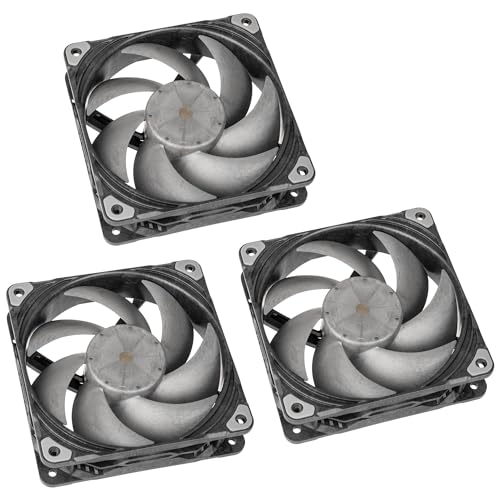
Specs
Size | 120 x 120 x 30 mm |
Speed | Up to 3000 RPM, three PWM profiles |
Airflow | 100.9 CFM (Advanced mode) |
Static pressure | 7.37 mmH2O at 3000 RPM |
Noise | 39.7 dBA at max |
Bearing | Maglev dual VAPO |
Lighting | None |
Pack | 3 fans |
Size
120 x 120 x 30 mm
Speed
Up to 3000 RPM, three PWM profiles
Airflow
100.9 CFM (Advanced mode)
Static pressure
7.37 mmH2O at 3000 RPM
Noise
39.7 dBA at max
Bearing
Maglev dual VAPO
Lighting
None
Pack
3 fans
What it does well
7.37 mmH2O. Nothing else here is within a factor of two. On a bracket carrying a thick 360mm radiator that is the difference between air moving through the fins and air finding a way around them, and it shows up as a CPU temperature delta rather than a spec-sheet line.
The 30mm frame is why. A deeper housing carries a blade roughly a quarter larger than a 25mm fan can, and both the pressure and the 100.9 CFM peak come from that. Same trick as a thicker radiator, applied to the fan.
Three hardware PWM profiles sit on a physical switch. Advanced runs it as a 100 CFM part, Performance sits at 67 CFM, Hybrid caps around 40 CFM for a quiet desktop. You buy three fans and choose one at install time.
What you give up
The depth. The EVO allows 87.5mm of radiator budget on the top and bottom brackets, and a 30mm fan plus a 27mm radiator plus mounting hardware eats into that faster than you expect. On the side bracket, depth competes with tall memory and the board tray. Buyers have flagged that some AIO and tall-RAM combinations force the side bracket outward to clear it.
At 3000 RPM it reaches 39.7 dBA, loud in a quiet room, which is why the three profiles exist. There is no lighting, and the cost per fan is the highest here by a wide margin.
Who it's for
The builder running a thick 360mm radiator and a high-TDP chip who wants the temperature delta and does not mind that the fan is invisible behind the rad.
Best Budget: Thermalright TL-C12C-S X3
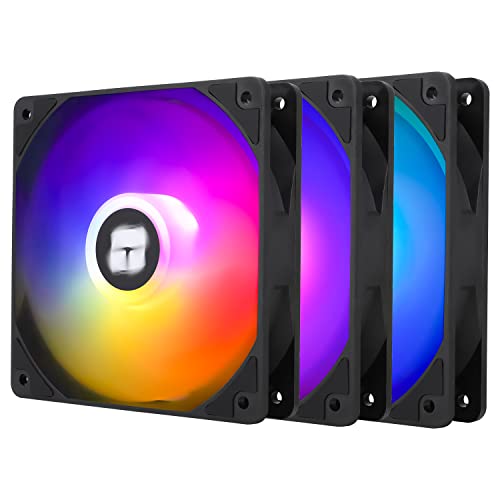
Specs
Size | 120 x 120 x 25 mm |
Speed | Up to 1550 RPM (PWM) |
Airflow | 66.17 CFM max |
Static pressure | 1.53 mmH2O max |
Noise | 25.6 dBA max |
Bearing | Sealed fluid dynamic |
Lighting | ARGB, 3-pin 5V |
Pack | 3 fans |
Size
120 x 120 x 25 mm
Speed
Up to 1550 RPM (PWM)
Airflow
66.17 CFM max
Static pressure
1.53 mmH2O max
Noise
25.6 dBA max
Bearing
Sealed fluid dynamic
Lighting
ARGB, 3-pin 5V
Pack
3 fans
What it does well
66.17 CFM at only 1550 RPM is a strong ratio. The fan is not straining to move that air, which is why it tops out at 25.6 dBA and never becomes the loudest thing in the case. On an open bottom bracket with nothing but a filter in front of it, that is close to ideal.
The bearing is sealed fluid dynamic rather than the sleeve bearing usual at this price. Across six or nine units the difference compounds, because one buzzing fan in a nine-fan build is a buzzing build.
ARGB runs on a standard 3-pin 5V header, so motherboard software drives it. No proprietary hub, no second lighting app arguing with the first.
What you give up
1.53 mmH2O is the weakest static pressure here and it is not close. Put these on a radiator bracket and the fin stack wins. They are open-bracket fans and should be used as such. The plastic diffuser rings also look like the cheaper option next to Lian Li's finish behind glass, because they are.
Reports suggest several near-identical TL-C12C-S X3 listings exist, separated only by colour and a revision suffix. If you are ordering two or three packs, confirm each one is the same listing.
Who it's for
The builder populating the open brackets on a budget who still wants lighting, and who already decided the money goes to the AIO.
Editor's Pick: Phanteks M25-120 Gen2 (3-Pack)

Specs
Size | 120 x 120 x 25 mm |
Speed | 500 to 2000 RPM (PWM) |
Airflow | 84.26 CFM max |
Static pressure | 2.67 mmH2O max |
Noise | 35.13 dBA max |
Bearing | Hydraulic |
Wiring | Daisy-chain frame, single Linq6 cable |
Pack | 3 fans |
Size
120 x 120 x 25 mm
Speed
500 to 2000 RPM (PWM)
Airflow
84.26 CFM max
Static pressure
2.67 mmH2O max
Noise
35.13 dBA max
Bearing
Hydraulic
Wiring
Daisy-chain frame, single Linq6 cable
Pack
3 fans
What it does well
84.26 CFM in a 25mm frame is the number nothing else here matches without going thicker. The bottom bracket sits over an open floor with a filter and a clear line to the GPU, and peak airflow is what that position rewards. Against the SL-Infinity in the same slot, this is 23 more CFM.
Static pressure holds up too, at 2.67 mmH2O, which edges every other 25mm fan in this group. Cybenetics rates it Platinum for airflow and Silver for static pressure, so it is not an airflow fan that falls apart the moment something sits in front of it.
The frames interlock and run on a single Linq6 cable, capturing most of the wiring benefit of the Lian Li ecosystem for less money.
What you give up
35.13 dBA at maximum is audible, and the floor is 500 RPM rather than a full stop, so the case is never truly silent. On a machine that idles most of the day, that matters.
The black PWM three-pack carries no lighting, and the ARGB version is a separate, dearer listing. Phanteks frames also do not interlock with Lian Li's, so mixing the two ecosystems mid-bracket leaves you running two hubs.
Who it's for
The builder who wants the bottom intake feeding the GPU as hard as it can, and who is fine with the fans staying invisible in the darkest part of the case.
Bottom line
If you are building the full showcase EVO with six fans or more, buy the Lian Li UNI FAN SL-Infinity 120 and take the airflow trade for a clean back chamber. If a thick 360mm radiator is in the plan, put Phanteks T30-120s on that bracket and something cheaper everywhere else. If the bottom intake is the priority and lighting is not, the Phanteks M25-120 Gen2 moves the most air per 25mm of depth. On a tight budget, ARCTIC P12 PWM PST five-packs cover two brackets for what one premium set costs. Whatever you choose, order the fans with the case, because this one arrives with none.
FAQ
How many fans do you need for the O11 Dynamic EVO?
Six is the practical minimum for a build with a discrete GPU: three on the bottom as intake, three on top as exhaust. Nine is the full configuration, adding the side bracket as a second intake. The rear 120mm is optional. If a 360mm radiator occupies a bracket, count its fans toward the total rather than adding three more.
Does the O11 Dynamic EVO come with fans?
No. The standard O11 Dynamic EVO ships with zero fans in every position, including the rear. Check the exact listing, since Lian Li sells RGB and XL variants with different bundles, but the base EVO includes none. Budget for a full fan order the same day you buy the case, because a three-glass-panel chassis with no air moving through it runs hot regardless of what is inside.
Should the side and bottom fans be intake or exhaust?
Intake, both of them. The EVO has no front intake because the front is glass, so the bottom and side brackets are the only places cool air gets in. Top and rear handle exhaust. Run intake slightly stronger than exhaust so the case sits at positive pressure, which stops dust being pulled through unfiltered seams. If a radiator occupies the side bracket it still runs as intake, feeding the loop fresh air rather than recycled case heat.
Can you use non-Lian-Li fans in the O11 Dynamic EVO?
Yes, with one caveat. Standard 120mm fans screw into the top, side, bottom, and rear positions normally, and every pick here except the top one is a third-party fan. The exception is a three-fan 140mm configuration on the top or bottom bracket, where screw points are missing and Lian Li's guidance is that UNI FAN frames hold without them. For 140mm there with another brand, plan on two.
What is the tallest air cooler that fits the O11 Dynamic EVO?
167mm is the rated ceiling. That clears most dual-tower air coolers but not the tallest flagship models, so measure before committing and leave a couple of millimetres for fan clips sitting proud of the heatsink. Going air frees all three brackets for case fans, which is the quiet advantage of an air build here.
Are 140mm fans better than 120mm in the O11 Dynamic EVO?
Usually not, in this specific case. Each bracket takes three 120mm fans or two 140mm, so going 140mm swaps three fans for two and covers less bracket area. The per-fan airflow advantage does not make up the difference. Add the missing screw points for a three-fan 140mm top or bottom, and the answer is three 120mm per bracket unless you are building around a 280mm radiator.
Related Articles

Best PC Case Fans 2026: 5 Picks for 120mm and 140mm
The best PC case fans for 2026: five 120mm and 140mm picks by mount position, so you know exactly which fan to buy for intake, exhaust and a radiator.
Aug 17, 2026

Best Fans for the Corsair 4000D Airflow (2026): 5 Picks
The best fans for the Corsair 4000D Airflow, matched to its six mounts: five picks from budget to premium, plus a mount, size, and radiator clearance guide.
Aug 18, 2026

Best Fans for the Fractal Design North (2026): 5 Picks
The best fans for the Fractal Design North, matched to its real mount map: five picks from budget to premium, plus the intake and exhaust layout to run.
Aug 22, 2026

Best NR200 Fans (2026): 5 Picks for Cooler Master SFF
The Cooler Master NR200 ships with no fans. Here are five NR200 fans picked by mount position, including slim 120mm picks for bottom intake under a thick GPU.
Aug 22, 2026

Best PC Cases for a 360mm AIO (2026): 5 Picks by Mount
The best PC case for a 360mm AIO comes down to mount location and top clearance. Five picks with radiator positions, clearance in mm, and GPU length costs.
Aug 22, 2026