Affiliate Disclosure: As an Amazon Associate we earn from qualifying purchases. Some links may earn us a commission at no cost to you.

Best Fans for the Lancool 216 (2026): 5 Picks by Mount
The Lancool 216 ships with two 160mm fans at the front, and that is the end of the front conversation. Nobody makes a 160mm aftermarket case fan, so the largest intake surface in this case is whatever Lian Li put there on day one. What is left to decide is a top bracket, a PSU shroud, a PCIe slot bracket and one rear mount.
The case advertises room for ten fans. Most 216 builds are better off at four. Here is every mount, what it takes, and whether filling it is worth your money.
Our top pick: ARCTIC P14 PWM PST A-RGB 3-Pack
The top bracket is the only empty mount on this case that reliably pays you back, it takes 140mm fans, and three of them cover the bracket with one left for the rear slot.

Quick picks
Pick | Fan | Best mount | Buy |
|---|---|---|---|
Best Overall | Top, 2 x 140mm exhaust | ||
Best Value | Top, 3 x 120mm exhaust | ||
Best Premium | Top or rear, quiet builds | ||
Best Budget | Top, 3 x 120mm exhaust | ||
Editor's Pick | Top, 3 x 120mm exhaust |
Best Overall
- Fan
- Best mount
Top, 2 x 140mm exhaust
- Buy
Best Value
- Fan
- Best mount
Top, 3 x 120mm exhaust
- Buy
Best Premium
- Fan
- Best mount
Top or rear, quiet builds
- Buy
Best Budget
- Fan
- Best mount
Top, 3 x 120mm exhaust
- Buy
Editor's Pick
- Fan
- Best mount
Top, 3 x 120mm exhaust
- Buy
Specs at a glance
Fan | Size | Speed | Connector | Lighting | Pack |
|---|---|---|---|---|---|
140mm | 200 to 1700 RPM | 4-pin PWM with PST | A-RGB | 3 fans | |
120mm | 200 to 1800 RPM | 4-pin PWM with PST | None | 5 fans | |
140mm | Up to 1900 RPM | 4-pin PWM | None | 1 fan | |
120mm | Up to 1550 RPM | 4-pin PWM | ARGB | 3 fans | |
120mm | 800 to 1900 RPM | Proprietary daisy-chain | ARGB infinity mirror | 3 fans plus controller |
- Size
140mm
- Speed
200 to 1700 RPM
- Connector
4-pin PWM with PST
- Lighting
A-RGB
- Pack
3 fans
- Size
120mm
- Speed
200 to 1800 RPM
- Connector
4-pin PWM with PST
- Lighting
None
- Pack
5 fans
- Size
140mm
- Speed
Up to 1900 RPM
- Connector
4-pin PWM
- Lighting
None
- Pack
1 fan
- Size
120mm
- Speed
Up to 1550 RPM
- Connector
4-pin PWM
- Lighting
ARGB
- Pack
3 fans
- Size
120mm
- Speed
800 to 1900 RPM
- Connector
Proprietary daisy-chain
- Lighting
ARGB infinity mirror
- Pack
3 fans plus controller
What the Lancool 216 gives you to work with
Mount | Sizes it takes | Ships with | Verdict |
|---|---|---|---|
Front | 3 x 120mm / 2 x 140mm / 2 x 160mm | 2 x 160mm PWM | Leave alone. No aftermarket 160mm exists. |
Top | 3 x 120mm / 2 x 140mm | Nothing | The upgrade that matters. Exhaust only. |
Rear | 1 x 120mm / 1 x 140mm | 1 x 140mm PWM | Optional swap, and only for noise. |
PSU shroud | 2 x 120mm / 2 x 140mm | Nothing | Skip it on almost every build. |
PCIe bracket | 1 x 120mm | Nothing | Niche. Only for a starved short card. |
Front
- Sizes it takes
3 x 120mm / 2 x 140mm / 2 x 160mm
- Ships with
2 x 160mm PWM
- Verdict
Leave alone. No aftermarket 160mm exists.
Top
- Sizes it takes
3 x 120mm / 2 x 140mm
- Ships with
Nothing
- Verdict
The upgrade that matters. Exhaust only.
Rear
- Sizes it takes
1 x 120mm / 1 x 140mm
- Ships with
1 x 140mm PWM
- Verdict
Optional swap, and only for noise.
PSU shroud
- Sizes it takes
2 x 120mm / 2 x 140mm
- Ships with
Nothing
- Verdict
Skip it on almost every build.
PCIe bracket
- Sizes it takes
1 x 120mm
- Ships with
Nothing
- Verdict
Niche. Only for a starved short card.
Radiator support runs to 360, 280 and 240mm at both the front and the top, with 240mm at the bottom. The motherboard tray is height adjustable, and dropping it into the water-cooling position opens a 63mm gap under the top panel. If a radiator is in your plan, work out whether a 360mm radiator fits before you buy fans, because a front radiator means the stock 160mm pair comes out.
One number to watch on the air-cooling side: the case lists 180.5mm of CPU cooler clearance, measured without a top fan row competing for the space. Tower coolers around 154mm fit clean. Anything near 168mm gets tight once the side panel is back on. The numbers that decide fit are in our cooler clearance guide.
The mounts that are not worth populating
The PSU shroud is the one that costs people the most money. Owners who have tested this exact case with and without shroud fans report roughly no change in GPU temperature at around 1450 RPM, and the most generous reports put the gain at one to two degrees. The front mesh already feeds the graphics card directly, so shroud fans are pushing air into a space that was not short of it.
The top bracket has its own trap. Configuration threads on the 216 suggest that a fan in the front-most top position pulls most of its air straight off the upper front intake fan and vents it out of the roof before it reaches the CPU cooler. Biasing the top toward the rear, or running two 140mm fans instead of three 120mm ones, keeps the front intake doing the job it was installed for.
The PCIe slot bracket does something, but only in one situation: a short graphics card with a blower or single-fan cooler sitting in dead air low in the case. A modern triple-fan card already sits in the front intake path.
None of this applies once liquid cooling enters the picture. A radiator changes the pressure map completely, and at that point the fan plan is a radiator fan plan. Our 240mm AIO picks cover that path.
How we picked
Count first. The question for this case is not which fan is best in the abstract, it is how many fans the chassis can use before the returns stop. That number is two, at the top, with a third available for the rear if you want a quieter one than the factory unit. Every pick below is sized to that answer rather than to the case's ten-mount maximum.
Size second. Where a mount takes both, 140mm beats 120mm: a larger blade moves the same air at a lower speed, and the 216's open top panel muffles nothing. The 120mm picks are here for buyers who want three lit fans across the bracket, or who are heading toward a front radiator.
Brand third, and only against evidence. Every fan here appears on independent fan test charts rather than only on retailer listings, which rules out the cheap lighting-first units that never publish a static pressure figure. The wider shortlist we draw from lives in our PC fan roundup.
Header budget counts as a spec. A mid-range board has two chassis headers once the CPU cooler takes one, so a three-fan top row either shares PWM signal or needs a fan hub. Two of the picks solve that in the box. Two of them do not, and we say so in their sections.
Best Overall: ARCTIC P14 PWM PST A-RGB 3-Pack
Specs
Size | 140mm |
Speed | 200 to 1700 RPM |
Bearing | Fluid dynamic |
Connector | 4-pin PWM with PST |
Lighting | A-RGB |
Pack size | 3 fans |
Best mount | Top exhaust |
Size
140mm
Speed
200 to 1700 RPM
Bearing
Fluid dynamic
Connector
4-pin PWM with PST
Lighting
A-RGB
Pack size
3 fans
Best mount
Top exhaust
What it does well
A 140mm blade moves the same air as a 120mm at a lower speed, and the 216's top bracket takes two of them. That is the whole argument for going 140 here. Lower RPM for the same exhaust means the case stays quiet under load, not only at idle.
PWM sharing is the part that makes this a three-fan purchase rather than a three-header problem. Chain the fans together, plug one lead into the chassis header, and the motherboard drives all three off a single curve. On a board with two chassis headers and a CPU cooler already occupying one, that matters more than it sounds.
The A-RGB versions of the 216 ship with lit 160mm fans at the front. These match that without adding a second piece of lighting software to the build.
What you give up
You are buying three fans for a two-fan mount. The third unit has one honest home, which is the rear slot, and the rear slot already has a competent 140mm PWM fan in it from the factory. Plenty of owners end up with a spare in a drawer.
A-RGB also means a second cable per fan, so the clean single-header story gets a little less clean once the lighting leads join in. And at matched speed this is not the quietest 140mm made. It is the one with the best ratio of air moved to money spent.
Who it's for
The default 216 owner. You want the top bracket handled correctly in one order, you already have the ARGB front, and you do not want to think about fan headers again.
Best Value: ARCTIC P12 PWM PST 5-Pack

Specs
Size | 120mm |
Speed | 200 to 1800 RPM |
Bearing | Fluid dynamic |
Connector | 4-pin PWM with PST |
Lighting | None |
Pack size | 5 fans |
Best mount | Top exhaust, PCIe bracket |
Size
120mm
Speed
200 to 1800 RPM
Bearing
Fluid dynamic
Connector
4-pin PWM with PST
Lighting
None
Pack size
5 fans
Best mount
Top exhaust, PCIe bracket
What it does well
This is the price-per-fan benchmark for the category, and has been for years. Five pressure-optimised 120mm fans cost about what two premium 140mm units do. If you are filling more than one case, or a front radiator is already in the plan, this pack covers both.
The blade profile is built for restricted mounts, which suits the 216's top bracket once the motherboard tray sits in its air-cooling position and the gap tightens up. Same PWM sharing as the 140mm version, so the whole top row still lands on one header.
What you give up
No lighting at all. On a 216 with the ARGB front fans that is a visible mismatch, and the top bracket sits directly in your eyeline on a desk.
Three 120mm fans at the top also need more speed than two 140mm fans to shift the same air, so the noise floor is higher for the same result. And a five-pack tempts you into filling mounts that do not pay. Buy it for the price per fan, not the count.
Who it's for
Builders with more than one machine to populate, and 216 owners who are heading toward a front radiator and will need 120mm units anyway.
Best Premium: be quiet! Silent Wings 4 140mm

Specs
Size | 140mm |
Speed | Up to 1900 RPM |
Bearing | Fluid dynamic |
Connector | 4-pin PWM |
Lighting | None |
Pack size | 1 fan |
Best mount | Top exhaust, rear exhaust |
Size
140mm
Speed
Up to 1900 RPM
Bearing
Fluid dynamic
Connector
4-pin PWM
Lighting
None
Pack size
1 fan
Best mount
Top exhaust, rear exhaust
What it does well
The 216 is a mesh case with an open top panel, which is exactly why it cools well and exactly why it leaks noise. Exhaust fans on this chassis sit under a vent with nothing between them and your ears. That is the narrow case where paying up for a quiet fan changes something you can hear.
The bearing is the quiet part, but the mounting corners are the part people underestimate. A top bracket is a large flat steel panel, and a fan bolted rigidly to one turns it into a speaker. The decoupled corners stop the panel picking up motor hum at the speeds a top exhaust runs at.
What you give up
One fan per box. Covering the 216's top bracket costs more than a three-pack of the Best Overall, and you still have nothing left for the rear.
There is no lighting, which rules it out of a showcase build. More importantly, the premium here buys noise and nothing else. If you game in a headset, the case could be twice as loud and you would not know. Most buyers have never tested whether they had a noise problem before paying to solve one.
Who it's for
Anyone who named quiet operation as a hard requirement: the machine lives on the desk, you work beside it, and the GPU is already the loudest thing you are willing to tolerate.
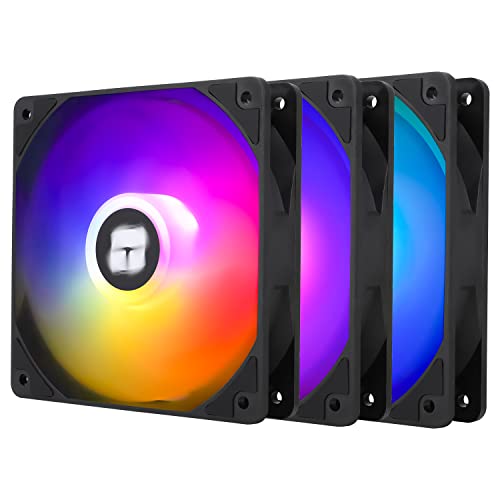
Best Budget: Thermalright TL-C12C-S X3
Specs
Size | 120mm |
Speed | Up to 1550 RPM |
Bearing | S-FDB |
Connector | 4-pin PWM |
Lighting | ARGB |
Pack size | 3 fans |
Best mount | Top exhaust |
Size
120mm
Speed
Up to 1550 RPM
Bearing
S-FDB
Connector
4-pin PWM
Lighting
ARGB
Pack size
3 fans
Best mount
Top exhaust
What it does well
Three lit 120mm fans for less than a single premium 140mm. Thermalright's budget line is the one that keeps turning up on independent test charts rather than only on retailer pages, and that is the bar worth holding at this price.
The bearing is an S-FDB rather than the plain sleeve bearing that usually shows up here, which is the difference between a fan that is still quiet in year three and one that starts ticking in month eight. A 1550 RPM ceiling is plenty for an open top bracket with no radiator behind it.
What you give up
No PWM sharing. Three fans mean three leads, and a mid-range board usually has two chassis headers once the CPU cooler has taken one. Budget for a splitter or a hub in the same order.
The ARGB will sit next to Lian Li's own front fans and not quite match them, since the two run on different controllers with different colour calibration. Static pressure is also thin, so these are a poor choice if a radiator ever goes in that bracket.
Who it's for
A first build on a real budget that wants the top bracket populated and lit without pulling money out of the GPU line.
Editor's Pick: Lian Li UNI Fan SL-Infinity 120 3-Pack

Specs
Size | 120mm |
Speed | 800 to 1900 RPM |
Bearing | Fluid dynamic |
Connector | Proprietary daisy-chain |
Lighting | ARGB infinity mirror |
Pack size | 3 fans plus controller |
Best mount | Top exhaust |
Size
120mm
Speed
800 to 1900 RPM
Bearing
Fluid dynamic
Connector
Proprietary daisy-chain
Lighting
ARGB infinity mirror
Pack size
3 fans plus controller
Best mount
Top exhaust
What it does well
Same house as the case, and it shows. The frames interlock, so a three-fan top row becomes one cable instead of six. In a case whose pitch is clean routing, that is worth something real.
The controller ships in the box rather than as a second purchase, which takes all three fans off the motherboard's header budget in one move. Lighting runs through the same software as the case's own front fans, so the front and the top finally agree with each other.
What you give up
The highest price per fan here by a wide margin, and the worst airflow per unit of spend. You are paying for the cable run and the lighting, not for the air.
The controller wants a SATA power lead and an internal USB 2.0 header, and USB 2.0 headers are contested on smaller boards. The proprietary connector also means these fans are awkward to carry into a non-Lian-Li case in a future build.
Who it's for
The owner building a showcase 216 who already runs Lian Li lighting and wants the top bracket to match the front without adding a second ecosystem to the machine.
Bottom line
If you own a 216 and want this settled in one order, buy the ARCTIC P14 PWM PST A-RGB 3-Pack and put two at the top. If you have several cases to fill or a front radiator coming, the ARCTIC P12 PWM PST 5-Pack is the cheaper path. If the machine lives on your desk and quiet is a hard requirement, pay up for the be quiet! Silent Wings 4 140mm. If the budget is genuinely tight, the Thermalright TL-C12C-S X3 fills the bracket for very little. And if the build is a showcase, the Lian Li UNI Fan SL-Infinity 120 3-Pack is the one that matches the case. Whatever you pick, stop at the top bracket. The Lancool 207 and the rest of our budget airflow case picks follow the same rule.
FAQ
Can you replace the Lancool 216's 160mm front fans?
Not with another 160mm fan. No manufacturer sells one as an aftermarket part, so the stock pair is the only 160mm option the case will ever have. The front bracket does take three 120mm or two 140mm fans instead, but swapping down trades away intake area for nothing unless you are fitting a radiator in that position. Leave the front alone until a radiator gives you a reason to touch it.
How many fans does the Lancool 216 actually need?
Four. The two 160mm front fans the case ships with, the rear 140mm it also ships with, and a top exhaust pair you add. That covers intake, a clear exhaust path and the CPU cooler's supply. The case advertises room for ten, but the mounts past those four are shroud and bracket positions that owner testing puts somewhere between a one degree gain and no measurable change at all.
Do PSU shroud fans help GPU temperatures in the Lancool 216?
Barely, and often not at all. Owners who have tested this specific case with and without shroud fans report roughly no change in GPU temperature at around 1450 RPM, with the most optimistic reports landing at one to two degrees. The front intake on this chassis already feeds the GPU directly through a mesh panel, so the shroud fans are adding air to a space that was not short of it.
Should the Lancool 216's top fans be intake or exhaust?
Exhaust. The front is already the intake side, and the case is designed around front to back and front to top airflow. Running the top as intake fights the front fans and traps warm air around the CPU cooler. Configuration threads on this case also suggest keeping the top biased toward the rear, since a fan in the front-most top slot tends to pull air straight off the upper front fan and vent it before it does any work.
Does a 360mm radiator fit in the Lancool 216?
Yes, in the front and in the top. The case lists 360, 280 and 240mm support in both positions, plus 240mm at the bottom. The motherboard tray is height adjustable, and dropping it into the water-cooling position opens a 63mm gap under the top panel, which is what makes a thick top radiator plus fans viable. A front radiator means removing the stock 160mm fans, so plan the fan purchase around it.
Are the Lancool 216's stock fans good enough to leave alone?
Yes. The usual reasons to replace stock case fans are that they buzz, that they run at a fixed speed with no per-fan control, or that there are simply too few of them. The 216 fails none of those tests. It ships with two large PWM front fans and a PWM rear fan, all under motherboard control. Spend the fan budget on the empty top bracket instead of replacing hardware that already works.
Related Articles

Will a 360mm AIO Fit in a Lian Li Lancool 216? (2026)
Yes, a 360mm AIO fits the Lian Li Lancool 216, but radiator thickness decides where. Here is the top and front clearance math, plus three AIOs that fit.
Aug 16, 2026

Best Fans for the Lian Li Lancool 207: 5 Picks for 2026
The best fans for the Lancool 207 start with its empty rear mount. Five picks for rear, top and front, plus the 30mm thickness trap that costs buyers returns.
Sep 1, 2026

Best PC Case Fans 2026: 5 Picks for 120mm and 140mm
The best PC case fans for 2026: five 120mm and 140mm picks by mount position, so you know exactly which fan to buy for intake, exhaust and a radiator.
Aug 17, 2026

Best PWM Fan Hubs and Controllers (2026): 5 Top Picks
The best PWM fan hub picks for 2026, plus the header budget math that tells you whether your build needs a powered hub, a passive splitter, or neither.
Sep 17, 2026

Best Airflow PC Cases Under $100 (2026): 5 Fan-Ready Picks
The best PC cases for airflow under $100, ranked by stock fan quality so you hit good temps without buying fans. Five picks, plus the mesh-front traps to skip.
Aug 11, 2026