Affiliate Disclosure: As an Amazon Associate we earn from qualifying purchases. Some links may earn us a commission at no cost to you.

Best Monitor for RX 7800 XT (2026): 5 Picks by Resolution
The best monitor for the RX 7800 XT is a 27-inch 1440p panel running 165Hz to 180Hz with FreeSync Premium. That is where this 16GB card lives: roughly 75 to 115 FPS in heavy AAA games at 1440p and 200 FPS or more in esports shooters, so a panel in that refresh band shows nearly every frame it renders.
Below are five picks matched to those frame rates, from a 180Hz IPS to an OLED, an ultrawide and one 4K panel for buyers willing to run FSR.
Our top pick: ASUS TUF Gaming VG27AQ3A
The ASUS TUF Gaming VG27AQ3A is a 180Hz Fast IPS with FreeSync Premium, which lines up with what the RX 7800 XT delivers at 1440p without paying for refresh the card rarely reaches in AAA games.

Quick picks
Pick | Monitor | Best for | Buy |
|---|---|---|---|
Best Overall | 1440p 180Hz, the card's native sweet spot | ||
Best Value | Real HDR at 1440p without OLED pricing | ||
Best Premium | OLED contrast and motion clarity at 1440p | ||
Best Ultrawide | 21:9 immersion at frame rates the card can hold | ||
Editor's Pick (4K) | 4K with FSR, plus a 1080p 320Hz esports mode |
Best Overall
- Monitor
- Best for
1440p 180Hz, the card's native sweet spot
- Buy
Best Value
- Monitor
- Best for
Real HDR at 1440p without OLED pricing
- Buy
Best Premium
- Monitor
- Best for
OLED contrast and motion clarity at 1440p
- Buy
Best Ultrawide
- Monitor
- Best for
21:9 immersion at frame rates the card can hold
- Buy
Editor's Pick (4K)
- Monitor
- Best for
4K with FSR, plus a 1080p 320Hz esports mode
- Buy
Specs at a glance
Monitor | Panel | Resolution and refresh | Adaptive sync |
|---|---|---|---|
27-inch Fast IPS | 2560x1440, 180Hz | FreeSync Premium, G-Sync Compatible | |
27-inch VA with Mini-LED backlight | 2560x1440, 180Hz | FreeSync Premium | |
27-inch QD-OLED | 2560x1440, 240Hz | Adaptive-Sync (FreeSync compatible) | |
34-inch VA, 1000R curve | 3440x1440 (21:9), 165Hz | FreeSync Premium | |
27-inch SuperSpeed IPS | 3840x2160 at 160Hz | FreeSync Premium, G-Sync Compatible |
- Panel
27-inch Fast IPS
- Resolution and refresh
2560x1440, 180Hz
- Adaptive sync
FreeSync Premium, G-Sync Compatible
- Panel
27-inch VA with Mini-LED backlight
- Resolution and refresh
2560x1440, 180Hz
- Adaptive sync
FreeSync Premium
- Panel
27-inch QD-OLED
- Resolution and refresh
2560x1440, 240Hz
- Adaptive sync
Adaptive-Sync (FreeSync compatible)
- Panel
34-inch VA, 1000R curve
- Resolution and refresh
3440x1440 (21:9), 165Hz
- Adaptive sync
FreeSync Premium
- Panel
27-inch SuperSpeed IPS
- Resolution and refresh
3840x2160 at 160Hz
- Adaptive sync
FreeSync Premium, G-Sync Compatible
Benchmarks
Competitive titles at 2560 x 1440: where a 180Hz or 240Hz panel earns its refresh.
- 574 FPS
- 234 FPS
- 229 FPS
- 204 FPS
- 114 FPS
Heavier games at 2560 x 1440 native, the band FreeSync Premium has to cover.
- 95 FPS
- 94 FPS
- 93 FPS
- 86 FPS
- 75 FPS
- 72 FPS
How we picked
We started from the card, not the monitor. In 2025 testing on a Ryzen 7 7700, the RX 7800 XT ran Forza Horizon 5 at 94 FPS, Black Myth: Wukong at 95 FPS with ray tracing off and S.T.A.L.K.E.R. 2 at 75 FPS, all at 1440p native. Competitive titles land far higher: Counter-Strike 2 at 204 FPS on Very High and Apex Legends at 229 FPS.
That spread decides the refresh tier. A 165Hz to 180Hz panel covers the AAA band inside its variable refresh range and still lets esports games run fast. A 240Hz panel only pays off if competitive shooters are most of your playtime, which is why the 240Hz pick here is an OLED, where the motion clarity helps at any frame rate.
FreeSync Premium was a hard requirement. It guarantees low framerate compensation, so a dip to 50 FPS in a heavy scene stays tear-free instead of falling out of the sync window. Every pick carries it or a FreeSync-compatible Adaptive-Sync implementation.
Resolution came next. 3440x1440 adds about a third more pixels than 1440p, which this card still handles at playable rates. Native 4K is a different story: heavy current games fall to roughly 40 to 60 FPS, so the 4K pick assumes FSR Quality as the normal way to play. Our DLSS vs FSR breakdown covers what that upscaler costs in image quality.
For the wider framework behind matching a card to a display, see our guide on how to choose a GPU and a matching monitor. If you are deciding between this card and its RDNA 4 replacement, the best gaming monitors for the RX 9070 applies the same logic one tier up.
Best Overall: ASUS TUF Gaming VG27AQ3A
Specs
Panel | 27-inch Fast IPS |
Resolution and refresh | 2560x1440, 180Hz |
Response time | 1ms GTG |
Adaptive sync | FreeSync Premium, G-Sync Compatible |
Motion | ELMB Sync (strobing with VRR) |
Color | 130% sRGB |
HDR | HDR10 (no real HDR brightness) |
Warranty | 3 years |
Panel
27-inch Fast IPS
Resolution and refresh
2560x1440, 180Hz
Response time
1ms GTG
Adaptive sync
FreeSync Premium, G-Sync Compatible
Motion
ELMB Sync (strobing with VRR)
Color
130% sRGB
HDR
HDR10 (no real HDR brightness)
Warranty
3 years
What it does well
180Hz is the right ceiling for this card at 1440p. The ASUS TUF Gaming VG27AQ3A shows every frame of a 120 to 180 FPS esports session, and when a heavy game drops to 80 FPS, FreeSync Premium keeps it smooth. Fast IPS response keeps motion in Counter-Strike 2 and Apex Legends clean, with none of the dark smearing a VA panel shows at this refresh.
ELMB Sync runs backlight strobing alongside variable refresh, which is rare at this tier. Turn it on for competitive play at high frame rates, off for single-player games. Color coverage at 130% sRGB is wide enough that SDR content looks saturated out of the box.
What you give up
HDR is a checkbox here. HDR10 support without a bright backlight or local dimming means HDR games look flatter than SDR, so treat it as an SDR monitor. Native IPS contrast is around 1000:1, so dark scenes in horror and space games look grey next to the Mini-LED and OLED picks.
The stand is basic and the built-in speakers are thin. Buyers have flagged IPS glow in the corners on dark screens, which is typical for this panel class.
Who it's for
RX 7800 XT owners who split time between competitive shooters and AAA games at 1440p and want the pairing that matches the card's output with nothing wasted. If your budget stretches and HDR matters, the AOC Mini-LED is the next step up.
Best Value: AOC Q27G3XMN Mini-LED
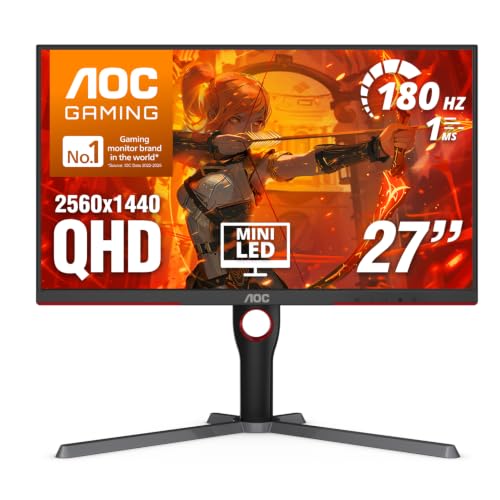
Specs
Panel | 27-inch VA with Mini-LED backlight |
Resolution and refresh | 2560x1440, 180Hz |
Local dimming | 336 zones |
HDR | VESA DisplayHDR 1000 |
Adaptive sync | FreeSync Premium |
Ports | DisplayPort 1.4, HDMI |
Stand | Height adjustable |
Panel
27-inch VA with Mini-LED backlight
Resolution and refresh
2560x1440, 180Hz
Local dimming
336 zones
HDR
VESA DisplayHDR 1000
Adaptive sync
FreeSync Premium
Ports
DisplayPort 1.4, HDMI
Stand
Height adjustable
What it does well
336 local dimming zones and DisplayHDR 1000 make this the cheapest real HDR monitor at 1440p 180Hz. Highlights in Forza Horizon 5 and Cyberpunk 2077 hit a brightness no edge-lit IPS reaches, and VA contrast keeps blacks deep in SDR too.
The refresh tier matches the card the same way the ASUS does: 180Hz covers the 7800 XT's esports output, and FreeSync Premium handles the 75 to 95 FPS AAA band. For single-player buyers that is the better trade than a faster panel with no HDR.
What you give up
Mini-LED VA panels show some blooming around bright objects on dark backgrounds, like subtitles or a cursor on a black screen. Dark transitions are slower than IPS, so fast motion in dim scenes smears more than on the ASUS. Competitive players will notice it in Counter-Strike 2.
One listing quirk: the Amazon title mentions 3440x1440 in one spot, and buyers have flagged the copy as confusing. The Q27G3XMN panel itself is 2560x1440, a standard 16:9 27-inch.
Who it's for
Single-player and racing buyers on an RX 7800 XT who want visible HDR without paying OLED pricing. If you mostly play competitive shooters, the ASUS VG27AQ3A suits you better.
Best Premium: MSI MAG 272QP QD-OLED X24

Specs
Panel | 27-inch QD-OLED |
Resolution and refresh | 2560x1440, 240Hz |
Response time | 0.03ms GTG |
Contrast | Per-pixel (infinite) |
Adaptive sync | Adaptive-Sync (FreeSync compatible) |
Ports | HDMI 2.1, DisplayPort 1.4a |
Stand | Tilt and height |
Panel
27-inch QD-OLED
Resolution and refresh
2560x1440, 240Hz
Response time
0.03ms GTG
Contrast
Per-pixel (infinite)
Adaptive sync
Adaptive-Sync (FreeSync compatible)
Ports
HDMI 2.1, DisplayPort 1.4a
Stand
Tilt and height
What it does well
QD-OLED changes how 90 FPS looks. Near-instant pixel response means a 90 FPS AAA game on the MSI MAG 272QP QD-OLED X24 looks cleaner in motion than the same frame rate on a 180Hz IPS, and per-pixel contrast makes dark scenes look the way they were graded.
240Hz gives the card's esports output somewhere to land: Counter-Strike 2 at 204 FPS and Apex Legends at 229 FPS fit under the ceiling. HDMI 2.1 also makes it a good console second input. For more OLED options in this class, see our best 1440p OLED gaming monitors.
What you give up
Burn-in is the trade. Static HUDs, taskbars and docked windows held for hours raise the risk, so check the burn-in warranty terms before buying and let the panel run its refresh cycles. Full-screen brightness is lower than the Mini-LED pick, so a sunny room washes it out.
QD-OLED's subpixel layout can show color fringing on text, which matters if this is also a work monitor. And 240Hz is wasted in AAA games, where the card sits at 75 to 115 FPS.
Who it's for
RX 7800 XT buyers who game in a dim room, play a mix of AAA and esports, and want the best-looking image this card can feed at 1440p. Office-heavy users should weigh the text fringing first.
Best Ultrawide: Samsung Odyssey G5 34-inch

Specs
Panel | 34-inch VA, 1000R curve |
Resolution and refresh | 3440x1440 (21:9), 165Hz |
Response time | 1ms MPRT |
Adaptive sync | FreeSync Premium |
HDR | HDR10 |
Model | LC34G55TWWNXZA |
Panel
34-inch VA, 1000R curve
Resolution and refresh
3440x1440 (21:9), 165Hz
Response time
1ms MPRT
Adaptive sync
FreeSync Premium
HDR
HDR10
Model
LC34G55TWWNXZA
What it does well
3440x1440 is the ultrawide resolution this card handles well. It is about a third more pixels than 1440p, which pulls AAA frame rates down into the 60 to 90 FPS range. That sits inside the 165Hz panel's FreeSync Premium window, and low framerate compensation covers the dips.
The 1000R curve on the Samsung Odyssey G5 34-inch wraps the edges of the frame into your peripheral vision, which suits racing, flight and open-world games. VA contrast keeps dark scenes deeper than IPS. Our best 1440p ultrawide gaming monitors covers OLED options if contrast is the priority.
What you give up
1000R is an aggressive curve. Reports suggest it suits gaming far more than spreadsheet or design work, where straight lines bend. VA response is slower than IPS in dark transitions, and HDR10 here is a badge rather than real HDR.
Not every game supports 21:9 properly. Some esports titles stretch or pillarbox, and cutscenes often play at 16:9 with black bars.
Who it's for
Sim racers and open-world players on an RX 7800 XT who want immersion over raw frame rate. Competitive shooter players should stay on a 27-inch 16:9 panel.
Editor's Pick (4K): Gigabyte G27U Dual Mode 4K

Specs
Panel | 27-inch SuperSpeed IPS |
Resolution and refresh | 3840x2160 at 160Hz |
Dual mode | 1920x1080 at 320Hz |
Response time | 1ms GTG |
Adaptive sync | FreeSync Premium, G-Sync Compatible |
Stand | Ergonomic stand |
Panel
27-inch SuperSpeed IPS
Resolution and refresh
3840x2160 at 160Hz
Dual mode
1920x1080 at 320Hz
Response time
1ms GTG
Adaptive sync
FreeSync Premium, G-Sync Compatible
Stand
Ergonomic stand
What it does well
Dual Mode is why this is the 4K pick for this card. The Gigabyte G27U Dual Mode 4K runs 3840x2160 at 160Hz, or switches to 1920x1080 at 320Hz for esports. On an RX 7800 XT, that means sharp 4K for slower games and a high-refresh mode the card can saturate in Counter-Strike 2 or Valorant.
At 27 inches, 4K gives noticeably sharper text and UI than 1440p, which helps if the monitor doubles as a work screen. SuperSpeed IPS response keeps motion clean at either mode.
What you give up
Native 4K is a 40 to 60 FPS proposition on this card in heavy current games, so FSR Quality is the operating norm here, not the exception. If you want native rendering at high settings, a 1440p panel serves the 7800 XT better, and the 16GB frame buffer is not the limit, raw throughput is. Our is 16GB of VRAM enough piece covers where memory does start to matter at 4K.
160Hz at 4K is mostly headroom this card cannot use, and the 1080p mode looks soft at 27 inches. HDR is basic.
Who it's for
Buyers who want a 4K panel today and plan to upgrade the GPU later, or who split work and play on one screen. More options at this refresh tier live in our best 4K 144Hz gaming monitors.
Bottom line
If you want the pairing that matches the RX 7800 XT at 1440p, buy the ASUS TUF Gaming VG27AQ3A. If HDR in single-player games is the priority, buy the AOC Q27G3XMN Mini-LED. If you game in a dark room and want the best image, buy the MSI MAG 272QP QD-OLED X24. If immersion beats frame rate, buy the Samsung Odyssey G5 34-inch. If you need 4K and accept FSR, buy the Gigabyte G27U Dual Mode 4K.
FAQ
Is the RX 7800 XT a 1440p or a 4K card?
It is a 1440p card. At 1440p native it runs most current games between 75 and 115 FPS and esports titles above 200 FPS. At 4K native, heavy games fall to roughly 40 to 60 FPS, so 4K works with FSR Quality as the normal setting. Buy a 1440p 165Hz to 180Hz monitor for the best match, and treat 4K as a choice for buyers who value sharpness over frame rate.
Can the RX 7800 XT run a 240Hz 1440p monitor?
Yes, but only esports games will use it. Counter-Strike 2, Apex Legends and Rainbow Six Siege all run above 200 FPS at 1440p on this card, so a 240Hz panel helps there. AAA games stay between 75 and 115 FPS, where 240Hz adds nothing. If competitive shooters are most of your playtime, a 240Hz OLED like the MSI MAG 272QP is worth it. Otherwise 180Hz is the better buy.
Is a 165Hz or 180Hz monitor enough for the RX 7800 XT?
Yes, for most buyers. A 165Hz or 180Hz 1440p panel covers the card's AAA frame rates inside its FreeSync range and still lets esports titles run fast. That is why the Best Overall and Best Value picks both sit at 180Hz. Only players who live in competitive shooters gain much from going higher.
Does the RX 7800 XT work with G-Sync monitors?
It works with G-Sync Compatible monitors, which are adaptive-sync panels, and every pick in this guide is one. Monitors with a dedicated Nvidia G-Sync module may only offer variable refresh to Nvidia cards, so check the listing. For an AMD card, FreeSync Premium is the label to look for, because it guarantees low framerate compensation below the panel's minimum refresh.
Is the RX 7800 XT good for a 3440x1440 ultrawide?
Yes. 3440x1440 is about a third more pixels than 1440p, and the card holds roughly 60 to 90 FPS in demanding games at that resolution with settings tuned, more in lighter titles. A 144Hz to 165Hz ultrawide like the Samsung Odyssey G5 34-inch is the right match. Skip 240Hz ultrawides on this card, since it will not reach those frame rates in most games.
Does the RX 7800 XT support DisplayPort 2.1?
Yes. The RX 7800 XT's DisplayPort outputs are DisplayPort 2.1 at UHBR13.5, about 54 Gbps of link bandwidth, and partner cards add HDMI 2.1. None of the monitors in this guide need that much bandwidth, so a standard DisplayPort 1.4 cable is fine for 1440p 180Hz or 240Hz. It matters only for future 4K 240Hz panels without compression.
Related Articles

Best Gaming Monitors for the RX 9070 (2026): 5 Picks
The best monitor for the RX 9070 is a 1440p 180Hz to 240Hz panel, not a 4K one. Five picks sized to what the card renders and what its DisplayPort link carries.
Aug 31, 2026

Best 1440p 240Hz Gaming Monitors (2026): 5 Picks by Panel
Five of the best 1440p 240Hz gaming monitors for 2026, picked by panel tech and GPU pairing: QD-OLED, WOLED, and IPS options for every budget and room.
Jun 21, 2026

How to Choose a GPU (and a Monitor That Matches)
A buyer's framework for picking a GPU and the monitor that pairs with it. Start with the panel and work the card back.
May 17, 2026

Best GPUs for 1440p Ultrawide (3440x1440) in 2026: 5 Picks
The best GPU for 1440p ultrawide gaming, matched to your 3440x1440 panel: 5 picks for 2026 from a 100Hz RX 9070 to a 240Hz QD-OLED RTX 5080 and 5K2K 5090.
Oct 16, 2026

AM4 vs AM5 in 2026: Is AM4 Still Worth It? (5 CPU Picks)
AM4 vs AM5 in 2026: AM5 still wins most new gaming builds despite DDR5 prices, but AM4 is the smarter buy below one budget line. See where it flips + 5 picks.
Oct 15, 2026