Affiliate Disclosure: As an Amazon Associate we earn from qualifying purchases. Some links may earn us a commission at no cost to you.

AM4 vs AM5 for Gaming in 2026: 5 Picks, One Cutoff
AM5 is still the right platform for a new gaming build in 2026. The memory crunch moved the line without flipping the answer, because DDR4 got dragged up alongside DDR5 rather than sitting the year out.
Below an entry-tier tower budget, or when you already own an AM4 board and a working DDR4 kit, AM4 is the better buy and it is not close. Above that line, the memory saving stops covering what you hand over. AM4 is finished, with no new CPUs coming. AM5 has committed silicon into the back half of the decade. Here is where the line sits, and what to buy on each side of it.
At a glance
Platform | Gaming sweet spot | Board tier | Memory | Upgrade runway | Buy |
|---|---|---|---|---|---|
AM4 | B450 or B550, mature and newly restocked | DDR4, dual channel | End of life, no new CPUs coming | ||
AM5 | B650 or B850 | DDR5, dual channel | Committed through 2029, Zen 6 on the same socket |
AM4
- Gaming sweet spot
- Board tier
B450 or B550, mature and newly restocked
- Memory
DDR4, dual channel
- Upgrade runway
End of life, no new CPUs coming
- Buy
AM5
- Gaming sweet spot
- Board tier
B650 or B850
- Memory
DDR5, dual channel
- Upgrade runway
Committed through 2029, Zen 6 on the same socket
- Buy
Where each one wins
Scenario | Why | Winner |
|---|---|---|
Entry-tier tower budget, 1080p, GPU-first | Every spare unit of budget belongs in the graphics card, and a six-core will not be the limit at this tier | |
You already own an AM4 board and a DDR4 kit | One part turns the machine you have into a materially different machine | |
Sim, strategy or MMO library on a tight budget | 96 MB of L3 is exactly what those engines are starved of | |
Fresh 1440p build with nothing to reuse | Paying the memory premium once beats rebuilding the platform in three years | |
A build you intend to upgrade rather than replace | Eight cores now, and a socket that still takes new silicon in 2029 | |
Top-tier card, high refresh, zero CPU bottleneck | Nothing on AM4 gets close once the GPU stops being the limit |
Entry-tier tower budget, 1080p, GPU-first
- Why
Every spare unit of budget belongs in the graphics card, and a six-core will not be the limit at this tier
- Winner
You already own an AM4 board and a DDR4 kit
- Why
One part turns the machine you have into a materially different machine
- Winner
Sim, strategy or MMO library on a tight budget
- Why
96 MB of L3 is exactly what those engines are starved of
- Winner
Fresh 1440p build with nothing to reuse
- Why
Paying the memory premium once beats rebuilding the platform in three years
- Winner
A build you intend to upgrade rather than replace
- Why
Eight cores now, and a socket that still takes new silicon in 2029
- Winner
Top-tier card, high refresh, zero CPU bottleneck
- Why
Nothing on AM4 gets close once the GPU stops being the limit
- Winner
What the memory crunch did to the math
Start with the number that decides this. Match the two baskets tier for tier, a mid-range B-series board on each side and the same 32 GB of memory, and every line item lands within noise of its counterpart. The board tiers cost about the same. The coolers cost the same. The memory does not, and that single row is the entire platform delta.
The slogan version of that delta is that DDR5 costs twice what DDR4 costs. On 32 GB kits at current prices, that holds. What the slogan misses is the direction both curves are moving. DDR5 rose several times over through 2026 as AI accelerators and server memory ate the fabs. DDR4 rose too, for a different reason: manufacturers are winding those lines down to free capacity for DDR5 and HBM, so the cheap platform is getting less cheap on a supply squeeze of its own. Our DDR4 kit picks carry the current shape of that market.
That direction matters more than the ratio does. A gap that is twice today was far wider than twice a year ago, and TrendForce has DRAM contract prices climbing another 13 to 18 percent through the third quarter with elevated pricing forecast into 2027. The AM4 saving is real. It also narrows every quarter DDR4 supply thins, which is the opposite of how a bargain is supposed to age. If the question underneath yours is really about timing, we answered that one separately.
One second-order effect cuts the other way and deserves naming. Board vendors responded to the crunch by putting new B550 stock on shelves in 2026, years after the socket stopped getting new CPUs. Buying a board for a closed platform is easier now than it was a year ago, which is a strange sentence to write and a genuine point in AM4's favor.
What the performance gap looks like
The performance question is easier than the money question, and the two are worth separating. Nothing on AM4 competes with the top of AM5. TechSpot recorded 668 fps in Counter-Strike 2 at 1080p on an RTX 4090 for the Ryzen 7 9800X3D, putting it 27 percent clear of the Ryzen 7 9700X and 13 percent clear of the 7800X3D. Across a hundred-plus game suite the same outlet put the 9800X3D 39 percent ahead of the Ryzen 7 5800X3D.
Read the test conditions before you read the margin. Those figures come from 1080p on a flagship card, which is exactly how you isolate a processor and exactly not how anybody plays. Push the same chips to 1440p under the GPU most readers own and the spread compresses hard, because the card becomes the limit and the CPU stops being asked difficult questions. The same compression shows up in the DDR4 and DDR5 gaming comparison, where memory generation matters far less at playable settings than the spec sheet suggests.
That compression is what makes the budget cutoff a real cutoff rather than a preference. At the top of the stack the platform choice is settled by performance. At the bottom it is settled by what the memory costs, because the chips are close enough that frames do not decide it.
How we picked
GPU first, always. The card decides the resolution and frame rate you live with for the next few years, and the processor exists to stay out of its way at that target. Every rung below was sized against that rule, which is why the entry picks are six-core parts rather than cache chips.
Platform is a horizon question, not a performance question. The one that decides it is whether you would swap the CPU in three years and keep the board. Answer yes and AM5 is the only sensible socket. Answer no honestly, and most people who say yes should answer no, and the socket's future stops being something worth paying for. The broader version of that reasoning lives in our CPU and motherboard buying framework.
Boards are where this category overspends, on both sockets. A mid-tier B550 feeds a 5800X3D without complaint, and a mid-tier B650 or B850 feeds a 9800X3D the same way. Socket compatibility is not the same as build-ready, so the floor still matters: a thin VRM heatsink with partial pad coverage is a no on either platform. Past that floor the money belongs in the graphics card, which is the point our sub-150 AM5 board roundup keeps making.
Entry AM4: AMD Ryzen 5 5600

Specs
Cores / threads | 6 / 12 |
Boost clock | Up to 4.4 GHz |
L3 cache | 32 MB |
TDP | 65 W |
Socket | AM4 |
Memory | DDR4, dual channel |
PCIe | 4.0 |
Cooler | Wraith Stealth included |
Cores / threads
6 / 12
Boost clock
Up to 4.4 GHz
L3 cache
32 MB
TDP
65 W
Socket
AM4
Memory
DDR4, dual channel
PCIe
4.0
Cooler
Wraith Stealth included
What it does well
Six cores and twelve threads is still the floor for a modern gaming machine, and the 5600 clears it for less than anything else in this article. At 1080p under a mid-range card it will not be the part holding the frame rate down in Valorant, Fortnite, Helldivers 2 or a current console-port AAA. The Zen 3 cores are old now. They are also quick enough for the job this rung is being asked to do.
The boxed Wraith Stealth matters more than it sounds. At 65 W it is adequate, and on a build this tight the cooler you do not buy is real budget that ends up in the graphics card instead. PCIe 4.0 covers every GPU a builder at this tier will put in the slot, and the AM4 board ecosystem is mature enough now that BIOS surprises are rare. If you are already running a 5600 and wondering where it goes next, we mapped that upgrade path separately.
What you give up
The 32 MB of L3 is a hard ceiling. Late-game Total War turns, dense MMO content, Factorio at scale, flight sim over a photogrammetry city: those are the workloads that separate cache chips from everything else, and the 5600 sits on the wrong side of the line. If your library leans that way, this is the wrong rung and no GPU fixes it.
The bigger cost is structural. This is the last CPU that board will ever hold, because reporting through 2026 has AMD closing the AM4 lineup for good. And the saving that justified being here has thinned, since DDR4 caught the memory crunch too.
Who it's for
A first build on a hard budget at 1080p, where the parts list is GPU-first and the buyer has no realistic plan to touch the processor again. If that is you, the 5600 is not a compromise. It is the correct answer.
AM4 gaming ceiling: AMD Ryzen 7 5800X3D

Specs
Cores / threads | 8 / 16 |
Boost clock | Up to 4.5 GHz |
L3 cache | 96 MB (3D V-Cache) |
TDP | 105 W |
Socket | AM4 |
Memory | DDR4, dual channel |
PCIe | 4.0 |
Overclocking | Multiplier locked |
Cooler | Not included |
Cores / threads
8 / 16
Boost clock
Up to 4.5 GHz
L3 cache
96 MB (3D V-Cache)
TDP
105 W
Socket
AM4
Memory
DDR4, dual channel
PCIe
4.0
Overclocking
Multiplier locked
Cooler
Not included
What it does well
96 MB of L3 is the whole argument, and it lands hardest exactly where cheap six-cores fall apart. Strategy campaigns deep into the turn count, MMO raid nights, sim racing grids, flight sim over dense scenery. Those engines are cache-starved rather than clock-starved, and the extra cache moves the 1% lows in a way a clock bump never does.
The generational framing is unflattering and the practical framing is not. TechSpot's hundred-plus-game suite put the 9800X3D 39 percent ahead of it, which reads like a rout until you notice that still leaves the 5800X3D clear of every non-cache chip of its own era. It also drops straight into a B450 or B550 board on a current BIOS, so an existing machine becomes a materially different machine for the price of one part. The BIOS step is the part people trip on, and it is worth doing before the chip arrives, not after.
What you give up
The multiplier is locked, so there is no headroom to claw back, and it wants a real cooler rather than the boxed unit the cheaper chips ship with. Both of those chip away at the platform saving that brought you here in the first place.
The structural cost is the one every AM4 rung carries, and it weighs more at this price. This is the terminal chip on a terminal socket. Buy it and the next upgrade is not a CPU, it is a board, a memory kit and an afternoon. Buyers coming from an older Ryzen part get the best of this deal, which is why the drop-in upgrade case reads so differently from the new-build case.
Who it's for
Someone already sitting on an AM4 board worth keeping, or a builder whose library is cache-hungry and whose budget will not stretch to a full AM5 basket. As a drop-in upgrade it is one of the best value moves available in 2026. As the foundation of a new build it needs the budget argument to hold.
The crossover pick: AMD Ryzen 5 9600X

Specs
Cores / threads | 6 / 12 |
Boost clock | Up to 5.4 GHz |
L3 cache | 32 MB |
TDP | 65 W |
Socket | AM5 |
Memory | DDR5, dual channel |
PCIe | 5.0 |
Cooler | Not included |
Cores / threads
6 / 12
Boost clock
Up to 5.4 GHz
L3 cache
32 MB
TDP
65 W
Socket
AM5
Memory
DDR5, dual channel
PCIe
5.0
Cooler
Not included
What it does well
This is where the line actually sits. Same six cores and twelve threads as the entry AM4 rung, a full Zen generation of IPC on top, and boost clocks up to 5.4 GHz. At 1440p it clears anything a mid-range card can feed, and it does it at 65 W on an inexpensive tower cooler.
The part that never shows up in a frame counter is the socket. AMD has extended AM5 support through 2029, and Asus, ASRock and MSI have all indicated Zen 6 lands on the same socket. The board you buy today takes a CPU that has not been announced yet. No AM4 board offers that at any price.
What you give up
The memory, and that is the entire delta. A 32 GB DDR5 kit runs roughly twice what the equivalent DDR4 kit does right now, while every other line item in the two baskets lands within noise of its counterpart. Whether that premium is worth paying is a question worth answering on its own terms before you commit to the socket.
The other giveaway is cache. 32 MB of L3 makes this a poor fit for the sim, strategy and MMO libraries the 5800X3D was built for, and there is no cooler in the box to soften the total.
Who it's for
A fresh 1440p build with nothing to reuse, bought by someone who would rather pay the memory premium once than rebuild the whole platform in three years. If you are choosing between this and the 5800X3D on cost alone, your library is the tiebreaker: cache-hungry goes AM4, everything else lands here.
AM5 mid: AMD Ryzen 7 9700X

Specs
Cores / threads | 8 / 16 |
Boost clock | Up to 5.5 GHz |
L3 cache | 32 MB |
TDP | 65 W |
Socket | AM5 |
Memory | DDR5, dual channel |
PCIe | 5.0 |
Cooler | Not included |
Cores / threads
8 / 16
Boost clock
Up to 5.5 GHz
L3 cache
32 MB
TDP
65 W
Socket
AM5
Memory
DDR5, dual channel
PCIe
5.0
Cooler
Not included
What it does well
Eight Zen 5 cores at 65 W is a genuinely efficient part for what it does. The two cores over the 9600X show up in the work that is not the game: an encode running alongside the session, a compile, a long export, forty browser tabs sitting behind a raid. In pure frame rate the gap over the 9600X is small enough that most people would never spot it blind.
It holds full boost on a mid-tier B650 or B850 with no VRM anxiety, and it inherits the same upgrade runway as the rest of the AM5 stack.
What you give up
On a gaming-only build this is the classic tier-jump trap. TechSpot put the 9800X3D 27 percent ahead of the 9700X in Counter-Strike 2 at 1080p on an RTX 4090, and the 9600X sits close enough behind the 9700X that the gap between them buys almost nothing visible. If frames are the only goal, that budget belongs in the graphics card or in the cache chip, not here.
No boxed cooler, and 32 MB of L3 means cache-sensitive libraries are still not its territory.
Who it's for
A 1440p build that also streams, edits occasionally or runs heavy background work, on a platform the buyer intends to upgrade rather than replace. Gaming-only buyers should look one rung down or one rung up, not at this one.
AM5 long-haul: AMD Ryzen 7 9800X3D
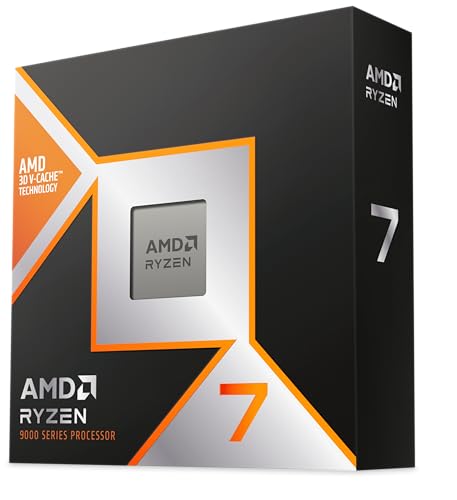
Specs
Cores / threads | 8 / 16 |
Boost clock | Up to 5.2 GHz |
L3 cache | 96 MB (second-generation 3D V-Cache) |
TDP | 120 W |
Socket | AM5 |
Memory | DDR5, dual channel |
PCIe | 5.0 |
Overclocking | Fully unlocked |
Cores / threads
8 / 16
Boost clock
Up to 5.2 GHz
L3 cache
96 MB (second-generation 3D V-Cache)
TDP
120 W
Socket
AM5
Memory
DDR5, dual channel
PCIe
5.0
Overclocking
Fully unlocked
What it does well
Second-generation 3D V-Cache puts the cache die underneath the cores rather than on top, which is why this chip clocks and overclocks freely where the 5800X3D is locked down. The margins are not subtle either. TechSpot recorded 668 fps in Counter-Strike 2 at 1080p on an RTX 4090, 27 percent clear of the 9700X and 13 percent clear of the 7800X3D.
What that buys in practice is the removal of the CPU from the conversation. Under a top-tier card at high refresh the 1% lows stop being a processor problem, which is the thing sim, strategy and MMO players actually feel during a session rather than read off a chart.
What you give up
It is the most expensive rung here by a wide margin, and the margin is only visible under conditions most people never play in. At 4K behind a mid-range GPU the extra cache returns nothing you can see, because the card ran out of headroom long before the processor did.
It wants real cooling at 120 W, and it is comfortably more chip than a 1080p build can use. Buying this and then economizing on the graphics card is the wrong order of operations, and it is a common one.
Who it's for
A high-refresh 1440p or 4K build with a top-tier card, or any library built on sims, strategy and MMOs where the cache is the entire reason to be here. If that is not you, a rung further down will feel identical during play and cost far less.
The case against AM4, handled honestly
The strongest argument against everything the budget math says is not about money at all. AM4 is over. Reporting through 2026 has AMD closing the lineup for good, so the board you buy today holds the CPU you buy today for as long as you own the machine. No BIOS update fixes that.
Treat it as a real cost rather than a talking point. A builder who genuinely expects to swap a processor and keep the board should not start on AM4 in 2026 no matter what memory costs, because the thing they are buying does not exist on that socket. The saving is a one-time discount against a permanent ceiling, and the same logic drives the AM5 against LGA1851 comparison one platform over.
The honest counter is that most people never make the swap they plan. If you have owned three machines and upgraded a processor in none of them, the runway you are paying for on AM5 is runway you will not use, and AM4 stops being a compromise. Answer that question truthfully and the platform mostly picks itself.
Bottom line
If you are building at 1080p on an entry budget, buy the Ryzen 5 5600 and put the difference in the graphics card. If you already own an AM4 board and a DDR4 kit, buy the Ryzen 7 5800X3D and stop there. If you are starting fresh at 1440p with nothing to reuse, buy the Ryzen 5 9600X and take the socket runway.
If you stream or work alongside the game, step up to the Ryzen 7 9700X. If you are feeding a top-tier card at high refresh, buy the Ryzen 7 9800X3D and stop thinking about the processor. The cutoff is real, and for most fresh builds this year it sits below where AM5 starts making sense, which is also why 2026 is a stranger year to build in than the last few were.
FAQ
Is AM4 still worth it in 2026?
Yes, under two conditions. If you already own an AM4 board and a working DDR4 kit, it is the best value upgrade path available, and a cache chip turns that machine into something close to current. If you are starting from nothing on an entry budget, the lower memory and board cost still wins. Outside those two cases the answer is no: the AM5 premium is now small enough that the missing upgrade path costs more than it saves.
Is AM4 dead?
As a product line, yes. Reporting through 2026 has AMD finished with the socket and the CPU lineup final, so nothing new arrives for it. As a platform to buy on, not quite. Boards are still being manufactured, DDR4 is still stocked, and the 5800X3D is still a capable gaming processor. The distinction matters. AM4 is a closed platform you can still build a good machine on, not a broken one to avoid.
Should I build AM4 or AM5 in 2026?
AM5, unless the budget forces the issue or you have AM4 parts to reuse. The reasoning is not performance at the entry rungs, where the two are closer than the generation gap suggests. It is that AM5 keeps taking new CPUs through 2029 and AM4 takes none. If the memory and board saving is the difference between building and not building, take it. If it is the difference between two comfortable budgets, take the socket with a future.
Is a B550 motherboard still worth buying in 2026?
For an AM4 build, yes. B550 gives you PCIe 4.0 to the graphics card and the primary NVMe slot, mature BIOS support after years of revisions, and enough VRM on the mid-tier boards to feed a 5800X3D without throttling. Vendors even put fresh stock on shelves in 2026 in response to memory pricing. What it does not give you is any upgrade beyond the chips that already exist, so buy it knowing the processor going in is the last one.
How long will AM5 be supported?
AMD has committed to AM5 through 2029, extended from earlier guidance that stopped at 2027, and Asus, ASRock and MSI have all indicated Zen 6 uses the same socket. A board bought today should accept at least one and probably two future CPU generations. Treat that as a strong signal rather than a contract, though AMD's track record on AM4 ran close to seven years, which is the reason the commitment carries weight at all.
Can I use DDR4 RAM on an AM5 motherboard?
No. AM5 is DDR5 only, with no DDR4 boards in the lineup at any tier, so a kit you already own cannot come with you. That single fact is what makes the platform decision expensive right now, because moving to AM5 means buying memory at 2026 prices instead of carrying yours across. We go through the details here.
Related Articles

Best DDR4 RAM for Gaming 2026: AM4 & LGA 1700 Survival Guide
The best DDR4 RAM for gaming in 2026: picks for AM4 Ryzen 5000 and LGA 1700 Intel. DDR4-3600 CL16 vs CL18 explained, plus the AM4 Infinity Fabric sweet spot.
May 31, 2026

DDR5 vs DDR4 Gaming in 2026: Which Platform Is Worth It?
DDR5 vs DDR4 for gaming in 2026: the real FPS delta at 1440p and 4K, the platform price premium during the DDR5 spike, and exactly when each one wins.
Jun 29, 2026

Should You Buy RAM Now, or Wait Out the 2026 Crisis?
Should you buy RAM now or wait out the 2026 memory crisis? A clear buy-or-wait call by your situation, plus the exact 32GB and 64GB kits worth owning today.
Jul 23, 2026

Will a 5700X3D Work on a B450 Motherboard? (BIOS, 2026)
Will a 5700X3D work on a B450 motherboard? Yes, once your BIOS is on AGESA 1.2.0.7. Per-vendor minimum versions, the flashback workaround, and what to buy.
Aug 14, 2026

Best CPU Upgrade From Ryzen 5 5600: AM4 or AM5 (2026)
The best CPU upgrade from a Ryzen 5 5600 comes down to one call: a cheap AM4 drop-in or a jump to AM5. We break down both paths with honest cost math.
Jul 8, 2026