Affiliate Disclosure: As an Amazon Associate we earn from qualifying purchases. Some links may earn us a commission at no cost to you.

Best Gaming Monitors for the RX 9070 (2026): 5 Picks
The RX 9070 renders between 75 and 172 fps at 1440p across a modern test suite, and its DisplayPort 2.1a outputs carry 54 Gbps. Those two numbers decide which monitor belongs in front of it.
A 1440p panel running at 180Hz to 240Hz sits comfortably inside both limits. A 4K high-refresh panel runs compressed over that link and drops the card into the 40s in heavy titles. The five screens below were chosen against what this card renders, not against a spec sheet.
Our top pick: Gigabyte GS27QXA
The Gigabyte GS27QXA puts 1440p and 240Hz on one panel for roughly what a 180Hz screen asks, and 240Hz is the exact tier this card can chase in the games where refresh changes how it feels.

Quick picks
Pick | Monitor | Best for | Buy |
|---|---|---|---|
Best Overall | 1440p 240Hz without paying OLED money | ||
Best Value | HDR that gets bright, with no burn-in question | ||
Best Premium | QD-OLED motion clarity at a refresh the card can fill | ||
Best Budget | The 1440p floor, with a stand that adjusts | ||
Editor's Pick | 21:9 width instead of 4K density |
Best Overall
- Monitor
- Best for
1440p 240Hz without paying OLED money
- Buy
Best Value
- Monitor
- Best for
HDR that gets bright, with no burn-in question
- Buy
Best Premium
- Monitor
- Best for
QD-OLED motion clarity at a refresh the card can fill
- Buy
Best Budget
- Monitor
- Best for
The 1440p floor, with a stand that adjusts
- Buy
Editor's Pick
- Monitor
- Best for
21:9 width instead of 4K density
- Buy
Specs at a glance
Monitor | Panel | Resolution | Refresh | HDR | Sync |
|---|---|---|---|---|---|
SuperSpeed IPS | 2560 x 1440 | 240Hz (OC 260Hz) | Not rated | FreeSync Premium | |
Mini-LED VA | 2560 x 1440 | 180Hz | DisplayHDR 1000 | FreeSync Premium | |
QD-OLED | 2560 x 1440 | 240Hz | True Black 400 | Adaptive Sync | |
IPS | 2560 x 1440 | 180Hz (OC 200Hz) | HDR10 | FreeSync and G-SYNC Compatible | |
34-inch curved | 3440 x 1440 | 160Hz | HDR10 | FreeSync Premium |
- Panel
SuperSpeed IPS
- Resolution
2560 x 1440
- Refresh
240Hz (OC 260Hz)
- HDR
Not rated
- Sync
FreeSync Premium
- Panel
Mini-LED VA
- Resolution
2560 x 1440
- Refresh
180Hz
- HDR
DisplayHDR 1000
- Sync
FreeSync Premium
- Panel
QD-OLED
- Resolution
2560 x 1440
- Refresh
240Hz
- HDR
True Black 400
- Sync
Adaptive Sync
- Panel
IPS
- Resolution
2560 x 1440
- Refresh
180Hz (OC 200Hz)
- HDR
HDR10
- Sync
FreeSync and G-SYNC Compatible
- Panel
34-inch curved
- Resolution
3440 x 1440
- Refresh
160Hz
- HDR
HDR10
- Sync
FreeSync Premium
Benchmarks
What the card renders at 2560 x 1440 before FSR 4 or frame generation enter the picture.
- 172 FPS
- 131 FPS
- 106 FPS
- 96 FPS
- 75 FPS
The same card at 3840 x 2160, where native frame rates leave high-refresh territory.
- 91 FPS
- 70 FPS
- 64 FPS
- 41 FPS
How we picked
Render rate came first. GamersNexus measured 131 fps in Cyberpunk 2077 at 1440p Ultra, 106 in Dying Light 2, 96 in Starfield and 75 in Black Myth Wukong, all native. A 240Hz panel has headroom for the top of that spread and variable refresh covers the bottom of it. A 360Hz panel spends money on frames this card reaches only in esports titles, which is also where its faster sibling pulls ahead by nine to twelve percent. How the two cards differ is worth knowing before you size the panel.
Link bandwidth came second, and it is the part nobody checks. RDNA 4 exposes DisplayPort 2.1a at the UHBR13.5 tier, which is 54 Gbps. The full 80 Gbps UHBR20 tier lives on the Nvidia side this generation. At 1440p 240Hz the link has room to spare. At 4K with a high refresh rate it does not, and the panel falls back on Display Stream Compression to fit. DSC is visually lossless in normal use, but it is the honest reason a 4K 240Hz screen is not the flex on this card that its box implies.
Durability of the answer came third. Sixteen gigabytes of memory across 56 compute units is why 1440p stays the right target for this card in three years rather than only this month, and it is the reason texture settings are not the first thing you will be turning down. Matching a card to a screen walks the same logic from the other direction.
Everything left over went into panel technology rather than a bigger refresh number. Once refresh is settled somewhere between 180Hz and 240Hz, the money buys contrast, HDR brightness and motion clarity, in that order. That is why a Mini-LED screen and a QD-OLED screen both sit in this list at refresh rates below the top pick's.
Best Overall: Gigabyte GS27QXA
Specs
Panel | 27-inch SuperSpeed IPS |
Resolution | 2560 x 1440 |
Refresh rate | 240Hz (260Hz overclock) |
Response time | 1ms MPRT |
Adaptive sync | AMD FreeSync Premium |
Inputs | HDMI and DisplayPort |
Panel
27-inch SuperSpeed IPS
Resolution
2560 x 1440
Refresh rate
240Hz (260Hz overclock)
Response time
1ms MPRT
Adaptive sync
AMD FreeSync Premium
Inputs
HDMI and DisplayPort
What it does well
The refresh number here matches the card instead of overshooting it. Counter-Strike 2 and Valorant clear 240 fps on an RX 9070 without help, so the top of the panel's range is reachable. In heavier titles the card lands between 75 and 172 fps native, and FreeSync Premium keeps all of that inside the variable refresh window rather than tearing against a fixed ceiling.
The IPS panel is the ordinary kind, and at 1440p 240Hz that turns out to be an advantage. Eight-bit colour at that resolution and refresh fits inside a DisplayPort 1.4 link, so nothing about this pairing depends on compression or on a cable being the right revision. Plug it in and it runs at its rated speed.
FreeSync Premium is AMD's own certification, which removes the one compatibility question worth asking about a Radeon card and a variable refresh panel.
What you give up
There is no local dimming behind this panel, so the HDR10 badge is a signal input format rather than a viewing experience. Bright highlights sit on the same grey backlight as everything else.
The 1ms figure is an MPRT rating, measured with backlight strobing on, and it flatters the panel against a grey-to-grey number from a competitor. Expect ordinary fast-IPS motion, which is very good and is not OLED. Reports also suggest the stand on this tier is tilt-only, so budget for an arm if you sit high.
Who it's for
The reader running one 27-inch screen across a mixed library who wants refresh to stop being the part that holds the card back. If you are cross-shopping against the faster sibling card, the XT changes the panel maths and gets its own shortlist.
Best Value: AOC Q27G3XMN Mini-LED
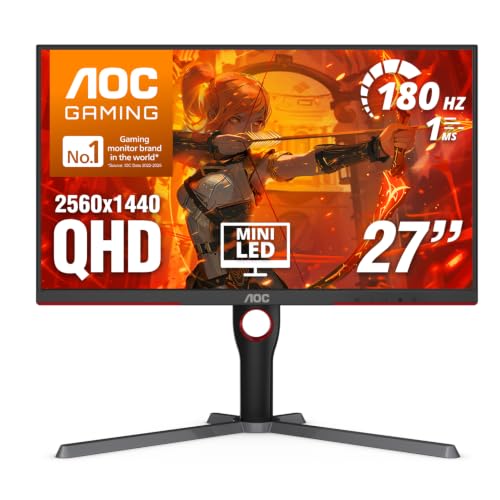
Specs
Panel | 27-inch Mini-LED VA |
Resolution | 2560 x 1440 |
Refresh rate | 180Hz |
HDR | VESA DisplayHDR 1000 |
Local dimming | Mini-LED backlight zones |
Adaptive sync | AMD FreeSync Premium |
Panel
27-inch Mini-LED VA
Resolution
2560 x 1440
Refresh rate
180Hz
HDR
VESA DisplayHDR 1000
Local dimming
Mini-LED backlight zones
Adaptive sync
AMD FreeSync Premium
What it does well
This is the only screen in the list where turning HDR on changes what you see. A Mini-LED backlight with zone control hits DisplayHDR 1000, and the difference between that and an edge-lit panel wearing an HDR10 label is not subtle in a dark scene with a bright light source in it.
VA contrast does the rest. Night scenes read as black rather than as dark grey, which is the thing IPS owners quietly put up with. At 180Hz the panel sits right inside the band the RX 9070 renders natively in most of its library, so variable refresh has room to work in both directions.
Nothing here wears out. A backlight does not carry the static-element risk an emissive panel does, which matters if the same HUD sits in the same corner for a few thousand hours.
What you give up
VA is still VA in fast motion. Dark-to-dark transitions smear on quick pans, and no amount of overdrive tuning fully removes it. If your library is mostly shooters, the IPS pick above is the cleaner motion.
Zone-based dimming means haloing. A bright cursor on a black desktop draws a soft glow around itself, and small bright objects against dark backgrounds bloom. Buyers have also flagged that local-dimming behaviour shifts between firmware revisions on this model, so check the version on arrival.
Who it's for
The reader whose evenings go into single-player and cinematic games, who wants HDR to mean something, and who would rather not think about panel wear at all.
Best Premium: MSI MAG 271QPX QD-OLED E2

Specs
Panel | 27-inch QD-OLED |
Resolution | 2560 x 1440 |
Refresh rate | 240Hz |
Response time | 0.03ms |
HDR | VESA True Black 400 |
Inputs | HDMI and DisplayPort |
Stand | Tilt and height adjustable |
Panel
27-inch QD-OLED
Resolution
2560 x 1440
Refresh rate
240Hz
Response time
0.03ms
HDR
VESA True Black 400
Inputs
HDMI and DisplayPort
Stand
Tilt and height adjustable
What it does well
Per-pixel emissive response is what makes a 240Hz number visible. An IPS panel at 240Hz still carries a smear that your eye reads as blur during fast camera work; this one does not. The jump in motion clarity is the largest single visual upgrade available at this budget, and it shows in ordinary play rather than only in test patterns.
True Black 400 with a real off-state is the presentation the Mini-LED pick approximates using zones. There is no halo because there is no backlight to leak.
The 240Hz revision is the right one for this card. The 360Hz version of the same family sells for similar money and asks the RX 9070 for frames it only produces in esports titles, where the extra clarity is least useful because those games already run clean.
What you give up
Burn-in is a real risk, not a myth someone repeated. Static taskbars, persistent HUD elements and a browser tab bar left open all day are the failure mode, and panel-care routines reduce it rather than remove it.
Full-screen brightness is well under the Mini-LED pick, so a room with a window behind you fights this panel. Desktop text also shows fringing from the triangular subpixel layout, which is easy to stop noticing and impossible to unsee first.
Who it's for
The reader who has already made peace with the OLED trade and wants the panel technology rather than a bigger refresh number. If that trade is still open for you, the burn-in question deserves its own read before you spend.
Best Budget: LG UltraGear 27GS75Q-B

Specs
Panel | 27-inch IPS |
Resolution | 2560 x 1440 |
Refresh rate | 180Hz (200Hz overclock) |
Response time | 1ms |
Adaptive sync | AMD FreeSync and G-SYNC Compatible |
HDR | HDR10 |
Stand | Tilt, height, pivot |
Panel
27-inch IPS
Resolution
2560 x 1440
Refresh rate
180Hz (200Hz overclock)
Response time
1ms
Adaptive sync
AMD FreeSync and G-SYNC Compatible
HDR
HDR10
Stand
Tilt, height, pivot
What it does well
It gets the resolution right, which is the decision that matters most on this card. An RX 9070 behind a 1080p panel is a card doing half its job, and the gap between a cheap 1080p screen and this one is the largest daily-use upgrade in the whole build.
The stand is the surprise. Tilt, height and pivot at this price is unusual, and it is normally the first thing deleted to hit a number. Getting the screen to eye level without buying an arm is worth more than another twenty frames.
Certification runs both ways, FreeSync and G-SYNC Compatible, so the panel survives a future move to an Nvidia card without becoming a compromise.
What you give up
HDR10 with no dimming layer is a label. Turn it off and stop thinking about it.
The 200Hz mode is an overclock toggle rather than a validated rating, and buyers have flagged that it needs re-enabling in the on-screen menu after some input switches. Panel uniformity at this price is also a lottery, so check corners on a grey slide before the return window closes.
Who it's for
The reader who put the money into the card and needs a screen that does not undercut it. This is also the right pairing if you are coming from an older Radeon and the whole upgrade is one card plus one panel.
Editor's Pick: LG UltraGear 34G600A-B
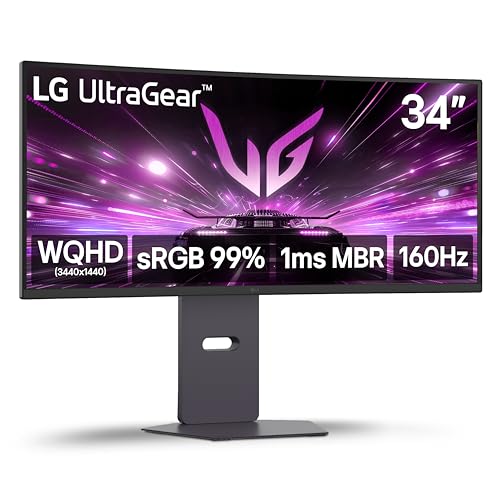
Specs
Panel | 34-inch curved |
Resolution | 3440 x 1440 |
Refresh rate | 160Hz |
Adaptive sync | AMD FreeSync Premium |
HDR | HDR10 |
Inputs | HDMI 2.1 and DisplayPort |
Stand | Tilt, height, swivel |
Panel
34-inch curved
Resolution
3440 x 1440
Refresh rate
160Hz
Adaptive sync
AMD FreeSync Premium
HDR
HDR10
Inputs
HDMI 2.1 and DisplayPort
Stand
Tilt, height, swivel
What it does well
3440 x 1440 is roughly a third more pixels than 1440p, which is the amount of extra work this card can absorb without falling out of high-refresh territory. Take the 1440p numbers, subtract about a quarter, and the result still sits near this panel's 160Hz ceiling in most titles rather than far above it.
Width is what most people are chasing when they reach for 4K. A 34-inch 21:9 panel changes how a cockpit, a strategy map or an open world sits in front of you far more than a denser 16:9 screen at the same diagonal does. If you are still choosing the card itself, the wider 1440p field is worth a look.
HDMI 2.1 on the second input keeps a console usable on the same desk, which the 27-inch picks generally handle less gracefully.
What you give up
Ultrawide support is uneven. Older titles letterbox, and a handful of competitive games either stretch the HUD or refuse the aspect ratio outright.
160Hz is a real step down from the 240Hz picks, and it is the wrong screen for anyone whose main library is shooters. Note also that Amazon lists a Renewed version of this exact model at a lower price; the pick is the new listing.
Who it's for
The reader living in single-player, sim or strategy games who would rather have field of view than pixel density.
Bottom line
If you want one screen that stops the card being the limit, buy the Gigabyte GS27QXA. If your library is single-player and you want HDR that does something, buy the AOC Q27G3XMN Mini-LED. If motion clarity is the upgrade you are after and you accept the wear risk, buy the MSI MAG 271QPX QD-OLED E2.
If the budget went into the card, the LG UltraGear 27GS75Q-B is a floor that does not embarrass it. If you would rather have width than density, take the LG UltraGear 34G600A-B. Whichever one lands on the desk, size the power supply for the card before the panel arrives.
FAQ
Is the RX 9070 a 1440p card or a 4K card?
It is a 1440p card that can visit 4K. GamersNexus measured 131 fps in Cyberpunk 2077 at 1440p Ultra and 96 in Starfield, both native. The same suite at 4K drops to 70 and 41 in the heaviest titles. Buy a 1440p panel and treat 4K as something you switch to for slower single-player games with upscaling on.
Can the RX 9070 drive a 240Hz 1440p monitor?
In the games where 240Hz matters, yes. Competitive shooters clear 240 fps on this card without upscaling. In heavier single-player titles it renders between 75 and 172 fps, and variable refresh covers that range rather than wasting the panel. Frame generation lifts the smoothness further, but treat it as a multiplier on a base that is already good: it turns 60 into 120 and never turns 30 into 120. A 240Hz screen gives you headroom at the top and costs nothing at the bottom.
Does the RX 9070 support DisplayPort 2.1, and does it matter?
It carries DisplayPort 2.1a at the UHBR13.5 tier, which is 54 Gbps. The higher UHBR20 tier at 80 Gbps is on the Nvidia side this generation. At 1440p and at 3440 x 1440 the difference never surfaces. It only becomes a talking point at 4K with a very high refresh rate, where the link runs out of room and compression takes over.
Do I need DSC for a 4K high-refresh monitor on the RX 9070?
Yes. Display Stream Compression is what makes 4K at 144Hz or higher fit through a 54 Gbps link, and it is visually lossless in normal use. The practical costs are small but real: some panels lose a display mode or two when DSC is active, and multi-monitor setups occasionally behave oddly on wake. At 1440p none of this applies.
Should I get an OLED or an IPS monitor for the RX 9070?
IPS if the screen doubles as a work monitor with static elements on it all day, or if the room is bright. OLED if games are most of what the screen does and motion clarity is the upgrade you want. The Mini-LED option sits between them: it gives you the contrast and the HDR brightness without the wear question, and it pays for that with VA smearing in fast motion.
Does the RX 9070 work with G-Sync monitors?
It works with any G-SYNC Compatible panel, because that certification is applied to monitors running the VESA Adaptive-Sync standard that FreeSync also uses. Older screens with a dedicated G-SYNC hardware module are the exception and will not do variable refresh on a Radeon card. Every pick in this list carries FreeSync, so the question does not come up.
Related Articles

Best Gaming Monitors for the RX 9070 XT (2026): 5 Picks
The best monitor for an RX 9070 XT, matched to what the card genuinely feeds: 1440p high refresh, QD-OLED, an ultrawide, plus when a 4K panel makes sense.
Aug 11, 2026

RX 9070 vs RX 9070 XT: Which RDNA 4 Card Wins in 2026
RX 9070 vs RX 9070 XT: the AMD-internal RDNA 4 call, decided by your 1440p panel ceiling, ray-tracing tolerance, and the efficiency vs raw-power tradeoff.
May 17, 2026

Best PSU for RX 9070 (2026): 750W or 850W? 5 Top Picks
The best PSU for an RX 9070 is 750W with ATX 3.1, or 850W with a high-end CPU. Its 220W TDP spikes to 830W, so transient response decides it, not wattage.
Aug 21, 2026

Is an OLED Gaming Monitor Worth It in 2026? Burn-In, 3 Picks
An OLED gaming monitor is worth it at 1440p or higher in a dim room. Where the price crossover lands, the burn-in risk in 2026, and when Mini-LED wins.
Aug 25, 2026

How to Choose a GPU (and a Monitor That Matches)
A buyer's framework for picking a GPU and the monitor that pairs with it. Start with the panel and work the card back.
May 17, 2026