Affiliate Disclosure: As an Amazon Associate we earn from qualifying purchases. Some links may earn us a commission at no cost to you.

Best Gaming Monitors for the RX 9070 XT (2026): 5 Picks
You already own the RX 9070 XT, or you are about to. The question now is what to put in front of it, and the answer is more specific than "get a 1440p monitor." This card renders in the triple digits at 2560 x 1440 in most of what people play, and it falls into the 30s and 60s at native 4K. That gap is the whole decision.
The five panels below are sorted by what the card can feed, not by what looks good on a spec sheet. Each one names the FreeSync tier it carries and the ports it uses, because both change what you get. For the wider version of this decision, start with the GPU and display pairing pillar.
Our top pick: MSI MPG 271QRX QD-OLED
The MSI MPG 271QRX QD-OLED matches this card on every axis that matters: 1440p native, 360Hz of headroom the 9070 XT will not exhaust in esports, and FreeSync Premium Pro rather than a badge that merely tolerates Adaptive-Sync.

Quick picks
Pick | Monitor | Best for | Buy |
|---|---|---|---|
Best Overall | 1440p mixed library with competitive titles | ||
Best Value | HDR that gets genuinely bright, with no burn-in risk | ||
Best Premium | 34-inch ultrawide immersion for single-player and sims | ||
Best Budget | The floor: 1440p 180Hz Fast IPS, budget stays with the GPU | ||
Editor's Pick | 4K desktop clarity when you accept FSR 4 upscaling |
Best Overall
- Monitor
- Best for
1440p mixed library with competitive titles
- Buy
Best Value
- Monitor
- Best for
HDR that gets genuinely bright, with no burn-in risk
- Buy
Best Premium
- Monitor
- Best for
34-inch ultrawide immersion for single-player and sims
- Buy
Best Budget
- Monitor
- Best for
The floor: 1440p 180Hz Fast IPS, budget stays with the GPU
- Buy
Editor's Pick
- Monitor
- Best for
4K desktop clarity when you accept FSR 4 upscaling
- Buy
Specs at a glance
Monitor | Resolution | Refresh | Panel | Adaptive sync | Video inputs |
|---|---|---|---|---|---|
2560 x 1440 | 360 Hz | QD-OLED | FreeSync Premium Pro | DP 1.4a, 2x HDMI 2.1, USB-C | |
2560 x 1440 | 180 Hz | Mini-LED VA | FreeSync Premium | 2x DP 1.4, 2x HDMI 2.0 | |
3440 x 1440 | 165 Hz | QD-OLED | FreeSync Premium Pro | 2x DP 1.4, HDMI 2.0 | |
2560 x 1440 | 180 Hz | Fast IPS | FreeSync Premium | DP 1.4, HDMI | |
3840 x 2160 | 160 Hz | Fast IPS | Adaptive-Sync | DP 1.4 DSC, HDMI 2.1, USB-C |
- Resolution
2560 x 1440
- Refresh
360 Hz
- Panel
QD-OLED
- Adaptive sync
FreeSync Premium Pro
- Video inputs
DP 1.4a, 2x HDMI 2.1, USB-C
- Resolution
2560 x 1440
- Refresh
180 Hz
- Panel
Mini-LED VA
- Adaptive sync
FreeSync Premium
- Video inputs
2x DP 1.4, 2x HDMI 2.0
- Resolution
3440 x 1440
- Refresh
165 Hz
- Panel
QD-OLED
- Adaptive sync
FreeSync Premium Pro
- Video inputs
2x DP 1.4, HDMI 2.0
- Resolution
2560 x 1440
- Refresh
180 Hz
- Panel
Fast IPS
- Adaptive sync
FreeSync Premium
- Video inputs
DP 1.4, HDMI
- Resolution
3840 x 2160
- Refresh
160 Hz
- Panel
Fast IPS
- Adaptive sync
Adaptive-Sync
- Video inputs
DP 1.4 DSC, HDMI 2.1, USB-C
Benchmarks
What the card renders at 2560 x 1440 before FSR 4 or frame generation enter the picture.
- 125 FPS
- 88 FPS
- 77 FPS
The same card at 3840 x 2160, where native frame rates fall out of high-refresh territory.
- 60 FPS
- 30 FPS
How we picked
Three things decide this pairing, and resolution comes first. We started from what the RX 9070 XT renders without help. At 2560 x 1440 the card sits in triple digits in Cyberpunk 2077 and lands in the high 70s in the heaviest title in the set, which means a 165Hz panel is comfortably filled and a 240Hz or 360Hz panel has headroom left for esports. At 3840 x 2160 the same card drops into a 30 to 60 band. That is the line between a panel the card feeds and a panel the card apologises to. If you are still choosing the card itself, the wider 1440p GPU shortlist covers that side.
Second is what the card can physically drive. RDNA 4 gives you three DisplayPort 2.1a outputs and one HDMI 2.1b, with two DisplayPort links running at full bandwidth at the same time. Those outputs run at UHBR13.5, which is 54 Gbps, below the 80 Gbps tier the current GeForce cards carry. In practice that changes nothing for any panel here, because every one of them connects over DisplayPort 1.4 or 1.4a with compression. It becomes a real limit only at 4K 240Hz uncompressed, which is not a resolution this card renders anyway. Where the 9070 XT lands against a 5080 has the rest of that comparison.
Third is the adaptive-sync tier, and the badges are not interchangeable. FreeSync Premium guarantees low framerate compensation, which keeps the picture smooth when frames dip below the panel's minimum. FreeSync Premium Pro adds HDR tone mapping over the same link. G-Sync Compatible means the panel speaks VESA Adaptive-Sync and passed NVIDIA validation, which works fine on a Radeon card but tells you nothing about AMD-side tuning. Two picks here carry Premium Pro, and both are the ones with HDR worth using. The 9070 XT's 1440p case against the RTX 5070 is the sibling argument.
What we left out matters too. No 4K 240Hz OLED made the list, because the card cannot fill one natively and buying refresh you only reach through frame generation is buying arithmetic. No 1080p panel made it either. A card in this class paired with 1080p is the wrong end of the build getting the money. If you landed on the non-XT instead, our monitor shortlist for the plain RX 9070 runs the same maths against its lower frame ceiling.
One principle sits underneath all of it. The display is the part you stare at, and it is the line item people cut first after overspending on the tower. If the choice is a cheaper panel or a cheaper card, the panel is not where the savings should come from.
One more thing worth saying out loud. Every panel here has a near-twin SKU one character away in the model number. The MPG 271QRX is not the MAG 271QPX, the VG27AQ3A is not the VG27AQL5A, and the AW3423DWF is not the AW3423DW. Check the exact string on the listing before you click buy, because the twins differ in refresh rate, panel technology, or adaptive-sync tier.
Best Overall: MSI MPG 271QRX QD-OLED
Specs
Panel | 26.5-inch QD-OLED |
Resolution | 2560 x 1440 |
Refresh rate | 360 Hz |
Response time | 0.03 ms GtG |
Adaptive sync | FreeSync Premium Pro |
HDR | DisplayHDR True Black 400 |
Video inputs | DisplayPort 1.4a, 2x HDMI 2.1, USB-C DP Alt (90W PD) |
Panel
26.5-inch QD-OLED
Resolution
2560 x 1440
Refresh rate
360 Hz
Response time
0.03 ms GtG
Adaptive sync
FreeSync Premium Pro
HDR
DisplayHDR True Black 400
Video inputs
DisplayPort 1.4a, 2x HDMI 2.1, USB-C DP Alt (90W PD)
What it does well
QD-OLED at 0.03 ms gray-to-gray removes the class of motion blur that Fast IPS panels still carry at high refresh. Fast camera pans stay legible instead of turning into a smear. That is a difference you feel in a shooter rather than measure in a chart.
Refresh headroom is the second reason it leads. At 1440p this card clears 120 frames in plenty of titles and goes far higher in esports, so a 360Hz ceiling stops being a marketing number and starts being usable. FreeSync Premium Pro carries low framerate compensation and HDR tone mapping over the same link, which matters when native frame rates swing between the high 70s and the mid 120s depending on what you load.
Connectivity is the quiet win. Two HDMI 2.1 ports and a USB-C input with 90W of power delivery mean a console and a work laptop can share the panel without a switch box. If you want the panel-tech argument in full, the QD-OLED versus WOLED breakdown covers it.
What you give up
Brightness is the honest weakness. 250 nits typical in SDR is dim in a room with a window behind you, and DisplayHDR True Black 400 flatters OLED contrast rather than pushing highlights hard. Buy this for a controlled-light desk, not a sunroom.
Burn-in risk has not gone away either. Static HUDs and taskbars are still the failure mode, and the warranty coverage is the reason to keep the receipt. The DisplayPort input here is 1.4a, so nothing on this card's DisplayPort 2.1a spec sheet gets used.
Who it's for
The buyer who put the money into a 9070 XT for 1440p raster and plays a mixed library with competitive titles in it. If you split time between ranked shooters and single-player games, this is the panel that does not force a choice between them. If you landed on the GRE rather than the XT, the GRE monitor pairing runs the same exercise one tier down.
Best Value: AOC Q27G3XMN Mini-LED
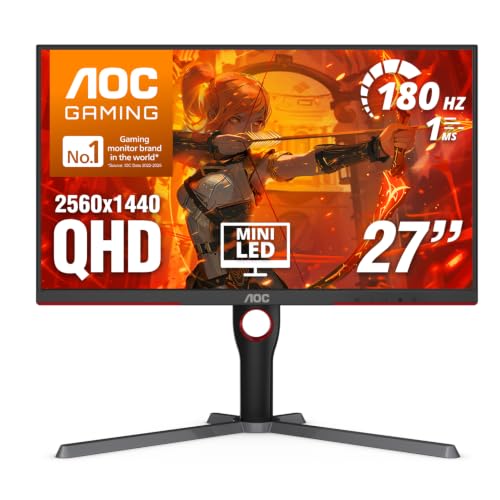
Specs
Panel | 27-inch VA with mini-LED backlight |
Resolution | 2560 x 1440 |
Refresh rate | 180 Hz |
HDR | DisplayHDR 1000 |
Adaptive sync | FreeSync Premium |
Video inputs | 2x DisplayPort 1.4, 2x HDMI 2.0 |
Panel tech note | Local dimming zones, VA contrast |
Panel
27-inch VA with mini-LED backlight
Resolution
2560 x 1440
Refresh rate
180 Hz
HDR
DisplayHDR 1000
Adaptive sync
FreeSync Premium
Video inputs
2x DisplayPort 1.4, 2x HDMI 2.0
Panel tech note
Local dimming zones, VA contrast
What it does well
A mini-LED backlight reaching DisplayHDR 1000 is the one place a non-OLED panel wins outright. Highlights get genuinely bright, and they do it without the burn-in anxiety that comes with an OLED doing desktop duty all day. If you have been going back and forth on the trade, whether OLED is worth it at all is the longer version of that argument.
VA contrast underneath the backlight holds dark scenes together where IPS washes them into grey. At 180Hz over DisplayPort 1.4 the panel sits above what the 9070 XT sustains natively in every heavy title in the benchmark set, so you are not paying for refresh the card cannot reach.
What you give up
VA response times are the cost. Dark-to-dark transitions smear in a way the QD-OLED simply does not, and it shows during fast camera movement through low-light scenes. Viewing angles are narrower than IPS, so a second seat off to the side gets a worse picture.
Local dimming has its own tells. Zone count is modest, so bright interface elements on a dark background carry a visible halo. Reports suggest the dimming feature ships switched off, which makes the panel look ordinary until you go find it in the menu.
Who it's for
The buyer who wants HDR that reaches real brightness, will not pay OLED money, and refuses to accept burn-in risk on a panel that also runs a desktop all day.
Best Premium: Alienware AW3423DWF QD-OLED

Specs
Panel | 34-inch curved QD-OLED, 1800R |
Resolution | 3440 x 1440 (21:9) |
Refresh rate | 165 Hz over DisplayPort |
Response time | 0.1 ms GtG |
Adaptive sync | FreeSync Premium Pro |
Color | 99.3% DCI-P3 |
Video inputs | 2x DisplayPort 1.4, 1x HDMI 2.0 (100 Hz cap) |
Panel
34-inch curved QD-OLED, 1800R
Resolution
3440 x 1440 (21:9)
Refresh rate
165 Hz over DisplayPort
Response time
0.1 ms GtG
Adaptive sync
FreeSync Premium Pro
Color
99.3% DCI-P3
Video inputs
2x DisplayPort 1.4, 1x HDMI 2.0 (100 Hz cap)
What it does well
3440 x 1440 is roughly a third more pixels than 16:9 1440p, which this card absorbs without falling out of its comfortable band. That is the whole reason the premium pick is an ultrawide rather than a 4K panel. The step-up spend goes to screen area the card can still drive, not to a resolution it has to fight.
The adaptive-sync story here is native rather than bolted on. This panel carries FreeSync Premium Pro from AMD's own certification, not an NVIDIA validation that a Radeon card happens to be able to use. Add 99.3 percent DCI-P3 coverage and QD-OLED contrast on an 1800R curve and it is the pick that makes a 9070 XT feel like a flagship without asking it to render 4K.
What you give up
The HDMI port is version 2.0 and tops out at 100Hz. Cable it over HDMI and you silently lose a third of the refresh rate, which is the easiest mistake to make with this monitor. Use DisplayPort.
1440 vertical pixels stretched across 34 inches is a coarser pixel pitch than a 27-inch panel, so text is less crisp for desk work. Ultrawide support in competitive titles is still uneven, and some engines letterbox instead of widening the field of view.
Who it's for
The single-player and sim buyer who wants immersion over frame count and has the desk depth for a 34-inch curve. If your library is mostly ranked shooters, take the 27-inch QD-OLED instead.
Best Budget: ASUS TUF Gaming VG27AQ3A

Specs
Panel | 27-inch Fast IPS |
Resolution | 2560 x 1440 |
Refresh rate | 180 Hz |
Response time | 1 ms |
Adaptive sync | FreeSync Premium, G-Sync Compatible |
Color | 130% sRGB |
Video inputs | DisplayPort 1.4, HDMI |
Panel
27-inch Fast IPS
Resolution
2560 x 1440
Refresh rate
180 Hz
Response time
1 ms
Adaptive sync
FreeSync Premium, G-Sync Compatible
Color
130% sRGB
Video inputs
DisplayPort 1.4, HDMI
What it does well
This is the floor a 9070 XT owner should accept, and it is a competent floor. Fast IPS at 1440p keeps the viewing angles and colour consistency VA gives up, 180Hz clears what the card renders natively in every title in the benchmark set, and FreeSync Premium carries low framerate compensation for the dips.
ELMB Sync is worth knowing about. It strobes the backlight to cut perceived motion blur, which gets an IPS panel closer to OLED clarity on esports nights at the cost of brightness. The bigger point is budget order. Leaving the money with the GPU rather than the panel is the right call when the card is the thing rendering the frames.
What you give up
HDR is a checkbox. The panel accepts an HDR signal and does nothing useful with it, so treat this as an SDR monitor and set expectations there. Contrast is ordinary IPS, which means dark scenes look grey next to either OLED pick.
There is no USB-C and no KVM, so a second machine needs a physical switch. The built-in speakers exist and are not worth using.
Who it's for
The buyer whose budget went into the card and who needs the panel to stop being the bottleneck without a second round of spending. It is also the right second monitor to sit next to one of the OLEDs.
Editor's Pick: ASUS ROG Strix XG27UCS

Specs
Panel | 27-inch Fast IPS |
Resolution | 3840 x 2160 |
Refresh rate | 160 Hz |
Response time | 1 ms |
Adaptive sync | Adaptive-Sync, G-Sync Compatible |
HDR | DisplayHDR 400 |
Video inputs | DisplayPort 1.4 (DSC), HDMI 2.1, USB-C |
Panel
27-inch Fast IPS
Resolution
3840 x 2160
Refresh rate
160 Hz
Response time
1 ms
Adaptive sync
Adaptive-Sync, G-Sync Compatible
HDR
DisplayHDR 400
Video inputs
DisplayPort 1.4 (DSC), HDMI 2.1, USB-C
What it does well
This is the honest 4K answer for this card, and it is an Editor's Pick rather than the Best Overall for a reason. 4K Fast IPS at 160Hz gives you desktop and productivity clarity nothing at 1440p matches, and a tripod socket plus USB-C makes it a reasonable creative monitor as well as a gaming one.
It is also the one pick where the card's upscaling story earns its keep. FSR 4 Quality at 4K on RDNA 4 is good enough in 2026 to be a real buying lever rather than a crutch, and it is what gets this panel's refresh headroom used. The same pairing on the NVIDIA side shows what a card with more 4K raster does with a similar panel.
What you give up
Native 4K is where this card runs out. Heavy titles land between 30 and 60 frames without upscaling, so the 160Hz ceiling gets reached with FSR 4 and frame generation rather than raster. Frame generation turns 60 into 120 and never turns 30 into 120, so the games where you most want the smoothness are the games where you are least likely to get it.
DisplayHDR 400 on IPS is the weakest HDR in this roundup. And the card's DisplayPort 2.1a outputs go unused again, because this panel connects over DisplayPort 1.4 with compression.
Who it's for
The buyer who mixes single-player gaming with desktop and creative work, and who is comfortable treating FSR 4 as part of the deal rather than as a compromise.
Bottom line
If you play a mixed library with ranked shooters in it, buy the MSI MPG 271QRX QD-OLED. If you want bright HDR without burn-in worry, the AOC Q27G3XMN Mini-LED is the value pick. If you live in single-player games and sims, take the Alienware AW3423DWF QD-OLED and cable it over DisplayPort. If the card ate the budget, the ASUS TUF Gaming VG27AQ3A is a floor you will not resent. And if your desk does as much work as it does gaming, the ASUS ROG Strix XG27UCS is the 4K pick, with FSR 4 doing part of the lifting. While you are speccing the rest of the build, PSU sizing for an RX 9070 build is the other thing people get wrong.
FAQ
Can the RX 9070 XT run 4K at 240Hz?
The card can output that signal, but it cannot render it. Its display engine drives DisplayPort 2.1a at UHBR13.5, which is 54 Gbps, and with Display Stream Compression that is enough to carry 4K 240Hz to a panel. Rendering is the harder problem. Native 4K in heavy titles lands between 30 and 60 frames on this card, so 240Hz would be a number on the box rather than an experience. At 1440p the picture flips and the card genuinely fills a high-refresh panel.
Does the RX 9070 XT support DisplayPort 2.1, and does it matter for my monitor?
Yes. Three DisplayPort 2.1a outputs plus one HDMI 2.1b, though only two DisplayPort links run at full bandwidth at the same time. Those outputs are UHBR13.5 (54 Gbps) rather than the 80 Gbps UHBR20 tier. For every panel in this roundup it makes no difference, because they all connect over DisplayPort 1.4 or 1.4a with compression. It would only matter on a 4K 240Hz panel you wanted to run uncompressed.
Is 1440p or 4K the better resolution for an RX 9070 XT?
1440p, for most buyers. The benchmark spread above is the argument: 77 to 125 frames native at 1440p in demanding single-player titles and far higher in esports, against 30 to 60 at native 4K. A 4K panel is still reasonable if your library leans single-player and you are happy running FSR 4 Quality, which is what the Editor's Pick assumes. If you want native frames and high refresh together, 1440p is the answer.
Do I need a FreeSync Premium Pro monitor for the RX 9070 XT, or is FreeSync Premium enough?
Premium is enough for tear-free gaming with low framerate compensation. Premium Pro adds HDR tone mapping over the adaptive-sync link, which only matters if the panel has HDR worth using. On an OLED or a mini-LED panel, chase Premium Pro. On an IPS panel wearing a DisplayHDR 400 badge, plain Premium costs you nothing real.
Will a G-Sync monitor work with the RX 9070 XT?
A G-Sync Compatible monitor will, because that label means the panel speaks VESA Adaptive-Sync, which is what FreeSync rides on. The one to avoid is a monitor with a hardware G-Sync module: variable refresh on those is NVIDIA-only, so you would be paying for a feature this card cannot use. Check the spec sheet for the word module.
Related Articles

Best Gaming Monitors for the RTX 5080 (2026): 5 Picks
The best gaming monitor for an RTX 5080, matched to what the card actually feeds: 4K 240Hz OLED, 1440p high refresh, ultrawide, and a budget 4K panel.
Aug 10, 2026

RTX 5070 vs RX 9070 XT (2026): 12GB DLSS 4 vs 16GB Raster
RTX 5070 vs RX 9070 XT at 1440p in 2026: the 9070 XT leads raster with 16GB, the 5070 wins ray tracing with DLSS 4 on 12GB. Pick by the games you actually play.
Sep 15, 2026

Best 1440p OLED Gaming Monitors (2026): QD-OLED vs WOLED Picks
The best 1440p OLED gaming monitors of 2026, from value-tier 360Hz QD-OLED to 480Hz WOLED flagship. With burn-in mitigation guidance.
May 14, 2026

Best PSU for RX 9070 (2026): 750W or 850W? 5 Top Picks
The best PSU for an RX 9070 is 750W with ATX 3.1, or 850W with a high-end CPU. Its 220W TDP spikes to 830W, so transient response decides it, not wattage.
Aug 21, 2026

Should You Wait for Nova Lake or Buy Intel Now? (2026)
Should you wait for Nova Lake or buy an Intel CPU now? LGA 1851 is a dead-end socket, so here is the buy-now pick, the hold case, and the revisit date.
Sep 24, 2026