Affiliate Disclosure: As an Amazon Associate we earn from qualifying purchases. Some links may earn us a commission at no cost to you.

Best GPU for Modern Warfare 4 (2026): 5 Picks by Target
The best GPU for Modern Warfare 4 is the Sapphire Pulse RX 9070 XT for most players: 16 GB of VRAM, native 1440p at high refresh, and a raster-heavy engine where AMD's RDNA 4 cards run level with Nvidia's. Drop to an RX 9060 XT 16GB for 1080p, and step up to an RTX 5070 Ti or RTX 5080 only for ray tracing or 4K.
Activision's spec sheet tells you what runs the game. These picks are for running it at the refresh rate you paid for. The full Modern Warfare 4 system requirements live in our companion guide. MW4 launches October 23, 2026, and we will fold in launch benchmarks.
Our top pick: Sapphire Pulse RX 9070 XT
The Sapphire Pulse RX 9070 XT holds roughly 120 fps at 1440p ultra in Black Ops 6 on the same engine family, carries the 16 GB the ray tracing tier asks for, and undercuts the Nvidia cards that match it.

Quick picks
Pick | GPU | Best for | Buy |
|---|---|---|---|
Best Overall | 1440p high refresh, native | ||
Best Value | 1080p 144Hz to 240Hz | ||
Best Premium | 4K high refresh, max settings | ||
Best Budget | 1080p high settings, official recommended tier | ||
Editor's Pick | 1440p ultra with ray tracing |
Best Overall
- GPU
- Best for
1440p high refresh, native
- Buy
Best Value
- GPU
- Best for
1080p 144Hz to 240Hz
- Buy
Best Premium
- GPU
- Best for
4K high refresh, max settings
- Buy
Best Budget
- GPU
- Best for
1080p high settings, official recommended tier
- Buy
Editor's Pick
- GPU
- Best for
1440p ultra with ray tracing
- Buy
Specs at a glance
GPU | VRAM | Memory bus | Board power | Upscaling |
|---|---|---|---|---|
16 GB GDDR6 | 256-bit | 304 W | FSR 4 | |
16 GB GDDR6 | 128-bit | 160 W (reference) | FSR 4 | |
16 GB GDDR7 | 256-bit | 360 W | DLSS 4 | |
12 GB GDDR6 | 192-bit | 190 W | XeSS 2 | |
16 GB GDDR7 | 256-bit | 300 W | DLSS 4 |
- VRAM
16 GB GDDR6
- Memory bus
256-bit
- Board power
304 W
- Upscaling
FSR 4
- VRAM
16 GB GDDR6
- Memory bus
128-bit
- Board power
160 W (reference)
- Upscaling
FSR 4
- VRAM
16 GB GDDR7
- Memory bus
256-bit
- Board power
360 W
- Upscaling
DLSS 4
- VRAM
12 GB GDDR6
- Memory bus
192-bit
- Board power
190 W
- Upscaling
XeSS 2
- VRAM
16 GB GDDR7
- Memory bus
256-bit
- Board power
300 W
- Upscaling
DLSS 4
Benchmarks
Modern Warfare 4 has not shipped, so nobody has independent benchmarks for it yet. The closest honest yardstick is Black Ops 6, which runs on the same IW engine family. The numbers below are native, at ultra, with upscaling and frame generation off. Read them as the shape of the ladder rather than a promise for MW4, and see our Black Ops 6 GPU testing for the settings side.
The Arc B580 is missing from these charts because we found no reviewer data for it at the same settings. The RTX 5080 rows double as the ceiling reference for the whole list.
Same IW engine family as Modern Warfare 4. Native, no upscaling and no frame generation.
- 113 FPS
- 178 FPS
- 181 FPS
- 198 FPS
The resolution most of these picks are built around.
- 77 FPS
- 121 FPS
- 126 FPS
- 140 FPS
Mainstream cards left off: 4K is outside what they are built for.
- 69 FPS
- 73 FPS
- 83 FPS
How we picked GPUs for Modern Warfare 4
We started from the official tiers and then asked a different question. Activision's recommended spec is an RTX 3060 Ti or RX 6700 XT class card, or an Arc B580, with 8 GB of VRAM, pitched at 90 fps in multiplayer on High. That clears the game. It does not clear a 165Hz or 240Hz panel, which is what most Call of Duty players own.
So each pick maps to a target: 1080p high refresh, native 1440p at high refresh, 1440p ultra with ray tracing, and 4K. The ray tracing tier is the one Infinity Ward was specific about: an RX 9070 XT or RTX 5070 Ti, 16 GB of VRAM, and 32 GB of system memory. That is where the 16 GB line in this guide comes from.
VRAM was the hard filter. A Call of Duty texture pool grows across two years of seasons and maps, and 8 GB cards are the first to start swapping. Every pick except the budget card has 16 GB, and the budget card has 12. GPU first, always: the card decides the experience, and the rest of the build flexes around it. Our guide on how to choose a GPU covers the wider framework.
Two things no card fixes. Modern Warfare 4 requires TPM 2.0 and Secure Boot, and without both enabled the game will not let you into an online match, whatever GPU is installed. And at 1080p on a 240Hz panel, the processor sets your 1% lows long before the graphics card runs out.
Best Overall: Sapphire Pulse RX 9070 XT
Specs
Chip | AMD Navi 48 (RX 9070 XT) |
Compute units | 64 |
VRAM | 16 GB GDDR6, 256-bit |
Total board power | 304 W |
Power connector | 2x 8-pin PCIe |
Our PSU floor | 750 W |
Upscaling | FSR 4 |
Chip
AMD Navi 48 (RX 9070 XT)
Compute units
64
VRAM
16 GB GDDR6, 256-bit
Total board power
304 W
Power connector
2x 8-pin PCIe
Our PSU floor
750 W
Upscaling
FSR 4
What it does well
In Black Ops 6, the closest stand-in for MW4, the 9070 XT averages about 121 fps at 1440p ultra and 178 fps at 1080p ultra, native. That is the number that makes a 144Hz or 165Hz panel feel settled. You set the game to high or ultra once and stop thinking about it.
Call of Duty is a raster-first engine, and raster is where RDNA 4 is strongest. The 9070 XT trades blows with the RTX 5070 Ti in this game, and some reviewers have measured it ahead in Black Ops 6, while it carries 16 GB on a 256-bit bus. It is also one of the two cards on the official ray tracing tier, so the RT preset stays on the table at 1440p with FSR 4 Quality. Our 1440p GPU picks lay out the rest of the tier.
What you give up
Ray tracing headroom. On the maps that lean on RT, Nvidia's hardware pulls ahead and DLSS 4 pulls further. FSR 4 is good at Quality, but Performance mode still shows its work in fast camera motion, which is exactly what a shooter does.
The SKU trap. Sapphire sells a Pulse and a Nitro+ RX 9070 XT under listing titles that differ by a few words. Buyers have flagged ordering the wrong one, and the Pulse part number, 11348-03-20G, is the reliable check. Plan on a 750 W supply for the 304 W board power and its two 8-pin connectors.
Who it's for
The 1440p player on a 144Hz to 165Hz panel who wants native frames in multiplayer and Warzone without paying for Nvidia's top tier, and who plays Call of Duty more than ray-traced single-player games.
Best Value: Sapphire Pulse RX 9060 XT (16 GB)

Specs
Chip | AMD Navi 44 (RX 9060 XT) |
Compute units | 32 |
VRAM | 16 GB GDDR6, 128-bit |
Total board power | 160 W reference (factory OC cards run higher) |
PCIe interface | PCIe 5.0 x16 |
Our PSU floor | 550 W |
Upscaling | FSR 4 |
Chip
AMD Navi 44 (RX 9060 XT)
Compute units
32
VRAM
16 GB GDDR6, 128-bit
Total board power
160 W reference (factory OC cards run higher)
PCIe interface
PCIe 5.0 x16
Our PSU floor
550 W
Upscaling
FSR 4
What it does well
Around 113 fps at 1080p ultra in Black Ops 6, native, and about 77 fps at 1440p ultra. On a 144Hz panel at high settings that is headroom rather than a target you are scraping at, and competitive players who drop settings push well past it.
The 16 GB frame buffer is why it is here instead of anything cheaper. It is double what Activision's recommended tier asks for, and it keeps the card clear of the texture swapping that catches 8 GB cards as a Call of Duty release collects seasons. At this tier, nothing Nvidia sells matches its VRAM for the money. Our 1080p GPU picks cover the rest of the shelf at this resolution.
What you give up
The 128-bit memory bus. This is a 1080p card that reaches into 1440p, not a 1440p card with room to spare, and it is out of its depth at 4K. Ray tracing is off the table in practice; the RT tier asks for a 9070 XT or 5070 Ti for a reason.
Watch the listing. An 8 GB RX 9060 XT sells under nearly identical names, and buyers have flagged the mix-up. Check for 16 GB in the title before you order.
Who it's for
The 1080p player on a 144Hz panel who wants high settings in MW4 and does not want to revisit the VRAM question for the life of the game.
Best Premium: ASUS TUF RTX 5080 OC

Specs
Chip | NVIDIA GB203 (RTX 5080) |
CUDA cores | 10,752 |
VRAM | 16 GB GDDR7, 256-bit |
Total graphics power | 360 W |
Power connector | 16-pin 12V-2x6 |
NVIDIA PSU guidance | 850 W |
Upscaling / frame gen | DLSS 4 with Multi Frame Generation |
Chip
NVIDIA GB203 (RTX 5080)
CUDA cores
10,752
VRAM
16 GB GDDR7, 256-bit
Total graphics power
360 W
Power connector
16-pin 12V-2x6
NVIDIA PSU guidance
850 W
Upscaling / frame gen
DLSS 4 with Multi Frame Generation
What it does well
The fastest Black Ops 6 result we would put in a Call of Duty build: about 140 fps at 1440p ultra and 83 fps at 4K ultra, native. Add DLSS 4 at Quality and 4K high refresh comes within reach, which is the target this card exists for.
DLSS 4's transformer model is the other half of the case. At 4K, Quality mode is hard to separate from native, and Multi Frame Generation turns an 80 fps base into smooth high-refresh motion in the campaign. AMD has no card at this tier this generation. Our 4K GPU picks cover the alternatives.
What you give up
Frame generation in multiplayer. It adds latency, so competitive players should leave it off, and that leaves the 5080's edge in MW4 multiplayer as raw raster. At 1440p ultra that is about 15 percent over the 9070 XT, not a tier's worth.
Power and size. It is a 360 W card on a 16-pin connector, and NVIDIA's guidance is an 850 W supply. TUF cards run past three slots, so check length and thickness against your case before you order. And 16 GB is right for 4K today, not a permanent buffer.
Who it's for
The 4K player, or the 1440p 240Hz player who wants ultra settings and the campaign with every effect on. On a 1440p 165Hz panel, the Best Overall pick gets you most of the way for much less.
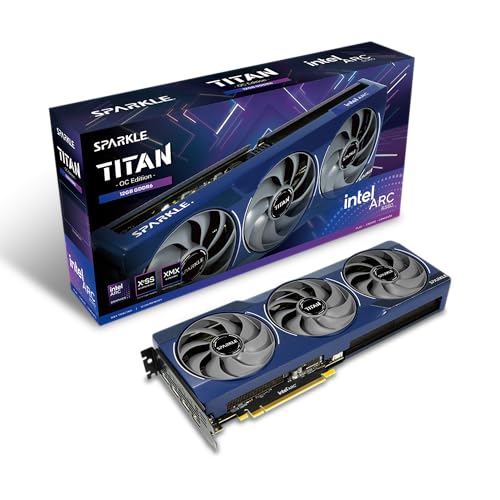
Best Budget: Sparkle Arc B580 Titan OC
Specs
Chip | Intel BMG-G21 (Arc B580) |
Xe cores | 20 |
VRAM | 12 GB GDDR6, 192-bit |
Total board power | 190 W |
PCIe interface | PCIe 4.0 x8 |
Resizable BAR | Required for full performance |
Upscaling / frame gen | XeSS 2 |
Chip
Intel BMG-G21 (Arc B580)
Xe cores
20
VRAM
12 GB GDDR6, 192-bit
Total board power
190 W
PCIe interface
PCIe 4.0 x8
Resizable BAR
Required for full performance
Upscaling / frame gen
XeSS 2
What it does well
The Arc B580 is named on Activision's own recommended tier, so this is the official recommended experience bought new. It brings 12 GB of VRAM, four more than that tier asks for, on a 192-bit bus.
For a 1080p panel at 60Hz to 120Hz on high settings, that is the right amount of card. XeSS 2 runs on Intel's own XMX hardware path here, which is where the upscaler looks its best, and the 190 W board power keeps PSU demands modest.
What you give up
Measured frame rates. We found no reviewer data for the B580 in Black Ops 6 at the settings in our charts, so its spot on this list rests on the official spec sheet and its 12 GB rather than a number we can show you. Launch benchmarks will settle it.
Resizable BAR. Intel Arc cards need it enabled in the BIOS for full performance, and older boards often ship with it off. Legacy DirectX 11 titles elsewhere in your library can still surface driver quirks, and stock on this card has been thin, so the live price on the button matters more here than anywhere else in this guide.
Who it's for
The 1080p player on a tight budget, on a platform with Resizable BAR available, who wants the official recommended experience with some VRAM headroom.
Editor's Pick: ASUS TUF RTX 5070 Ti OC

Specs
Chip | NVIDIA GB203 (RTX 5070 Ti) |
CUDA cores | 8,960 |
VRAM | 16 GB GDDR7, 256-bit |
Total graphics power | 300 W |
Power connector | 16-pin 12V-2x6 |
NVIDIA PSU guidance | 750 W |
Upscaling / frame gen | DLSS 4 with Multi Frame Generation |
Chip
NVIDIA GB203 (RTX 5070 Ti)
CUDA cores
8,960
VRAM
16 GB GDDR7, 256-bit
Total graphics power
300 W
Power connector
16-pin 12V-2x6
NVIDIA PSU guidance
750 W
Upscaling / frame gen
DLSS 4 with Multi Frame Generation
What it does well
This is the card for the ray tracing tier. Infinity Ward's RT spec names the RTX 5070 Ti alongside the RX 9070 XT, both with 16 GB, and on the Nvidia side the RT effects cost less while DLSS 4 recovers more of what they cost. In Black Ops 6 it lands near 126 fps at 1440p ultra and 73 fps at 4K ultra, native.
DLSS 4 at Quality is close to indistinguishable from native at 1440p, which is how you keep ray tracing on and the frame rate above 100 in a shooter. If the same PC streams, NVENC AV1 is a second reason to land here. We compare the two ray tracing tier cards in detail in RTX 5070 Ti vs RX 9070 XT.
What you give up
Raster value. With ray tracing off, the 9070 XT lands within a few frames of it in Black Ops 6 for less money, so a competitive 1440p player sees little return on the difference. This is a ray tracing and feature purchase.
It is a 1440p ultra card that does 4K with DLSS, not a native 4K card. The TUF cooler runs past three slots, so measure the case first, and size the supply at 750 W with a native 16-pin cable rather than an adapter.
Who it's for
The player who runs the campaign and Warzone at 1440p ultra with ray tracing on, or who streams from the same PC. With RT off, the Best Overall pick is the better buy.
Bottom line
If you play at 1440p on a 144Hz or 165Hz panel, buy the Sapphire Pulse RX 9070 XT. If you play at 1080p and want VRAM that lasts, buy the Sapphire Pulse RX 9060 XT (16 GB). If you want ray tracing on at 1440p or you stream, buy the ASUS TUF RTX 5070 Ti OC. If you play at 4K, buy the ASUS TUF RTX 5080 OC. If the budget is tight and your board supports Resizable BAR, the Sparkle Arc B580 Titan OC covers the official recommended tier.
Check TPM 2.0 and Secure Boot before launch day, and see our mouse and controller picks for Call of Duty if your controls need work too.
FAQ
What GPU do you need for Modern Warfare 4?
The official minimum is a GTX 970, GTX 1060, RX 470 or Arc A580 with 3 GB of VRAM, and the recommended tier is an RTX 3060 Ti or RX 6700 XT class card, or an Arc B580, with 8 GB. Those run the game. For high refresh, plan on a 16 GB card: an RX 9060 XT 16GB at 1080p, an RX 9070 XT at 1440p, and an RTX 5070 Ti or RTX 5080 for ray tracing or 4K.
Is 8GB of VRAM enough for Modern Warfare 4?
It meets the recommended spec, so the game will run at 1080p on High. It is not enough to count on for the life of the game. Call of Duty releases keep adding maps, modes and textures across their seasons, and 8 GB cards are the first to start swapping and stuttering at higher settings. The ray tracing tier asks for 16 GB outright. If you are buying a card now, buy 12 GB at the very least and 16 GB if you can.
What GPU do you need for ray tracing in Modern Warfare 4?
Infinity Ward's ray tracing tier lists an RX 9070 XT or RTX 5070 Ti with 16 GB of VRAM, plus 32 GB of system memory and a Ryzen 7 3700X or Core i7-10700K class processor, and it is pitched at 4K with upscaling. Of those two cards, the RTX 5070 Ti is the stronger ray tracing performer. The RTX 5080 is the step up if you want 4K with ray tracing at higher frame rates.
Is the RX 9070 XT or RTX 5070 Ti better for Modern Warfare 4?
For multiplayer with ray tracing off, buy the RX 9070 XT. The two land within a few frames of each other in Black Ops 6 on the same engine family, the AMD card costs less, and both carry 16 GB. For ray tracing, streaming with NVENC, or DLSS 4, buy the RTX 5070 Ti. Most Call of Duty players fall in the first group, which is why the 9070 XT is our Best Overall pick.
Should you wait for launch benchmarks before buying a GPU for MW4?
If you already own a 16 GB card from this generation, yes: there is no reason to buy anything before October 23. If you are on an 8 GB card or older hardware, the tier you need is already clear from the official specs and from Black Ops 6 on the same engine family, and the order of these picks is unlikely to change. We will update this guide with launch data.
Will a GTX 1060 run Modern Warfare 4?
Yes, at the minimum spec. The GTX 1060 and GTX 970 are both on Activision's minimum list, alongside the RX 470 and Arc A580, with 3 GB of VRAM as the floor. Expect low settings at 1080p and frame rates well short of a high-refresh panel. Your PC also needs TPM 2.0 and Secure Boot enabled. On a budget, the Arc B580 or RX 9060 XT 16GB is the sensible upgrade.
Related Articles

Modern Warfare 4 System Requirements: Official 2026 Specs
Modern Warfare 4 system requirements are official: GTX 1060 min, RTX 3060 Ti recommended. Plus the GPU tier for 1440p high refresh and the TPM 2.0 gate.
Sep 25, 2026

Best GPUs for Black Ops 6 (2026): Every Setting Tested
The best GPUs for Black Ops 6 at every budget tier, tested at 1080p competitive, 1440p high, and 4K. Picks chosen for real-world FPS, not spec sheets.
May 28, 2026

RTX 5070 Ti vs RX 9070 XT (2026): 5% Raster, 15% RT Gap
RTX 5070 Ti vs RX 9070 XT: the 9070 XT is 5% behind at 1440p raster for far less money, the 5070 Ti wins ray tracing by 15%. Which one you should buy.
Sep 3, 2026

Best 4K Gaming Monitor 2026: 5 OLED, Mini-LED and IPS Picks
Best 4K gaming monitor picks for 2026: OLED, Mini-LED and IPS compared from 144Hz to 240Hz, with the GPU each tier needs and a budget IPS entry point.
Oct 9, 2026

Best GPUs for Cyberpunk 2077 Path Tracing (2026): 5 Picks
Best GPUs for Cyberpunk 2077 path tracing in 2026: which card makes Overdrive playable at 1080p, 1440p or 4K with DLSS 4 frame gen, plus RT Ultra and AMD picks.
Oct 9, 2026