Affiliate Disclosure: As an Amazon Associate we earn from qualifying purchases. Some links may earn us a commission at no cost to you.

Modern Warfare 4 System Requirements (2026): 3 GPU Tiers
A current 16 GB mid-range graphics card clears Modern Warfare 4 at 1080p high refresh and at 1440p high. You step up only if you want ray tracing on at 1440p ultra, you drive a 4K panel, or the same machine does creative work. That is the verdict.
One caveat before any of it. Activision has not published a PC system-requirements sheet for MW4, and launch is October 23, 2026. The only PC requirement the company has confirmed is a security one: TPM 2.0 and Secure Boot. Every hardware figure below is a projection anchored to the Call of Duty engine shipping today, and it gets replaced the day the official sheet lands.
At a glance
Tier | The pick | VRAM | Target it clears | Buy |
|---|---|---|---|---|
Enough for 1080p | 16 GB | 1080p max, 144Hz to 240Hz | ||
Recommended | 16 GB | 1440p high refresh, native | ||
Step-up | 16 GB | 1440p ultra with RT, or 4K | ||
CPU | 96 MB L3 | 240Hz multiplayer 1% lows |
Enough for 1080p
- The pick
- VRAM
16 GB
- Target it clears
1080p max, 144Hz to 240Hz
- Buy
Recommended
- The pick
- VRAM
16 GB
- Target it clears
1440p high refresh, native
- Buy
Step-up
- The pick
- VRAM
16 GB
- Target it clears
1440p ultra with RT, or 4K
- Buy
CPU
- The pick
- VRAM
96 MB L3
- Target it clears
240Hz multiplayer 1% lows
- Buy
Is a mid-range card enough for Modern Warfare 4?
Short answer, yes, for most of the ways people play Call of Duty. The step-up cases are specific and small. If you play at 1080p on a high-refresh panel, the limiting part is more likely to be your processor than your graphics card, which is the same pattern our esports GPU picks at 1080p 144Hz piece runs into.
What you play | Is a 16 GB mid-range card enough? | Winner |
|---|---|---|
1080p 144Hz competitive multiplayer | Yes, comfortably | |
1080p 240Hz and up competitive multiplayer | Yes on the GPU, the CPU is the limit | |
1440p high, high refresh | Yes, this is the sweet spot | |
1440p ultra with ray tracing | No, step up | |
4K 60 and above | No, step up |
1080p 144Hz competitive multiplayer
- Is a 16 GB mid-range card enough?
Yes, comfortably
- Winner
1080p 240Hz and up competitive multiplayer
- Is a 16 GB mid-range card enough?
Yes on the GPU, the CPU is the limit
- Winner
1440p high, high refresh
- Is a 16 GB mid-range card enough?
Yes, this is the sweet spot
- Winner
1440p ultra with ray tracing
- Is a 16 GB mid-range card enough?
No, step up
- Winner
4K 60 and above
- Is a 16 GB mid-range card enough?
No, step up
- Winner
What Activision has actually confirmed
Here is the state of it as of early August 2026. Activision's official MW4 page carries one PC requirement, and it is not a graphics card. The footnote reads: TPM 2.0 and Secure Boot required for PC, other security measures may be enforced. There is no CPU listed, no GPU tier, no memory figure, no install size.
So the table below is ours, not theirs. The GPU, VRAM, RAM and storage rows are projections anchored to the shipping Call of Duty engine and to what the last two Call of Duty installs weighed on disk. The security row is the only line in it that comes from Activision. If you want the broader framework for matching a card to a panel rather than to one game, our guide on how to choose a GPU and a monitor that matches covers it.
Projected minimum | Projected recommended | Projected 1440p high refresh | |
|---|---|---|---|
GPU class | GTX 1060 6 GB / RX 580 class | RTX 2070 / RX 5700 XT class | RX 9060 XT 16 GB or better |
VRAM | 6 GB | 8 GB | 16 GB |
System memory | 12 GB | 16 GB | 16 GB |
Storage | NVMe SSD, roughly 120 GB free | NVMe SSD, roughly 120 GB free | NVMe SSD, roughly 120 GB free |
Security | TPM 2.0 and Secure Boot (confirmed) | TPM 2.0 and Secure Boot (confirmed) | TPM 2.0 and Secure Boot (confirmed) |
GPU class
- Projected minimum
GTX 1060 6 GB / RX 580 class
- Projected recommended
RTX 2070 / RX 5700 XT class
- Projected 1440p high refresh
RX 9060 XT 16 GB or better
VRAM
- Projected minimum
6 GB
- Projected recommended
8 GB
- Projected 1440p high refresh
16 GB
System memory
- Projected minimum
12 GB
- Projected recommended
16 GB
- Projected 1440p high refresh
16 GB
Storage
- Projected minimum
NVMe SSD, roughly 120 GB free
- Projected recommended
NVMe SSD, roughly 120 GB free
- Projected 1440p high refresh
NVMe SSD, roughly 120 GB free
Security
- Projected minimum
TPM 2.0 and Secure Boot (confirmed)
- Projected recommended
TPM 2.0 and Secure Boot (confirmed)
- Projected 1440p high refresh
TPM 2.0 and Secure Boot (confirmed)
The TPM 2.0 and Secure Boot gate
This is the requirement most likely to stop a perfectly capable gaming PC from launching the game, and it is the one nobody is treating as a buying consideration.
Two things have to be true. Your machine needs a TPM 2.0 module, which on any AMD or Intel platform from the last decade means the firmware TPM baked into the chipset rather than a physical add-in header. And Windows has to be booting with Secure Boot on, which means booting in UEFI mode rather than legacy.
The problem is that a machine built before roughly 2021 very often ships with both switched off. Board vendors shipped AMD fTPM and Intel PTT disabled by default, and they shipped the Compatibility Support Module enabled so older boot media would work. Nothing about that configuration hurts anything until a game refuses to launch.
Check it before you buy hardware. Press Win+R, run tpm.msc, and look for a TPM 2.0 device reporting as ready. Then run msinfo32 and read two lines: BIOS Mode should say UEFI, and Secure Boot State should say On. If both read correctly you are done, and nothing below applies to you.
If they do not, the order of operations matters more than the individual steps. Enable fTPM in BIOS on an AMD board, or PTT on an Intel one. Then disable CSM. Then enable Secure Boot. Reboot between the last two.
Here is the trap that will cost you an evening. If Windows was installed with CSM enabled, it is sitting on an MBR partition table. Turning Secure Boot on without converting that disk first leaves the machine refusing to boot, and the fix at that point is a recovery drive. Microsoft ships mbr2gpt for exactly this. It converts a system disk from MBR to GPT in place, without touching data, and it has to run while CSM is still enabled. Convert first, then flip the firmware settings. Doing it in the other order is how people end up reinstalling Windows over a game requirement.
Platform coverage is uneven. AM5 and LGA1851 boards ship with everything present and usually enabled. AM4 boards on the 300 and 400 series chipsets frequently need a BIOS update before fTPM appears in the menu at all, and some early Intel 8th through 10th generation boards hide PTT under a vendor-specific submenu with a different name. Read your board's manual rather than guessing at it.
If your platform cannot expose TPM 2.0 at any BIOS version, that is not a settings problem. That is a platform replacement, and the processor section further down is where that conversation starts.
Benchmarks
MW4 has no benchmarks because MW4 has not shipped. What exists is Black Ops 6, running on the engine MW4 is built on, and that is the closest honest yardstick anyone has right now. The numbers below are native, at ultra, with upscaling and frame generation off. Read them as the shape of the ladder rather than as MW4 predictions. Our Black Ops 6 GPU testing goes deeper on the settings side.
One row in each chart is an RTX 5080. It sits there as a ceiling reference so you can see where the curve flattens, not as a recommendation.
Native, no upscaling and no frame generation.
- 113 FPS
- 178 FPS
- 181 FPS
- 198 FPS
Native, no upscaling and no frame generation. This is the resolution the recommended tier is built around.
- 77 FPS
- 121 FPS
- 126 FPS
- 140 FPS
Native, no upscaling and no frame generation. The mainstream tier is left off because 4K is outside what it is built for.
- 69 FPS
- 73 FPS
- 83 FPS
Enough for 1080p high refresh: Sapphire Pulse RX 9060 XT

Specs
Chip | Radeon RX 9060 XT (RDNA 4) |
VRAM | 16 GB GDDR6 |
Bus | 128-bit |
Interface | PCIe 5.0 |
Outputs | 2x HDMI 2.1b, 2x DisplayPort 2.1a |
Cooling | Dual-fan, 2-slot |
Upscaling | FSR 4 |
Chip
Radeon RX 9060 XT (RDNA 4)
VRAM
16 GB GDDR6
Bus
128-bit
Interface
PCIe 5.0
Outputs
2x HDMI 2.1b, 2x DisplayPort 2.1a
Cooling
Dual-fan, 2-slot
Upscaling
FSR 4
What it does well
On the shipping Call of Duty build this card averages 113 fps at 1080p with the settings maxed, and 77 fps at 1440p ultra. Those are native numbers. No upscaling, no frame generation. For a 1080p 144Hz panel that is headroom rather than a target you are scraping at.
The 16 GB frame buffer is why it is here instead of something cheaper. Call of Duty ships a texture pool that grows across a two-year live-service run, and 8 GB cards are the ones that start swapping first. We went through the numbers on whether 8 GB of VRAM is still enough, and the short version is that it is not, at any price, for a game you intend to play for years.
RDNA 4 also lands well in this engine specifically. Reviewers measured the 9060 XT roughly 32 percent ahead of the RTX 5060 Ti 16 GB in Black Ops 6, a wider gap than the two cards show across a broad game average.
What you give up
Ray tracing outside Call of Duty. Turn on heavy RT in a Cyberpunk-class title and the Nvidia side of the shelf pulls away. FSR 4 has closed most of the upscaling gap at Quality, but Performance mode still shows its work in fast camera motion, which is the exact condition a shooter puts it in.
The 128-bit memory bus caps what this card does at 4K. It is a 1080p card that reaches into 1440p, not a 1440p card with room to spare. And if the same machine renders in Blender or runs Stable Diffusion, the missing CUDA support is a real cost.
One buying note. An 8 GB version of this card exists under a listing name that reads almost identically. Buyers have flagged the confusion. Check the capacity in the title before you order.
Who it's for
The 1080p player on a 144Hz to 240Hz panel who wants max settings and does not want to revisit the VRAM question for three years. If you are shopping that resolution more broadly, our 1080p picks by refresh tier cover the rest of the shelf.
The recommended tier: Sapphire Pulse RX 9070 XT

Specs
Chip | Radeon RX 9070 XT (RDNA 4) |
VRAM | 16 GB GDDR6 |
Bus | 256-bit |
Interface | PCIe 5.0 |
SKU | 11348-03-20G (Pulse, not Nitro+) |
Cooling | Triple-fan |
Upscaling | FSR 4 |
Chip
Radeon RX 9070 XT (RDNA 4)
VRAM
16 GB GDDR6
Bus
256-bit
Interface
PCIe 5.0
SKU
11348-03-20G (Pulse, not Nitro+)
Cooling
Triple-fan
Upscaling
FSR 4
What it does well
At 1440p ultra the 9070 XT lands near 121 fps in Black Ops 6. That is the number that makes a 165Hz panel feel settled rather than negotiated. You are not trading texture quality against frame rate at that resolution. You set it once and stop thinking about it.
Call of Duty is a raster-first engine, and raster is where RDNA 4 is strongest. The 9070 XT beats the RTX 5070 outright in raster and trades blows with cards a tier above it, while carrying 16 GB on a 256-bit bus instead of 12 GB on a narrower one. For a game you play at high refresh, that trade lands the right way.
If you are cross-shopping the whole tier rather than just this one game, our 1440p GPU picks by tier lay out the alternatives.
What you give up
Ray tracing, again. On the maps that lean on RT reflections, Nvidia's hardware pulls ahead and DLSS 4 pulls further. FSR 4 is good now in a way FSR 3 never was, but the gap has not closed to zero.
Then there is the SKU trap. Sapphire sells a Pulse and a Nitro+ under listing titles that differ by a few words, at different prices, and the part number is the only reliable way to tell them apart at a glance. The Pulse is 11348-03-20G. Buyers have flagged ordering the wrong one often enough that it is worth checking twice.
Who it's for
The 1440p 165Hz player who wants native frames without shopping the top of the shelf, and who plays Call of Duty more than they play ray-traced single-player titles.
The step-up: ASUS TUF RTX 5070 Ti OC

Specs
Chip | GeForce RTX 5070 Ti (Blackwell) |
VRAM | 16 GB GDDR7 |
Interface | PCIe 5.0 |
Slots | 3.125-slot |
Outputs | HDMI 2.1, DisplayPort 2.1 |
Upscaling | DLSS 4 with Multi-Frame Gen |
Warranty | 3 years |
Chip
GeForce RTX 5070 Ti (Blackwell)
VRAM
16 GB GDDR7
Interface
PCIe 5.0
Slots
3.125-slot
Outputs
HDMI 2.1, DisplayPort 2.1
Upscaling
DLSS 4 with Multi-Frame Gen
Warranty
3 years
What it does well
Roughly 126 fps at 1440p ultra and 73 fps at 4K ultra on the shipping build. The 4K figure is the one that matters, because 4K is where the tier below stops being an answer.
DLSS 4's transformer model is the other half of the case. At 1440p and above, Quality mode is hard to separate from native, and in a fast shooter that is a genuine setting rather than a compromise. If the same machine streams, NVENC AV1 is a second reason to sit on this side of the shelf.
What you give up
Money you may not see returned. For a competitive player at 1440p who keeps ray tracing off and cares about input latency, most of the gap over the tier below goes unused. This is a resolution and feature purchase, not a Call of Duty purchase.
It is a 3.125-slot card. Measure the case, count the exposed PCIe slots on the back panel, and confirm front-to-back clearance before ordering. Buyers have flagged this one on mid-tower builds that looked fine on paper.
And 16 GB is the right amount today, not a permanent 4K buffer.
Who it's for
The reader who plays campaign and Warzone at 1440p ultra with ray tracing on, drives a 4K panel, streams, or runs CUDA work on the same box. If none of those four describe you, the tier below is the better buy.
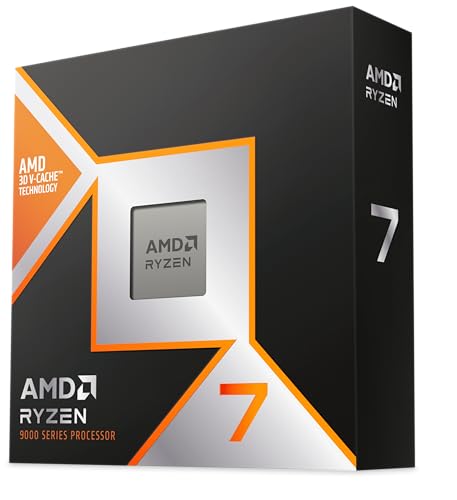
The CPU side: AMD Ryzen 7 9800X3D
Specs
Cores / threads | 8 / 16 |
L3 cache | 96 MB (3D V-Cache) |
Socket | AM5 |
Architecture | Zen 5 |
Memory | DDR5 |
Cooler | Not included |
Security | fTPM 2.0 available on every AM5 board |
Cores / threads
8 / 16
L3 cache
96 MB (3D V-Cache)
Socket
AM5
Architecture
Zen 5
Memory
DDR5
Cooler
Not included
Security
fTPM 2.0 available on every AM5 board
What it does well
Call of Duty multiplayer is a processor load before it is a graphics load. Average frame rate is what a graphics card buys you. The 1% lows in a full lobby, with a dozen players in view and a killcam about to fire, are what the processor buys you. The 9800X3D carries 96 MB of L3 cache, and a cache-sensitive shooter is exactly the workload that turns cache into frames.
AM5 is a live socket, so the board outlives the chip. And every AM5 board exposes AMD fTPM, which means the security gate above is a BIOS toggle rather than a hardware problem.
What you give up
Relevance, if your monitor tops out at 1080p 144Hz. A Ryzen 5 class chip clears that target and the difference belongs in the graphics card instead. Pairing this processor with an 8 GB card is the most common way to build a machine that runs slower than its parts list reads.
There is no cooler in the box either. Budget for one.
Who it's for
Players on 240Hz and faster panels, and anyone whose 1% lows already collapse in Warzone on their current chip. If you are building the display side at the same time, our 1080p 240Hz monitors piece covers the panels.
Bottom line
If you play at 1080p on a high-refresh panel, buy the Sapphire Pulse RX 9060 XT and stop there. If you play at 1440p and want native frames at high refresh, the Sapphire Pulse RX 9070 XT is the tier to buy. If you run ray tracing at 1440p ultra, drive a 4K panel, or stream and render on the same box, step up to the ASUS TUF RTX 5070 Ti OC. If your monitor is 240Hz or faster, spend on the AMD Ryzen 7 9800X3D before you spend on the graphics card.
And before you buy any of it, go run tpm.msc, because that is the one requirement Activision has confirmed. The peripherals side is its own question, and our mouse and controller picks for Call of Duty covers it.
FAQ
What are the minimum PC requirements for Modern Warfare 4?
Activision has not published them. As of early August 2026 the official MW4 page lists exactly one PC requirement, TPM 2.0 and Secure Boot, and no hardware specifications at all. Our projection, anchored to the shipping Call of Duty engine, is that a GTX 1060 6 GB or RX 580 class card with 12 GB of system memory clears a 1080p minimum, and that an NVMe SSD with roughly 120 GB free is not optional. Treat those figures as ours until the official sheet publishes, which we expect close to the October 23, 2026 launch.
Does Modern Warfare 4 require TPM 2.0 and Secure Boot?
Yes. This is the one PC requirement Activision has confirmed, and it appears in a footnote on the official game page alongside a note that other security measures may be enforced. Most machines built in the last few years already satisfy it. Older builds often do not, because board vendors shipped firmware TPM disabled and legacy boot enabled by default. Run tpm.msc and msinfo32 to check. If Secure Boot State reads Off, convert the system disk with mbr2gpt before you disable CSM, or you will need a recovery drive.
How much storage does Modern Warfare 4 need?
No official figure exists yet. The last two Call of Duty releases installed at roughly 102 GB and 116 GB, so planning for about 120 GB of free space is the sensible move, with more set aside for post-launch season updates. The bigger point is drive type. Recent Call of Duty releases dropped mechanical hard drive support and lean on fast storage for texture streaming, so budget for an NVMe SSD rather than a SATA drive or a spinning disk.
Will Modern Warfare 4 support DLSS 4 and ray tracing?
Neither has been confirmed for MW4 specifically, but every recent Call of Duty release has shipped with DLSS, FSR and XeSS support, and ray-traced options have appeared in the last several entries. Assume they will be there. One caution for competitive play: frame generation multiplies smoothness, it does not create performance. It turns 60 frames into 120 and it never turns 30 into 120, and it adds input latency. If you play ranked, leave it off and buy for native frames instead.
Can a GTX 1060 or RX 580 still run Modern Warfare 4?
Probably, at 1080p with settings turned down, and only if the machine clears the TPM 2.0 and Secure Boot check. Both cards sat at the minimum tier for the last two Call of Duty releases and would land in the same place here. What they will not do is high refresh. If your panel is 144Hz or faster, a card of that generation leaves most of it unused, and the 6 GB and 8 GB frame buffers are the part that ages worst against a live-service game's growing texture pool.
Related Articles

Best GPUs for Black Ops 6 (2026): Every Setting Tested
The best GPUs for Black Ops 6 at every budget tier, tested at 1080p competitive, 1440p high, and 4K. Picks chosen for real-world FPS, not spec sheets.
May 28, 2026

Best GPUs for 1440p Gaming (2026): 5 16GB Picks, 60-240Hz
The best GPUs for 1440p gaming in 2026: five 16GB picks matched to 60, 144, and 240 Hz targets, with real benchmarks, trade-offs, and who each card fits.
Aug 8, 2026

Is 8GB VRAM Enough for Gaming in 2026, or Do You Need 16GB?
Is 8GB VRAM enough for gaming in 2026? It holds at 1080p, cracks at 1440p, and fails at 4K. Here is when 8GB works, when you need 16GB, and what to buy.
Jul 23, 2026

Best Monitors for the Steam Machine (2026): 5 Picks
The best monitor for the Steam Machine is 1440p, not 4K. Five picks by resolution and refresh tier, sized to what a 28 CU RDNA 3 box renders in real games.
Sep 19, 2026

DLSS 5 Supported GPUs (2026): RTX 50 Now, RTX 40 Confirmed
DLSS 5 supported GPUs: live on all RTX 50 cards, RTX 40 confirmed but undated, so skip the upgrade today. RTX 30 and older get nothing. Sourced to Nvidia.
Sep 19, 2026