Affiliate Disclosure: As an Amazon Associate we earn from qualifying purchases. Some links may earn us a commission at no cost to you.

AMD vs Nvidia for Gaming (2026): Best GPU per Resolution
AMD vs Nvidia for gaming in 2026 is not one answer, it is three. Radeon wins the money at 1080p and 1440p, where RDNA 4 puts 16 GB on cards Nvidia still sells with 8 or 12. GeForce wins the moment ray tracing goes on, and it wins 4K by default because AMD stopped building for that tier this generation.
So the useful question is not which brand is better. It is which brand is better at the resolution you actually play at. Pick your row below and you are done.
Quick verdict
Buy Radeon if you play mostly raster games at 1080p or 1440p and you want the most frames per dollar. The RX 9070 XT trades blows with the RTX 5070 Ti in rasterized titles while sitting a full tier below it on price, and the RX 9060 XT 16 GB beats anything Nvidia ships at the mainstream tier.
Buy GeForce if ray tracing is a real part of your library, if you game at 4K, or if you do any creative or AI work. Nvidia holds roughly a 15 percent lead at 1440p once RT is enabled, DLSS 4 is still the better upscaler, and above the RX 9070 XT there is simply no Radeon card to buy.

At a glance
What you're buying | AMD Radeon (RDNA 4) | Nvidia GeForce (Blackwell) |
|---|---|---|
Raster per dollar | Wins clearly at 1080p and 1440p | Only competitive at the top of the stack |
Ray tracing | Playable, roughly one tier behind | Clear lead, and it widens with path tracing |
Upscaling | FSR 4 quality mode is genuinely good at 1440p and up | DLSS 4 transformer model is still the best in class |
VRAM for the money | 16 GB across the entire current lineup | 8 GB and 12 GB SKUs still ship below the 5070 Ti |
Top of the stack | Stops at the RX 9070 XT | RTX 5080 and RTX 5090, with no Radeon answer |
Creative and AI work | Improving, still second | CUDA and NVENC make this a non-contest |
Efficiency | Lower board power at the mainstream tier | Higher draw, and a 16-pin connector to plan around |
Raster per dollar
- AMD Radeon (RDNA 4)
Wins clearly at 1080p and 1440p
- Nvidia GeForce (Blackwell)
Only competitive at the top of the stack
Ray tracing
- AMD Radeon (RDNA 4)
Playable, roughly one tier behind
- Nvidia GeForce (Blackwell)
Clear lead, and it widens with path tracing
Upscaling
- AMD Radeon (RDNA 4)
FSR 4 quality mode is genuinely good at 1440p and up
- Nvidia GeForce (Blackwell)
DLSS 4 transformer model is still the best in class
VRAM for the money
- AMD Radeon (RDNA 4)
16 GB across the entire current lineup
- Nvidia GeForce (Blackwell)
8 GB and 12 GB SKUs still ship below the 5070 Ti
Top of the stack
- AMD Radeon (RDNA 4)
Stops at the RX 9070 XT
- Nvidia GeForce (Blackwell)
RTX 5080 and RTX 5090, with no Radeon answer
Creative and AI work
- AMD Radeon (RDNA 4)
Improving, still second
- Nvidia GeForce (Blackwell)
CUDA and NVENC make this a non-contest
Efficiency
- AMD Radeon (RDNA 4)
Lower board power at the mainstream tier
- Nvidia GeForce (Blackwell)
Higher draw, and a 16-pin connector to plan around
Quick picks
Your resolution | Winner | Why it wins | Buy |
|---|---|---|---|
1080p high refresh | 16 GB at the tier where Nvidia still sells 8 | ||
1440p, raster first | Matches the 5070 Ti in raster from a tier below | ||
1440p with ray tracing | About 15 percent ahead once RT is on | ||
4K | AMD builds nothing in this tier this generation |
1080p high refresh
- Winner
- Why it wins
16 GB at the tier where Nvidia still sells 8
- Buy
1440p, raster first
- Winner
- Why it wins
Matches the 5070 Ti in raster from a tier below
- Buy
1440p with ray tracing
- Winner
- Why it wins
About 15 percent ahead once RT is on
- Buy
4K
- Winner
- Why it wins
AMD builds nothing in this tier this generation
- Buy
How we picked the winners
We size the card to the monitor, not to the brand. Resolution and refresh rate set the frame target, the frame target sets the tier, and only then does the vendor question matter. That order is the whole framework, and it is why the answer flips three times in one article.
VRAM is the first hard filter. A 2026 build should not leave the store with 8 GB, and 12 GB is already tight for 1440p with textures turned up. Every card in this guide carries 16 GB, which is also the cleanest single reason Radeon wins the lower two rows: AMD put 16 GB on the mainstream tier and Nvidia did not.
Raster performance per dollar comes next, measured on native frames rather than on an upscaled marketing number. Frame generation multiplies smoothness once you are already above 60, and it does nothing useful below that. A card that needs interpolation to reach a playable number is not a card at that tier.
Ray tracing gets weighed honestly rather than dismissed. If your library is Counter-Strike, Apex, and last year's shooters, RT is a checkbox you will never tick and Radeon's deficit costs you nothing. If it is Cyberpunk, Alan Wake 2, and whatever ships next with path tracing, the deficit is the entire decision.
Finally, the feature tax. Any Blender, Premiere, DaVinci, or local model work pushes the answer to Nvidia regardless of what the raster charts say, because CUDA support is not something AMD can price its way around. Streamers who care about AV1 through NVENC land in the same place.
Verdict: what the benchmarks show
In rasterized games at 1440p, the RX 9070 XT and the RTX 5070 Ti are close enough that the winner changes with the title. Across large multi-game roundups the two land within a few percent of each other, with Radeon nosing ahead in engines that lean on raw shader throughput. Given where the two cards sit on price, a tie in raster is an AMD win.
Turn ray tracing on and the picture inverts. Reviewers measuring Cyberpunk 2077 at 1440p with RT enabled put the RTX 5070 Ti roughly 15 percent ahead, and the margin grows in path-traced showcases. That gap is structural, not a driver problem waiting to be fixed.
At the mainstream tier the raster race is even tighter. Across a ten-game 1080p average, the RX 9060 XT 16 GB lands within a few percent of the RTX 5060 Ti 16 GB while drawing meaningfully less power. Nvidia's card is marginally faster on paper and materially more expensive in practice, which is why the 1080p row goes to Radeon.
At 4K there is no race to report. The RTX 5080 sits somewhere between 10 and 20 percent ahead of the RX 9070 XT depending on the title, and that is AMD's fastest card being compared against Nvidia's second fastest. Above the RTX 5080 sits the RTX 5090 and nothing from Radeon at all.
Best 1440p value: Sapphire Pulse RX 9070 XT
This is the card that makes the AMD argument. It is the fastest Radeon of the generation, it carries 16 GB, and it lands a full tier below the Nvidia card it matches in raster.
Specs
Chip | Radeon RX 9070 XT (RDNA 4) |
VRAM | 16 GB GDDR6 |
Memory bus | 256-bit |
Boost clock | Up to 2,970 MHz |
Board power | 304 W |
Power connectors | 2x 8-pin |
Slots | 2.5 |
Chip
Radeon RX 9070 XT (RDNA 4)
VRAM
16 GB GDDR6
Memory bus
256-bit
Boost clock
Up to 2,970 MHz
Board power
304 W
Power connectors
2x 8-pin
Slots
2.5
What it does well
Rasterized 1440p is where this card lives, and it is comfortable there at high and ultra presets in almost anything current. The 16 GB buffer means texture settings are a preference rather than a negotiation, which is not true of the 12 GB Nvidia card sitting at a similar price.
FSR 4 changed the calculus here. On RDNA 4 the quality mode at 1440p and above is good enough to use without thinking about it, which was not a sentence anyone could write about FSR 3. That closes most of the practical upscaling gap for the games where you would reach for it.
The Pulse board itself is the sensible pick of the Sapphire stack: two 8-pin connectors, a 2.5-slot cooler that fits normal cases, and no factory overclock theatre. It runs quiet at stock and does not need a case rebuild to accommodate it.
What you give up
Ray tracing is the honest weakness. It is playable, and it is roughly one tier behind the GeForce card at the same performance level. In a path-traced title you will be turning settings down that a 5070 Ti owner leaves alone.
Board power sits above 300 W, which is more than the Nvidia card it competes with, and creative workloads are still a second-class experience. If Blender or a local model is part of your week, this is the wrong card no matter how the game charts look.
Who it's for
The 1440p gamer with a 144 Hz or 165 Hz panel and a mostly rasterized library who wants the most frames the budget can buy. If that description fits, this is the best value in the current generation.
Best 1440p with ray tracing: ASUS TUF RTX 5070 Ti OC
If ray tracing is not a checkbox for you, this is the Nvidia card worth paying for. It is the quiet value pick of the 50-series, and the only one that makes RT at 1440p a non-issue.

Specs
Chip | GeForce RTX 5070 Ti (Blackwell) |
VRAM | 16 GB GDDR7 |
Memory bus | 256-bit |
Boost clock | 2,452 MHz |
Board power | 300 W |
Power connectors | 1x 16-pin (12V-2x6) |
Slots | 3.125 |
Chip
GeForce RTX 5070 Ti (Blackwell)
VRAM
16 GB GDDR7
Memory bus
256-bit
Boost clock
2,452 MHz
Board power
300 W
Power connectors
1x 16-pin (12V-2x6)
Slots
3.125
What it does well
With RT enabled at 1440p it holds roughly a 15 percent lead over the fastest Radeon, and the lead widens in path-traced titles where the RT hardware is doing most of the work. That is the specific thing you are buying.
DLSS 4's transformer model is still the best upscaler shipping. At 1440p the quality mode is hard to separate from native, and multi-frame generation turns an 80 fps base into something that fills a 240 Hz panel properly. The base framerate is high enough that frame generation is a smoothness multiplier rather than a rescue.
It is also the entry point to the CUDA and NVENC side of the house. Blender, DaVinci, Stable Diffusion, and AV1 streaming all work better here, and that tips a lot of buyers who thought they were making a gaming-only decision.
What you give up
You pay a real premium over the Radeon card it ties with in raster. For a purely rasterized library that premium buys you very little, which is exactly why the 1440p value row does not go to this card.
It is physically large at over three slots and it wants a 16-pin connector, so an older PSU means an adapter or a replacement. Check clearance before ordering rather than after.
Who it's for
The 1440p buyer whose library includes Cyberpunk 2077, Alan Wake 2, or anything path traced, and anyone who does creative work alongside gaming. It is also the sane entry to 4K with DLSS quality, though it is not a native 4K card.
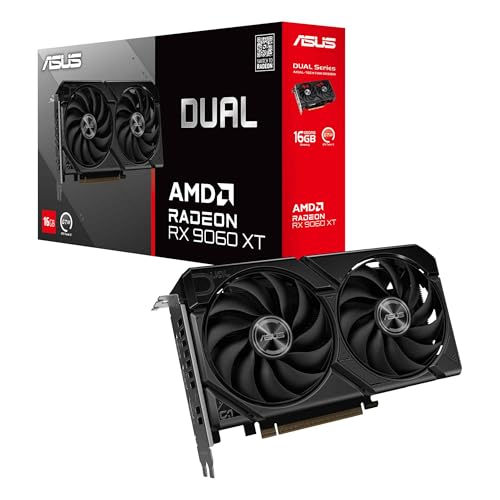
Best 1080p value: ASUS Dual RX 9060 XT
At the mainstream tier the argument is not close. This card puts 16 GB in a bracket where Nvidia is still shipping 8 GB parts, and it does it at meaningfully lower power.
Specs
Chip | Radeon RX 9060 XT (RDNA 4) |
VRAM | 16 GB GDDR6 |
Memory bus | 128-bit |
Boost clock | Up to 3,130 MHz |
Board power | 160 W |
Power connectors | 1x 8-pin |
Slots | 2.5 |
Chip
Radeon RX 9060 XT (RDNA 4)
VRAM
16 GB GDDR6
Memory bus
128-bit
Boost clock
Up to 3,130 MHz
Board power
160 W
Power connectors
1x 8-pin
Slots
2.5
What it does well
For 1080p at high refresh it has more card than the resolution needs in most titles, which is the position you want to buy into. It stretches to 1440p in lighter games and esports titles without complaint.
The 16 GB buffer is the whole point. An 8 GB card at this tier will start dropping textures inside the ownership window, and buyers have flagged exactly that pattern on the last two generations of 8 GB parts. Paying a little more for double the VRAM is the least regretted upgrade at this price.
A 160 W board power and a single 8-pin connector mean it drops into an older or budget system without a PSU conversation, which matters more at this tier than at any other.
What you give up
The 128-bit memory bus limits how far the card scales at 1440p ultra, so treat 1440p as a stretch rather than the target. Ray tracing at this tier is a technology demo on either brand.
The Nvidia card at the equivalent tier is a few percent faster in raw 1080p averages. If that margin matters more to you than the price gap or the encoder, the GeForce option is defensible.
Who it's for
The 1080p high-refresh builder, and anyone assembling a first system who wants it to still be fine in three years. This is the card that keeps a mainstream build honest.
Best 4K pick: ASUS TUF RTX 5080 OC
At 4K the vendor question answers itself. AMD skipped this tier entirely this generation, so the only real decision is which GeForce card, and this is the one most 4K buyers should take.

Specs
Chip | GeForce RTX 5080 (Blackwell) |
VRAM | 16 GB GDDR7 |
Memory bus | 256-bit |
Boost clock | 2,617 MHz |
Board power | 360 W |
Power connectors | 1x 16-pin (12V-2x6) |
Slots | 3.6 |
Chip
GeForce RTX 5080 (Blackwell)
VRAM
16 GB GDDR7
Memory bus
256-bit
Boost clock
2,617 MHz
Board power
360 W
Power connectors
1x 16-pin (12V-2x6)
Slots
3.6
What it does well
It is a genuine 4K card rather than a 1440p card with upscaling bolted on. Native 4K at high settings holds up across current AAA releases, and DLSS 4 quality plus multi-frame generation makes 4K at 120 Hz reachable in nearly everything.
Ray tracing at 4K is the case where Nvidia's hardware advantage stops being an abstraction. Path-traced titles that are a settings compromise on any Radeon card run as intended here.
For anyone mixing 4K gaming with rendering, video, or local model work, this is the tier where the CUDA advantage and the 16 GB of GDDR7 stop being a tiebreaker and start being the reason.
What you give up
The gap to the RTX 5090 above it is unusually wide for a second-tier card, and the pricing has never really settled. If your work genuinely needs more than 16 GB of VRAM, this card is not the answer and the step up is a large one.
It draws 360 W, runs to 3.6 slots, and expects a 16-pin connector fed properly rather than through the bundled adapter. Budget for a quality high-wattage supply and a case with real airflow.
Who it's for
The 4K gamer with a 120 Hz or 144 Hz panel, and the creator who games. Anyone below 4K is buying more card than the monitor can use.
Final call: is AMD or Nvidia better for gaming?
If you play at 1080p on a high-refresh panel, buy Radeon. The RX 9060 XT 16 GB is the best-value card in the current generation and the VRAM decision alone justifies it.
If you play at 1440p and your library is mostly rasterized, buy Radeon. The RX 9070 XT matches a card a full tier above it and the savings belong in a better monitor.
If you play at 1440p and ray tracing matters, buy Nvidia. The RTX 5070 Ti is the cheapest way to stop thinking about RT settings, and it is the pick for anyone doing creative work on the same machine.
If you play at 4K, buy Nvidia, because there is nothing else to buy. The RTX 5080 is the sensible ceiling for gaming, and the RTX 5090 above it only makes sense for workloads that need the VRAM.
Bottom line
There is no brand answer in 2026, only a resolution answer. Radeon owns the money below the flagship tier. GeForce owns ray tracing, 4K, and every workload that touches CUDA.
If you buy one card off this page, make it the RX 9070 XT. It is the pick that fits the most builders, at the resolution most people play at, for the least money.
If ray tracing or creative work is in the picture, step across to the RTX 5070 Ti and stop second-guessing it. If the monitor says 4K, the RTX 5080 is the only real shortlist.
FAQ
Is AMD or Nvidia better for gaming in 2026?
Neither wins outright. AMD is better at 1080p and 1440p, where RDNA 4 delivers more raster performance per dollar and puts 16 GB on cards Nvidia still ships with 8 or 12. Nvidia is better once ray tracing is enabled, better at 4K, and the only option above the RX 9070 XT. Pick by the resolution you play at and the kind of games in your library, not by brand.
Does Nvidia still beat AMD at ray tracing?
Yes, and the gap is structural rather than a driver issue. At 1440p with ray tracing enabled in Cyberpunk 2077, reviewers put the RTX 5070 Ti roughly 15 percent ahead of the RX 9070 XT, and the margin widens in path-traced titles where the RT hardware carries most of the load. RDNA 4 narrowed the deficit compared with previous Radeon generations, but it did not close it.
Is AMD better value than Nvidia for 1440p?
For rasterized games, yes. The RX 9070 XT trades blows with the RTX 5070 Ti across large multi-game raster averages while sitting a full tier lower on price, and both carry 16 GB. The value case flips if your library leans on ray tracing or if you do any Blender, video, or local model work, because CUDA support is not something AMD can price around.
Which is better for 4K gaming, Radeon or GeForce?
GeForce, and it is not a close call. AMD did not build a card above the RX 9070 XT this generation, so the entire high-end tier is Nvidia only. The RTX 5080 sits roughly 10 to 20 percent ahead of AMD's fastest card and pairs native 4K capability with DLSS 4 quality mode and multi-frame generation. For 4K at 120 Hz, it is the sensible pick.
Is FSR 4 good enough to compete with DLSS 4?
It is much closer than FSR 3 ever was. On RDNA 4 hardware, FSR 4 quality mode at 1440p and above is clean enough to leave on without thinking about it. DLSS 4's transformer model is still the better upscaler, particularly in performance mode and at lower input resolutions, so treat upscaling as a real but no longer decisive point in Nvidia's favour.
Related Articles

RTX 5070 Ti vs RX 9070 XT (2026): 5% Raster, 15% RT Gap
RTX 5070 Ti vs RX 9070 XT: the 9070 XT is 5% behind at 1440p raster for far less money, the 5070 Ti wins ray tracing by 15%. Which one you should buy.
Sep 3, 2026

Best GPU for 1440p Gaming 2026: 5 16GB Picks, 144-240Hz
The best GPU for 1440p gaming in 2026: five 16GB picks matched to 144 and 240 Hz targets, the 8GB cards to skip, and the benchmarks behind every call.
Sep 26, 2026

How to Choose a GPU (and a Monitor That Matches)
A buyer's framework for picking a GPU and the monitor that pairs with it. Start with the panel and work the card back.
May 17, 2026

Best 4K 144Hz Gaming Monitors (2026): 5 Dual-Mode Picks
The best 4K 144Hz gaming monitors for 2026: 5 picks that clear 144Hz natively, plus the dual-mode FHD refresh, GPU pairing and exact cable each one needs.
Sep 26, 2026

Is 850W Enough for an RTX 5090? Only on ATX 3.1 (2026)
Is 850W enough for an RTX 5090? Yes, but only on an ATX 3.1 unit beside a Ryzen 7 class CPU. Older 850W units trip on transient spikes. Both picks inside.
Sep 26, 2026