Affiliate Disclosure: As an Amazon Associate we earn from qualifying purchases. Some links may earn us a commission at no cost to you.

Intel Arc G3 Extreme vs Ryzen Z2 Extreme: 4 Picks (2026)
Intel's Arc G3 Extreme is the faster handheld chip. Reviewers who put it on a bench measured it roughly 41 percent ahead of the Ryzen Z2 Extreme on average at a matched 35 watt limit, and it reaches Z2 Extreme frame rates while drawing about half the power. That half of the argument is settled.
What is not settled is which handheld you buy. The only handheld carrying the Arc G3 Extreme is MSI's Claw 8 EX AI+, it sits at flagship money, and it is not stocked on Amazon at all. So the chip verdict goes to Intel and every buyable pick below lands on Ryzen Z2 Extreme hardware.
At a glance
Spec | Intel Arc G3 Extreme | AMD Ryzen Z2 Extreme |
|---|---|---|
CPU layout | 14 cores, two P-cores plus eight E-cores plus four LP E-cores, Panther Lake derived | 8 cores, Zen 5 and Zen 5c |
Graphics | 12 Xe cores, Arc B390 class | Radeon 890M class, RDNA 3.5 |
Matched-power lead | Around 41 percent ahead on average at 35W across eight games | Baseline |
Performance per watt | Matches a 35W Z2 Extreme while drawing about 17W | Baseline |
Driver maturity | New branch; reports note the non-Extreme G3 still lacks a listed driver | Years of handheld polish, near-universal FSR support |
On Amazon today | No device listed, accessories only | Every tier, several brands |
CPU layout
- Intel Arc G3 Extreme
14 cores, two P-cores plus eight E-cores plus four LP E-cores, Panther Lake derived
- AMD Ryzen Z2 Extreme
8 cores, Zen 5 and Zen 5c
Graphics
- Intel Arc G3 Extreme
12 Xe cores, Arc B390 class
- AMD Ryzen Z2 Extreme
Radeon 890M class, RDNA 3.5
Matched-power lead
- Intel Arc G3 Extreme
Around 41 percent ahead on average at 35W across eight games
- AMD Ryzen Z2 Extreme
Baseline
Performance per watt
- Intel Arc G3 Extreme
Matches a 35W Z2 Extreme while drawing about 17W
- AMD Ryzen Z2 Extreme
Baseline
Driver maturity
- Intel Arc G3 Extreme
New branch; reports note the non-Extreme G3 still lacks a listed driver
- AMD Ryzen Z2 Extreme
Years of handheld polish, near-universal FSR support
On Amazon today
- Intel Arc G3 Extreme
No device listed, accessories only
- AMD Ryzen Z2 Extreme
Every tier, several brands
Where each one wins
Your priority | Winner | Where to buy |
|---|---|---|
Best balance of speed, battery and price | ||
Biggest and best screen | ||
Keeping the spend down | ||
Docking to a monitor over Thunderbolt | ||
Longest AAA runtime per charge |
Best balance of speed, battery and price
- Winner
- Where to buy
Biggest and best screen
- Winner
- Where to buy
Keeping the spend down
- Winner
- Where to buy
Docking to a monitor over Thunderbolt
- Winner
- Where to buy
Longest AAA runtime per charge
- Winner
- Where to buy
Benchmarks
Average frames per second with ray tracing on the low preset and no frame generation.
- 64 FPS
- 47 FPS
Frame generation narrows the gap that native ray tracing opens up.
- 88 FPS
- 80 FPS
Measured on the MSI Claw 8 EX AI+ against the Lenovo Legion Go 2 at the same power ceiling.
- 89 FPS
- 74 FPS
How we picked
A handheld chip decides two things that matter and several that it does not. It sets the frame-rate ceiling in new AAA releases and it sets how long the battery lasts at a given frame rate. It does not set how the device feels in your hands, how good the panel is, or whether the storage is upgradeable, and those are the parts buyers complain about six months in. The picks below start from the chip verdict and then sort by everything the chip cannot fix. Our handheld gaming PC guide covers the operating-system half of that decision.
Distribution counted as a hard filter. A chip you cannot buy is a specification sheet, not a recommendation. Every pick here resolved to a real Amazon listing, and the Arc G3 Extreme device did not, which is why it appears in the verdict and the benchmark tables but nowhere in the picks. The same filter kept the ROG Xbox Ally bundles out: nearly every one of those listings carries the Ryzen Z2 A rather than the Z2 Extreme, and the two are not close. For that side of the family compared directly, we did it in Steam Deck OLED against the ROG Ally X.
Memory and storage floors did the rest of the sorting. 16GB of shared memory is the point where Windows starts taking frames away from the game, and a 512GB drive is the most common regret in this category by a distance. Where a pick ships below either floor, its section says so and points at the fix instead of pretending the base configuration is enough.
Best overall: MSI Claw A8 Polar Tempest

Specs
Chip | AMD Ryzen Z2 Extreme |
Graphics | Radeon 890M class, RDNA 3.5 |
Display | 8-inch FHD+ 120Hz |
Memory | 24GB LPDDR5X |
Storage | 1TB NVMe, M.2 2280 |
Battery | 80Wh |
Wireless | Wi-Fi 7 |
OS | Windows 11 |
Chip
AMD Ryzen Z2 Extreme
Graphics
Radeon 890M class, RDNA 3.5
Display
8-inch FHD+ 120Hz
Memory
24GB LPDDR5X
Storage
1TB NVMe, M.2 2280
Battery
80Wh
Wireless
Wi-Fi 7
OS
Windows 11
What it does well
The 80Wh battery is the whole argument. Seven-inch Z2 Extreme handhelds sag on DC power in a way this one mostly does not, and holding clocks off the wall is worth more in practice than a handful of frames on a bench. Long flights are where you notice it.
24GB of LPDDR5X is the second argument. Windows, the Xbox app and a browser tab will happily eat several gigabytes before a game even launches, and on a 16GB handheld that comes straight out of the frame budget. The larger pool is why this one holds settings a 16GB device has to drop.
Storage sits on a full-length M.2 2280 slot rather than the short 2230 drives most handhelds take, so the upgrade path is wide open and cheap. Wi-Fi 7 is there too, which matters more than it sounds if you stream to the device. If you plan to swap the drive, our SSD upgrades for gaming handhelds roundup covers the sizes that fit.
What you give up
It is an LCD. Next to the Legion Go 2's OLED the black levels read grey, and in a dark room that is the first thing you notice. It is also heavy in one hand once you pass the hour mark, and MSI Center M remains the roughest of the three vendor overlays, with a habit of forgetting per-game power profiles.
The bigger concession is the chip itself. This is the silicon Intel just beat by a wide margin at matched power. You are buying the platform that works today rather than the one that benchmarks best, and that is a real trade rather than a rounding error.
Who it's for
The buyer who plays AAA games for hours away from a wall socket, and who would rather have the runtime and the memory headroom than the last stretch of frame rate.
Best big screen: Lenovo Legion Go 2 (Z2 Extreme)
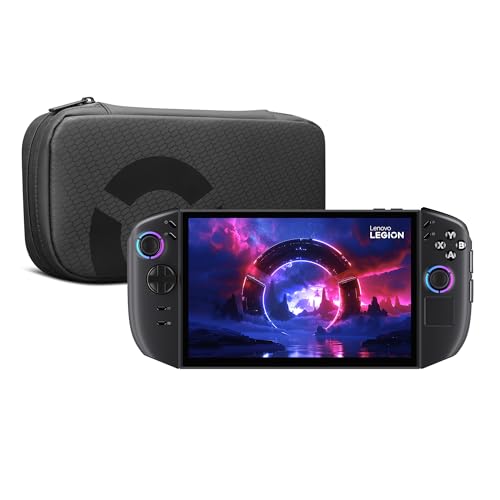
Specs
Chip | AMD Ryzen Z2 Extreme |
Display | 8.8-inch WQXGA OLED 144Hz |
Memory | 32GB |
Storage | 2TB NVMe |
Controllers | Detachable |
Extras | Fingerprint reader |
OS | Windows 11 |
Chip
AMD Ryzen Z2 Extreme
Display
8.8-inch WQXGA OLED 144Hz
Memory
32GB
Storage
2TB NVMe
Controllers
Detachable
Extras
Fingerprint reader
OS
Windows 11
What it does well
The 8.8-inch WQXGA OLED at 144Hz is the best display fitted to any handheld gaming PC, and it is not a close race. HDR content has actual highlights, dark games stop looking washed out, and the extra vertical resolution makes small text in strategy games readable without scaling tricks.
32GB of memory and 2TB of storage mean nothing needs upgrading on day one, which offsets part of the price. The controllers detach, so it doubles as a tablet for emulation, deck builders and anything you would rather play with a touchscreen.
What you give up
Size and weight come first. This is a large object and it does not disappear into a bag the way an 8-inch handheld does. Battery life takes the hit you would expect from driving a bigger, brighter panel, so the runtime advantage the Claw A8 holds gets wider in daily use.
Price is the other problem, and it moves. Reports since launch have retail listings drifting well above where the device opened, which makes the value case something you check on the day rather than something a review settles. Buyers have flagged the swing repeatedly.
Who it's for
The buyer who wants the screen to be the reason they picked a handheld, and who will genuinely use the detachable pads rather than leaving them clipped on.
Best budget pick: Lenovo Legion Go S (Z2 Go)

Specs
Chip | AMD Ryzen Z2 Go |
Display | 8-inch PureSight IPS 120Hz, VRR |
Memory | 16GB |
Storage | 512GB NVMe |
Grip | Unibody, no detachable pads |
OS | Windows 11 |
Chip
AMD Ryzen Z2 Go
Display
8-inch PureSight IPS 120Hz, VRR
Memory
16GB
Storage
512GB NVMe
Grip
Unibody, no detachable pads
OS
Windows 11
What it does well
The grip is the best in the category. Lenovo shaped this one like a controller instead of a tablet with handles, and after two hours the difference is not subtle. The 8-inch 120Hz panel supports variable refresh, which hides the frame-rate dips a Z2 Go is going to produce.
Storage is a standard M.2 slot, so the 512GB base is a problem you solve for the price of a drive. A fast card in the reader covers the overflow if you would rather not open it, and our microSD cards for handhelds picks cover the ones worth buying.
What you give up
The Z2 Go is a clear step down from a Z2 Extreme and a long way from an Arc G3 Extreme. New AAA releases need settings turned down and FSR turned on from the first day, and a few of them will not be pleasant at any setting.
16GB of shared memory is tight, for the reason the framework section gives. Between that and the slower graphics block, this is a device for a specific library rather than a general-purpose one. If your budget is tighter still, our budget handheld guide goes a rung lower.
Who it's for
The buyer coming from a Switch or a phone who mostly plays indie titles, emulation and the back catalogue, and who wants Windows so Game Pass works.
Best Intel handheld on Amazon today: MSI Claw 8 AI+ (Core Ultra 7)

Specs
Chip | Intel Core Ultra 7 258V |
Graphics | Arc 140V |
Display | 8-inch FHD 120Hz |
Memory | 32GB LPDDR5 |
Storage | 1TB NVMe |
Ports | Thunderbolt 4, microSD reader |
Battery | 80Wh |
OS | Windows 11 |
Chip
Intel Core Ultra 7 258V
Graphics
Arc 140V
Display
8-inch FHD 120Hz
Memory
32GB LPDDR5
Storage
1TB NVMe
Ports
Thunderbolt 4, microSD reader
Battery
80Wh
OS
Windows 11
What it does well
Thunderbolt 4 is the reason this one is on the list. No other handheld in the category docks as cleanly to a monitor, a keyboard and an external drive over a single cable, and if the device spends most of its life on a desk that changes the math. Our handheld docks roundup covers what to plug it into.
32GB of memory and an 80Wh battery match the class leaders, and the Lunar Lake Arc 140V driver branch has two years of fixes behind it. That is the opposite of the risk profile on the brand-new G3 branch, which counts for something if launch-window graphics drivers have burned you before.
What you give up
Frame rate, mostly. The Arc 140V sits a generation behind the G3 Extreme and trails the Ryzen Z2 Extreme in most AAA titles at matched power, which makes this the slowest of the four in games. Nothing about the headline comparison at the top of this page applies to it.
It is also the pick most exposed to listing games. The same SKU shows up under several sellers at a wide spread, and the first-party MSI listing is the one to use. Check the seller before you check out.
Who it's for
The buyer who docks their handheld to a monitor more often than they carry it out of the house, and wants one cable to handle it.
Bottom line
The Arc G3 Extreme wins the benchmark argument outright and still is not the chip to buy, because the one device carrying it is not on the shelf. If you want a handheld that gets the balance right, buy the MSI Claw A8 Polar Tempest. If the screen is the point, buy the Lenovo Legion Go 2. If the budget is tight, the Lenovo Legion Go S is the honest floor. If your handheld lives on a desk, the Thunderbolt port on the MSI Claw 8 AI+ earns the frame-rate hit. Still weighing whether a handheld makes sense at all? We made that case separately.
FAQ
Is the Intel Arc G3 Extreme actually faster than the Ryzen Z2 Extreme?
Yes, and by more than the usual generational step. Independent reviews put the Arc G3 Extreme roughly 41 percent ahead on average at a matched 35 watt limit across eight games, with individual titles stretching further. In Cyberpunk 2077 at 900p with ray tracing on low, reviewers measured 64 frames per second against 47 on the Z2 Extreme. The efficiency gap is the more interesting number: the Arc part matches a 35 watt Z2 Extreme while drawing around 17 watts. None of that changes the fact that only one shipping device uses it.
Is the MSI Claw 8 EX AI+ worth the money?
For most buyers, no, and availability decides it before price does. The Claw 8 EX AI+ is the only Arc G3 Extreme handheld, it sits at flagship money, and it is not carried on Amazon, so buying one means going direct or waiting. If you want the fastest handheld silicon and you are comfortable being early on a new driver branch, it is the only option there is. If you want something to buy this week, the Ryzen Z2 Extreme picks above cost less and ship now.
How is battery life on the Arc G3 Extreme compared to the Z2 Extreme?
Better, and it is the strongest part of Intel's case. The Arc G3 Extreme reaches Z2 Extreme frame rates at roughly half the power draw, so you can run the same game longer or run it faster for the same runtime. Reviewers reported four to six and a half hours from the Claw 8 EX AI+ depending on the workload. On the AMD side the practical lever is battery capacity rather than efficiency, which is why the 80Wh handhelds outlast the smaller ones.
Are Intel's handheld graphics drivers reliable now?
Better than they were, and still the open risk. Reviewers of the Claw 8 EX AI+ reported day-zero support for major libraries and precompiled shaders that address the stutter the earlier Claw devices had. The wrinkle is coverage: reports have noted that the non-Extreme Arc G3 still does not appear in Intel's handheld driver listings, which suggests attention is concentrated on the flagship part. AMD's advantage here is not cleverness, it is years of handheld-specific fixes and near-universal FSR support.
Which gaming handheld should I buy on a tight budget?
The Lenovo Legion Go S with the Ryzen Z2 Go. It gives up real performance against the Z2 Extreme picks, but it keeps the 8-inch 120Hz variable-refresh panel and the best grip in the category, and the storage sits on a standard M.2 slot so the small base drive is fixable. Expect to run FSR and lower settings in new AAA releases. If that sounds like too much compromise, stepping up to a Z2 Extreme device buys a genuinely different experience rather than a marginal one.
Can you upgrade the SSD in a Ryzen Z2 Extreme handheld?
In most cases yes, and it is the upgrade worth planning for. The MSI Claw A8 takes a full-length M.2 2280 drive, which is unusual in this class and means standard desktop drives fit. Several other handhelds take the shorter 2230 format, so check the length before ordering. Either way the base 512GB configurations fill up fast once a couple of modern installs land, and a drive swap costs less than buying the larger factory configuration.
Related Articles

Best Handheld Gaming PC (2026): SteamOS vs Windows
The best handheld gaming PC in 2026 comes down to SteamOS vs Windows and battery vs raw performance. Picks for AAA, Game Pass, emulation, and budget.
Jul 7, 2026

Steam Deck OLED vs ROG Ally X (2026): SteamOS or Windows?
Steam Deck OLED vs ROG Ally X: three matched-settings benchmarks, a real battery rundown, and the SteamOS-or-Windows call that decides which one you buy.
Aug 28, 2026

Best Budget Gaming Handheld Under $400 (2026): 5 Picks
The best budget gaming handheld under $400 in 2026: one true handheld PC, four strong Android picks, and an honest look at what you give up at this price.
Jul 13, 2026

Best SSD Upgrades for Gaming Handhelds: 5 Picks (2026)
The best SSD for Steam Deck, ROG Ally X, and Legion Go 2: five M.2 2230 and 2280 picks matched to your handheld, plus the single-sided trap you need to avoid.
Jul 14, 2026

Why You Should Consider a Handheld Gaming PC (2026)
Why you should consider a handheld gaming PC in 2026: the honest case for a second device, who it fits, who should skip it, and three picks worth buying.
Jul 14, 2026