Affiliate Disclosure: As an Amazon Associate we earn from qualifying purchases. Some links may earn us a commission at no cost to you.

Best Monitors for College Students 2026: Gaming & Study
The best monitor for most college students is a 27-inch 1440p IPS panel that refreshes at 144Hz or faster. That one spec covers both jobs a student screen has to do: it lays out split-screen lecture notes and dense PDFs during the day, and it runs games at full speed after class.
The dorm desk sets the real constraint. Depth runs out fast, so 27 inches is the practical ceiling and 24 inches is the safe floor, and a laptop-first setup gets far tidier when one cable carries video and charging at once. The step up from a throwaway 1080p panel to a real 1440p high-refresh screen does more for a daily setup than any other line item. These five picks cover that reality from the budget floor to a calibrated creator-grade dock.
Our top pick: GIGABYTE GS27Q
The GIGABYTE GS27Q is the do-everything default: a 27-inch 1440p 165Hz IPS panel that games smoothly and keeps text crisp for a full day of coursework.

Quick picks
Pick | Monitor | Best for | Where to buy |
|---|---|---|---|
Best Overall | 27-inch 1440p 165Hz do-everything | ||
Best Value | Mini-LED HDR contrast for the money | ||
Best Premium | One USB-C cable, charges the laptop | ||
Best Budget | 165Hz on the tightest dorm desk | ||
Editor's Pick | Calibrated color for design majors |
Best Overall
- Monitor
- Best for
27-inch 1440p 165Hz do-everything
- Where to buy
Best Value
- Monitor
- Best for
Mini-LED HDR contrast for the money
- Where to buy
Best Premium
- Monitor
- Best for
One USB-C cable, charges the laptop
- Where to buy
Best Budget
- Monitor
- Best for
165Hz on the tightest dorm desk
- Where to buy
Editor's Pick
- Monitor
- Best for
Calibrated color for design majors
- Where to buy
Specs at a glance
Monitor | Size / panel | Resolution | Refresh | USB-C dock |
|---|---|---|---|---|
27" SS IPS | 2560x1440 | 165Hz | No | |
27" VA Mini-LED | 2560x1440 | 180Hz | No | |
27" IPS | 2560x1440 | 144Hz | Yes (65W) | |
24" VA | 1920x1080 | 165Hz | No | |
27" IPS | 2560x1440 | 75Hz | Yes (65W) |
- Size / panel
27" SS IPS
- Resolution
2560x1440
- Refresh
165Hz
- USB-C dock
No
- Size / panel
27" VA Mini-LED
- Resolution
2560x1440
- Refresh
180Hz
- USB-C dock
No
- Size / panel
27" IPS
- Resolution
2560x1440
- Refresh
144Hz
- USB-C dock
Yes (65W)
- Size / panel
24" VA
- Resolution
1920x1080
- Refresh
165Hz
- USB-C dock
No
- Size / panel
27" IPS
- Resolution
2560x1440
- Refresh
75Hz
- USB-C dock
Yes (65W)
How we picked
Every pick here has to survive a real school day, not just a benchmark. That means the panel earns its place on two axes at once: how it games after class, and how it handles hours of reading, writing, and split-screen research during it. A monitor that only does one of those well is the wrong buy for a student.
The second filter is the cable. A laptop-first student benefits enormously from single-cable USB-C docking, where one cord carries video and charges the laptop, so two of these picks lead with that. The rest keep the price down by sticking to HDMI and DisplayPort. Either way, the goal is the same clean desk our gaming laptop guide points students toward.
The third filter is footprint. Dorm desks are shallow and shared, so 27 inches is the practical ceiling and 24 inches is the safe floor. We ranked by which panel gives the most usable resolution and refresh for the money inside that size window, then sanity-checked stock and warranty on Amazon. If the desk is truly too small, or the screen has to travel home at break, the best portable monitor for gaming covers panels that fold into a backpack and run off one USB-C cable.
24 or 27 inches? Sizing for a dorm desk
Measure the desk before you shop. A 27-inch 16:9 panel is roughly 24 inches wide and wants about 20 inches of depth to sit at a comfortable viewing distance, which is more than a lot of standard dorm desks give you once a laptop and a notebook are already on it. If the desk is shallower than that, the screen ends up too close and you spend the year turning your head to read the edges.
24 inches is the safe floor, and it is not a downgrade at 1080p, where the pixel density still reads clean at close range. Go 27 inches only if you have the depth, and pair it with 1440p rather than 1080p, because a 27-inch 1080p panel spreads the same pixels over more glass and text starts to look soft. A VESA mount is the escape hatch either way: it lifts the panel off the desk and hands the footprint back to you.
Do you need 144Hz for schoolwork?
Honestly, no. Reading papers and watching lectures runs perfectly well at 60Hz, and no assignment gets done faster because the panel refreshes more often. If schoolwork were the only job, a plain office monitor would do.
The reason to buy high-refresh anyway is that it costs almost nothing extra in 2026. A 165Hz panel sits a hair above a 60Hz one, and the moment you game or even scroll a busy webpage, the difference is obvious. You are not paying for smoother studying, you are getting smoother gaming thrown in. That is the same logic behind our 144Hz monitor picks.
What one USB-C cable replaces on your desk
Two of these picks dock over USB-C, and it is worth being precise about what that buys. One cable carries the video signal to the monitor, sends power back to charge the laptop, and passes through whatever is plugged into the monitor's own USB ports, so a keyboard, mouse, and headset stay connected to the screen rather than the laptop. You close the lid, plug in one cord, and the desk is live.
The number that matters is the power delivery wattage. Both the Dell 27 Plus S2725DC and the ASUS ProArt PA278CV push 65 watts, which fully covers a thin-and-light ultrabook. A gaming laptop that ships with a 90-watt or larger brick will still charge, just slowly, and under load it draws from the battery anyway, so plan on keeping its own adapter. If your laptop has no USB-C video output at all, the feature is moot and the HDMI picks are the better value.
Best Overall: GIGABYTE GS27Q
Specs
Panel | 27-inch SS IPS |
Resolution | 2560x1440 (QHD) |
Refresh rate | 165Hz |
Response time | 1ms MPRT |
Adaptive sync | FreeSync Premium |
Ports | DisplayPort 1.4, 2x HDMI 2.0 |
HDR | HDR Ready |
Panel
27-inch SS IPS
Resolution
2560x1440 (QHD)
Refresh rate
165Hz
Response time
1ms MPRT
Adaptive sync
FreeSync Premium
Ports
DisplayPort 1.4, 2x HDMI 2.0
HDR
HDR Ready
What it does well
Text stays sharp across an eight-hour reading day. A 1440p panel packs enough pixels that PDFs and dense lecture slides read cleanly, without the softness a stretched 1080p screen shows at this size. That matters more for a student than any gaming spec, because the monitor spends more hours on coursework than on games.
The 165Hz refresh makes everything feel immediate, from desktop scrolling between browser tabs to fast shooters after class. On a fast SS IPS panel the motion is clean and the viewing angles are wide, so the picture holds up when a roommate leans in to watch. FreeSync Premium keeps tearing away when a mid-range laptop or desktop GPU cannot hold a locked frame rate.
What you give up
There is no USB-C, so a laptop still needs its own charger plus a separate HDMI or DisplayPort cable. That is two cords instead of one, which is the tradeoff for the lower price against the docking picks below.
The HDR badge is nominal. This panel does not do real contrast-mapped HDR, so treat it as an SDR monitor that happens to accept an HDR signal. The base stand is tilt-only too, so getting the top of the screen to eye level means a riser, a stack of textbooks, or a cheap VESA arm.
Who it's for
This is the pick for the student who wants one screen to cover gaming, classwork, and Netflix without overthinking it, and who does not mind running two cables to a laptop or a tower. It is the resolution and refresh combination worth keeping for all four years and taking to a first apartment after graduation.
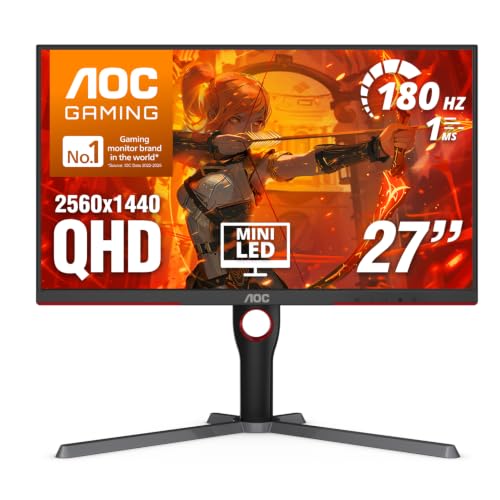
Best Value: AOC Q27G3XMN
Specs
Panel | 27-inch VA Mini-LED |
Resolution | 2560x1440 (QHD) |
Refresh rate | 180Hz (DP) / 144Hz (HDMI) |
Response time | 1ms GtG |
Local dimming | 336 zones |
HDR | DisplayHDR 1000 |
Adaptive sync | Adaptive-Sync |
Panel
27-inch VA Mini-LED
Resolution
2560x1440 (QHD)
Refresh rate
180Hz (DP) / 144Hz (HDMI)
Response time
1ms GtG
Local dimming
336 zones
HDR
DisplayHDR 1000
Adaptive sync
Adaptive-Sync
What it does well
The mini-LED backlight with 336 dimming zones is the story here. Dark scenes in games and movies look genuinely deep instead of the washed grey that edge-lit HDR produces. Paired with VA contrast, it is the most visible picture upgrade a student will feel in a dark dorm room, and it carries real DisplayHDR 1000 certification rather than a token badge.
It runs at 180Hz over DisplayPort, which covers fast shooters as well as the top pick does. The three-year zero-bright-dot warranty is unusually generous for this tier, which takes some of the risk out of buying a value panel sight unseen.
What you give up
VA response time smears more than IPS in the darkest transitions, so a competitive player chasing every millisecond of clarity will notice it in shadowy corners. Off-angle color shifts more than IPS too, which matters when two people crowd around one screen.
Mini-LED blooming shows up as a faint halo around bright objects on dark backgrounds, an inherent tradeoff of zone-based dimming at this price. And like the top pick, there is no USB-C, so laptop users are back to two cables.
Who it's for
Reach for this if you watch as much as you game and want the biggest contrast and HDR jump for the money. It suits the student who plays mostly single-player or casually competitive titles, where the deep blacks pay off more than the last few milliseconds of pixel response.
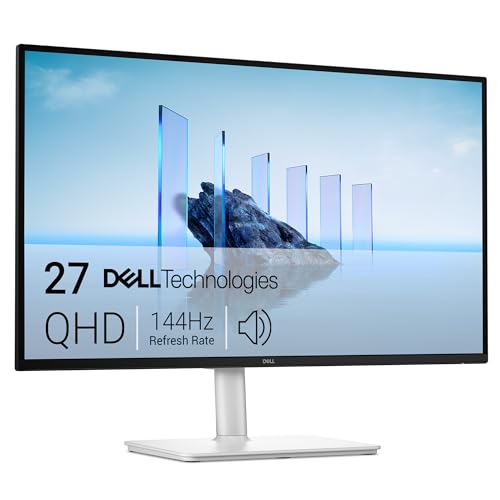
Best Premium: Dell 27 Plus S2725DC
Specs
Panel | 27-inch IPS |
Resolution | 2560x1440 (QHD) |
Refresh rate | 144Hz |
Response time | 1ms MPRT |
Power delivery | USB-C 65W |
Ports | USB-C, HDMI 2.1, DisplayPort 1.4 |
Stand | Height / Tilt / Pivot / Swivel |
Speakers | 2x 3W |
Panel
27-inch IPS
Resolution
2560x1440 (QHD)
Refresh rate
144Hz
Response time
1ms MPRT
Power delivery
USB-C 65W
Ports
USB-C, HDMI 2.1, DisplayPort 1.4
Stand
Height / Tilt / Pivot / Swivel
Speakers
2x 3W
What it does well
One USB-C cable carries video and 65 watts of charge to a laptop. Close the lid, plug in a single cord, and you have a full 1440p 144Hz display and a laptop that charges while it drives the screen. For a laptop-first student that single-cable dock replaces a hub, a charger, and a video cable all at once, which is the cleanest desk in the building.
The stand adjusts for height, tilt, pivot, and swivel, so the screen reaches eye level without a stack of books. That fixes the neck-craning posture a shallow dorm desk forces. Built-in speakers cover lecture playback and background music, and the 144Hz IPS panel still games well.
What you give up
The 65 watt power delivery is sized for thin-and-light laptops, not a full gaming laptop. A 90-watt-plus machine will slowly drain under a gaming load even while plugged in, so heavy gaming laptops still need their own brick.
At 144Hz it trails the 165 to 180Hz picks for the twitchiest esports, and the single-cable convenience carries a real premium over a plain HDMI panel.
Who it's for
This is the laptop-first student's pick: someone who values a one-cable, closed-lid desk and clean ergonomics over the last few Hz of refresh. If the daily driver is a thin-and-light and the goal is a tidy setup that charges the laptop through the same cord, this is the one.
Best Budget: KOORUI 24E4

Specs
Panel | 24-inch VA |
Resolution | 1920x1080 (FHD) |
Refresh rate | 165Hz |
Response time | 1ms MPRT |
Adaptive sync | FreeSync |
Ports | 2x HDMI 1.4, DisplayPort 1.2 |
Mount | VESA 75x75 |
Panel
24-inch VA
Resolution
1920x1080 (FHD)
Refresh rate
165Hz
Response time
1ms MPRT
Adaptive sync
FreeSync
Ports
2x HDMI 1.4, DisplayPort 1.2
Mount
VESA 75x75
What it does well
This is high-refresh gaming at the price of a basic office panel. 165Hz on a 24-inch screen is smooth for shooters and racers, and 24 inches is the right size for a genuinely cramped dorm desk. At this diagonal 1080p still looks sharp, avoiding the fuzziness the same resolution shows stretched across a 27-inch panel.
VA contrast beats budget IPS for movies in a dark room, and the VESA mount means it can move to an arm later once the budget loosens. It runs cleanly off a mid-range laptop GPU or an entry desktop card, so it will not outrun the hardware a first-year student is likely to own.
What you give up
1080p starts to feel low-res the moment you sit in front of a 1440p screen, so this is a monitor you may outgrow. There is no USB-C, no height adjustment, and the stand is tilt-only, so ergonomics need a riser or an arm.
VA smearing shows in dark scenes, and the build is budget-tier plastic. None of that is a dealbreaker at this price, but it is the honest ceiling of the tier.
Who it's for
Buy this if the budget is genuinely capped, or if a smaller laptop GPU means 1440p pixels would just tank the frame rate. It gets a student into real 165Hz gaming with a compact footprint now, with a clear path to upgrade resolution later.
Editor's Pick: ASUS ProArt PA278CV

Specs
Panel | 27-inch IPS |
Resolution | 2560x1440 (QHD) |
Refresh rate | 75Hz |
Color | 100% sRGB, 100% Rec.709, factory dE<2 |
Power delivery | USB-C 65W |
Ports | USB-C, DisplayPort daisy-chain, HDMI, USB hub |
Stand | Height / Tilt / Pivot / Swivel |
Panel
27-inch IPS
Resolution
2560x1440 (QHD)
Refresh rate
75Hz
Color
100% sRGB, 100% Rec.709, factory dE<2
Power delivery
USB-C 65W
Ports
USB-C, DisplayPort daisy-chain, HDMI, USB hub
Stand
Height / Tilt / Pivot / Swivel
What it does well
This is the pick for the student whose classwork is the point. It ships factory-calibrated to 100% sRGB and 100% Rec. 709 with Delta E under 2, so design, photo, and film work is accurate straight out of the box with no calibrator needed. For a graphic design, architecture, or film major, that calibration is the feature the gaming panels cannot promise.
It also docks over a single USB-C cable with 65 watts of charging, the same clean setup as the Dell, and adds DisplayPort daisy-chaining plus a built-in USB hub so it works as a real docking station. The full ergonomic stand rounds it out.
What you give up
The trade is refresh rate. At 75Hz this is a creator monitor first, so fast shooters will not feel as fluid as they do on the 144 to 180Hz picks. There is no meaningful HDR either.
It also costs more than the gaming picks while giving a gamer less refresh, so it only makes sense when accurate color is a real coursework requirement rather than a nice-to-have.
Who it's for
This is for the design, film, photo, or architecture student whose assignments demand accurate color, and who games casually enough that 75Hz is a fair trade for a calibrated, single-cable dock. If your degree lives in Photoshop, Lightroom, or a CAD suite, calibration beats refresh.
Bottom line
If you want one screen that does everything and never think about it again, buy the GIGABYTE GS27Q. If you watch as much as you game, the AOC Q27G3XMN gives you mini-LED contrast the others cannot touch. If you live on a laptop and want a one-cable desk, the Dell 27 Plus S2725DC is the clean setup. If the budget is tight or the desk is tiny, the KOORUI 24E4 gets you real 165Hz gaming now. And if your degree runs on accurate color, the ASUS ProArt PA278CV is the calibrated pick worth the refresh-rate trade.
FAQ
Do you need 144Hz for schoolwork, or is 60Hz fine?
For pure classwork, 60Hz is completely fine. Reading, writing papers, and watching lectures do not benefit from a higher refresh rate. The reason to go higher is that a high-refresh panel costs almost nothing extra now, and the moment you game or even just scroll a webpage, 144Hz or 165Hz feels noticeably smoother. You are not paying for schoolwork performance, you are paying for gaming that a study monitor gives you for free.
Is a 1440p or a 1080p monitor better for a college dorm?
At 27 inches, 1440p is the better choice because it keeps text sharp and gives more usable space for split-screen notes and research. At 24 inches, 1080p still looks crisp and costs less, which suits the tightest desks and smaller laptop GPUs. The deciding factor is size and budget: go 1440p if you want a 27-inch screen you keep for years, and 1080p if the desk is small or the budget is capped.
Can one USB-C cable really run a monitor and charge a laptop at the same time?
Yes, on monitors with USB-C power delivery like the Dell 27 Plus S2725DC and the ASUS ProArt PA278CV. A single cable carries video to the screen and up to 65 watts of charge back to the laptop. That is enough to keep most thin-and-light laptops topped up while they drive the display. A full gaming laptop drawing 90 watts or more under load can still slowly drain, so check your laptop's charging wattage first.
What size monitor fits a dorm desk?
For most dorm desks, 27 inches is the practical ceiling. A 27-inch panel gives a comfortable viewing size without crowding a shallow desk, and it leaves room for a keyboard and notebook. If the desk is especially small or shared, a 24-inch screen like the KOORUI 24E4 is the safer footprint. Anything larger than 27 inches usually means sitting too close for comfort in a dorm.
Can a gaming laptop drive an external monitor at 144Hz?
Most modern gaming laptops can, but the connection matters. To hit 144Hz or higher you usually need DisplayPort, either directly or through a USB-C port that supports DisplayPort Alt Mode. Plain HDMI on some older laptops caps out lower. Check that your laptop has a DisplayPort-capable output, then match it to a monitor input that supports the refresh rate you want.
Do you need built-in speakers, or is that a waste in a dorm?
Built-in speakers are genuinely useful in a dorm where desk space is tight and a separate speaker set is one more thing to store. They are fine for lectures, video calls, and background music. They will not satisfy anyone who cares about game audio or music quality, and most students game in a headset anyway to avoid bothering roommates. Treat them as a convenience for casual audio, not a reason to pick one monitor over another.
Related Articles

Best Gaming Monitors 2026: 5 Picks, Budget to 4K OLED
The best gaming monitor for your GPU and budget: five picks from the 1440p 240Hz OLED sweet spot up to 4K and ultrawide, plus when to skip the OLED tax.
Sep 7, 2026

Best 1440p Computer Monitor 2026: Top Picks for Work
The best 1440p computer monitor picks for 2026, ranked for productivity: USB-C single-cable docking, KVM, color accuracy, and light gaming on the side.
Jun 25, 2026

Best Gaming Laptops for College Students (2026): 5 Tested
The best gaming laptops for college students in 2026: five tested picks ranked by weight, honest battery life, and gaming power you can carry to class.
Aug 8, 2026

Best 1080p Gaming Monitors 2026: 5 Picks, 144Hz to 540Hz
The best 1080p gaming monitors for 2026, from a 144Hz 27-inch AAA panel to a 540Hz esports flagship. Five picks, real tradeoffs, and which refresh tier to buy.
Sep 2, 2026

Best 144Hz Gaming Monitors 2026: 5 Picks, 144 vs 180Hz
Five 144Hz gaming monitors picked for 1080p and 1440p, the GPU each one needs to hold high frames, and whether 165Hz or 180Hz is worth paying more for.
Aug 16, 2026