Affiliate Disclosure: As an Amazon Associate we earn from qualifying purchases. Some links may earn us a commission at no cost to you.

Best Monitors for the Steam Machine (2026): 5 Picks
Valve sells the Steam Machine on a 4K60 promise, and the box will happily output 4K. What it renders is a different question. The GPU is a semi-custom RDNA 3 part with 28 compute units, which independent reviews place between a desktop RX 6600 and an RX 7600.
That gap between the output spec and the render budget is the entire monitor decision. Pair it with 1440p and variable refresh and the machine looks quick. Pair it with 4K and you will spend two years turning settings down. Five picks below, laddered by the resolution and refresh tier this hardware can fill.
Our top pick: LG UltraGear 27GS75Q-B
1440p at 180Hz with FreeSync across the range is the shape of panel this box wants: enough resolution to justify buying a desktop machine, enough refresh headroom that older titles are not capped, and a variable refresh window wide enough to smooth the 55 to 70 fps band where modern games land.

Quick picks
Pick | Monitor | Tier | Buy |
|---|---|---|---|
Best Overall | 1440p 180Hz IPS | ||
Best Value | 1080p 180Hz Fast IPS | ||
Best Premium | 1440p 360Hz QD-OLED | ||
Best Budget | 1080p 200Hz IPS | ||
Editor's Pick | 4K 160Hz with a 1080p 320Hz mode |
Best Overall
- Monitor
- Tier
1440p 180Hz IPS
- Buy
Best Value
- Monitor
- Tier
1080p 180Hz Fast IPS
- Buy
Best Premium
- Monitor
- Tier
1440p 360Hz QD-OLED
- Buy
Best Budget
- Monitor
- Tier
1080p 200Hz IPS
- Buy
Editor's Pick
- Monitor
- Tier
4K 160Hz with a 1080p 320Hz mode
- Buy
Specs at a glance
Monitor | Resolution | Refresh | Panel | Ports |
|---|---|---|---|---|
2560 x 1440 | 180Hz (200Hz OC) | 27 in IPS | DP 1.4, 2x HDMI | |
1920 x 1080 | 180Hz | 24.5 in Fast IPS | DP 1.2, 2x HDMI 2.0 | |
2560 x 1440 | 360Hz | 26.7 in QD-OLED | DP, HDMI, USB hub | |
1920 x 1080 | 200Hz | 24 in IPS | DP 1.4, HDMI 2.0 | |
3840 x 2160 (1080p dual mode) | 160Hz (320Hz in FHD) | 27 in SuperSpeed IPS | DP 1.4, 3x HDMI 2.1, USB-C |
- Resolution
2560 x 1440
- Refresh
180Hz (200Hz OC)
- Panel
27 in IPS
- Ports
DP 1.4, 2x HDMI
- Resolution
1920 x 1080
- Refresh
180Hz
- Panel
24.5 in Fast IPS
- Ports
DP 1.2, 2x HDMI 2.0
- Resolution
2560 x 1440
- Refresh
360Hz
- Panel
26.7 in QD-OLED
- Ports
DP, HDMI, USB hub
- Resolution
1920 x 1080
- Refresh
200Hz
- Panel
24 in IPS
- Ports
DP 1.4, HDMI 2.0
- Resolution
3840 x 2160 (1080p dual mode)
- Refresh
160Hz (320Hz in FHD)
- Panel
27 in SuperSpeed IPS
- Ports
DP 1.4, 3x HDMI 2.1, USB-C
What the Steam Machine renders
Numbers settle this faster than opinion does. With FSR 3 in Performance mode, Cyberpunk 2077 runs at 76 fps at 1080p, 68 fps at 1440p and 40 fps at 4K on the same box and the same settings. Baldur's Gate 3 holds around 55 fps at 1440p high with nothing upscaling for it. Remnant 2 at native 4K sits in the mid-forties. The shape is consistent across reviewers: 1440p is where this hardware is comfortable, and 4K is where it starts asking for compromises.
If your reference point is a Steam Deck, Valve pitches this as roughly six times the handheld's graphics performance, and our handheld gaming PC roundup covers where that baseline sits.
Average frame rate at each output resolution with FSR 3.0 in Performance mode.
- 76 FPS
- 68 FPS
- 40 FPS
What the Steam Machine holds when nothing is upscaling for it.
- 55 FPS
- 45 FPS
How we picked
Resolution came first, and it is not a taste question. This box renders 1080p natively and reaches 1440p with FSR carrying part of the load. A panel that asks for more pixels than that does not slow the machine down in theory, it slows it down every session. Our gaming monitor buying framework applies the same order of operations to any GPU.
Refresh rate came second, and the useful number is the bottom of the variable refresh window rather than the peak. A 1440p game holding 58 fps needs the panel to follow it down without tearing. Every pick here carries FreeSync or VESA Adaptive-Sync, which the AMD silicon in this box drives regardless of which badge is printed on the retail carton.
Ports were a hard filter. The display output stack is DisplayPort 1.4 for high-refresh modes and HDMI 2.0 for televisions, and that split is what makes this a PC decision rather than a console one. Arbitrary resolutions, arbitrary refresh rates, and a DisplayPort path that is not sharing bandwidth with a television's audio return channel. Panels without DisplayPort did not make the list.
Panel technology came last. It matters, and the QD-OLED pick below is a genuinely different experience, but a buyer who gets resolution wrong will not be rescued by contrast ratio. The GPU and monitor pairing pillar has the long version of that ordering.
Best Overall: LG UltraGear 27GS75Q-B
Specs
Panel | 27 in IPS |
Resolution | 2560 x 1440 (QHD) |
Refresh rate | 180Hz, 200Hz overclock over DisplayPort |
Response time | 1 ms GtG |
Adaptive sync | AMD FreeSync, G-Sync Compatible |
Brightness | 300 cd/m2 |
Color | 99% sRGB, HDR10 |
Ports | 1x DisplayPort 1.4, 2x HDMI |
Panel
27 in IPS
Resolution
2560 x 1440 (QHD)
Refresh rate
180Hz, 200Hz overclock over DisplayPort
Response time
1 ms GtG
Adaptive sync
AMD FreeSync, G-Sync Compatible
Brightness
300 cd/m2
Color
99% sRGB, HDR10
Ports
1x DisplayPort 1.4, 2x HDMI
What it does well
This is the panel that matches the machine. 1440p is the resolution the Steam Machine reaches once FSR is doing part of the work, and 27 inches is where that pixel count stops looking like a compromise and starts looking like the point of buying a desktop box instead of a handheld.
The refresh number that matters here is not 180. It is the bottom of the FreeSync window. A modern game on this hardware lands somewhere between 55 and 70 fps at 1440p, and variable refresh across that band is what turns a wobbly frame rate into something that reads as smooth. Older and lighter titles then get the headroom, and the DisplayPort overclock takes the ceiling to 200Hz for the ones that can fill it.
LG also put a real stand on it. Height and pivot adjustment at this tier is not a given, and a Steam Machine on a desk benefits from a panel you can position. If the budget stops here, our picks in the same bracket cover the wider field.
What you give up
IPS contrast is IPS contrast. Dark scenes go grey next to the QD-OLED pick further down, and no amount of HDR10 badging changes that. At 300 nits this is a panel for a room with curtains, not a south-facing window.
The 200Hz overclock is DisplayPort-only, and it is mostly academic anyway. Nothing this box renders at 1440p is going to ask for 200 frames. Treat the overclock as insurance for a future machine rather than a feature you will use this year.
Who it's for
The buyer who wants one display that fits the Steam Machine now, will not embarrass a mid-range desktop GPU later, and does not want to think about the decision again.
Best Value: ASUS TUF Gaming VG259Q3A

Specs
Panel | 24.5 in Fast IPS |
Resolution | 1920 x 1080 (FHD) |
Refresh rate | 180Hz |
Response time | 1 ms GtG |
Adaptive sync | AMD FreeSync with variable overdrive |
Brightness | 250 cd/m2 |
Color | 99% sRGB |
Ports | 2x HDMI 2.0, 1x DisplayPort 1.2 |
Panel
24.5 in Fast IPS
Resolution
1920 x 1080 (FHD)
Refresh rate
180Hz
Response time
1 ms GtG
Adaptive sync
AMD FreeSync with variable overdrive
Brightness
250 cd/m2
Color
99% sRGB
Ports
2x HDMI 2.0, 1x DisplayPort 1.2
What it does well
Native rendering is underrated. The Steam Machine was built around 1080p, and at 1080p it does not need FSR to hold a high frame rate, which means no upscaling artefacts in motion and no reconstruction softness on fine detail. Cyberpunk 2077 clears 76 fps at this resolution with FSR still enabled; turn it off and the picture is simply the picture.
ASUS put a Fast IPS panel behind it with Extreme Low Motion Blur and variable overdrive, so the 180Hz is usable rather than decorative. Overdrive that scales with refresh rate matters specifically on a box with a moving frame rate, because a fixed overshoot setting tuned for 180 fps looks wrong at 60.
24.5 inches is the right size for this resolution. Bigger 1080p panels stretch the pixels until text goes soft, and a Steam Machine on a desk spends real time in the SteamOS interface, not just in games.
What you give up
Once you have used 1440p, 1080p on a 25 inch class panel looks coarse, and that is not a spec-sheet complaint. It is the first thing you notice and the last thing you stop noticing.
250 nits is dim, the speakers are a courtesy rather than a feature, and DisplayPort 1.2 means this panel has no headroom left if it ever gets paired with something faster than a Steam Machine.
Who it's for
The buyer who wants every frame rendered rather than reconstructed, and would rather spend the difference on games than on pixels the box has to work for.
Best Premium: Alienware AW2725DF QD-OLED

Specs
Panel | 26.7 in QD-OLED |
Resolution | 2560 x 1440 (QHD) |
Refresh rate | 360Hz |
Response time | 0.03 ms |
Adaptive sync | AMD FreeSync Premium Pro |
Color | 99.3% DCI-P3 |
HDR | HDR400 |
Ports | DisplayPort, HDMI, USB 3.2 Gen 1 hub |
Panel
26.7 in QD-OLED
Resolution
2560 x 1440 (QHD)
Refresh rate
360Hz
Response time
0.03 ms
Adaptive sync
AMD FreeSync Premium Pro
Color
99.3% DCI-P3
HDR
HDR400
Ports
DisplayPort, HDMI, USB 3.2 Gen 1 hub
What it does well
QD-OLED is the one upgrade here that changes what the box looks like rather than what it does. Per-pixel black levels make the Steam Machine's HDR output worth turning on instead of worth ignoring, and 99.3% DCI-P3 coverage means the colour volume is there to use.
The 0.03 ms response figure is the practical win, not the 360Hz. Sample-and-hold IPS panels smear at 60 fps in a way that is easy to stop seeing and impossible to unsee once someone points it out. An OLED at the same frame rate looks sharper in motion without the box working any harder. Our wider OLED roundup goes deeper on the QD-OLED and WOLED trade-off if you want to compare panels rather than tiers.
FreeSync Premium Pro brings low framerate compensation, which is the feature that earns its keep on hardware like this. When a scene drops below the panel's minimum refresh, the panel doubles frames rather than tearing.
What you give up
You are buying a lot of refresh rate you cannot use. A 28 compute unit part is not feeding 360 frames per second at 1440p in anything released this decade, so a meaningful share of the price is headroom for a machine you do not own yet.
QD-OLED still wants care. SteamOS has static interface elements, and a box that idles on a library screen is exactly the usage pattern burn-in mitigation exists for. Leave the panel's protection features on.
Who it's for
The buyer who already owns the Steam Machine, expects a desktop build next, and wants the display to be the component that does not need replacing.
Best Budget: AOC 24G42HE
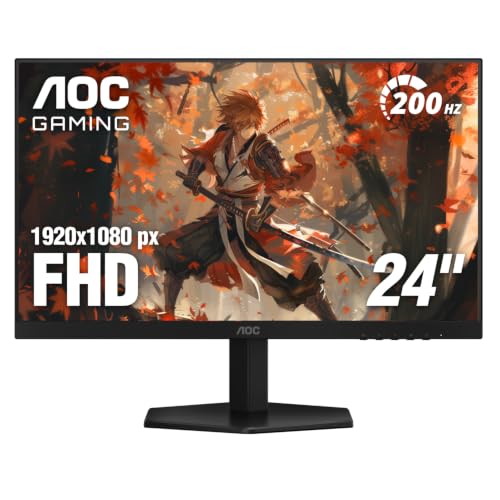
Specs
Panel | 24 in IPS |
Resolution | 1920 x 1080 (FHD) |
Refresh rate | 200Hz |
Response time | 1 ms GtG, 0.3 ms MPRT |
Adaptive sync | Adaptive-Sync, G-Sync Compatible |
Color | 116% sRGB, HDR10 |
Ports | 1x HDMI 2.0, 1x DisplayPort 1.4 |
Extras | 3-sided frameless, VESA mount |
Panel
24 in IPS
Resolution
1920 x 1080 (FHD)
Refresh rate
200Hz
Response time
1 ms GtG, 0.3 ms MPRT
Adaptive sync
Adaptive-Sync, G-Sync Compatible
Color
116% sRGB, HDR10
Ports
1x HDMI 2.0, 1x DisplayPort 1.4
Extras
3-sided frameless, VESA mount
What it does well
The floor has moved. A budget gaming panel used to mean TN colour and a 60Hz refresh ceiling; this one is IPS at 200Hz with working adaptive sync, and those are the only three things that matter for making a Steam Machine feel fast.
DisplayPort 1.4 on a panel at this price is genuinely unusual, and it is the reason this pick made the list over several cheaper ones. It gives the box its clean path in rather than routing everything through the HDMI 2.0 output that Valve aimed at televisions.
The G-Sync Compatible badge is a certification, not a restriction. Underneath it is VESA Adaptive-Sync, which the AMD silicon in this box drives over DisplayPort regardless.
What you give up
There is no ergonomic stand to speak of. Tilt only, so budget for a VESA arm if the panel needs to sit at a sensible height. That erodes some of the saving.
HDR10 here is a label rather than an experience, and 200Hz is a number this box will approach only in older and lighter titles. Buy it for the panel type and the port, not the headline.
Who it's for
The buyer who put the money into the larger Steam Machine SKU and needs a display that does not undo that decision. If you are still weighing the storage tier against the display budget, our verdict on the smaller Steam Machine covers which side to give ground on.
Editor's Pick: GIGABYTE M27UP SA

Specs
Panel | 27 in SuperSpeed IPS |
Resolution | 3840 x 2160 (UHD), dual mode to 1920 x 1080 |
Refresh rate | 160Hz at 4K, 320Hz in FHD dual mode |
Response time | 1 ms GtG |
Adaptive sync | AMD FreeSync Premium Pro, G-Sync Compatible |
Brightness | 350 cd/m2 SDR, 450 cd/m2 peak HDR |
Color | 95% DCI-P3, 10-bit |
Ports | 1x DisplayPort 1.4, 3x HDMI 2.1, USB-C with KVM |
Panel
27 in SuperSpeed IPS
Resolution
3840 x 2160 (UHD), dual mode to 1920 x 1080
Refresh rate
160Hz at 4K, 320Hz in FHD dual mode
Response time
1 ms GtG
Adaptive sync
AMD FreeSync Premium Pro, G-Sync Compatible
Brightness
350 cd/m2 SDR, 450 cd/m2 peak HDR
Color
95% DCI-P3, 10-bit
Ports
1x DisplayPort 1.4, 3x HDMI 2.1, USB-C with KVM
What it does well
This pick answers the 4K question by refusing to pick a side. The panel runs 3840 x 2160 at 160Hz for slower games, desktop work and anything where resolution is doing the heavy lifting, then switches to a 1920 x 1080 mode at 320Hz when a shooter needs frames instead of pixels.
That switch maps onto how the Steam Machine behaves. Turn-based games, strategy titles and older libraries run fine at 4K here. Anything modern and fast does not, and the same panel becomes a high-refresh 1080p display instead of a 4K one you have to apologise for.
Three HDMI 2.1 ports make it the practical choice if the Steam Machine shares a desk with a console, and the USB-C input with KVM lets a laptop borrow the display without recabling anything.
What you give up
4K at 160Hz is a mode this box will essentially never fill. The refresh spec is for the machine after this one, and you pay for it today.
Dual mode is an on-screen display toggle, not something a game triggers. Reports suggest it is a manual step every time, which is fine once and tiresome if you switch genres in an evening.
IPS contrast again, at 1000:1. This is a resolution and flexibility pick rather than an image-quality one, and anyone shopping on picture rather than pixel count should be reading the QD-OLED section instead.
Who it's for
The buyer who wants 4K for everything that is not a shooter, and is willing to press a button to get high refresh when it counts.
Bottom line
If you want one panel that matches this box and nothing more, buy the LG UltraGear 27GS75Q-B. If you would rather every frame render natively, the ASUS TUF Gaming VG259Q3A is the honest pairing. If the display is meant to outlast the machine, the Alienware AW2725DF QD-OLED is the one worth overspending on. If the budget is already spent, the AOC 24G42HE clears the bar without embarrassing itself. And if you want 4K anyway, the GIGABYTE M27UP SA is the only pick here that lets you have it without giving up refresh when it counts.
Coming to this from a PS5 or an Xbox, the calculus is different, and our console monitor picks cover that side of the question.
FAQ
Is the Steam Machine really a 4K console?
It outputs 4K and it renders 4K in a narrow set of titles. The DisplayPort 1.4 connection is rated up to 4K at 240Hz and the HDMI 2.0 output handles televisions, so the signal side is covered. The render side is the limit. A 28 compute unit RDNA 3 part sits between a desktop RX 6600 and RX 7600, and independent reviews put modern games in the forties at native 4K. Treat 4K as a mode this box has rather than a target it hits.
Should I get a 1440p or a 4K monitor for the Steam Machine?
1440p, for almost everyone. With FSR 3 in Performance mode, Cyberpunk 2077 runs at 68 fps at 1440p and 40 fps at 4K on the same hardware and the same settings. That is the whole argument in two numbers. A 1440p panel keeps the box inside a frame rate band where variable refresh smooths everything out; a 4K panel pushes it into a band where you spend the session lowering settings. Buy 4K only if you want the desktop resolution and accept 1080p gaming modes alongside it.
Does the Steam Machine support VRR and FreeSync?
Yes. Valve lists FreeSync support on the HDMI output alongside HDR and HDMI-CEC, and the DisplayPort 1.4 output carries variable refresh for monitors as well. Practically, any panel advertising FreeSync or VESA Adaptive-Sync will work. A monitor badged only as G-Sync Compatible is also fine, because that certification runs on top of the same VESA Adaptive-Sync standard the AMD silicon in this box drives. What you want to check is the bottom of the variable refresh range, not the top.
Should I use HDMI or DisplayPort with the Steam Machine?
DisplayPort, when the display has it. The DisplayPort 1.4 output is the one rated for the high-refresh modes, and it is where features like the LG pick's 200Hz overclock become available. HDMI 2.0 is the television path: it carries 4K with HDR, FreeSync and CEC, which is what a living-room setup needs. If your monitor has both, run DisplayPort and keep HDMI free for a console or a streaming box.
What refresh rate makes sense for the Steam Machine?
Somewhere between 144Hz and 180Hz at 1440p, or up to 200Hz at 1080p. The reasoning is not about hitting the ceiling. Modern games on this hardware land in the 55 to 70 fps range at 1440p, and older or lighter titles run far higher, so you want a variable refresh window wide enough to cover both without tearing at either end. Paying for 240Hz or 360Hz buys headroom this box cannot use, unless you expect the panel to outlive the machine.
Is a TV or a monitor better for the Steam Machine?
It depends on where the box lives, and the answer is genuinely different from the console version of this question. A television on HDMI 2.0 gets 4K, HDR, FreeSync and CEC, which is everything a couch setup needs. A monitor on DisplayPort gets arbitrary resolutions, higher refresh rates and a cleaner variable refresh range, which is what a desk setup wants. Because this is a PC rather than a console, the monitor side has more to offer than it would on a PS5 or an Xbox.
Related Articles

Is 512GB Enough for the Steam Machine? 2TB Verdict (2026)
Is 512GB enough for the Steam Machine, or is the 2TB worth it? We do the capacity math against real drive prices, then name the SSD and card to upgrade with.
Sep 4, 2026

Best Monitors for Console Gaming (2026): PS5 & Xbox Picks
The best monitor for console gaming needs a real HDMI 2.1 input. We name five PS5 and Xbox Series X picks that hit 4K 120Hz with VRR, plus a 1440p budget pick.
Aug 21, 2026

Best 1440p Gaming Monitors Under $300 (2026): 5 Picks 180Hz+
Five 1440p gaming monitors under $300, all 180Hz or faster, sorted by price band. The mini-LED upset, the IPS value floor, and the tradeoff each one makes.
Aug 11, 2026

How to Choose a GPU (and a Monitor That Matches)
A buyer's framework for picking a GPU and the monitor that pairs with it. Start with the panel and work the card back.
May 17, 2026

Best Prebuilt Gaming PC Under $2,500: 5 4K Picks for 2026
Best prebuilt gaming PCs under $2,500: five 4K-ready rigs averaging 78fps at 4K native, ranked on the RTX 5070 Ti vs 5080 value line and when to stop spending.
Sep 19, 2026