Affiliate Disclosure: As an Amazon Associate we earn from qualifying purchases. Some links may earn us a commission at no cost to you.

Is 512GB Enough for the Steam Machine? 2TB Verdict (2026)
Valve sells the Steam Machine in two sizes, and the only real decision at checkout is which one. Buy the 2TB. Storage got expensive in 2026, and the capacity Valve bundles into the larger box now costs roughly what the same capacity costs as a bare retail drive, so the old advice of taking the cheap SKU and swapping the drive yourself no longer saves what it used to.
The 512GB is still the right buy in two cases: your rotation is a handful of esports titles, or your budget stops at the smaller box. Both have a fix, and the M.2 slot behind the panel is a real one.
At a glance
Path | What it gets you | Trade-off | Buy |
|---|---|---|---|
2TB internal, full Gen4 speed | One teardown, and a spare 2230 left over | ||
4TB internal, buy once and stop | The priciest thing you will add to the box | ||
1TB of overflow, no teardown | UHS-I speeds, longer loads on streaming titles |
- What it gets you
2TB internal, full Gen4 speed
- Trade-off
One teardown, and a spare 2230 left over
- Buy
- What it gets you
4TB internal, buy once and stop
- Trade-off
The priciest thing you will add to the box
- Buy
- What it gets you
1TB of overflow, no teardown
- Trade-off
UHS-I speeds, longer loads on streaming titles
- Buy
Is 512GB enough?
Your library | 512GB verdict | What to do | Winner |
|---|---|---|---|
Three esports titles and a couple of indies | Enough, with room | Take the 512GB. Add a card only if you collect. | |
Mixed library, two AAA installs resident | Tight | 512GB plus a card for the back catalogue | |
AAA rotation with 100GB-plus titles | Not enough | Take the 2TB, or the 512GB and swap the drive | |
You want the whole library resident | Not close | Take the 2TB and plan on a bigger drive later |
Three esports titles and a couple of indies
- 512GB verdict
Enough, with room
- What to do
Take the 512GB. Add a card only if you collect.
- Winner
Mixed library, two AAA installs resident
- 512GB verdict
Tight
- What to do
512GB plus a card for the back catalogue
- Winner
AAA rotation with 100GB-plus titles
- 512GB verdict
Not enough
- What to do
Take the 2TB, or the 512GB and swap the drive
- Winner
You want the whole library resident
- 512GB verdict
Not close
- What to do
Take the 2TB and plan on a bigger drive later
- Winner
The line falls where a single modern install eats a third of the usable space. Two AAA games resident is the point at which the smaller box starts asking you to uninstall something every week, and most people underestimate how fast they get there. For the general version of this question on a desktop build, how much storage a gaming machine needs covers the same ground without a fixed SKU delta to argue with.
What a modern rotation costs
Install sizes for a rotation most Steam Machine buyers would recognise. The 512GB model has roughly 450 to 470GB of usable space once SteamOS and the recovery partition are accounted for.
- Call of Duty (current release plus Warzone)280 GB
- Microsoft Flight Simulator 2024250 GB
- God of War Ragnarok190 GB
- S.T.A.L.K.E.R. 2: Heart of Chornobyl160 GB
- Baldur's Gate 3145 GB
- Cyberpunk 2077 with Phantom Liberty100 GB
Six games. That is the whole argument. Any two of the top four fill the 512GB model's usable space on their own, and all six together take more than half of a 2TB drive before you add a launcher, a shader cache or a single screenshot. The same arithmetic plays out on desktops, where the same question on a desktop lands on the same answer for the same reason. Builds we have specced around one small drive have a way of coming back inside a year with the same question, which is how to add storage.
Internal NVMe versus the microSD slot
Rated sequential read for each storage path the Steam Machine offers. The M.2 slot runs at PCIe 4.0 and the card slot is UHS-I only, which is where the gap comes from.
- WD_Black SN71007250 MB/s
- Crucial P3107100 MB/s
- Samsung PRO Plus microSD180 MB/s
The gap is real, and it is not the gap people fear. Slower reads land on loading screens and on the first run of a game while shaders compile, not on frame rate once you are playing. That makes the card a good home for a back catalogue and a poor home for the open-world title you are forty hours into.
How the upgrade path works
Storage is the one part of this machine that welcomes a screwdriver. A single panel comes off, the fan panel lifts away, and the drive sits on its own small daughterboard with a full-length M.2 slot. Valve fitted standoffs at 30mm and 80mm and put the 80mm post in the box, so the 2230 module the machine ships with can come out and a full-size 2280 drive can go straight in.
The slot runs at PCIe 4.0, and that single fact settles the drive choice. A Gen5 drive cannot reach its rated speed here, it draws more power doing less, and owners have reported the slot browning out under sustained writes with the hungriest Gen5 modules. Buy a good Gen4 drive and you have already taken everything this interface has to give. If you want the longer version, why Gen5 does nothing here goes through the numbers.
Skip the heatsink versions as well. The daughterboard has no clearance for a PS5-style cooler, and the chassis airflow is the cooling plan. Bare drives only. If you have upgraded a handheld before the job will feel familiar, though this machine takes the full-size 2280 rather than the 2230 drives handhelds take.
One contrast is worth knowing before you order. Memory is not the same story. Teardown coverage puts a RAM swap at dozens of steps deep inside the chassis, so storage is the only headroom this box hands you cheaply. Pick the capacity you want at checkout rather than assuming you will fix it later.
The 512GB fix: WD_Black SN7100 2TB
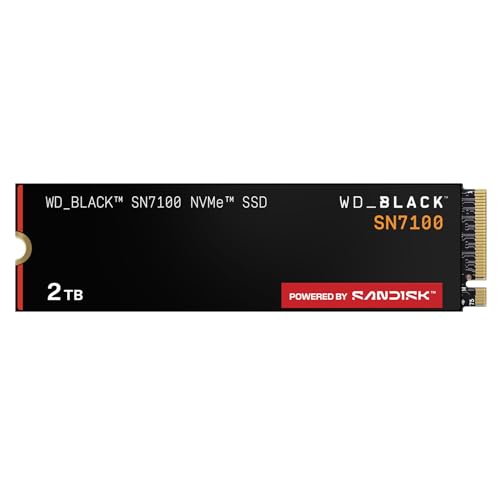
Specs
Capacity | 2TB |
Interface | PCIe 4.0 x4 NVMe |
Form factor | M.2 2280, single-sided |
Sequential read | Up to 7,250 MB/s |
Sequential write | Up to 6,900 MB/s |
NAND | TLC 3D NAND |
DRAM | Host memory buffer, no onboard cache |
Warranty | 5 years |
Capacity
2TB
Interface
PCIe 4.0 x4 NVMe
Form factor
M.2 2280, single-sided
Sequential read
Up to 7,250 MB/s
Sequential write
Up to 6,900 MB/s
NAND
TLC 3D NAND
DRAM
Host memory buffer, no onboard cache
Warranty
5 years
What it does well
This drive is matched to the slot rather than to a spec sheet. Rated at 7,250 MB/s read, it saturates the PCIe 4.0 link the Steam Machine gives it and leaves nothing behind. Anything faster is speed the machine cannot use.
It is single-sided and bare, which matters more here than the throughput number does. It drops onto the 80mm standoff, the panel goes back on, and nothing fouls. WD sells this line at laptops and handheld gaming devices, and the reason is power draw: a low-draw controller keeps heat and fan noise out of the conversation in a chassis this small. Our wider Gen4 NVMe picks cover the same controller family at other capacities.
The NAND is TLC rather than QLC. A 200GB install writes at speed most of the way through instead of falling off a cliff halfway in, which is the difference between a coffee break and an afternoon.
What you give up
There is no onboard DRAM. The drive borrows a slice of system memory through the host memory buffer instead, which is a fine trade for game loading and a worse one for random-heavy work. If this machine were doubling as a scratch disk for video, a DRAM drive would be the better answer.
Sustained writes past the SLC cache slow down, and you will meet that exactly once, on the giant install that fills the drive. The 2230 module you pull out is the other cost. It becomes a spare with nowhere obvious to go, because almost nothing else in the house takes one.
Who it's for
You bought the 512GB, or you already own one, and you want the machine's own storage fixed rather than routed onto a card. This is the swap that makes the smaller box behave like the larger one.
The step-up: Crucial P310 4TB

Specs
Capacity | 4TB |
Interface | PCIe 4.0 x4 NVMe |
Form factor | M.2 2280, bare, no heatsink |
Sequential read | Up to 7,100 MB/s |
Sequential write | Up to 6,000 MB/s |
NAND | Micron TLC 3D NAND |
DRAM | Host memory buffer, no onboard cache |
Warranty | 5 years |
Capacity
4TB
Interface
PCIe 4.0 x4 NVMe
Form factor
M.2 2280, bare, no heatsink
Sequential read
Up to 7,100 MB/s
Sequential write
Up to 6,000 MB/s
NAND
Micron TLC 3D NAND
DRAM
Host memory buffer, no onboard cache
Warranty
5 years
What it does well
Same shape of drive, twice the room. The P310 is a bare 2280 rated at 7,100 MB/s read, which is again everything the Gen4 slot can carry, and Crucial lists handheld consoles alongside laptops on the box because the power profile suits small enclosures.
Four terabytes changes the behaviour, not just the number. A rotation of 200GB installs stops being a rotation. The six titles in the chart above fit together twice over, with room for the launcher sprawl nobody accounts for. To see the wider field at this capacity, our 4TB NVMe picks compare the alternatives.
What you give up
Cost, and a lot of it. Under the 2026 flash crunch this is the most expensive thing most Steam Machine owners will ever add to the box, and the gap between it and the 2TB drive above is wider than it was two years ago. It is a host-memory-buffer drive as well, so the same caveat carries over.
If your library is three shooters and a handful of indies, this is capacity you will never touch. Buying storage you do not use is the one storage mistake that is genuinely wasteful, and it deserves saying out loud in a piece that spends this long arguing for more of it.
Who it's for
You took the 2TB and hit the wall anyway, or you would rather open this machine once and never think about storage again.
The no-teardown overflow: Samsung PRO Plus 1TB microSD

Specs
Capacity | 1TB |
Type | microSDXC |
Bus | UHS-I |
Speed class | U3, V30, A2 |
Sequential read | Up to 180 MB/s |
Sequential write | Up to 130 MB/s |
In the box | Full-size SD adapter |
Warranty | 10 years limited |
Capacity
1TB
Type
microSDXC
Bus
UHS-I
Speed class
U3, V30, A2
Sequential read
Up to 180 MB/s
Sequential write
Up to 130 MB/s
In the box
Full-size SD adapter
Warranty
10 years limited
What it does well
No screwdriver, no reinstall, no leftover module. The card goes in the slot, SteamOS sees it, and moving a game between internal storage and the card takes a few clicks in the storage menu. That turns the card into a shelf. Everything you are not playing this month lives there and stays one click from playable.
At 180 MB/s rated read, this card sits at the ceiling the hardware allows. The Steam Machine's slot is UHS-I only, with no UHS-II or UHS-III rates, so a faster card is money that does nothing. If you want the full ladder, how the microSD tiers compare lays out where the returns stop.
What you give up
Speed, and the chart above shows how much. The card reads at roughly a fortieth of what the internal drive manages. In practice that lands on loading screens and on first-run shader compilation rather than on frame rate, and the pain is worst on open-world titles that stream assets while you move. A turn-based game will not care. A large streaming world will.
The other thing you give up is the old assumption that cards are the cheap option. Flash pricing moved hard in 2026, and a high-capacity card is no longer the rounding error it used to be. Price it against the internal drive before you decide rather than after.
Who it's for
You own the 512GB and would rather not open the machine, or you have a back catalogue you want parked but reachable.
Bottom line
If you are buying the machine today and your library has any AAA in it, buy the 2TB. If your library is esports and indies, the 512GB is genuinely enough and the card slot covers the rest. If you already own the 512GB, the SN7100 is the swap that fixes it. If you own the 2TB and filled it, the P310 is the drive that ends the problem.
One caveat on all of it. This verdict rests on a two-SKU lineup and on 2026 flash pricing, and a third SKU or a market move changes the arithmetic. If you are weighing whether to buy storage at all right now, our read on buying now versus waiting is the wider view.
FAQ
Can you upgrade the Steam Machine's SSD?
Yes, and Valve built the slot to be reached. One panel comes off, the fan panel lifts away, and the drive sits on its own daughterboard with a full-length M.2 slot. Both the 2230 module the machine ships with and a full-size 2280 drive are supported, with standoffs at 30mm and 80mm and the 80mm post included in the box. It is a screwdriver job rather than a teardown. Memory is the part that is not practical to change, so storage is where the headroom lives.
How much usable storage does the 512GB Steam Machine have?
Roughly 450 to 470GB, depending on firmware and how the recovery partition is sized. The gap comes from three places: the difference between how drives are labelled and how the filesystem counts, SteamOS itself, and the recovery partition that lets you reinstall without a second machine. In practical terms that is one current Call of Duty install with a little room left, which is why the sufficiency question turns on your library rather than on the number printed on the box.
Does the Steam Machine have a microSD slot?
It does, and Valve supports UHS-I U3 cards or faster. The slot does not run at UHS-II or UHS-III rates, so the fastest cards on the market cannot stretch their legs here and a good UHS-I card is the sensible buy. SteamOS lets you move an install between the internal drive and the card from the storage menu, which makes the card a workable home for a back catalogue. Keep the titles you play most on the internal drive.
What size M.2 SSD does the Steam Machine take?
Both 2230 and 2280. The machine ships with a 2230 module, and the SSD daughterboard carries a full-length slot with standoffs at 30mm and 80mm, so a standard desktop-size 2280 drive fits using the included post. Buy a bare drive rather than a heatsink version, because there is no clearance for one. Stick to PCIe 4.0 as well: the slot is Gen4, so a Gen5 drive costs more, runs hotter and cannot reach its rated speed.
Is the 2TB Steam Machine worth the extra cost?
For most buyers in 2026, yes. The capacity Valve adds in the larger SKU costs roughly what the same capacity costs as a bare retail drive right now, and buying it that way skips the teardown, the reinstall and the leftover module. That calculation is a product of the current flash market rather than a permanent truth, so it is worth re-checking drive prices before you order. If your library genuinely fits in the smaller box, the smaller box is still the right call.
Related Articles

Is 1TB Enough for Gaming, or Do You Need 2TB? (2026)
Modern AAA installs run 100 to 150+ GB each. Here's when 1TB is enough, when 2TB is the safe default, and which NVMe drive to buy for each tier.
Jul 25, 2026

Best SSD for Steam Deck & ROG Ally X: 5 Picks (2026)
The best SSD for Steam Deck and ROG Ally X: five 2230 and 2280 picks matched to your handheld's slot, plus the single-sided rule that keeps the EMI shield on.
Oct 6, 2026

Should You Buy an SSD Now, or Wait Out the 2026 Crunch?
Should you buy an SSD now or wait out the 2026 NAND crunch? A clear buy-or-wait call by situation, plus the 1TB and 2TB NVMe drives worth owning today.
Aug 9, 2026

Steam Deck OLED vs ROG Ally X (2026): FPS + Battery Tested
Steam Deck OLED vs ROG Ally X in 2026: which handheld to buy for a Steam library, Game Pass or long trips, backed by matched FPS tests and a battery rundown.
Oct 19, 2026

Is 650W Enough for an RTX 5070? Verdict for 6 Builds (2026)
Is a 650W PSU enough for an RTX 5070? Yes for 4 of 6 common builds, matching NVIDIA's 650W spec. See which CPUs need 750W and the ATX 3.1 PSU worth buying.
Oct 18, 2026