Affiliate Disclosure: As an Amazon Associate we earn from qualifying purchases. Some links may earn us a commission at no cost to you.

Is 550W Enough for an RX 9070 GRE? 650W Math (2026)
Short answer: a good 550W unit will run an RX 9070 GRE next to a six-core processor. AMD rates the card at 220W, and measurement puts it at roughly 223W sustained with peaks just under 225W. The graphics card is not the problem here.
What sits beside it is. Put a Ryzen 9 or a Core i9 in the socket and the sustained figure climbs close enough to a 550W nameplate that the margin stops being a margin. Buy 650W. That is the floor rather than the target.
At a glance
Pick | Power supply | Rated output | Best for | Buy |
|---|---|---|---|---|
The 650W answer | 650W | A GRE beside a six or eight core CPU | ||
The 750W step-up | 750W | A GRE beside a Ryzen 9 or Core i9 | ||
The long-haul pick | 850W | A bigger card going in later |
The 650W answer
- Power supply
- Rated output
650W
- Best for
A GRE beside a six or eight core CPU
- Buy
The 750W step-up
- Power supply
- Rated output
750W
- Best for
A GRE beside a Ryzen 9 or Core i9
- Buy
The long-haul pick
- Power supply
- Rated output
850W
- Best for
A bigger card going in later
- Buy
All three are ATX 3.1 units on Tier A platforms. What separates them is how much of your next build you are paying for today.
Is 550W enough for an RX 9070 GRE?
Your build | Sustained draw | Verdict | What to buy |
|---|---|---|---|
GRE plus Ryzen 5 9600X | About 371W | 550W copes, 650W is what to own | |
GRE plus Ryzen 7 9800X3D | About 445W | 550W is thin, 650W is right | |
GRE plus Ryzen 9 9950X | About 483W | 550W is out, step to 750W | |
GRE plus Core i9-14900K | About 536W | 550W is out, step to 750W | |
GRE now, bigger card in two years | 445W today | Size for the card you have not bought |
GRE plus Ryzen 5 9600X
- Sustained draw
About 371W
- Verdict
550W copes, 650W is what to own
- What to buy
GRE plus Ryzen 7 9800X3D
- Sustained draw
About 445W
- Verdict
550W is thin, 650W is right
- What to buy
GRE plus Ryzen 9 9950X
- Sustained draw
About 483W
- Verdict
550W is out, step to 750W
- What to buy
GRE plus Core i9-14900K
- Sustained draw
About 536W
- Verdict
550W is out, step to 750W
- What to buy
GRE now, bigger card in two years
- Sustained draw
445W today
- Verdict
Size for the card you have not bought
- What to buy
The variable most answers leave out is the processor. The graphics card draws what it draws, and it reaches its 220W ceiling even at 1080p rather than coasting at lower resolutions. The total swings on what is next to it. A Ryzen 5 9600X is allowed 88W of package power. A Core i9-14900K is allowed 253W. That 165W spread on one side of the build is most of the gap between a 550W unit that copes and one that does not.
Age matters as much as the label. A 550W supply that has been in service for a decade has lost capacitor headroom, and how much it has lost is specific to the unit. Buyers have flagged the failure mode as an intermittent shutdown under load rather than a clean refusal to boot, which is why a machine that ran fine all week is weak evidence that the sizing is right. The same arithmetic on the XT, which pulls 304W instead of 220W, lands a whole tier higher: whether 650W is enough for an RX 9070 XT runs those numbers.
Wattage and quality are separate questions, and treating them as one is how people end up with a bottom-tier 650W unit and a worse machine than they started with. A Tier A 550W supply is a better thing to own than an unbranded 650W one. If what is in the case now carries no OEM you can name, wattage is not the question to be asking. Replace it, then use the math below to size the replacement.
Benchmarks
What the graphics card asks for on its own, before anything else in the case.
- Rated total board power220 Watts
- Gaming average, measured223 Watts
- Peak in demanding titles225 Watts
- Idle, single display7 Watts
The card at its measured 223W, plus each processor's package ceiling, plus roughly 60W for board, memory, drives and fans.
- Ryzen 5 9600X build371 Watts
- Ryzen 7 9800X3D build445 Watts
- Ryzen 9 9950X build483 Watts
- Core i9-14900K build536 Watts
What each nameplate leaves above the 445W sustained figure from the table above.
- 550W unit105 Watts
- 650W unit205 Watts
- 750W unit305 Watts
Two things fall out of those numbers. The card alone never asks for much, and a 9800X3D build with a GRE in it sits at roughly 445W sustained, which leaves a 550W nameplate 105W of room. That reads survivable until you remember what sustained means. Both the card and the processor spike well above their steady figures for microseconds at a time, and a unit already running near its rated output has spent the margin those spikes want.
How we picked
Wattage and quality get chosen off the transient spike behaviour of the parts, not off their TDP numbers. The GRE is mild by current standards. The principle is what keeps a machine stable when the card that replaces it is not mild.
The floor is a Tier A platform and Cybenetics Gold or better. I will not put my name on a build running a bottom-tier or unknown-brand unit, even when that means cutting the budget somewhere else. The power supply is the one part that can take every other part in the case with it.
Then headroom. If the answer to “would you swap the graphics card in three years” is yes, add roughly 150W of buffer and buy once. That one question is what separates the 650W pick below from the 850W one. For the general version of this math, start with how much wattage a gaming PC needs.
The 650W answer: Corsair RM650e ATX 3.1

Specs
Rated output | 650W continuous |
Standard | ATX 3.1, PCIe 5.1 |
Efficiency | 80 Plus Gold |
Modularity | Fully modular |
12V-2x6 | Native cable included |
PCIe 8-pin | Two, enough for the GRE |
Warranty | 7 years |
Rated output
650W continuous
Standard
ATX 3.1, PCIe 5.1
Efficiency
80 Plus Gold
Modularity
Fully modular
12V-2x6
Native cable included
PCIe 8-pin
Two, enough for the GRE
Warranty
7 years
What it does well
The number on the box is the least interesting thing about this unit. What matters is that it is built to ATX 3.1 and PCIe 5.1, so it is specified to ride out the kind of microsecond excursion a modern card and a modern processor produce together rather than tripping its protection on one.
Fully modular cabling earns its keep on this particular build. The GRE wants two 8-pin PCIe runs and nothing else, so every other cable stays in the box. In a mid tower that is the difference between a tidy front chamber and a bundle pressed against the intake. The RM650e's native 12V-2x6 cable ships in the box as well, which matters the day the next card wants it.
What you give up
Seven years of warranty rather than the ten both step-up picks carry. That is not a reliability verdict on its own, but it is a shorter runway if you intend to keep this supply across two graphics cards.
The headroom is the real trade. Over a 9800X3D build this unit leaves 205W. That covers the GRE and it covers very little else. If a 300W-class card is on the horizon, you are buying this twice.
Who it's for
A GRE beside a Ryzen 5, Ryzen 7, Core i5 or Core i7, in a build where the graphics card is staying put. That describes most of the people asking this question.
The 750W step-up: MSI MAG A750GL PCIE5

Specs
Rated output | 750W continuous |
Standard | ATX 3.1, PCIe 5.1 |
Efficiency | 80 Plus Gold |
Modularity | Fully modular |
12V-2x6 | Native dual-color cable |
Depth | 140 mm compact ATX body |
Warranty | 10 years |
Rated output
750W continuous
Standard
ATX 3.1, PCIe 5.1
Efficiency
80 Plus Gold
Modularity
Fully modular
12V-2x6
Native dual-color cable
Depth
140 mm compact ATX body
Warranty
10 years
What it does well
This is the cheapest honest way onto the 750W row. A native dual-color 12V-2x6 cable rather than an adapter, ATX 3.1 and PCIe 5.1 on the label, and ten years of warranty behind it.
The 140 mm body counts for more than it sounds like it should. Compact ATX units clear the drive cage in cases that fight a full-depth supply, and they leave enough room to route the 24-pin without forcing a hard bend against the tray.
What you give up
MAG is MSI's value line. MPG and MEG sit above it, and a bench chasing the lowest measured ripple would shop there instead. For a card pulling 223W sustained, the difference is academic.
You are also buying 750W that a GRE on its own will never touch. This purchase only makes sense if the processor is large or the graphics card is temporary. Reports suggest the compact depth can leave the modular cable bank close to a front-mounted radiator in shallow mid towers, so check that clearance before ordering.
Who it's for
A Ryzen 9 or Core i9 sitting beside the GRE, which is the row where sustained draw climbs past 480W and a 550W nameplate stops being a serious answer. It is also the right call for anyone who expects the graphics card to change before the power supply does.
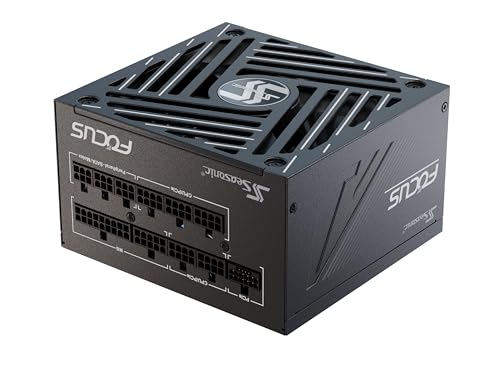
The long-haul pick: Seasonic Focus GX-850 ATX 3.1
Specs
Rated output | 850W continuous |
Standard | ATX 3.1, PCIe 5.1 |
Efficiency | 80 Plus Gold |
Platform | Seasonic in-house |
Modularity | Fully modular |
Capacitors | Japanese |
Warranty | 10 years |
Rated output
850W continuous
Standard
ATX 3.1, PCIe 5.1
Efficiency
80 Plus Gold
Platform
Seasonic in-house
Modularity
Fully modular
Capacitors
Japanese
Warranty
10 years
What it does well
Seasonic builds its own platforms instead of rebadging someone else's, so the OEM question answers itself. Japanese capacitors and a large fan are the two things that make a supply boring in the right way, and under a 223W card the fan has almost nothing to do.
850W is the number that stops this from being a decision you revisit. A 300W-class replacement card next to a Ryzen 9 still leaves real margin, which is the whole argument for buying above your current build. To see the full field at this tier, our ATX 3.1 roundup covers the native 12V-2x6 units.
What you give up
Cost, plainly. This sits well above both other picks, for wattage a GRE will never approach, and nothing in the measured numbers argues that this card needs it.
There is a listing trap as well. The ATX 3.1 version of the Focus GX-850 shares almost its whole product name with an older ATX 3.0 unit. Confirm 3.1 and PCIe 5.1 on the listing before you check out.
Who it's for
Builders who keep a power supply across two graphics cards, and anyone already bitten by a cheap unit who is not interested in a second round.
Bottom line
If your GRE sits beside a six or eight core processor and the card is staying, 550W will run it and 650W is what you should own. Buy the Corsair RM650e ATX 3.1. If the processor is a Ryzen 9 or a Core i9, sustained draw is already past 480W and you want the MSI MAG A750GL PCIE5. If a bigger card is going into this machine before the power supply changes, buy the Seasonic Focus GX-850 ATX 3.1 once and stop thinking about it. And if the 550W unit in the case now is unbranded or bottom-tier at any age, wattage is not the question. Replace it. For the pairing side of this build, where the GRE lands against the RTX 5070 is the place to start.
FAQ
Is 550W enough for an RX 9070 GRE?
Beside a six-core processor, yes. The card is rated at 220W and measures about 223W sustained, so a 9600X build lands near 371W and a good 550W unit has room. Beside a Ryzen 9 or a Core i9 the sustained figure climbs past 480W and 550W stops being a serious answer. Either way, 650W is the number to own, because the margin is what absorbs the spikes.
How many 8-pin connectors does the RX 9070 GRE need?
Two standard 8-pin PCIe connectors. The card does not use 12V-2x6, so no adapter is part of this build. When you shop a replacement supply, count the native 8-pin runs rather than the 12V-2x6 feature line. A unit that leads with the new connector can still ship fewer PCIe cables than a 220W card with two inputs expects.
What is the RX 9070 GRE's TBP?
220W total board power. Measurement puts real gaming draw at about 223W with peaks just under 225W, and the card reaches that ceiling even at 1080p rather than coasting at lower resolutions. Idle sits around 7W on a single display. Those figures are the stable half of the budget. The processor is the half that moves.
Is 650W enough for an RX 9070 GRE with a Ryzen 7 9800X3D?
Yes, and it is the pairing the 650W tier exists for. The 9800X3D is allowed 162W of package power, so the build sits around 445W sustained and a 650W unit leaves roughly 205W above that. That is enough room for the spikes both parts produce. Step to 750W only if the graphics card is going to change before the supply does.
Do I need an ATX 3.1 power supply for the RX 9070 GRE?
You do not need one, because the card uses 8-pin connectors rather than 12V-2x6. You should still want one. ATX 3.1 units are specified to survive a 200 percent power excursion for 100 microseconds, which is the behaviour that decides whether a supply rides out a spike or trips protection. It also makes the unit ready for the card after this one.
Can I keep my old 550W unit if it has been running fine?
Running fine for a week is weak evidence. A supply in service for years has lost capacitor headroom, and the failure mode buyers report is an intermittent shutdown under load rather than a clean refusal to boot, which reads like a driver problem for months before anyone suspects the power supply. If the unit is a decade old, or from a brand with no OEM you can name, replace it regardless of the wattage math.
Related Articles

Best PSU for RX 9070 (2026): 750W or 850W? 5 Top Picks
The best PSU for an RX 9070 is 750W with ATX 3.1, or 850W with a high-end CPU. Its 220W TDP spikes to 830W, so transient response decides it, not wattage.
Aug 21, 2026

Is 650W Enough for an RX 9070 XT or Do You Need 750W? (2026)
Is 650W enough for an RX 9070 XT? Yes on a quality ATX 3.1 unit with a Ryzen 5 or 7 pairing, no on a factory OC card. Here is the headroom math and the picks.
Aug 10, 2026

RX 9070 GRE vs RTX 5070: Which 1440p GPU to Buy in 2026
RX 9070 GRE vs RTX 5070: same 12GB, same nominal price, different street reality. Our 1440p verdict by buyer profile, with ray tracing and FSR 4 weighed in.
Aug 9, 2026

Best ATX 3.1 Power Supplies (2026): 5 Native 12V-2x6 Picks
Five ATX 3.1 power supplies with native 12V-2x6 connectors, Cybenetics Gold through Platinum, all 850W, plus how to spot an ATX 3.0 unit sold with an adapter.
Aug 14, 2026

How Much PSU Wattage Do You Need for a Gaming PC? (2026)
How much PSU wattage your gaming PC needs in 2026: a GPU-tier decision matrix for RTX 5060 through RTX 5090, with ATX 3.1 picks at every wattage tier.
Jun 1, 2026