Affiliate Disclosure: As an Amazon Associate we earn from qualifying purchases. Some links may earn us a commission at no cost to you.

RX 9070 GRE vs RTX 5070: Which 1440p GPU to Buy in 2026
The RX 9070 GRE is not the RX 9070. It is a cut-down 48-compute-unit card with 12 GB of GDDR6, and AMD shipped it worldwide at the same nominal price Nvidia set for the RTX 5070. If you arrived here off a 9070 search, start with that distinction. We covered the full 16 GB matchup separately.
On paper the two look interchangeable. Same capacity, same 192-bit bus, same 1440p target. In practice they split on ray tracing, on Unreal Engine 5, on upscaling quality, and on what each one actually costs the week you buy it. That last one decides more purchases than the average frame rate does.
At a glance
Card | VRAM | Board power | Upscaling | Buy |
|---|---|---|---|---|
12 GB GDDR6, 192-bit | 220 W | FSR 4 | ||
12 GB GDDR7, 192-bit | 250 W | DLSS 4 with Multi Frame Generation |
- VRAM
12 GB GDDR6, 192-bit
- Board power
220 W
- Upscaling
FSR 4
- Buy
- VRAM
12 GB GDDR7, 192-bit
- Board power
250 W
- Upscaling
DLSS 4 with Multi Frame Generation
- Buy
Where each one wins
Scenario | Winner | Why |
|---|---|---|
1440p raster on a hard budget cap | The raster deficit is single digits in most titles and the GRE consistently sells for less | |
Ray tracing and path tracing at 1440p | The ray-tracing gap is the widest in the comparison and grows further with path tracing | |
Unreal Engine 5 titles | Nvidia's UE5 lead is the single largest raster delta reviewers measured | |
High-refresh panel with frame generation | DLSS 4 Multi Frame Generation has no equally polished AMD counterpart | |
Creative work, Blender, or local AI | CUDA is the whole answer and AMD has no substitute | |
Linux gaming and open drivers | AMD's in-kernel driver stack is the better daily-use experience |
1440p raster on a hard budget cap
- Winner
- Why
The raster deficit is single digits in most titles and the GRE consistently sells for less
Ray tracing and path tracing at 1440p
- Winner
- Why
The ray-tracing gap is the widest in the comparison and grows further with path tracing
Unreal Engine 5 titles
- Winner
- Why
Nvidia's UE5 lead is the single largest raster delta reviewers measured
High-refresh panel with frame generation
- Winner
- Why
DLSS 4 Multi Frame Generation has no equally polished AMD counterpart
Creative work, Blender, or local AI
- Winner
- Why
CUDA is the whole answer and AMD has no substitute
Linux gaming and open drivers
- Winner
- Why
AMD's in-kernel driver stack is the better daily-use experience
Benchmarks
Rasterized run with ray tracing off. Switching to RT Ultra drops the GRE to roughly 40 fps.
- 60 FPS
- 68 FPS
Northlight leans on Nvidia-centric features, yet the two cards land within a point of each other.
- 62 FPS
- 61 FPS
Unreal Engine 5. The gap widens to 18 percent at Cinematic settings with upscaling enabled.
- 61 FPS
- 65 FPS
The widest rasterized margin in the suite at 14 percent.
- 75 FPS
- 86 FPS
Both cards clear 60 fps native, and both clear 80 fps with upscaling enabled.
- 61 FPS
- 68 FPS
Sapphire Pulse RX 9070 GRE
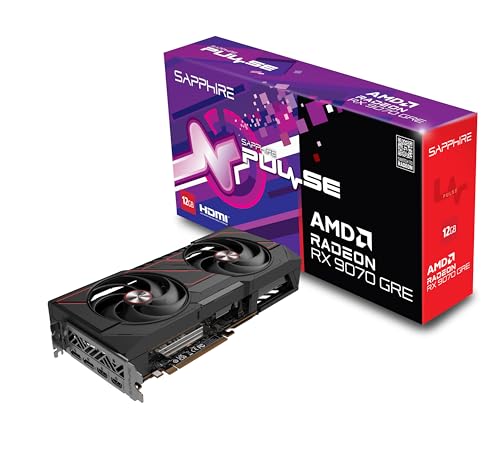
Specs
Chip | Radeon RX 9070 GRE (RDNA 4) |
Compute units | 48, with 3rd-gen RT accelerators |
VRAM | 12 GB GDDR6 at 18 Gbps |
Memory bus | 192-bit, 432 GB/s |
Boost clock | Up to 2,920 MHz |
Board power | 220 W |
Upscaling | FSR 4 |
Interface | PCIe 5.0 x16 |
Chip
Radeon RX 9070 GRE (RDNA 4)
Compute units
48, with 3rd-gen RT accelerators
VRAM
12 GB GDDR6 at 18 Gbps
Memory bus
192-bit, 432 GB/s
Boost clock
Up to 2,920 MHz
Board power
220 W
Upscaling
FSR 4
Interface
PCIe 5.0 x16
What it does well
The GRE clears 60 fps native at 1440p across the current AAA set, without leaning on upscaling to get there. Reviewer testing puts it at 60 in Cyberpunk 2077 at Ultra with ray tracing off, 62 in Alan Wake 2, 61 in Black Myth: Wukong at High, and 75 in Battlefield 6. Those are native numbers on a card sold for 1440p, which is the bar it needed to clear.
It also wins in places you would not predict. Doom: The Dark Ages runs a couple of percent faster on the GRE than on the RTX 5070, and Alan Wake 2 is close enough to a tie that the difference is noise. Across the rasterized suite the deficit is single digits far more often than it is anything larger.
FSR 4 is the other change worth naming. On RDNA 4 it runs on the AI accelerators rather than the older heuristic path, and at Quality at 1440p it holds up in a way FSR 3 never did. The card draws 220 W, the lower of the two figures here, which keeps PSU sizing uncomplicated on a mid-tower build.
Sapphire's Pulse sits in the middle of the board-partner stack, above the reference-clocked entry cards and below the Nitro+ halo. It is the SKU most AMD buyers land on for a reason. The cooler is sized properly and the acoustics do not become the thing you regret.
What you give up
Ray tracing is the honest weakness, and reviewers were blunt about it. The GRE's ray-tracing performance falls off harder than its compute-unit count suggests it should. Turn ray tracing on in Cyberpunk 2077 at 1440p and the card lands near 40 fps, which is the point where you start negotiating with the settings menu instead of playing.
Unreal Engine 5 is the other soft spot, and it matters more than it used to because so much of the current release slate ships on UE5. Black Myth: Wukong at Cinematic with upscaling is the clearest example. The RTX 5070 holds a playable line there and the GRE does not.
There is no CUDA here. If you touch Blender, DaVinci Resolve, or anything running a local diffusion or language model, that is not a preference question, it is a hard stop. And the 12 GB pool is the same ceiling the Nvidia card has, so the VRAM question does not resolve in AMD's favour either.
Who it's for
Buy the GRE if you play at 1440p, your library is mostly rasterized, and your budget has a hard ceiling. It is also the better card for Linux, where AMD's in-kernel driver is the difference between installing a GPU and configuring one. If Nvidia's value tier is the other side of your comparison rather than the RTX 5070, the GRE against the RTX 5060 Ti 16GB runs the same question against the card the GRE was priced to displace.
One caveat worth holding onto: reviewers have flagged that the GRE sits uncomfortably close to the 16 GB RX 9070 in AMD's own stack. If both are on the shelf and the gap between them is small, the extra memory is the more durable purchase. If the GRE is where you land, the next decision is the panel in front of it, and our monitor picks for the RX 9070 GRE sort the options by what its 12 GB actually feeds.
ASUS TUF RTX 5070 OC

Specs
Chip | GeForce RTX 5070 (Blackwell, GB205) |
CUDA cores | 6,144, with 4th-gen RT cores |
VRAM | 12 GB GDDR7 at 28 Gbps |
Memory bus | 192-bit, 672 GB/s |
Boost clock | Up to 2,512 MHz reference, factory OC on this card |
Board power | 250 W |
Upscaling | DLSS 4 with Multi Frame Generation |
Interface | PCIe 5.0 x16 |
Chip
GeForce RTX 5070 (Blackwell, GB205)
CUDA cores
6,144, with 4th-gen RT cores
VRAM
12 GB GDDR7 at 28 Gbps
Memory bus
192-bit, 672 GB/s
Boost clock
Up to 2,512 MHz reference, factory OC on this card
Board power
250 W
Upscaling
DLSS 4 with Multi Frame Generation
Interface
PCIe 5.0 x16
What it does well
The 5070 is the faster card in almost every scenario, and the margin scales with how much of the frame is being computed rather than rasterized. In pure raster at 1440p it runs a few percent to low teens ahead: 68 in Cyberpunk 2077 at Ultra, 65 in Black Myth: Wukong at High, 86 in Battlefield 6. That Battlefield gap is the widest raster delta in the suite.
Turn on ray tracing and the shape of the comparison changes. Fourth-generation RT cores and a 672 GB/s GDDR7 bus give the 5070 room the GRE does not have, and path-traced titles widen the gap further than any rasterized benchmark does. Unreal Engine 5 shows the same pattern for different reasons.
DLSS 4's transformer model is the better upscaler, and the separation is largest at Performance mode. Quality mode at 1440p is difficult to tell from native. Multi Frame Generation sits on top of that: with a base framerate already at 60 or above, it turns a high-refresh 1440p panel into something the card can saturate. Below 60 native it is not a fix, and no amount of frame interpolation makes it one.
CUDA is the quiet reason a lot of buyers end up here regardless of the gaming numbers. Blender, Resolve, Stable Diffusion, local model inference: all of it assumes Nvidia. The TUF board is ASUS's mid-tier line rather than the Prime entry cooler, with a heavier heatsink and a three-year warranty behind it.
What you give up
Twelve gigabytes on a card asked to ray trace at 1440p is the complaint of this generation, and it is a fair one. The 5070 has the ray-tracing throughput to run heavier settings than its memory pool comfortably feeds. That mismatch does not improve as texture budgets grow.
Street pricing is the other thing. The 5070 has sat above its nominal figure since launch, and that is the entire reason this matchup exists. Two cards at the same list price are a spec argument. Two cards at different real prices are a buying decision.
Physically it is the bigger card. The TUF is a 3.125-slot design pulling 250 W, so measure your case and check your PSU headroom before ordering. A mid-tower with a front radiator is where this one gets tight.
Who it's for
Buy the 5070 if ray tracing is something you actually turn on, if your play time skews toward Unreal Engine 5 releases, if you stream with NVENC, or if any part of your workload is creative. It is also the right call for a 240 Hz panel, where Multi Frame Generation has a good base framerate to multiply.
If you are driving an ultrawide 1440p panel, treat this card as the floor rather than the target.
Which one should you buy?
The 1440p raster gamer on a fixed cap. Your library is Battlefield, Doom, Crimson Desert, and a competitive shooter or two. Ray tracing is a toggle you leave off. In that world the GRE gives up single digits and asks for less money, and the money it saves is real. Buy the Sapphire Pulse RX 9070 GRE.
The ray-tracing and Unreal Engine 5 player. Cyberpunk with path tracing on, Wukong at Cinematic, whatever ships next on UE5. This is where the GRE stops keeping up and the gap stops being academic. Buy the ASUS TUF RTX 5070 OC, and go in knowing 12 GB is still the ceiling. If you are weighing the tier above instead, the RTX 5070 Ti vs RX 9070 XT matchup asks the same question one step up the stack.
The creator or streamer. Blender, Resolve, NVENC AV1 to Twitch, a local model or two. There is no version of this comparison where AMD wins your workload. Buy the ASUS TUF RTX 5070 OC and stop reading frame-rate tables, because they are not the deciding input for you.
The Linux builder. Kernel-level driver support, no out-of-tree module, no display-server surprises after an update. AMD has owned this for years and RDNA 4 does not change it. Buy the Sapphire Pulse RX 9070 GRE unless a CUDA dependency forces your hand.
Bottom line
If you play rasterized games at 1440p and your budget has a ceiling, buy the Sapphire Pulse RX 9070 GRE. If ray tracing, Unreal Engine 5, or creative work is in your week, buy the ASUS TUF RTX 5070 OC. The 5070 is the better card. The GRE is the better buy only while it carries a real discount, and that gap is the whole argument. Neither one escapes the 12 GB ceiling, so if you want a card that grows into heavier ray tracing, the answer is a tier up rather than a step sideways. Anything below this pair belongs in 1080p territory.
FAQ
Is the RX 9070 GRE the same card as the RX 9070?
No. The GRE is a cut-down version with 48 compute units and 12 GB of GDDR6 on a 192-bit bus. The standard RX 9070 carries 16 GB on a wider bus and more compute units, and it sits a step above the GRE in every benchmark. The naming is confusing and the two are not interchangeable. If a listing says 9070 without GRE attached, you are looking at the larger card.
Is 12 GB of VRAM enough for 1440p gaming in 2026?
For rasterized 1440p, yes, in nearly everything shipping today. The constraint shows up the moment you enable ray tracing at that resolution, where texture data and ray-tracing structures compete for the same pool. Both cards here carry 12 GB, so it is not a differentiator between them. It is a reason to look at the next tier up if you plan to hold the card for three years and keep ray tracing on.
Does the RTX 5070 beat the RX 9070 GRE in ray tracing?
Yes, and the margin is wider than in rasterized testing. Reviewers consistently found the GRE's ray-tracing performance falling off harder than its raw specification suggests it should, and the gap grows further in path-traced titles. In practical terms, the 5070 lets you leave ray tracing on at 1440p in more games than the GRE does. If you keep ray tracing on, this is the deciding factor.
How does FSR 4 compare to DLSS 4 on these two cards?
FSR 4 closed most of the gap on RDNA 4 by moving to an AI-accelerated path, and at Quality at 1440p it holds up well. DLSS 4's transformer model is still ahead, and the lead widens at Performance mode where FSR 4 shows more instability. Nvidia also has Multi Frame Generation with no equally polished AMD counterpart. Treat frame generation as a smoothness multiplier on a good base framerate, not as a way to rescue a weak one.
Is the RX 9070 GRE worth buying over the RX 9070?
Only when the price gap between them is meaningful. Reviewers landed near-unanimously on the view that the GRE sits awkwardly in AMD's stack, close enough to the 16 GB RX 9070 that the extra memory usually justifies the step up. Check both listings before committing. If the two sit within a small margin of each other, take the 16 GB card and stop thinking about it.
What power supply do you need for the RX 9070 GRE or the RTX 5070?
The GRE is rated at 220 W board power and the RTX 5070 at 250 W. Paired with a current mid-range or high-end CPU, a quality 650 W unit covers either card with headroom, and 750 W is the comfortable default if you plan to upgrade the GPU later. Buy the unit on its OEM platform and warranty rather than on its wattage label, because the difference between a good 650 W and a bad 750 W is not the number on the box.
Related Articles

RTX 5070 vs RX 9070
RTX 5070 vs RX 9070: same-tier Blackwell-vs-RDNA-4 decided by the 12GB-vs-16GB VRAM ceiling, RT workload, and 1440p panel target.
May 16, 2026

Best GPUs for 1440p Ultrawide Gaming (2026): 5 Picks by Panel
Five GPUs for 3440x1440 and 5K2K ultrawide gaming, segmented by refresh target and workload. Honest pixel-count math, the AMD-versus-Nvidia call by tier, and which card matches your panel.
May 20, 2026

Is 8GB VRAM Enough for Gaming in 2026, or Do You Need 16GB?
Is 8GB VRAM enough for gaming in 2026? It holds at 1080p, cracks at 1440p, and fails at 4K. Here is when 8GB works, when you need 16GB, and what to buy.
Jul 23, 2026

Best PSU for RX 9070 (2026): 750W or 850W? 5 Top Picks
The best PSU for an RX 9070 is 750W with ATX 3.1, or 850W with a high-end CPU. Its 220W TDP spikes to 830W, so transient response decides it, not wattage.
Aug 21, 2026

How to Choose a GPU (and a Monitor That Matches)
A buyer's framework for picking a GPU and the monitor that pairs with it. Start with the panel and work the card back.
May 17, 2026