Affiliate Disclosure: As an Amazon Associate we earn from qualifying purchases. Some links may earn us a commission at no cost to you.

Is 750W Enough for an RTX 5080, or Do You Need 850W? (2026)
A 750W power supply is enough for an RTX 5080 if the chip next to it is a Ryzen 7 or a Core Ultra 7, and if the unit carries an ATX 3.1 rating. Put a Ryzen 9 9950X3D or a Core Ultra 9 285K on the same board and 750W stops being enough.
The 850W number everyone repeats is a system recommendation, not a property of the card. What decides the answer is the CPU class, the drive count, and whether your unit was ever specified to survive transient excursions.
At a glance
Tier | Unit | Best paired with | Buy |
|---|---|---|---|
750W, recommended | Ryzen 7 or Core Ultra 7 class, 1 to 2 drives | ||
750W, budget | Same pairing, tighter total budget | ||
850W, step-up | Ryzen 9 or Core Ultra 9, 4 or more drives, GPU upgrade path |
750W, recommended
- Unit
- Best paired with
Ryzen 7 or Core Ultra 7 class, 1 to 2 drives
- Buy
750W, budget
- Unit
- Best paired with
Same pairing, tighter total budget
- Buy
850W, step-up
- Unit
- Best paired with
Ryzen 9 or Core Ultra 9, 4 or more drives, GPU upgrade path
- Buy
Where 750W clears it and where it doesn't
Your build | Is 750W enough? | Why | Winner |
|---|---|---|---|
RTX 5080 with a Ryzen 7 9800X3D or Core Ultra 7, air cooler, 1 to 2 NVMe drives | Yes | The CPU tops out near its 162 W package ceiling, and the ATX 3.1 excursion allowance covers the card's spikes | Corsair RM750x ATX 3.1 |
RTX 5080 with a Ryzen 7, tight total budget | Yes | Same headroom math, cheaper unit that clears the same standard | be quiet! Pure Power 13 M 750W |
RTX 5080 with a Ryzen 9 9950X3D or Core Ultra 9 285K | No | Sustained CPU package power alone reaches the low 200s to low 300s | Corsair RM850x ATX 3.1 |
RTX 5080 with a 360mm AIO, four or more drives, full fan complement | No | Accessory load eats the remaining margin at 750W | Corsair RM850x ATX 3.1 |
Reusing an existing 750W ATX 2.x unit, any CPU | No | ATX 2.x carries no published excursion figure, so the rating is not comparable | Corsair RM750x ATX 3.1 |
RTX 5080 with a Ryzen 7 9800X3D or Core Ultra 7, air cooler, 1 to 2 NVMe drives
- Is 750W enough?
Yes
- Why
The CPU tops out near its 162 W package ceiling, and the ATX 3.1 excursion allowance covers the card's spikes
- Winner
Corsair RM750x ATX 3.1
RTX 5080 with a Ryzen 7, tight total budget
- Is 750W enough?
Yes
- Why
Same headroom math, cheaper unit that clears the same standard
- Winner
be quiet! Pure Power 13 M 750W
RTX 5080 with a Ryzen 9 9950X3D or Core Ultra 9 285K
- Is 750W enough?
No
- Why
Sustained CPU package power alone reaches the low 200s to low 300s
- Winner
Corsair RM850x ATX 3.1
RTX 5080 with a 360mm AIO, four or more drives, full fan complement
- Is 750W enough?
No
- Why
Accessory load eats the remaining margin at 750W
- Winner
Corsair RM850x ATX 3.1
Reusing an existing 750W ATX 2.x unit, any CPU
- Is 750W enough?
No
- Why
ATX 2.x carries no published excursion figure, so the rating is not comparable
- Winner
Corsair RM750x ATX 3.1
Benchmarks
Rated and measured GPU-only power for the RTX 5080 Founders Edition.
- 325 W
- Rated TGP360 W
- 375 W
Top of the measured or specified sustained package-power band for each CPU class an RTX 5080 typically pairs with.
- Ryzen 7 9800X3D162 W
- 228 W
- 325 W
ATX 3.1 versus ATX 2.x: the badge matters more than the number
Wattage ratings describe sustained output. Graphics cards do not draw sustained power. An RTX 5080 averages around 325 W across a gaming session against a 360 W rated limit, but it gets there in bursts, and the bursts are what trip a power supply's over-current protection. A unit that drops the system mid-match is almost never a unit that ran out of watts. It is a unit that failed to ride out a spike.
That is what the ATX 3.1 badge buys. The specification defines an excursion ladder: roughly 120 percent of rated output for tens of milliseconds, about 150 percent for around 10 milliseconds, and a full 200 percent for microsecond bursts near 100 microseconds long. A 750W unit built to that standard is tested to deliver 1,500 W for the length of a spike without dropping the rail.
ATX 2.x carried no formal excursion specification. Older units were engineered to a sustained rating plus whatever transient margin the designer chose to include, and that margin was never published. So the honest comparison is not 750W against 850W. It is a unit with a published spike allowance against a unit whose allowance nobody can look up. If you are shopping the standard rather than the sticker, our ATX 3.1 picks sort by platform instead of by number.
The connector is the other half of this. All three units here ship a native 12V-2x6 cable rather than a four-headed 8-pin adapter, which removes a junction from the highest-current run in the case. Reports of melted connectors on Blackwell cards cluster around adapters and partial seating rather than around the cable itself, so buy the unit that came with the right one. Sizing the rest of the cooling and power side follows the same logic.
Best 750W for an RTX 5080: Corsair RM750x ATX 3.1

Specs
Wattage | 750 W continuous |
Standard | ATX 3.1, PCIe 5.1 |
Efficiency | Cybenetics Gold |
GPU connector | Native 12V-2x6, 600 W |
Cabling | Fully modular |
Transient headroom | 200% excursion per ATX 3.1 |
Warranty | 10 years |
Wattage
750 W continuous
Standard
ATX 3.1, PCIe 5.1
Efficiency
Cybenetics Gold
GPU connector
Native 12V-2x6, 600 W
Cabling
Fully modular
Transient headroom
200% excursion per ATX 3.1
Warranty
10 years
What it does well
The excursion rating is the feature. Corsair builds the RMx line on a CWT platform and rates it to Cybenetics Gold rather than to an 80 PLUS sticker, which is a tighter measurement regime taken at more load points and a friendlier set of assumptions stripped out. Under an RTX 5080 that means the unit holds its rail while the card is doing its worst.
It ships a native 12V-2x6 cable. No adapter, no four-headed octopus hanging off the side of the card, one fewer junction in the run that carries the most current in the build. On a Blackwell card that is worth more than a wattage tier.
The rest is unglamorous and correct. Fully modular, so only the cables the build needs go in. Ten years of warranty, which on a part that can take the rest of the machine with it when it fails is not a marketing number. Low-noise operation under gaming load, which matters because a power supply fan that ramps is a power supply telling you it is working harder than it should be.
What you give up
Headroom for the next GPU. A 5080 on a 750W unit lands in a comfortable band, not a generous one, and the card that eventually replaces it will not fit the same margin. If there is a GPU swap coming inside three years, this is the wrong tier to buy today and you will end up paying for a power supply twice.
It also gives up the accessory-heavy build. Four drives, a 360mm AIO with a full fan complement, a pump, a fan hub, and a strip of lighting all draw from the same pool, and at 750W that pool is not deep. Every watt you add somewhere else comes out of the transient margin you bought this unit for.
Who it's for
A builder pairing the 5080 with a 9800X3D, a 7800X3D, a 9700X, or a Core Ultra 7, running an air cooler or a single 240mm AIO and one or two NVMe drives. If that sounds like a 5070-class build with a bigger card dropped into it, that is because the CPU side is doing the same work; our 750W picks for 5070 builds overlap heavily with this one.
Best budget 750W for an RTX 5080: be quiet! Pure Power 13 M 750W

Specs
Wattage | 750 W continuous |
Standard | ATX 3.1 |
Efficiency | 80 PLUS Gold |
GPU connector | 12V-2x6 |
Cabling | Fully modular |
Transient headroom | 200% excursion per ATX 3.1 |
Form factor | ATX |
Wattage
750 W continuous
Standard
ATX 3.1
Efficiency
80 PLUS Gold
GPU connector
12V-2x6
Cabling
Fully modular
Transient headroom
200% excursion per ATX 3.1
Form factor
ATX
What it does well
It clears the same bar. ATX 3.1, so the same 200 percent excursion allowance applies, and that allowance is what decides whether a 5080 build stays up. Nothing on the specification sheet is doing less work here than in the pricier unit.
Fully modular at a tier where semi-modular is still normal, which keeps clutter down behind the tray. be quiet! earned the name honestly: the fan profile is conservative and the unit stays out of the way under gaming load.
It is the right answer when the GPU already took the budget. Spending past the standard that matters buys margin the system will never ask for, and I would rather that money went into a second NVMe drive.
What you give up
Measurement rigor and warranty length. 80 PLUS Gold is a looser regime than Cybenetics Gold, taken at fewer load points, and the warranty is shorter than the RMx decade. Neither shows up on a well-matched build. Both show up on a build that runs close to the line.
Ripple and load-regulation margins are thinner at the same wattage. That is the honest trade here, and it is why this is a pick for a Ryzen 7 build with two drives rather than for anything that pushes the unit.
Who it's for
The budget-first builder who put every available dollar into the card and is pairing it with a mainstream Ryzen 7 or Core Ultra 7, one NVMe drive, and an air cooler. One warning belongs here: budget does not mean the Corsair CX or CV line, or an unknown brand at a bigger number. Those are a different OEM tier, fine in an office box, and I will not put one in a build with a 5080 in it. Check what a full gaming PC pulls before you commit.
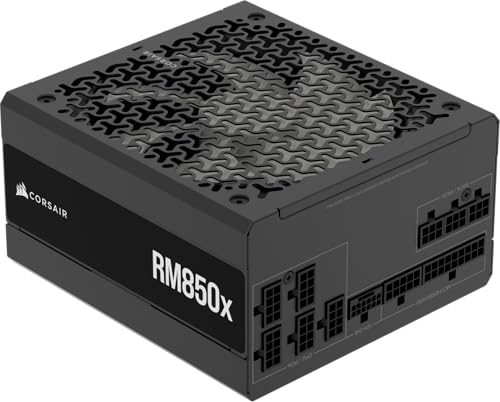
When to step up: Corsair RM850x ATX 3.1
Specs
Wattage | 850 W continuous |
Standard | ATX 3.1, PCIe 5.1 |
Efficiency | Cybenetics Gold |
GPU connector | Native 12V-2x6, 600 W |
Cabling | Fully modular |
Transient headroom | 200% excursion per ATX 3.1 |
Warranty | 10 years |
Wattage
850 W continuous
Standard
ATX 3.1, PCIe 5.1
Efficiency
Cybenetics Gold
GPU connector
Native 12V-2x6, 600 W
Cabling
Fully modular
Transient headroom
200% excursion per ATX 3.1
Warranty
10 years
What it does well
It absorbs the CPU class that breaks the 750W math. A Core Ultra 9 285K can pull past 300 W under a sustained all-core load and a 9950X3D lands in the low 200s. Put either next to a 360 W card and the 750W margin is spent before you count a single fan. This is the same platform family one rung up, so the choice stays a wattage decision rather than a brand decision.
The extra 100 W is also the upgrade answer. Ask how long the build has to last and whether you would swap the card in three years, because that single answer is what sets the wattage buffer. A yes means buying the headroom now instead of buying a second power supply later.
Everything the 750W sibling does well carries over: native 12V-2x6, Cybenetics Gold, fully modular, ten years of warranty. If your build sits where 850W is the floor rather than the comfortable choice, our full 850W shortlist for the 5080 goes deeper on the alternatives.
What you give up
Money, and a little efficiency at idle, where a larger unit sits further down its curve than a smaller one under the same load. Neither is a reason to avoid it if the build genuinely needs the watts.
What it does not give you is performance. An 850W unit is not faster, not quieter, and not more stable than a 750W unit on the same platform in a system that never asks for the extra output. Buying this for a 9800X3D build with two drives is paying for a number, and that is the exact overspend this article exists to prevent.
Who it's for
Anyone pairing the 5080 with a Ryzen 9 9950X3D, a Core Ultra 9 285K, or an i9-class chip. Also the builder running four or more drives, a 360mm AIO with a full fan complement, or anyone who intends to put a larger card in this case before the platform turns over.
Bottom line
If you are running a 9800X3D, a 7800X3D, or a Core Ultra 7 with one or two drives, buy the Corsair RM750x ATX 3.1 and stop reading. If the budget is tight, the be quiet! Pure Power 13 M 750W clears the same standard for less. If you are running a 9950X3D, a 285K, or four drives behind a full fan wall, buy the Corsair RM850x ATX 3.1. If your current 750W unit predates ATX 3.1, replace it no matter which CPU you own. The number on the box was never the thing that decides this, and the full PSU buying framework walks through the rest of it.
FAQ
Is 750W enough for an RTX 5080?
Yes, if two things are true. The unit carries an ATX 3.1 rating, and the CPU next to the card is a Ryzen 7 or Core Ultra 7 class chip rather than a Ryzen 9 or Core Ultra 9. Under those conditions a 750W unit has real margin: the card averages around 325 W in games against a 360 W rated limit, and the CPU tops out near 162 W. If either condition fails, move to 850W. A 750W unit without the ATX 3.1 rating is a no at any CPU class.
Does an RTX 5080 need an ATX 3.1 power supply?
It does not require one to boot, but it is the specification worth buying. ATX 3.1 defines how much output a unit must deliver during a transient excursion: roughly 200 percent of its rating for microsecond bursts, about 150 percent for around 10 milliseconds, and 120 percent for tens of milliseconds. Blackwell cards spike well above their sustained draw, and a spike is what trips over-current protection. ATX 2.x units carry no published excursion figure at all, so their margin is unknowable rather than simply smaller.
Can I reuse my old 750W ATX 2.x PSU with an RTX 5080?
This is not a call worth making on wattage alone. An ATX 2.x unit was engineered to a sustained rating plus whatever transient headroom its designer chose, and that figure was never published, so there is no way to compare it against a modern unit. Add age to that: capacitors degrade, and a unit that shipped several GPU generations ago has less margin now than it had new. If the unit predates ATX 3.0 and you are installing a 5080, replace it. That is the one upgrade here that is not optional.
What PSU should I get for an RTX 5080 and a 9800X3D?
A 750W ATX 3.1 unit. The 9800X3D is a 120 W part with a 162 W package ceiling, and in games it typically sits far below even that. Paired with a card averaging around 325 W, the combination leaves a working margin at 750W, with the ATX 3.1 excursion allowance covering the spikes. The Corsair RM750x ATX 3.1 is the pick, or the be quiet! Pure Power 13 M 750W on a tighter budget. Move up to 850W only if you are also running four or more drives and a full fan complement.
Why does NVIDIA recommend 850W for the RTX 5080?
Because the recommendation is a system figure, not a card figure. It is sized against a high-end platform with a Ryzen 9 class CPU, several drives, and a full cooling load, which is the safe assumption for a vendor who cannot see your parts list. Read as a floor for that configuration it is correct. Read as a property of the card it misleads, because the card is a 360 W part and the CPU class next to it is what moves the total. Size the unit off your build, not off the box.
Will a 750W PSU shut my PC down under load with a 5080?
Only if the unit runs out of transient headroom, and that is a different failure from running out of watts. When a spike pushes instantaneous draw past what the unit can deliver, over-current protection fires and the system drops instantly, usually mid-scene rather than at a loading screen. An ATX 3.1 unit at 750W is specified against exactly that case. An older 750W unit paired with a Ryzen 9 is the combination that produces the shutdown people describe, and the fix is the standard plus the wattage, not the wattage alone.
Related Articles

Best 750W PSUs for RTX 5070 Builds: 5 ATX 3.1 Picks (2026)
Best 750W PSU for an RTX 5070 build? These 5 ATX 3.1 picks skip the 850W upsell and still handle the card's transient spikes without tripping protection.
Sep 8, 2026

Best 850W PSUs for the RTX 5080 (2026): 5 ATX 3.1 Picks
The best 850W PSU for an RTX 5080 needs ATX 3.1 and a native 12V-2x6 cable. Five picks that clear that bar, across quiet, value, budget and Titanium tiers.
Aug 11, 2026

How Much PSU Wattage Do You Need for a Gaming PC? (2026)
How much PSU wattage your gaming PC needs in 2026: a GPU-tier decision matrix for RTX 5060 through RTX 5090, with ATX 3.1 picks at every wattage tier.
Jun 1, 2026

Best ATX 3.1 Power Supplies (2026): 5 Native 12V-2x6 Picks
Five ATX 3.1 power supplies with native 12V-2x6 connectors, Cybenetics Gold through Platinum, all 850W, plus how to spot an ATX 3.0 unit sold with an adapter.
Aug 14, 2026

How to Choose a Power Supply for Your Gaming PC (2026)
How to choose a power supply for a gaming PC: size it to your GPU's transient spikes, pick the right 80 Plus tier, get ATX 3.1, and buy a trusted OEM brand.
Jul 19, 2026