Affiliate Disclosure: As an Amazon Associate we earn from qualifying purchases. Some links may earn us a commission at no cost to you.

Should You Wait for the Intel Arc B770? Not Anymore (2026)
No. Stop waiting for the Intel Arc B770. The gaming card Intel never formally announced is not coming, and the silicon it was supposed to use already shipped in March 2026 as the Arc Pro B70, a workstation and AI card with 32GB of memory and a professional price tag.
That leaves the real question in its place: what do you buy in the slot the B770 was going to fill? Four cards cover it, from a tight budget up to 1440p ultra headroom. Here is the short version, then the reporting behind the verdict.
At a glance
Pick | Card | Memory | Best for | Buy |
|---|---|---|---|---|
Best overall now | 16GB GDDR6, 128-bit | 1440p raster on a mainstream budget | ||
Best for ray tracing and creator work | 16GB GDDR7, 128-bit | Ray-traced titles, streaming, CUDA work | ||
Best budget | 12GB GDDR6, 192-bit | 1080p high refresh on the tightest budget | ||
Best step-up | 16GB GDDR6, 256-bit | 1440p ultra headroom |
Best overall now
- Card
- Memory
16GB GDDR6, 128-bit
- Best for
1440p raster on a mainstream budget
- Buy
Best for ray tracing and creator work
- Card
- Memory
16GB GDDR7, 128-bit
- Best for
Ray-traced titles, streaming, CUDA work
- Buy
Best budget
- Card
- Memory
12GB GDDR6, 192-bit
- Best for
1080p high refresh on the tightest budget
- Buy
Best step-up
- Card
- Memory
16GB GDDR6, 256-bit
- Best for
1440p ultra headroom
- Buy
What happened to the Arc B770
The waiting population built up over a year of leaks. In September 2025, Notebookcheck relayed a Moore's Law Is Dead report that had the B770 alive and due that quarter with 32 Xe cores, a 256-bit bus and roughly RTX 4070 class performance. The same report said Intel had pulled the next-generation Celestial desktop GPU from its roadmap, which should have been the first warning.
The card never showed. TweakTown noted its absence at CES in January 2026, and later that month Igor's Lab and the leaker SquashBionic both reported the consumer B770 cancelled as financially unviable, with the BMG-G31 silicon redirected to the professional segment. On 25 March 2026 Intel announced the Arc Pro B70 and B65 on exactly that die: 32 Xe cores, 32GB of GDDR6, aimed at AI inference and professional graphics. No gaming variant. The chip people were waiting for is on sale right now, in a workstation.
The reason everyone cites is memory. DRAM contract pricing climbed through 2026 as AI demand soaked up supply, and both NVIDIA and AMD pushed board-price increases through their partners. A 16GB consumer card at a mid-range price stopped penciling out, and that same squeeze is raising what you pay for everything below. If you are weighing a similar wait on the NVIDIA side, the Super refresh question has its own answer.
Which card should you buy instead?
Your scenario | Why this one | Get it |
|---|---|---|
1440p, mostly raster, mainstream budget | 16GB clears the 1440p memory floor at the lowest price in this guide | |
Ray tracing, streaming or creative work | DLSS 4, NVENC AV1 and CUDA are levers the Radeon cannot match | |
Tightest budget, 1080p high refresh | 12GB and the best cost per frame here, with a 1080p ceiling | |
1440p ultra, no compromise on headroom | A 256-bit bus and real ultra-preset room above the mainstream tier |
1440p, mostly raster, mainstream budget
- Why this one
16GB clears the 1440p memory floor at the lowest price in this guide
- Get it
Ray tracing, streaming or creative work
- Why this one
DLSS 4, NVENC AV1 and CUDA are levers the Radeon cannot match
- Get it
Tightest budget, 1080p high refresh
- Why this one
12GB and the best cost per frame here, with a 1080p ceiling
- Get it
1440p ultra, no compromise on headroom
- Why this one
A 256-bit bus and real ultra-preset room above the mainstream tier
- Get it
Benchmarks
Suite averages for the two mainstream picks, both at 1440p with upscaling off.
- 134 FPS
- 142 FPS
The other two picks sit outside that chart on purpose: different reviews, different test suites. For reference, TechSpot's Arc B580 re-review put that card well ahead of the RTX 4060 at 1440p, and reviewer testing has the RX 9070 XT near 133 fps in Cyberpunk 2077 at native 1440p.
How we picked
Resolution sets the floor. At 1440p the memory floor is 12GB and 16GB is what you want, which is exactly the spec that made the B770 interesting. Every card here clears 12GB; three clear 16GB.
Upscaling counts, within limits. DLSS 4 and FSR 4 both hold up at Quality presets at 1440p. Frame generation is a smoothness multiplier, not a performance level: it turns 60 into 120, never 30 into 120. A card sold on a frame-generated number is a slower card with arithmetic attached.
The last filter is availability. A card you can order today beats a card that might exist later, which is the whole point of this page. For the longer framework, how to choose a GPU and the display that matches covers the full decision.
Best overall now: ASRock Challenger RX 9060 XT 16GB

Specs
Chip | Radeon RX 9060 XT (RDNA 4) |
VRAM | 16GB GDDR6 |
Memory bus | 128-bit |
Boost clock | 3290 MHz |
Interface | PCIe 5.0 |
Cooling | Dual fan, 0dB idle |
Outputs | DisplayPort 2.1a, HDMI 2.1b |
Upscaling | FSR 4 |
Chip
Radeon RX 9060 XT (RDNA 4)
VRAM
16GB GDDR6
Memory bus
128-bit
Boost clock
3290 MHz
Interface
PCIe 5.0
Cooling
Dual fan, 0dB idle
Outputs
DisplayPort 2.1a, HDMI 2.1b
Upscaling
FSR 4
What it does well
This is the card sitting in the slot the B770 was aimed at. 16GB at a mainstream price was the headline spec of the rumoured Intel part, and the Radeon delivers it today. At 1440p that buffer is the difference between dropping textures in two years and never thinking about it.
Raster is strong for the tier. Hardware Unboxed's 1440p suite put it within roughly five percent of the RTX 5060 Ti on average, close enough that the choice comes down to what you do with the card. FSR 4 closed most of the gap to DLSS at Quality, so upscaling is a real option rather than a concession.
What you give up
The 128-bit bus is the structural limit: stack high-resolution textures and ray tracing and the card runs short on bandwidth before it runs short on memory. Ray tracing trails NVIDIA at this tier, and anything touching CUDA, Blender or a local AI model puts you on the wrong side of the fence.
ASRock's Challenger is not an AIB line we reach for first; it earns its place on the 16GB spec, not the cooler. Watch the listing too: the 8GB RX 9060 XT carries nearly the same name and shows up cheaper. At 1440p it is a different card.
Who it's for
You game at 1440p, your library leans raster, and you were waiting on the B770 for its memory buffer. You do not stream or render.
Best for ray tracing and creator work: MSI RTX 5060 Ti 16G Shadow 2X OC

Specs
Chip | GeForce RTX 5060 Ti (Blackwell) |
VRAM | 16GB GDDR7 |
Memory bus | 128-bit |
Memory speed | 28 Gbps |
Interface | PCIe 5.0 |
Cooling | Dual fan |
Outputs | 3x DisplayPort 2.1a, HDMI 2.1b |
Upscaling | DLSS 4 with Multi Frame Generation |
Chip
GeForce RTX 5060 Ti (Blackwell)
VRAM
16GB GDDR7
Memory bus
128-bit
Memory speed
28 Gbps
Interface
PCIe 5.0
Cooling
Dual fan
Outputs
3x DisplayPort 2.1a, HDMI 2.1b
Upscaling
DLSS 4 with Multi Frame Generation
What it does well
Club386 read Intel's Arc Pro B70 numbers as putting a hypothetical gaming B770 around RTX 5060 Ti territory. This is that performance class, shipping, with 16GB of GDDR7 behind it. If your model of the B770 was mid-range money with more memory, the 16GB 5060 Ti is the closest thing on shelves.
The feature stack is what the extra money buys. DLSS 4's transformer model at Quality belongs in the buying decision at 1440p, not the footnotes. Ray tracing is playable here in a way it is not on the Radeon, NVENC AV1 matters if you stream, and CUDA matters the moment you open Blender.
What you give up
Price, mostly. This is the most expensive way into the tier, and the raster gap to the 16GB Radeon does not cover the difference. The 128-bit bus is the same structural limit, so what you gain is features rather than bandwidth.
Skip the 8GB RTX 5060 Ti. It shares the model name and should not be a 1440p purchase in 2026. Buyers have flagged how easy the two listings are to confuse.
Who it's for
You play ray-traced titles, you stream, or you render. The CUDA tax flips the equation and this becomes the obvious pick rather than the expensive one.
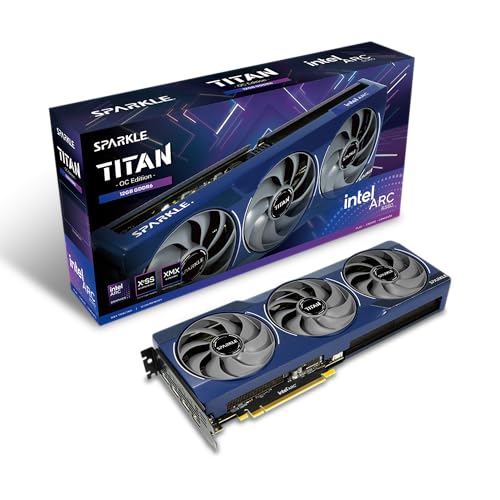
Best budget: Sparkle Arc B580 Titan OC
Specs
Chip | Intel Arc B580 (Xe2 Battlemage) |
VRAM | 12GB GDDR6 |
Memory bus | 192-bit |
Interface | PCIe 4.0 x8 |
Cooling | Torn Cooling 2.0 axial fans |
Outputs | DisplayPort 2.1, HDMI 2.1 |
Upscaling | XeSS 2 |
Extras | Metal backplate |
Chip
Intel Arc B580 (Xe2 Battlemage)
VRAM
12GB GDDR6
Memory bus
192-bit
Interface
PCIe 4.0 x8
Cooling
Torn Cooling 2.0 axial fans
Outputs
DisplayPort 2.1, HDMI 2.1
Upscaling
XeSS 2
Extras
Metal backplate
What it does well
If you were waiting on the B770 because you wanted Intel specifically, this is the only answer. The B580 tops Intel's consumer Battlemage stack now that the bigger die has gone professional.
It holds up on value. 12GB on a budget card reads well against the 8GB competition, and the cost per frame is the best here by a clear margin. XeSS 2 also runs on Intel's own XMX hardware path rather than the weaker fallback other vendors get.
What you give up
This is a 1080p card that reaches into 1440p, not a 1440p card. We mapped where that line falls in whether the B580 is enough at 1440p, and in the tier below it if your budget is tighter still.
Drivers are far better than the Alchemist era, but older DX9 and DX11 titles still surface problems, and reports suggest Arc cards lose disproportionate performance on an older CPU because of driver overhead. Supply has been the least reliable of anything here.
Who it's for
You play at 1080p on a high-refresh panel, budget is the binding constraint, and you would rather own a card than refresh rumour threads.
Best step-up: Sapphire Pulse RX 9070 XT

Specs
Chip | Radeon RX 9070 XT (RDNA 4) |
VRAM | 16GB GDDR6 |
Memory bus | 256-bit |
Interface | PCIe 5.0 |
Cooling | Triple fan |
Outputs | 2x HDMI, 2x DisplayPort |
Manufacturer SKU | 11348-03-20G |
Upscaling | FSR 4 |
Chip
Radeon RX 9070 XT (RDNA 4)
VRAM
16GB GDDR6
Memory bus
256-bit
Interface
PCIe 5.0
Cooling
Triple fan
Outputs
2x HDMI, 2x DisplayPort
Manufacturer SKU
11348-03-20G
Upscaling
FSR 4
What it does well
Some people waiting on the B770 were not waiting for a mainstream card. They wanted 1440p ultra without thinking about it, and hoped Intel would make that cheap. The 256-bit bus doubles what the mainstream picks get, with the same 16GB behind it.
Reviewer testing lands it near 133 fps in Cyberpunk 2077 at native 1440p, a different conversation from the cards above. Sapphire's Pulse is one of the mid-tier AIB lines worth reaching for, and the triple-fan cooler is sized for the power draw rather than the spec sheet.
What you give up
The jump in price is large, which is why this is a step-up rather than the default. If the budget does not stretch, the 16GB RX 9060 XT is the honest answer, and whether you need the step-up walks through where that line falls.
Ray tracing still trails NVIDIA, stock has been thin all generation, and the Pulse is a long card. Measure your case before you order.
Who it's for
You want 1440p ultra headroom and can absorb the jump. Your library is raster-led, or you accept that ray-traced titles will lean on FSR 4.
Bottom line
If you game at 1440p and your library is raster-led, buy the ASRock Challenger RX 9060 XT 16GB. If you ray trace, stream or render, buy the MSI RTX 5060 Ti 16G Shadow 2X OC. If budget is the binding constraint and you play at 1080p, buy the Sparkle Arc B580 Titan OC. If you want ultra-preset headroom at 1440p, buy the Sapphire Pulse RX 9070 XT.
Whichever one fits, buy it now. The B770 is not coming back, and memory pricing is moving the wrong way. We will revisit this page by 13 December 2026, or sooner if Intel says something new. For the wider field at this resolution, our 1440p GPU guide goes broader.
FAQ
Is the Intel Arc B770 actually cancelled?
Intel never formally announced a gaming B770, so there is nothing official to cancel. What exists is reporting: Igor's Lab and the leaker SquashBionic both said in January 2026 that the consumer card had been dropped as financially unviable, and Intel shipped the same silicon in March as the workstation Arc Pro B70. Treat it as dead until Intel says otherwise.
What is the Intel Arc Pro B70, and can you game on it?
It is the professional card built on the die the B770 was going to use: 32 Xe cores and 32GB of GDDR6, announced on 25 March 2026. It will render frames, but it is priced and driver-tuned for AI inference and professional graphics, not for games.
Is the Intel Arc B580 still worth buying in 2026?
For 1080p high-refresh gaming on a tight budget, yes. 12GB and the best cost per frame in this guide carry it. It is not a 1440p card, older DX9 and DX11 titles still cause trouble, and supply has been the shakiest of anything here.
Will Intel make another gaming graphics card after Battlemage?
Unclear, and the signals are not encouraging. The same September 2025 report that kept the B770 alive also said Intel had pulled the Celestial desktop GPU from its roadmap, and nothing since has contradicted it. Buy on what Intel ships today, not on a roadmap.
Should I wait for GPU prices to come down instead?
Nothing in the current reporting points that way. DRAM contract pricing has risen through 2026 on AI demand, and both NVIDIA and AMD have passed increases to their board partners. Analysts expect the squeeze to run for years, so waiting for a dip looks like the worse bet.
What would the Arc B770 have competed with?
The leaked configuration was 32 Xe cores on a 256-bit bus with 16GB of memory, which reporting placed around RTX 4070 performance. Club386 read the Arc Pro B70's numbers as landing a gaming version near the RTX 5060 Ti. Both targets are on this page, with the memory to match.
Related Articles

Is the Arc B580 Enough for 1440p in 2026? 12GB Verdict
Is the Arc B580 enough for 1440p in 2026? Its 12GB holds up at high settings with XeSS, but at current street prices the RX 9060 XT 16GB is the smarter buy.
Sep 30, 2026

RX 9060 XT vs 9070 (2026): Is 16GB Enough for 1440p?
Is the RX 9060 XT enough for 1440p gaming? It clears 1080p and 1440p high settings; the RX 9070 only pays off at 1440p ultra. Benchmarks and buyable picks.
Sep 10, 2026

Best GPU for 1440p Gaming 2026: 5 16GB Picks, 144-240Hz
The best GPU for 1440p gaming in 2026: five 16GB picks matched to 144 and 240 Hz targets, the 8GB cards to skip, and the benchmarks behind every call.
Sep 26, 2026

Should You Wait for the RTX 50 Super or Buy Now? (2026)
Should you wait for the RTX 50 Super or buy a GPU now? We break down the rumored VRAM jump, the memory-shortage delay, and which current cards are safe buys.
Jul 23, 2026

How to Choose a GPU (and a Monitor That Matches)
A buyer's framework for picking a GPU and the monitor that pairs with it. Start with the panel and work the card back.
May 17, 2026