Affiliate Disclosure: As an Amazon Associate we earn from qualifying purchases. Some links may earn us a commission at no cost to you.

Best 1TB NVMe SSDs for Gaming (2026): 5 Picks, DRAM vs HMB
A 1TB NVMe SSD is the most common boot drive in a gaming PC, and in 2026 it is also the capacity the NAND shortage hit hardest. Good 1TB drives now cost what 2TB drives did two years ago, so the drive you pick has to earn its slot.
These five picks cover the jobs a 1TB drive really does: a DRAM boot drive, a fast value pick, a Gen5 speed pick, a cheap second drive, and a heatsink drive for the PS5. Each one comes with the trade-off it asks you to accept.
Our top pick: WD Black SN850X 1TB
The WD Black SN850X 1TB is the safest single 1TB drive to build around: DRAM, TLC NAND and 7,300 MB/s reads keep it quick even when Windows, apps and a few big games fill it close to the top.

Quick picks
Pick | Product | Best for | Buy |
|---|---|---|---|
Best Overall | DRAM boot drive that stays fast when full | ||
Best Value | Fast game drive for less | ||
Best Premium | Gen5 speed for big file work | ||
Best Budget | Cheapest known-parts game drive | ||
Editor's Pick | PS5 expansion or boards without a heatsink |
Best Overall
- Product
- Best for
DRAM boot drive that stays fast when full
- Buy
Best Value
- Product
- Best for
Fast game drive for less
- Buy
Best Premium
- Product
- Best for
Gen5 speed for big file work
- Buy
Best Budget
- Product
- Best for
Cheapest known-parts game drive
- Buy
Editor's Pick
- Product
- Best for
PS5 expansion or boards without a heatsink
- Buy
Specs at a glance
Product | Interface | Read / write | DRAM | NAND | Endurance |
|---|---|---|---|---|---|
PCIe 4.0 | 7,300 / 6,300 MB/s | Yes (DDR4) | TLC | 600 TBW | |
PCIe 4.0 | 7,250 / 6,900 MB/s | No (HMB) | TLC | 600 TBW | |
PCIe 5.0 | 14,700 / 13,300 MB/s | Yes (LPDDR4X) | Samsung V8 TLC | 600 TBW | |
PCIe 4.0 | 7,100 / 6,000 MB/s | No (HMB) | Micron 232-layer QLC | 220 TBW | |
PCIe 4.0 | 7,450 / 6,900 MB/s | Yes (LPDDR4) | Samsung V7 TLC | 600 TBW |
- Interface
PCIe 4.0
- Read / write
7,300 / 6,300 MB/s
- DRAM
Yes (DDR4)
- NAND
TLC
- Endurance
600 TBW
- Interface
PCIe 4.0
- Read / write
7,250 / 6,900 MB/s
- DRAM
No (HMB)
- NAND
TLC
- Endurance
600 TBW
- Interface
PCIe 5.0
- Read / write
14,700 / 13,300 MB/s
- DRAM
Yes (LPDDR4X)
- NAND
Samsung V8 TLC
- Endurance
600 TBW
- Interface
PCIe 4.0
- Read / write
7,100 / 6,000 MB/s
- DRAM
No (HMB)
- NAND
Micron 232-layer QLC
- Endurance
220 TBW
- Interface
PCIe 4.0
- Read / write
7,450 / 6,900 MB/s
- DRAM
Yes (LPDDR4)
- NAND
Samsung V7 TLC
- Endurance
600 TBW
How we picked these 1TB NVMe SSDs
Every pick here is a PCIe NVMe drive in the standard M.2 2280 size, sold new on Amazon, with a known controller and NAND. That last part rules out drives whose parts change between production batches. Our guide on how to choose an SSD covers the basics behind these specs.
DRAM vs HMB. A DRAM cache holds the drive's map of where data lives. DRAM-less drives use HMB instead, borrowing a small slice of system memory. For loading games the difference is close to zero. It shows up on a boot drive that is nearly full and busy with updates, downloads and app installs at once, which is exactly how a 1TB system drive tends to live. That is why the top pick has DRAM and the value pick does not.
TLC vs QLC. TLC NAND holds its write speed longer and lasts more write cycles. QLC is cheaper per gigabyte but slows sharply once its fast cache fills. For a game drive that mostly reads, QLC is fine. For a scratch drive, it is not.
Gen4 vs Gen5. A good Gen4 drive and a Gen5 drive load the same game within a second or two of each other. Gen5 earns its place on large file copies and creative work, not on load screens. Our Gen4 vs Gen5 for gaming breakdown covers the numbers.
The 2TB plan. We would not build a new mid-range or high-end gaming PC around a single 1TB drive. Every build we have helped spec with one 1TB drive came back within 8 months asking how to add storage. A modern AAA install runs well past 100 GB, so 1TB holds the OS plus a handful of games. Buy 1TB for the boot drive or a tight budget, and leave a second M.2 slot free for one of the best 2TB NVMe SSDs later. If you are still deciding, read is 1TB enough for gaming first.
Best Overall: WD Black SN850X 1TB
The SN850X is the drive we default to when someone needs one 1TB drive and does not want to think about it again.
Specs
Interface | PCIe 4.0 x4 NVMe, M.2 2280 |
Sequential read / write | 7,300 / 6,300 MB/s |
DRAM cache | Yes (DDR4) |
NAND | TLC |
Endurance | 600 TBW |
Warranty | 5 years |
Heatsink | Optional variant (WDS100T2XHE) |
Interface
PCIe 4.0 x4 NVMe, M.2 2280
Sequential read / write
7,300 / 6,300 MB/s
DRAM cache
Yes (DDR4)
NAND
TLC
Endurance
600 TBW
Warranty
5 years
Heatsink
Optional variant (WDS100T2XHE)
What it does well
The SN850X pairs a DDR4 cache with TLC NAND, so it stays consistent as a busy boot drive fills up. Reads top out at 7,300 MB/s and writes at 6,300 MB/s, near the ceiling of what PCIe 4.0 allows.
It has a long firmware track record, a 600 TBW endurance rating and a 5-year warranty. WD's dashboard also adds a Game Mode that keeps the drive out of low-power states while you play. Mature, boring and fast is exactly what you want from the drive your OS lives on.
What you give up
You pay a premium over DRAM-less Gen4 drives that load games just as fast. If this is purely a game library drive, the SN7100 below gets you nearly the same experience for less.
Reviewers have also flagged that the bare SN850X runs warm under sustained load. Mount it under your motherboard's M.2 heatsink, or buy the heatsink version if your board has none.
Who it's for
Builders who want one 1TB drive to carry Windows, apps and the current game rotation, on a desktop board with an M.2 heatsink. It is also the right pick for a boot drive you plan to pair with a bigger game drive later.
Best Value: WD Black SN7100 1TB
The SN7100 gets within a whisker of the SN850X on paper while costing less and drawing less power.

Specs
Interface | PCIe 4.0 x4 NVMe, M.2 2280 |
Sequential read / write | 7,250 / 6,900 MB/s |
DRAM cache | No (HMB) |
NAND | TLC |
Endurance | 600 TBW |
Warranty | 5 years |
Heatsink | None |
Interface
PCIe 4.0 x4 NVMe, M.2 2280
Sequential read / write
7,250 / 6,900 MB/s
DRAM cache
No (HMB)
NAND
TLC
Endurance
600 TBW
Warranty
5 years
Heatsink
None
What it does well
Reads hit 7,250 MB/s and writes 6,900 MB/s from TLC NAND, and the 1TB model carries the same 600 TBW rating and 5-year warranty as the SN850X. In games, you will not see a load-time difference between the two.
It is also one of the most efficient Gen4 drives around, which means less heat in a small case and a drive that works in a laptop or handheld later if you move it.
What you give up
There is no DRAM. The SN7100 uses HMB, borrowing a slice of system memory for its mapping table. Reports suggest that under sustained mixed workloads on a nearly full drive it is less consistent than a DRAM drive. For a game library that mostly reads, that rarely shows.
There is no heatsink option either, so it relies on your board's M.2 cover in a hot case.
Who it's for
Gamers who want a fast, efficient 1TB game drive or a boot drive for a lighter system, and would rather put the savings toward a second drive later.
Best Premium: Samsung 9100 Pro 1TB
The 9100 Pro is the fastest 1TB drive you can buy, and the shortage has pushed it to within a few dollars of the best Gen4 drives.

Specs
Interface | PCIe 5.0 x4 NVMe, M.2 2280 |
Sequential read / write | 14,700 / 13,300 MB/s |
DRAM cache | Yes (LPDDR4X) |
NAND | Samsung V8 TLC |
Endurance | 600 TBW |
Warranty | 5 years |
Heatsink | None on this SKU |
Interface
PCIe 5.0 x4 NVMe, M.2 2280
Sequential read / write
14,700 / 13,300 MB/s
DRAM cache
Yes (LPDDR4X)
NAND
Samsung V8 TLC
Endurance
600 TBW
Warranty
5 years
Heatsink
None on this SKU
What it does well
Samsung rates the 1TB model at 14,700 MB/s reads and 13,300 MB/s writes over PCIe 5.0, roughly double any Gen4 drive. It keeps a DRAM cache and TLC NAND, with 600 TBW and a 5-year warranty.
That bandwidth matters when you copy large files, scrub video timelines or move game installs between drives. It also means your boot drive is not the bottleneck on a high-end platform for years.
What you give up
Games barely notice. Load times on a Gen5 drive land within a second or two of a good Gen4 drive, because games are limited by decompression and CPU work, not raw sequential speed.
It needs a Gen5 M.2 slot to reach its rated speed, and Gen5 drives run hot. This SKU has no heatsink, so plan on your motherboard's M.2 heatsink to avoid throttling.
Who it's for
AM5 or Intel 800-series owners with a Gen5 M.2 slot who also edit video or move large files, and want the top 1TB drive now rather than an upgrade later.
Best Budget: Crucial P310 1TB
The P310 is the cheapest 1TB Gen4 drive we would put in a gaming PC, because its parts are known and its reads are full speed.

Specs
Interface | PCIe 4.0 x4 NVMe, M.2 2280 |
Sequential read / write | 7,100 / 6,000 MB/s |
DRAM cache | No (HMB) |
NAND | Micron 232-layer QLC |
Endurance | 220 TBW |
Warranty | 5 years |
Heatsink | None |
Interface
PCIe 4.0 x4 NVMe, M.2 2280
Sequential read / write
7,100 / 6,000 MB/s
DRAM cache
No (HMB)
NAND
Micron 232-layer QLC
Endurance
220 TBW
Warranty
5 years
Heatsink
None
What it does well
Reads reach 7,100 MB/s, so games load as fast as on drives that cost more. Crucial uses its own Micron NAND with a Phison controller, which avoids the parts lottery some budget lines run.
It runs cool, sips power and carries a 5-year warranty. As a second drive for a game library, or the only drive in a tight budget build, it does the job without drama.
What you give up
The NAND is QLC. Buyers and reviewers have flagged that writes fall to roughly 300 MB/s once the SLC cache is exhausted, so large installs and file copies slow down partway through.
Endurance is rated at 220 TBW, about a third of the TLC picks. That is plenty for a game drive, but not what you want as a scratch disk for daily video work.
Who it's for
Budget builders and anyone adding a second drive for games, where the drive mostly reads and rarely takes huge sustained writes.
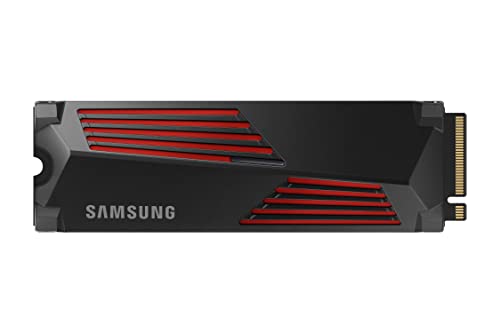
Editor's Pick: Samsung 990 Pro 1TB Heatsink
This is the 1TB pick for the PS5, and it doubles as a DRAM desktop drive for boards without an M.2 heatsink.
Specs
Interface | PCIe 4.0 x4 NVMe, M.2 2280 |
Sequential read / write | 7,450 / 6,900 MB/s |
DRAM cache | Yes (LPDDR4) |
NAND | Samsung V7 TLC |
Endurance | 600 TBW |
Warranty | 5 years |
Heatsink | Included, PS5-compatible |
Interface
PCIe 4.0 x4 NVMe, M.2 2280
Sequential read / write
7,450 / 6,900 MB/s
DRAM cache
Yes (LPDDR4)
NAND
Samsung V7 TLC
Endurance
600 TBW
Warranty
5 years
Heatsink
Included, PS5-compatible
What it does well
The integrated heatsink fits the PS5 expansion bay, and Samsung markets this SKU as PS5-compatible. Reads of 7,450 MB/s are the highest of any Gen4 drive here, well past the PS5's recommended minimum.
It keeps a DRAM cache and TLC NAND with 600 TBW and a 5-year warranty, so it is a strong boot drive too. See our PS5 SSD guide for the full console list.
What you give up
It costs more than the SN850X, and the heatsink adds height. On a desktop board that already has an M.2 heatsink, the two can clash, so you remove the board's cover or buy the bare drive instead.
For a PC that only needs a game drive, the money buys more capacity elsewhere in this list.
Who it's for
PS5 owners adding storage, and desktop builders whose motherboard has no M.2 heatsink.
Bottom line
If you want one 1TB drive to build around, buy the WD Black SN850X 1TB. If you want nearly the same speed for less, buy the WD Black SN7100 1TB. If you have a Gen5 slot and move big files, buy the Samsung 9100 Pro 1TB. If the budget is tight or this is a second game drive, buy the Crucial P310 1TB. If it is going in a PS5, buy the Samsung 990 Pro 1TB Heatsink.
Whichever you pick, plan the second drive now. Prices move monthly in the shortage, so check whether to buy now or wait out the shortage before you add one, and see our 4TB NVMe picks if you want to buy the library drive once.
FAQ
Is 1TB enough for a gaming PC in 2026?
For the OS plus a handful of current games, yes. Large AAA installs run well past 100 GB each, so a single 1TB drive fills fast if you keep a big library installed. We treat 1TB as the boot drive or a budget starting point and plan a 2TB second drive. If you only play a few games at a time, 1TB is workable.
Do I need DRAM on a 1TB NVMe SSD for gaming?
Not for loading games. DRAM-less drives with HMB, like the WD Black SN7100, load games as fast as DRAM drives. DRAM helps most on a busy boot drive that runs close to full, which is why our top pick, the WD Black SN850X, has it. For a second game drive, skip DRAM and save the money.
Is a Gen5 1TB SSD worth it for gaming?
Only if you also do heavy file work. A Gen5 drive like the Samsung 9100 Pro roughly doubles sequential speed, but game load times land within a second or two of a good Gen4 drive. If you only game, a Gen4 drive with DRAM is the better buy. Gen5 also needs a Gen5 slot and a heatsink.
Does a faster NVMe SSD give you more FPS?
No. Once a game is loaded, frame rate comes from your GPU and CPU. A faster SSD shortens load screens and can reduce texture pop-in during streaming, but it does not raise average FPS. Spend on the GPU first, then pick the drive by capacity and role.
Which 1TB NVMe SSD works in a PS5?
Any PCIe 4.0 M.2 drive that fits the bay and has a heatsink. The Samsung 990 Pro 1TB Heatsink is our pick because it ships with a PS5-compatible heatsink and DRAM. A bare drive works too if you add a slim third-party heatsink, as long as the total height fits the PS5 slot.
Is QLC NAND bad for a gaming SSD?
Not for a drive that mostly reads. QLC drives like the Crucial P310 load games at full speed, but writes slow sharply once the fast cache fills, and endurance ratings are lower than TLC. That matters for big installs and file copies, not for playing games already installed.
Related Articles

Is 1TB Enough for Gaming, or Do You Need 2TB? (2026)
Modern AAA installs run 100 to 150+ GB each. Here's when 1TB is enough, when 2TB is the safe default, and which NVMe drive to buy for each tier.
Jul 25, 2026

Best 2TB NVMe SSDs Under $150 (2026): DRAM vs HMB Picks by Use Case
The best 2TB NVMe SSD under $150 isn't one drive. It's five, keyed to use case. DRAM-versus-HMB tradeoffs, PS5 fitment, and an honest answer for each.
May 19, 2026

Best 4TB NVMe SSDs for Gaming (2026): 5 Picks, Gen4 First
The best 4TB NVMe SSDs for gaming in 2026: five picks that hold a full library. Why a fast Gen4 loads games quicker than any Gen5 drive at this capacity.
Aug 20, 2026

Best Budget NVMe SSD for Gaming in 2026 (Under $100)
The best budget NVMe SSDs for gaming under $100 in 2026: five 1TB PCIe 4.0 picks that match pricier drives in real games, from value champ to fastest.
Jun 29, 2026

How to Choose an SSD for Gaming: Gen4 vs Gen5 (2026)
How to choose an SSD for gaming without overpaying: why Gen4 is the 2026 sweet spot, when Gen5 is actually worth it, DRAM vs DRAM-less, and capacity by tier.
Jul 24, 2026