Affiliate Disclosure: As an Amazon Associate we earn from qualifying purchases. Some links may earn us a commission at no cost to you.

Best SSDs for PS5 (2026): 5 Picks That Meet Sony's Specs
Sony's storage bay is fussier than a motherboard slot. A drive needs at least 5,500 MB/s of rated sequential read, an M.2 2280 PCIe 4.0 NVMe body, and a cooling stack that fits inside 11.25mm total. Most drives that fail here fail on the third rule, not the first.
The WD_BLACK SN850X 2TB heatsink model clears all three and keeps a DRAM cache, which is why it leads. Below it sit four more drives sorted by what you are solving for: cost, capacity, thinness, or the wish to never think about compatibility again.
Our top pick: WD_BLACK SN850X 2TB (Heatsink)
The WDS200T2XHE part number ships with its heatsink already attached, rates 7,300 MB/s read against Sony's 5,500 MB/s floor, and carries a full DRAM cache so a 120GB install does not stall halfway through. That is what a console drive needs, in one purchase.

Quick picks
Pick | Drive | Capacity | Best for | Buy |
|---|---|---|---|---|
Best Overall | 2 TB | The default upgrade | ||
Best Value | 2 TB | Thinnest heatsink stack | ||
Best Premium | 4 TB | Never managing storage again | ||
Best Budget | 2 TB | Cheapest compliant 2TB | ||
Editor's Pick | 2 TB | Sony-validated peace of mind |
Best Overall
- Drive
- Capacity
2 TB
- Best for
The default upgrade
- Buy
Best Value
- Drive
- Capacity
2 TB
- Best for
Thinnest heatsink stack
- Buy
Best Premium
- Drive
- Capacity
4 TB
- Best for
Never managing storage again
- Buy
Best Budget
- Drive
- Capacity
2 TB
- Best for
Cheapest compliant 2TB
- Buy
Editor's Pick
- Drive
- Capacity
2 TB
- Best for
Sony-validated peace of mind
- Buy
Sony's three actual requirements
The first rule is speed, and it is the one everybody quotes. Sony asks for a sequential read rating of 5,500 MB/s or better. That number is a floor, not a target. Every drive on this page rates well past it, and the console will not turn the extra headroom into anything you can feel.
The second rule is shape. The bay accepts M.2 2230, 2242, 2260, 2280 and 22110 sticks on a PCIe Gen4 or faster NVMe interface. In practice you want 2280, because that is where the drives with real DRAM caches live. SATA M.2 sticks do not work at all, and no adapter fixes that.
The third rule is the one that sends drives back. The total stack, drive plus cooling, has to stay under 11.25mm above the board and 2.45mm below it. That rules out most aftermarket finned towers, including several sold with PS5 branding on the box. A drive that is compliant on its own becomes non-compliant the moment you bolt the wrong cooler to it, which is why every pick here ships with cooling that already fits. If you are shopping coolers separately for a desktop instead, our PCIe 5.0 heatsink guide covers the tall ones.
Sony requires the cooling rather than recommending it. The bay has no airflow of its own, and a bare Gen4 drive under sustained write load will throttle in there.
Specs at a glance
Drive | Capacity | Rated read | Rated write | DRAM cache | Heatsink |
|---|---|---|---|---|---|
2 TB | 7,300 MB/s | 6,300 MB/s | Yes | Included, low-profile finned | |
2 TB | 7,100 MB/s | 5,800 MB/s | Yes | Included, low-profile aluminium | |
4 TB | 7,450 MB/s | 6,900 MB/s | Yes | Included, slim heat spreader | |
2 TB | 7,100 MB/s | 6,000 MB/s | No, Host Memory Buffer | Included, flat plate | |
2 TB | 7,300 MB/s | Not published | Yes | Included, Sony-licensed design |
- Capacity
2 TB
- Rated read
7,300 MB/s
- Rated write
6,300 MB/s
- DRAM cache
Yes
- Heatsink
Included, low-profile finned
- Capacity
2 TB
- Rated read
7,100 MB/s
- Rated write
5,800 MB/s
- DRAM cache
Yes
- Heatsink
Included, low-profile aluminium
- Capacity
4 TB
- Rated read
7,450 MB/s
- Rated write
6,900 MB/s
- DRAM cache
Yes
- Heatsink
Included, slim heat spreader
- Capacity
2 TB
- Rated read
7,100 MB/s
- Rated write
6,000 MB/s
- DRAM cache
No, Host Memory Buffer
- Heatsink
Included, flat plate
- Capacity
2 TB
- Rated read
7,300 MB/s
- Rated write
Not published
- DRAM cache
Yes
- Heatsink
Included, Sony-licensed design
Benchmarks
Manufacturer read ratings for each pick. These are rated specifications, not console measurements: the PS5 caps what it reports for thermal reasons, so its built-in speed test lands in a narrow band regardless of drive.
- Samsung 990 PRO7450 MB/s
- WD_BLACK SN850X7300 MB/s
- WD_BLACK SN850P7300 MB/s
- Corsair MP600 PRO LPX7100 MB/s
- Crucial P3107100 MB/s
How we picked
Compliance came first. A drive that misses any of Sony's three rules is not a slower option, it is a non-option, so the shortlist started with drives that ship a heatsink in the box at a total height the bay accepts. That alone cut most of the popular Gen4 sticks.
Then came the part number. Almost every drive here has a bare twin on Amazon at a lower price, with a thumbnail that looks identical at phone size. Buyers land on the wrong one constantly. Each pick below names its part number in the specs table so you can check the listing before you commit.
DRAM was the third filter. The PS5 does not hand a drive host memory the way a desktop does, so a DRAM-less design loses the cache assist it was built around. Four of the five picks carry a real DRAM cache. The one that does not is the budget pick, and its section says so plainly. The DRAM versus HMB split in 2TB drives matters more here than it does in a tower.
Speed rankings did little work. Once a drive clears 5,500 MB/s the console stops caring, and measurements from the PS5's own speed test cluster tightly regardless of what the sticker claims. Capacity and heat behaviour separate these drives. Sequential read does not. For the wider framework, our RAM and storage guide covers the reasoning end to end.
One common budget suggestion did not survive the first filter. The Silicon Power UD90 rates 5,000 MB/s read, under Sony's floor, so it is out no matter how good the price looks.
Best Overall: WD_BLACK SN850X 2TB (Heatsink)
Specs
Capacity | 2 TB |
Interface | PCIe Gen4 x4 NVMe |
Form factor | M.2 2280 |
Rated sequential read | 7,300 MB/s |
Rated sequential write | 6,300 MB/s |
DRAM cache | Yes |
Heatsink | Included, low-profile finned |
Part number | WDS200T2XHE |
Capacity
2 TB
Interface
PCIe Gen4 x4 NVMe
Form factor
M.2 2280
Rated sequential read
7,300 MB/s
Rated sequential write
6,300 MB/s
DRAM cache
Yes
Heatsink
Included, low-profile finned
Part number
WDS200T2XHE
What it does well
Rated at 7,300 MB/s read and 6,300 MB/s write, the SN850X sits about a third above Sony's requirement on the read side and holds up on the write side, which is the half that matters when a 120GB download lands. The DRAM cache is why. Sustained writes on a drive with real onboard cache degrade gently. On a console that offers no host memory buffer, a DRAM-less design falls off a cliff instead.
The bundled cooler is a thin finned plate rather than a block, so the bay door closes without pressure and the fins get whatever passive convection the enclosure allows. Underneath is the same silicon that has been the default Gen4 recommendation on the desktop side for years.
Two terabytes roughly doubles a stock PS5's usable space, which covers a working library of large installs without reaching the price cliff that 4TB brings.
What you give up
The heatsink version costs more than the bare WDS200T2X0E, and on a phone the two listings are nearly indistinguishable. That price gap is exactly the trap. The cheaper listing is a different product that does not satisfy Sony's cooling requirement on its own.
WD also sells the SN850P, the same platform under a Sony licence with a different cooler. Three SN850-family listings competing for one search makes this the easiest drive on this page to buy wrong. Buyers have flagged that the bundled heatsink cannot be removed without breaking the warranty seal, so this is not the drive to pick if you plan to move it into a motherboard with its own M.2 armor later.
Who it's for
The PS5 owner who wants one purchase to settle storage and never revisit it. If you install large games, keep them for months, and rotate occasionally, this is the drive.
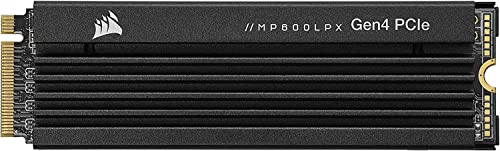
Best Value: Corsair MP600 PRO LPX 2TB
Specs
Capacity | 2 TB |
Interface | PCIe Gen4 x4 NVMe |
Form factor | M.2 2280 |
Rated sequential read | 7,100 MB/s |
Rated sequential write | 5,800 MB/s |
DRAM cache | Yes |
Heatsink | Included, low-profile aluminium |
PS5 positioning | Marketed as optimized for PS5 |
Capacity
2 TB
Interface
PCIe Gen4 x4 NVMe
Form factor
M.2 2280
Rated sequential read
7,100 MB/s
Rated sequential write
5,800 MB/s
DRAM cache
Yes
Heatsink
Included, low-profile aluminium
PS5 positioning
Marketed as optimized for PS5
What it does well
Corsair built the LPX around the console rather than adapting a desktop cooler to fit it. The aluminium plate is the thinnest stack in this group, which means the fit question is answered before you open the box. On a bay with a hard 11.25mm ceiling, that is worth more than a spec-sheet win.
7,100 MB/s rated read clears Sony's floor with room to spare, and the drive carries a DRAM cache, so it behaves properly under sustained write. Corsair sells the same drive in white, which is a real consideration if your console wears white side panels.
What you give up
Rated write of 5,800 MB/s is the slowest among the DRAM-equipped picks here. In practice that shows up as a slightly longer wait on the largest installs, not as anything you feel while playing.
The heatsink is fixed to the drive. Fine for a console, awkward for anything else, because a motherboard with its own M.2 armor will not accept it. Buyers cross-shopping the black and white versions have also flagged that the two listings publish different rated write figures, so check the one you are adding to the cart.
Who it's for
The buyer who wants the manufacturer to have already answered the fit question, and who is not planning to migrate the drive into a desktop later.
Best Premium: Samsung 990 PRO 4TB (Heatsink)

Specs
Capacity | 4 TB |
Interface | PCIe Gen4 x4 NVMe |
Form factor | M.2 2280 |
Rated sequential read | 7,450 MB/s |
Rated sequential write | 6,900 MB/s |
DRAM cache | Yes |
Heatsink | Included, slim heat spreader |
Capacity
4 TB
Interface
PCIe Gen4 x4 NVMe
Form factor
M.2 2280
Rated sequential read
7,450 MB/s
Rated sequential write
6,900 MB/s
DRAM cache
Yes
Heatsink
Included, slim heat spreader
What it does well
Four terabytes ends storage management. A stock PS5 plus this drive holds a library most players will not fill, which means no more deleting a finished game to make room for a preload.
On paper it is also the fastest drive here, rated 7,450 MB/s read and 6,900 MB/s write. The write figure is the useful one. A large install finishes before the drive exhausts its fast cache and drops into its slower steady state. Samsung's heat spreader is a slim plate rather than a tower, so height compliance is never in question.
If you want the same capacity for a desktop instead, our 4TB NVMe roundup compares the same tier without the console constraints.
What you give up
Cost per terabyte at 4TB is worse than at 2TB, and the console does nothing with this drive's speed advantage. Sony caps what the PS5 reports and draws, so the gap between 7,450 and 7,100 MB/s is a number on a box rather than a difference you experience.
The slim spreader also runs warmer than WD's finned design under back-to-back writes. In a bay with no airflow, that is a real difference rather than a rounding error. And the bare 990 PRO listing sits beside this one with an almost identical thumbnail, so confirm the title reads with Heatsink before ordering.
Who it's for
The player with a large digital library who is tired of the install and delete cycle, or someone who expects to move this drive into a desktop later where the speed gets used.
Best Budget: Crucial P310 2TB PS5 (Heatsink)

Specs
Capacity | 2 TB |
Interface | PCIe Gen4 x4 NVMe |
Form factor | M.2 2280 |
Rated sequential read | 7,100 MB/s |
Rated sequential write | 6,000 MB/s |
DRAM cache | No, Host Memory Buffer |
Heatsink | Included, flat plate |
Part number | CT2000P310SSD5-01 |
Capacity
2 TB
Interface
PCIe Gen4 x4 NVMe
Form factor
M.2 2280
Rated sequential read
7,100 MB/s
Rated sequential write
6,000 MB/s
DRAM cache
No, Host Memory Buffer
Heatsink
Included, flat plate
Part number
CT2000P310SSD5-01
What it does well
CT2000P310SSD5-01 is the PS5 bundle, which means the heatsink arrives in the box rather than as a separate line item. It is a flat plate, so the stack sits well under the ceiling with room to spare.
Rated 7,100 MB/s read and 6,000 MB/s write, it clears Sony's floor comfortably, matches the Corsair on read and beats it on paper write. At the lowest entry cost of any 2TB pick here, that is a lot of compliant capacity.
What you give up
This is a DRAM-less drive. It leans on Host Memory Buffer, which borrows a slice of system memory to hold its mapping tables, and the PS5 does not provide it. On a desktop that compromise is mild. In this bay, sustained writes drop off harder than on any other pick on this page, which you feel during a large install and not while playing.
The flat plate also runs hotter than a finned design during back-to-back installs, according to buyer reports. And the non-PS5 P310 listing, part number CT2000P310SSD801, is the same drive without a heatsink and is frequently the cheaper search result. Read the part number.
Who it's for
The buyer adding capacity for a library that gets installed once and played for months. If you rotate a dozen large games a season, spend up to a DRAM-equipped pick instead.
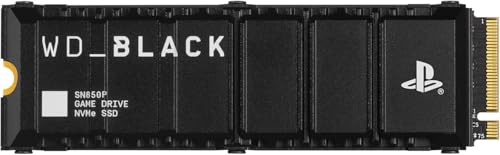
Editor's Pick: WD_BLACK SN850P 2TB (PS5 Licensed)
Specs
Capacity | 2 TB |
Interface | PCIe Gen4 x4 NVMe |
Form factor | M.2 2280 |
Rated sequential read | 7,300 MB/s |
DRAM cache | Yes |
Heatsink | Included, Sony-licensed design |
Licensing | Officially licensed for PS5 |
Part number | WDBBYV0020BNC-WRSN |
Capacity
2 TB
Interface
PCIe Gen4 x4 NVMe
Form factor
M.2 2280
Rated sequential read
7,300 MB/s
DRAM cache
Yes
Heatsink
Included, Sony-licensed design
Licensing
Officially licensed for PS5
Part number
WDBBYV0020BNC-WRSN
What it does well
This is the only drive here Sony has validated directly. The licence means the heatsink geometry and the 7,300 MB/s read rating were checked against Sony's own requirements rather than inferred from a support page. For a buyer who does not want to audit a spec sheet, that is the whole value.
Underneath it is the same DRAM-equipped WD platform as the SN850X, so the performance story is identical. The packaging matches the console, which is not a technical argument but is a real one when the drive is a gift.
What you give up
You pay a licensing premium for a drive that performs the same as the SN850X heatsink model. Cross-shoppers routinely find the SN850X cheaper for equivalent hardware, and nothing about the licence makes the drive faster.
The licensed cooler is also taller than the Corsair plate. It stays inside the ceiling, so this is not a fit problem, but it is not the pick if your bay has ever felt tight. And SN850P versus SN850X is one letter of difference across near-identical marketing, so read the part number before you order.
Who it's for
The buyer who wants a decision they will never second-guess, or anyone buying the drive for someone else who would rather see PlayStation on the box than a spec table.
Why Gen5 is wasted on a PS5
The PS5's storage controller is PCIe Gen4. A Gen5 drive dropped into that bay negotiates down to Gen4 speeds and delivers exactly what a good Gen4 drive delivers, at a higher price, with more heat to shed in an enclosure that has no airflow to give.
Gen5 drives also arrive with the tall coolers they need, which is precisely the class of heatsink Sony's 11.25mm ceiling rules out. The ones that ship bare leave you hunting for a low-profile cooler that can handle a drive which runs hot in a bay that traps heat.
The Gen5 question for gaming is already marginal on a desktop. On a console with a Gen4 bus, it is settled.
The same drive is a different buy for your PC
If you build PCs as well, this ranking is not the one you would use for a tower. Two things change. Your motherboard almost certainly supplies its own M.2 heatsink, which makes a bundled cooler redundant and sometimes an obstacle. And your PC does provide Host Memory Buffer, which removes most of the penalty that pushes DRAM-less drives down this page. Consoles diverge as well. A Switch 2 takes no M.2 drive at all, and it refuses standard microSD cards for game storage, so the best microSD Express cards for Switch 2 are the only storage upgrade that machine will accept.
That flips the value order. On a desktop the bare version of a drive is usually the better buy, and a good HMB drive is genuinely competitive on cost per terabyte. Our NVMe picks for gaming PCs reflects that reality rather than this one.
Handhelds change the shape again, since most take 2230 sticks and care about power draw more than sequential read, which is a separate list. And if you are kitting out the console rather than the rig, a PS5 headset is the other upgrade worth the money.
Bottom line
Buy the WD_BLACK SN850X 2TB heatsink model if you want one drive that settles PS5 storage. Buy the Corsair MP600 PRO LPX if your bay feels tight and you want the thinnest possible stack. Buy the Samsung 990 PRO 4TB if you are done managing storage. If cost is the constraint and your library is static, the Crucial P310 is compliant and cheap, with an honest DRAM caveat attached. If you would rather have Sony's sign-off than the better price, take the SN850P.
FAQ
Does a PS5 SSD need a heatsink?
Yes. Sony requires a cooling structure rather than suggesting one. The M.2 bay sits under a metal cover with no airflow of its own, and a Gen4 drive under sustained write load will throttle in there without help. The simplest route is a drive that ships with cooling already attached, which is what every pick here does. If you buy a bare drive you have to add a cooler that keeps the total stack under 11.25mm, and most aftermarket towers do not.
What read speed does an SSD need for the PS5?
Sony's requirement is 5,500 MB/s of rated sequential read or better. Treat it as a floor rather than a target. Every drive on this page rates between 7,100 and 7,450 MB/s, and the console will not turn that headroom into anything you notice. The PS5 caps what it draws from the drive for thermal reasons, so results from its built-in speed test cluster in a narrow band no matter which of these you install. Buy for capacity and cooling, not for the number on the box.
Can you put any M.2 SSD in a PS5?
No. The drive has to be NVMe on a PCIe Gen4 or faster interface, in one of the accepted M.2 lengths, rated at 5,500 MB/s read or better, and it has to fit inside the height limit with its cooling attached. SATA M.2 drives are rejected outright and no adapter changes that. In practice, 2280 with a bundled low-profile heatsink is the shape you want, because that is where the drives with real DRAM caches live.
Is a 4TB SSD worth it for the PS5?
It depends on how you play. Four terabytes ends storage management, which is worth real money if you keep a large library installed and hate deleting finished games to make room for preloads. Cost per terabyte is worse at that tier though, so if you play a handful of titles at a time, 2TB does the same job for less. The Samsung 990 PRO 4TB is the pick if you want the capacity. Otherwise the 2TB drives here cover most libraries.
Does a PCIe 5.0 SSD work in a PS5?
It will run, and it will run at Gen4 speeds, because the console's storage controller is Gen4. You gain nothing and pay more. Gen5 drives also tend to need taller cooling than Sony's 11.25mm ceiling allows, so the ones that ship with their own heatsinks are often disqualified on height alone. Stick with a Gen4 drive that already meets the read requirement and comes with a low-profile cooler in the box.
Do you have to format an SSD after installing it in a PS5?
Yes, and the console handles it. Once the drive is installed and the cover is back on, the PS5 prompts you to format the expansion storage on the next boot. That wipes anything already on the drive, so move data off first if you are reusing a stick from a desktop. After formatting finishes you can choose which games install to the new drive and move existing ones across from the storage settings menu.
Related Articles

Best NVMe SSD for Gaming in 2026: PCIe 4.0 Sweet Spot
The best PCIe 4.0 NVMe SSDs for gaming in 2026, ranked by capacity and budget. Five picks plus why a fast Gen4 drive beats Gen5 for most gaming builds.
Jun 28, 2026

Best 4TB NVMe SSDs for Gaming (2026): 5 Picks, Gen4 First
The best 4TB NVMe SSDs for gaming in 2026: five picks that hold a full library. Why a fast Gen4 loads games quicker than any Gen5 drive at this capacity.
Aug 20, 2026

Best PCIe 5.0 SSD Heatsinks (2026): Five Picks for Gen5 Thermal Reality
PCIe 5.0 SSDs throttle hard without proper cooling. Five heatsink picks across passive and active tiers, plus the honest answer to whether your motherboard's built-in is enough.
May 14, 2026

How to Choose RAM and Storage
A builder's framework for RAM and storage: match the platform, buy capacity over speed, and put your money in the right SSD tier.
Jun 29, 2026

Best Headset for PS5 2026: Cross-Platform Picks That Also Work on PC
The best PS5 headsets that also work on PC — wired, wireless, and planar. Honest picks including which ones actually support Tempest 3D.
Jun 5, 2026