Affiliate Disclosure: As an Amazon Associate we earn from qualifying purchases. Some links may earn us a commission at no cost to you.

Is 750W Enough for a 5070 Ti, or Do You Need 850W? (2026)
Yes, 750 watts is enough for an RTX 5070 Ti. A stock card behind a Ryzen 7 or Core Ultra 7 class CPU lands around 450 watts of continuous system draw, which puts a quality 750W unit near 60 percent load with room left over for the card's transient spikes.
The 850W question is not really about the graphics card. You buy the extra 100 watts when the CPU is a 16-core part, when the card is overclocked behind a 360mm AIO and a full fan set, or when a 5080-class upgrade is already on the calendar. What follows is the arithmetic behind that call.
At a glance
Pick | Wattage tier | Best for | Buy |
|---|---|---|---|
750W ATX 3.1 | Stock 5070 Ti on a Ryzen 7 or Core Ultra 7 | ||
750W ATX 3.1 | Same tier for less money | ||
850W ATX 3.1 | 16-core CPUs, overclocks, upgrade path |
- Wattage tier
750W ATX 3.1
- Best for
Stock 5070 Ti on a Ryzen 7 or Core Ultra 7
- Buy
- Wattage tier
750W ATX 3.1
- Best for
Same tier for less money
- Buy
- Wattage tier
850W ATX 3.1
- Best for
16-core CPUs, overclocks, upgrade path
- Buy
All three are ATX 3.1 units with a native 12V-2x6 cable, because that pair of specs is what separates a power supply suited to this card from one that merely has the right number printed on the side. Choosing between them is a choice about headroom, and about how much you want to pay to stop thinking about it.
Where 750W holds and where 850W wins
Your build | Verdict | Why | Winner |
|---|---|---|---|
Stock 5070 Ti, Ryzen 7 9800X3D or Core Ultra 7 265K | 750W is enough | Around 450 to 470 watts continuous, close to 60 percent load | |
5070 Ti with a Ryzen 9 9950X or Core Ultra 9 285K | Go 850W | All-core CPU spikes stack on top of the GPU's transients | |
Overclocked 5070 Ti, 360mm AIO, six or more fans | Go 850W | A raised power limit, a pump and a full fan set add up quietly | |
A 5080-class upgrade planned inside two years | Go 850W | Buying the power supply twice costs more than buying it once | |
Reusing an ATX 2.x 750W unit older than five years | Replace it | Rated watts are not the spec that matters on that platform |
Stock 5070 Ti, Ryzen 7 9800X3D or Core Ultra 7 265K
- Verdict
750W is enough
- Why
Around 450 to 470 watts continuous, close to 60 percent load
- Winner
5070 Ti with a Ryzen 9 9950X or Core Ultra 9 285K
- Verdict
Go 850W
- Why
All-core CPU spikes stack on top of the GPU's transients
- Winner
Overclocked 5070 Ti, 360mm AIO, six or more fans
- Verdict
Go 850W
- Why
A raised power limit, a pump and a full fan set add up quietly
- Winner
A 5080-class upgrade planned inside two years
- Verdict
Go 850W
- Why
Buying the power supply twice costs more than buying it once
- Winner
Reusing an ATX 2.x 750W unit older than five years
- Verdict
Replace it
- Why
Rated watts are not the spec that matters on that platform
- Winner
The 60 percent figure is not superstition. A power supply's efficiency curve peaks somewhere between 40 and 60 percent load, the fan stays slower in that band, and the capacitors run cooler, which is most of what decides whether the unit is still healthy in year seven. Sizing so the continuous load lands there is why a 750W unit is the right answer for a machine that only ever draws 450 watts.
Sizing the power supply is one leg of a three-part decision. The PSU, cooler, and case guide covers how the other two constrain it, and the short version is that the case decides the cable run and the cooler decides how much of the CPU's ceiling you will ever see.
What an RTX 5070 Ti actually pulls
Measured graphics card power only, not total system draw.
- Idle desktop22 W
- 1440p gaming average280 W
- Sustained stress load (rated TGP)300 W
- 20 millisecond transient peak (OC card)355 W
Estimates built from component figures, not a single wall measurement.
- RTX 5070 Ti and Ryzen 7 9800X3D450 W
- RTX 5070 Ti and Core Ultra 7 265K470 W
- RTX 5070 Ti and Ryzen 9 9950X520 W
NVIDIA rates the 5070 Ti at 300 watts of board power. Reviewer measurements put a real 1440p gaming average closer to 280, with idle desktop draw around 22. Neither of those is the number that decides a power supply purchase.
The transient is. Hardware Busters captured 20 millisecond excursions to roughly 355 watts on an overclocked partner card, well above the rated board power. Spikes that short never register on a wall meter. They are long enough to trip over-power protection on a unit that was not built to ride them out, which is the entire reason ATX 3.1 exists as a standard: it writes excursion tolerance into the spec instead of leaving it to whichever vendor built the platform.
Stack the rest of the build on top and a 5070 Ti system settles into the 450 to 520 watt range under load, with the CPU doing most of the moving. A 750W unit covers that with about a third of its capacity in reserve, which is where the full wattage framework says you want to sit.
The 750W pick: Corsair RM750x 750W

Specs
Wattage | 750W continuous |
Standard | ATX 3.1, PCIe 5.1 |
Efficiency | Cybenetics Gold |
GPU connector | Native 12V-2x6, 600W |
Cooling | 140mm FDB fan, zero-RPM mode |
Capacitors | 105C Japanese electrolytic |
Modularity | Fully modular |
Warranty | 10 years |
Wattage
750W continuous
Standard
ATX 3.1, PCIe 5.1
Efficiency
Cybenetics Gold
GPU connector
Native 12V-2x6, 600W
Cooling
140mm FDB fan, zero-RPM mode
Capacitors
105C Japanese electrolytic
Modularity
Fully modular
Warranty
10 years
What it does well
The RM750x ships with a native 12V-2x6 cable, so the adapter that became the story of the last GPU generation never enters the build. One cable, one connector, seated once, and nothing in the middle to work loose behind a side panel you will not open again for two years.
It carries the ATX 3.1 label honestly. The excursion tolerance written into that standard is scoped around cards behaving the way this one behaves, and the CWT-built RMx platform has the margin to absorb a 355 watt spike without the protection circuit reading it as a fault. That is the whole job.
The 140mm fluid dynamic bearing fan holds zero-RPM mode through most of a gaming session at this load, and the warranty runs ten years. The wider 750W shortlist has cheaper entries on it, and none of them change the answer for this card.
What you give up
It is not the cheapest route to 750 watts, and it sits in the same bracket as 850W units built on weaker platforms. That trade reads badly on a spec sheet and reads correctly in a build, but a buyer comparing two numbers in a listing grid will feel it.
There is no headroom story past a stock 5070 Ti. Drop in a 16-core CPU or a larger card and the margin you paid for is spent. This unit answers one question well and does not answer the next one.
Who it's for
A stock or lightly boosted 5070 Ti, a Ryzen 7 or Core Ultra 7 class chip, air cooling or a 240mm AIO. Buy it once and stop thinking about the power supply.
The value 750W pick: be quiet! Pure Power 13 M 750W

Specs
Wattage | 750W continuous |
Standard | ATX 3.1, PCIe 5.1 |
Efficiency | 80 Plus Gold, up to 94.3 percent |
GPU connector | Native 12V-2x6, 600W |
Cooling | 120mm fan, semi-passive zero-RPM |
Rail layout | Single 12V rail |
Modularity | Fully modular |
Warranty | 10 years |
Wattage
750W continuous
Standard
ATX 3.1, PCIe 5.1
Efficiency
80 Plus Gold, up to 94.3 percent
GPU connector
Native 12V-2x6, 600W
Cooling
120mm fan, semi-passive zero-RPM
Rail layout
Single 12V rail
Modularity
Fully modular
Warranty
10 years
What it does well
Same tier, less money, and none of the corners you would expect a cheaper unit to cut. ATX 3.1, PCIe 5.1, a native 12V-2x6 cable rated to 600 watts, fully modular cabling.
Cybenetics scored the series Platinum for efficiency with a top noise grade, which is the measurement that counts for a unit sitting under a gaming load for hours at a stretch. Semi-passive cooling keeps the fan off entirely at desktop load, so the machine is silent when the reader is not gaming.
A single 12V rail means no rail-balancing surprises when the CPU and the GPU spike in the same millisecond, which on a multi-rail unit is where the odd unexplained shutdown comes from. The warranty matches the Corsair at ten years.
The efficiency badge is worth reading carefully. 80 Plus Gold is what the box claims; Cybenetics measured this platform at Platinum with a top noise grade, and Cybenetics tests at the temperatures a real case reaches rather than a bench-friendly 23 degrees. When the two labels disagree, the Cybenetics one is describing the unit you will own.
What you give up
The 120mm fan has less surface area than the Corsair's 140mm, so it spins up earlier once the build settles into a sustained load. Audible rather than loud, and the difference is real.
be quiet!'s cable set is stiffer than Corsair's embossed cables. In a compact case with a bottom-mounted PSU and a shroud cutout in an awkward place, that turns into an hour of the build you did not plan for.
Who it's for
Anyone who wants the 750W tier done properly and would rather put the difference into the graphics card or the monitor. That is usually the right call.
The step-up: Corsair RM850x 850W
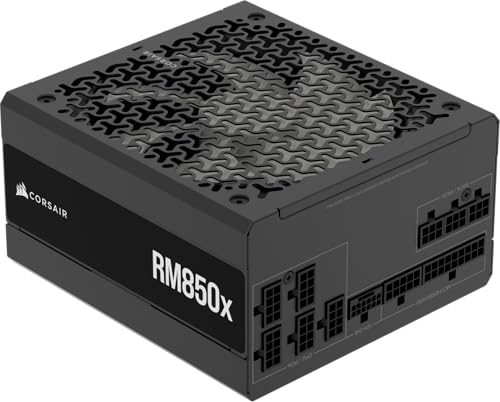
Specs
Wattage | 850W continuous |
Standard | ATX 3.1, PCIe 5.1 |
Efficiency | Cybenetics Gold |
GPU connector | Native 12V-2x6, 600W |
Cooling | 140mm FDB fan, zero-RPM mode |
Capacitors | 105C Japanese electrolytic |
Modularity | Fully modular |
Warranty | 10 years |
Wattage
850W continuous
Standard
ATX 3.1, PCIe 5.1
Efficiency
Cybenetics Gold
GPU connector
Native 12V-2x6, 600W
Cooling
140mm FDB fan, zero-RPM mode
Capacitors
105C Japanese electrolytic
Modularity
Fully modular
Warranty
10 years
What it does well
It is the RM750x with a higher ceiling. Same platform, same fan, same connector, same ten-year warranty, 100 more watts on the 12V rail. Nothing about the buying decision changes except how much room is left at the top.
Spreading the same load across more capacity keeps the fan in zero-RPM mode across a wider slice of the curve, so the unit is quieter doing an identical job. A 450 watt build on an 850W platform barely wakes it up.
The upgrade path is the actual purchase here. A 5080-class card lands in the range the 850W shortlist is built around, and buying the power supply once beats buying it twice by a wide margin.
One thing the extra capacity does not buy is a different connector story. Both units ship the same native 12V-2x6 cable rated to 600 watts, so a 5080 or a 5090 would plug into either one identically. What changes is whether the platform behind that cable has room for what the bigger card asks of it.
What you give up
Money, for headroom a stock 5070 Ti build will never reach. If the CPU is a Ryzen 7 and the card runs at stock, that extra capacity sits unused for the life of the machine.
A 750W-tier load on an 850W unit runs slightly below the efficiency curve's sweet spot. It is a rounding error on a power bill rather than a reason to avoid the unit, and it is still true.
Who it's for
Owners of 16-core CPUs, anyone raising the card's power limit, builds carrying a 360mm AIO plus a full fan set, and readers who already know a bigger graphics card is coming.
When 850W is the right buy
The CPU decides this more often than the graphics card does. A 9800X3D holds near 120 watts under a gaming load, one of the lower figures in its class. A 9950X or a Core Ultra 9 285K under an all-core spike is a different animal, and it spikes on the same rail in the same instant the GPU does. CPU pairings for the 5070 Ti is where that split gets drawn.
Overclocking counts, though not for the reason most people assume. Raising the card's power limit moves the ceiling rather than the average, and the ceiling is what the protection circuit watches. Add a pump, six fans and a second NVMe drive and the continuous figure creeps up too.
The upgrade path is the honest argument. If a 5080 or better is already the plan, an 850W unit today costs less than a 750W unit today plus an 850W unit in eighteen months. Readers who want the ceiling raised further than that can look at the 1000W picks for this card.
One case does not fit the pattern: an existing 750W unit that predates ATX 3.0. Rated watts are not the spec that matters there. A five-year-old 750W platform driving a 12VHPWR adapter has thin transient margins and an extra connection in the path, and replacing it with a 750W ATX 3.1 unit is a bigger upgrade than moving to 850 watts on the old standard.
Bottom line
If your 5070 Ti runs at stock behind a Ryzen 7 or Core Ultra 7, buy the Corsair RM750x 750W and move on. If you want the same tier for less, the be quiet! Pure Power 13 M 750W is the same answer with a smaller fan. If the CPU is a 16-core part, the card is overclocked, or a 5080 is already on the list, buy the Corsair RM850x 850W. If you already own a 750W unit, read the standard on the label before you read the wattage. And if you are one tier down the stack, the same question for the RTX 5070 has its own answer.
FAQ
What PSU wattage does the RTX 5070 Ti need?
NVIDIA's official guidance is 750 watts, and that number holds for a normal build. A stock 5070 Ti paired with a Ryzen 7 or Core Ultra 7 class CPU pulls roughly 450 to 470 watts of continuous system power, so a quality 750W unit runs near 60 percent load. Wattage alone is not the whole spec, though. A 750W ATX 3.1 unit from a Tier A manufacturer is a better power supply for this card than a budget 850W unit built to the older standard.
How much power does an RTX 5070 Ti draw under load?
Board power sits around 280 watts as a 1440p gaming average, against a rated 300 watt TGP, and idle desktop draw is roughly 22 watts. The figure that matters for a power supply is the transient. Reviewer captures show 20 millisecond excursions to about 355 watts on overclocked partner cards. Those spikes never appear on a wall meter, and they are exactly what a power supply's over-power protection reacts to when the platform was not built to absorb them.
Does the RTX 5070 Ti need an ATX 3.1 or 12V-2x6 power supply?
It does not strictly require one, and you should buy one anyway. The card takes a 12V-2x6 input, and an older unit drives it through a four-way adapter cable that adds connections where you want none. A native cable removes that. The ATX 3.1 part matters more: the standard writes transient excursion tolerance into the spec, which is the behaviour this card shows every time a demanding scene loads.
Will a 750W PSU shut down or trip with an RTX 5070 Ti?
Not on a decent unit. A shutdown under load means the over-power protection saw a spike it read as a fault, which happens on power supplies with thin transient margins, usually older ATX 2.x units or budget platforms. A 750W ATX 3.1 unit from a Tier A manufacturer has the margin to absorb a 355 watt excursion without reacting. If an existing 750W unit does trip with this card, the unit is the problem rather than the wattage.
Is 750W enough for an RTX 5070 Ti and a 9800X3D?
Yes, comfortably. The 9800X3D holds near 120 watts under a gaming load, one of the lower figures in its class, and the pairing lands around 450 watts of continuous system draw. That leaves roughly 300 watts of headroom on a 750W unit, more than enough for the card's transient spikes plus fans, drives and a pump. Step up to 850 watts only if a larger graphics card is already planned.
Related Articles

Is 650W Enough for an RTX 5070, or Do You Need 750W? (2026)
Is a 650W PSU enough for an RTX 5070? Yes on a quality ATX 3.1 unit with a mainstream CPU. Here is the headroom math, the connector trap, and the picks.
Aug 14, 2026

Best 750W PSUs for RTX 5070 Builds: 5 ATX 3.1 Picks (2026)
Best 750W PSU for an RTX 5070 build? These 5 ATX 3.1 picks skip the 850W upsell and still handle the card's transient spikes without tripping protection.
Sep 8, 2026

Best 1000W PSU for RTX 5070 Ti (2026): 750W Is the Floor
The best 1000W PSU for an RTX 5070 Ti absorbs the CPU spikes a 750W unit rides at its limit. Five ATX 3.1 native 12V-2x6 picks, and when 850W is enough.
Aug 25, 2026

How Much PSU Wattage for a Gaming PC? 9 GPU Tiers (2026)
How much PSU wattage do you need? Sized floors for 9 GeForce and Radeon tiers, why 850W is usually overkill for gaming, and an ATX 3.1 pick at each tier.
Sep 22, 2026

Best CPUs for the RTX 5070 Ti (2026): 5 Picks by Tier
The best CPU for an RTX 5070 Ti depends on your resolution. Five picks from budget AM5 to 16-core flagship, plus the bottleneck math for 1080p, 1440p and 4K.
Aug 11, 2026