Affiliate Disclosure: As an Amazon Associate we earn from qualifying purchases. Some links may earn us a commission at no cost to you.

Is 650W Enough for an RTX 5070, or Do You Need 750W? (2026)
Yes. A 650W PSU is enough for an RTX 5070, and it is not a close call. The card's board power sits at 250W, and a mainstream gaming CPU next to it puts a typical build near half of a 650W budget. Half load is where a good unit is quietest and most efficient, not where it starts to struggle.
What decides whether that build is stable is the supply itself: whether it carries a native 12V-2x6 cable, and how it rides out the millisecond current spikes a Blackwell card throws. Shop the badge and the cable, not the number on the box.
At a glance
Tier | Power supply | Standard | Best for | Buy |
|---|---|---|---|---|
650W | ATX 3.1, native 12V-2x6 | An RTX 5070 with a Ryzen 5 or 7, or a Core Ultra 5 or 7 | ||
750W | ATX 3.1, native 12V-2x6 | Heavy CPU pairings, or a planned 5070 Ti or 5080 upgrade |
650W
- Power supply
- Standard
ATX 3.1, native 12V-2x6
- Best for
An RTX 5070 with a Ryzen 5 or 7, or a Core Ultra 5 or 7
- Buy
750W
- Power supply
- Standard
ATX 3.1, native 12V-2x6
- Best for
Heavy CPU pairings, or a planned 5070 Ti or 5080 upgrade
- Buy
Verdict by build: is 650W enough for an RTX 5070?
Your build | Is 650W enough? | Why | Winner |
|---|---|---|---|
RTX 5070 with a Ryzen 5 or Core Ultra 5, one or two drives | Yes, comfortably | The whole system sits near half load on a 650W unit | |
RTX 5070 with a Ryzen 7 9800X3D, air cooled | Yes | X3D chips draw less in games than their TDP suggests | |
RTX 5070 with a Ryzen 9 9950X3D or Core Ultra 9 285K | Tight, step up | Sustained CPU draw eats the margin you were counting on | |
RTX 5070 now, a 5070 Ti or 5080 inside two years | No, buy for the upgrade | The next tier up moves the goalposts by 50W to 110W | |
RTX 5070 in an ITX or small-form-factor case | Yes on capacity, no on selection | A 650W SFX unit with a native 12V-2x6 cable barely exists | |
An existing ATX 2.x 650W unit and the bundled 8-pin adapter | It works, but replace it | The adapter is the weak link, not the wattage |
RTX 5070 with a Ryzen 5 or Core Ultra 5, one or two drives
- Is 650W enough?
Yes, comfortably
- Why
The whole system sits near half load on a 650W unit
- Winner
RTX 5070 with a Ryzen 7 9800X3D, air cooled
- Is 650W enough?
Yes
- Why
X3D chips draw less in games than their TDP suggests
- Winner
RTX 5070 with a Ryzen 9 9950X3D or Core Ultra 9 285K
- Is 650W enough?
Tight, step up
- Why
Sustained CPU draw eats the margin you were counting on
- Winner
RTX 5070 now, a 5070 Ti or 5080 inside two years
- Is 650W enough?
No, buy for the upgrade
- Why
The next tier up moves the goalposts by 50W to 110W
- Winner
RTX 5070 in an ITX or small-form-factor case
- Is 650W enough?
Yes on capacity, no on selection
- Why
A 650W SFX unit with a native 12V-2x6 cable barely exists
- Winner
An existing ATX 2.x 650W unit and the bundled 8-pin adapter
- Is 650W enough?
It works, but replace it
- Why
The adapter is the weak link, not the wattage
- Winner
Four of those six rows say yes, and the two that say no have nothing to do with the 5070. One is a CPU that pulls real sustained power in games, the other is a graphics card you have not bought yet. If neither applies, the wattage question is already answered and the rest of this article is about which 650W unit to buy.
The last row is where most people already are. A working 650W supply from 2021 will run an RTX 5070 today. It will do it through the four-headed adapter that came in the GPU box, which is the part worth getting rid of. We covered the same question from the AMD side in our look at whether 650W is enough for an RX 9070 XT, and the answer there was tighter because that card pulls more.
How we sized it: RTX 5070 power draw
Computed from the RTX 5070's measured gaming board power plus typical in-game CPU package power plus platform overhead for board, memory, storage, and fans.
- RTX 5070 with Ryzen 5 7600340 watts
- RTX 5070 with Ryzen 7 9800X3D355 watts
- RTX 5070 with Core Ultra 7 265K385 watts
- RTX 5070 with Ryzen 9 9950X3D410 watts
Published total graphics power for the 5070 and for the cards a 5070 owner is most likely to upgrade into.
- RTX 5070250 watts
- RTX 5070 Ti300 watts
- RX 9070 XT304 watts
- RTX 5080360 watts
The first table is the one that settles the argument. Even the worst pairing in it lands around 410W of sustained load, which is 63 percent of a 650W unit. The efficiency curve on a Gold-rated supply peaks somewhere near 50 percent load and stays flat well past that, so none of these builds is asking the supply to do anything uncomfortable.
The second table explains the step-up case. Moving from a 5070 to a 5070 Ti adds 50W of board power, and a 5080 adds 110W. Buy the 650W unit and that upgrade means buying a second power supply. If you are weighing those two cards anyway, our RTX 5070 versus 5070 Ti comparison covers what the extra money buys in frames.
Transient spikes are the other half of the sizing question, and they are the reason wattage alone is a bad proxy. A Blackwell card can pull several hundred watts above its sustained draw for windows measured in milliseconds. A supply either rides those out or trips its protection and reboots the machine mid-game.
ATX 3.1 versus ATX 3.0: the badge that decides this
Here is the part most wattage calculators skip. ATX 3.0 and ATX 3.1 specify the same power excursion envelope: 200 percent of rated output for 100 microseconds across the whole supply, and 300 percent at the GPU connector. An ATX 3.1 sticker does not buy you more spike tolerance than a good ATX 3.0 unit already had.
What ATX 3.1 changed is physical. The 12V-2x6 connector shortens the four sense pins so a plug that is not fully seated reports itself instead of quietly running full current through a partial contact patch. That seating failure is what sat behind the melted connector stories, and it is a mechanical problem rather than a wattage problem. No amount of extra headroom fixes a plug that is half in.
The practical consequence for a 650W buyer is simple. The three-way or four-way 8-pin adapter in the GPU box is the component to design out. It adds two connection points and a fan of stiff cable that fights the side panel. A supply with a native single-cable 12V-2x6 run removes both. That single feature, not the wattage, is why a new 650W unit beats a working old one.
If you already own a high-quality ATX 3.0 supply with a native 12VHPWR cable, you are not disqualified and you do not need to replace anything. Our guide to picking a power supply walks through how to tell a good platform from a rebadge, and if you would rather avoid the question entirely, there is a shortlist of GPUs that drop into an existing supply without any of this.
The 650W that clears it: Corsair RM650e ATX 3.1
This is the cheapest honest route to a native 12V-2x6 cable under a 250W card, which is the actual shopping criterion once you accept that 650W is enough.

Specs
Rated output | 650W continuous |
Standard | ATX 3.1, PCIe 5.1 |
Efficiency | Cybenetics Gold |
GPU connector | One native 12V-2x6, rated 600W |
Cabling | Fully modular |
Capacitors | 105C rated |
Warranty | 7 years |
Rated output
650W continuous
Standard
ATX 3.1, PCIe 5.1
Efficiency
Cybenetics Gold
GPU connector
One native 12V-2x6, rated 600W
Cabling
Fully modular
Capacitors
105C rated
Warranty
7 years
What it does well
The 12V-2x6 cable ships in the box. An RTX 5070 plugs in with one run of cable and no adapter fan behind the card, which matters more in a mid-tower than the spec sheet suggests once the side panel has to close.
Load sits around 45 to 55 percent on a 5070 build with a mainstream CPU. That is the flat part of the efficiency curve and the quiet part of the fan curve. The unit spends a gaming session doing easy work.
Modern Standby support is a small thing that shows up daily. The supply behaves across sleep and wake cycles instead of tripping the machine into a cold boot.
What you give up
The e line is not the x line. Corsair's RMx sits above it on platform, warranty, and ripple margin, and if this were a 5080 build we would tell you to go get one. Under a 250W card the gap is theoretical, but it is real and worth naming.
The fan does not idle fully stopped the way the RMx does, so a build tuned for silence will hear it under sustained load. Buyers have also flagged that Corsair has shipped several RM650e revisions, and only the ATX 3.1 and PCIe 5.1 listing carries the native 12V-2x6 cable. Older stock is 8-pin only.
Who it's for
Anyone building or rebuilding around an RTX 5070 with a Ryzen 5, Ryzen 7, Core Ultra 5, or Core Ultra 7 who wants the correct connector without paying for headroom they will never touch.
When to step up to 750W: Seasonic Focus GX-750
The step-up is not a 5070 decision. It is a decision about the CPU sitting next to it and the graphics card that eventually replaces it. The same CPU-class rule decides the answer one generation back, where whether 550W is enough for an RTX 4070 Super turns on the processor beside it.
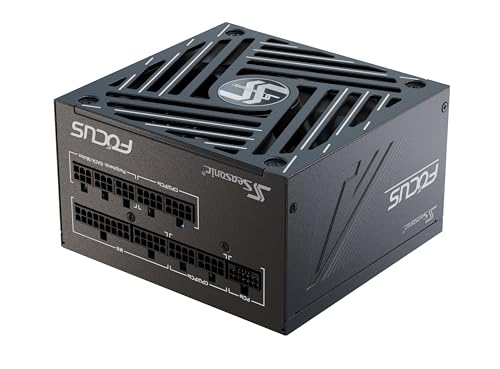
Specs
Rated output | 750W continuous |
Standard | ATX 3.1, PCIe 5.1 |
Efficiency | 80 Plus Gold |
GPU connector | One native 12V-2x6, rated 600W |
Cabling | Fully modular |
Fan | 120mm fluid dynamic bearing, hybrid mode |
Warranty | 10 years |
Rated output
750W continuous
Standard
ATX 3.1, PCIe 5.1
Efficiency
80 Plus Gold
GPU connector
One native 12V-2x6, rated 600W
Cabling
Fully modular
Fan
120mm fluid dynamic bearing, hybrid mode
Warranty
10 years
What it does well
Seasonic builds its own platforms. That removes the guessing game where a brand name spans three OEMs and the model number is the only clue which one you are holding.
Ten years of warranty is the longest cover in this bracket, and a power supply is the one component where that matters, because when it fails it can take other parts with it.
Hybrid fan mode keeps the fan stopped through most of a 5070 gaming session, because the load never reaches the threshold that spins it up. The headroom buys silence before it buys anything else.
What you give up
You are paying for capacity the 5070 will never ask for, and a lightly loaded 750W unit is not meaningfully more efficient than a properly loaded 650W one. The extra spend only earns its keep if the upgrade path or the CPU pairing is real rather than hypothetical.
Reports suggest the model naming trips people up: Seasonic sells a CORE GX-750 next to this Focus GX-750 at a similar price, and CORE is the cheaper platform. Read the model string, not the number. The same tier logic one step up is covered in our look at whether 750W is enough for an RTX 5080.
Who it's for
Builders pairing a 5070 with a 16-core X3D chip or a Core Ultra 9, anyone who expects to drop a 5070 Ti or 5080 into the same case within two years, and anyone running several drives behind a full wall of fans. If that describes your build, the 750W picks for RTX 5070 builds cover the full shortlist at that tier, from the Seasonic Vertex GX-750 down to the budget MSI MAG A750GL.
The ITX answer: Corsair SF750 SFX Platinum
The 5070 is the natural small-form-factor graphics card of this generation, and SFX buyers do not get to shop the 650W bracket sensibly, so the sufficiency question changes shape.

Specs
Rated output | 750W continuous |
Form factor | SFX, ATX bracket included |
Standard | ATX 3.1, PCIe 5.1 |
Efficiency | 80 Plus Platinum |
GPU connector | One native 12V-2x6, rated 600W |
Cabling | Fully modular |
Warranty | 7 years |
Rated output
750W continuous
Form factor
SFX, ATX bracket included
Standard
ATX 3.1, PCIe 5.1
Efficiency
80 Plus Platinum
GPU connector
One native 12V-2x6, rated 600W
Cabling
Fully modular
Warranty
7 years
What it does well
It puts a full 750W and a native 12V-2x6 cable into a box 100mm deep. That is what makes a 5070 ITX build work at all, because an adapter fan has nowhere to go in a case that measures its spare volume in millimetres.
Platinum efficiency is not a vanity number here. Less waste heat inside a chassis with no room to move air is a thermal win for every other component in the box.
What you give up
The 92mm fan is audible under sustained load in a way no 120mm ATX unit is, and it does not idle silent. Small-form-factor builds trade noise for volume, and this is where most of that trade gets paid.
Cost per watt runs roughly double the ATX equivalents, and the cables are short by design. That is correct for ITX and awkward the day the included bracket puts it in a mid-tower. Buyers have flagged that 650W SFX units with the right connector are thin on the ground, which is why the practical SFF answer skips straight to 750W.
Who it's for
Anyone putting a 5070 into an ITX or small-form-factor case where SFX is the only option, and anyone who wants that build to keep an upgrade path once it is sealed up.
Bottom line
If you are building an RTX 5070 rig with a Ryzen 5, Ryzen 7, or Core Ultra 5 or 7, buy the Corsair RM650e ATX 3.1 and stop thinking about wattage. If you are pairing it with a 9950X3D or a 285K, or a 5070 Ti is already on your list, buy the Seasonic Focus GX-750 instead. If the build is ITX, the Corsair SF750 is the only sensible shape. And if you already own a good 650W unit, the thing to replace is the adapter, not the supply. One tier down, the same question for a 550W supply and an RTX 5060 Ti lands on a yes for mainstream chips and a no for the 250W Intel parts.
The wider version of this reasoning, across cooling and case sizing as well as power, lives in our power, cooling, and case guide. A tier down, the same math is worked out for the RTX 5060 Ti.
FAQ
What PSU wattage does the RTX 5070 need?
NVIDIA lists 650W as the recommended system power for the RTX 5070, and that number holds up. The card is rated at 250W of board power and averages closer to 225W in games. Add a mainstream gaming CPU and the rest of a normal build and you land between 340W and 410W of sustained draw, which sits comfortably inside a 650W budget. Go to 750W only if the CPU is a 16-core X3D or a Core Ultra 9, or if a bigger graphics card is already in the plan.
Does the RTX 5070 need an ATX 3.1 PSU or a 12V-2x6 cable?
It does not need one, but you want one. ATX 3.0 and ATX 3.1 specify the same spike tolerance, so the badge itself buys nothing extra. The 12V-2x6 cable is the real prize: a single native run from the supply to the card, with shortened sense pins that catch a plug which is not fully seated. That removes the bundled adapter and the two extra connection points it introduces, which is where connector trouble starts.
Will a 650W PSU bottleneck an RTX 5070?
No. A power supply does not throttle a graphics card the way a slow CPU does. Either it delivers the current the system asks for or its protection circuit trips and the machine reboots. At 340W to 410W of sustained load on a 650W unit there is no mechanism for a quiet performance loss. If a 5070 build is underperforming, the cause is thermal, driver, or CPU related, not the supply.
How much power does an RTX 5070 draw under load?
The RTX 5070 is rated at 250W total graphics power. Measured gaming draw runs lower, averaging near 225W with peaks around 245W in demanding titles at 1440p. Those are sustained figures. Instantaneous transient spikes reach several hundred watts above the average for windows measured in milliseconds, which is exactly what the ATX 3.x excursion spec exists to absorb.
Can I use my existing 650W PSU with the 8-pin adapter that came with the card?
You can, and on a quality unit it will run fine. The adapter is the part to be careful with rather than the wattage. Seat every 8-pin fully at the supply end, seat the 12VHPWR end until it clicks, and route the card so nothing is pulling sideways on the plug. If the supply is older than about five years or came from a budget line, replace it while you are in there. A failing supply is the one component that can take others with it.
Is 650W still enough if I upgrade to an RTX 5070 Ti later?
It is tighter than it looks. The 5070 Ti raises board power from 250W to 300W, which pushes a mid-range build to roughly 460W of sustained load and eats most of the comfortable margin. It will run on a good 650W unit with a modest CPU. If the upgrade is genuinely planned rather than idle speculation, buying the 750W unit now is cheaper than buying a 650W now and a 750W in eighteen months.
Related Articles

Is 650W Enough for an RX 9070 XT? Yes on ATX 3.1 (2026)
Is 650W enough for an RX 9070 XT? Yes on ATX 3.1 with a Ryzen 5 or 7, no on a factory OC card. Here is the headroom math per CPU pairing and the picks.
Sep 26, 2026

Is 750W Enough for an RTX 5080, or Do You Need 850W? (2026)
Is 750W enough for an RTX 5080? Yes with a Ryzen 7 class CPU on an ATX 3.1 unit, no with a 9950X3D or Core Ultra 9. Here is the wattage call and the picks.
Aug 4, 2026

How to Choose a Power Supply for Your Gaming PC (2026)
How to choose a power supply for a gaming PC: size it to your GPU's transient spikes, pick the right 80 Plus tier, get ATX 3.1, and buy a trusted OEM brand.
Jul 19, 2026

RTX 5070 vs 5070 Ti (2026): 12 GB or 16 GB, Which Wins?
RTX 5070 vs RTX 5070 Ti: does 16 GB and 46% more cores reach your screen at 1440p or 4K? The up-tier call, answered row by row instead of by one average.
Sep 25, 2026

Best GPU For A 650W Or 550W PSU (2026): 5 No-Swap Picks
Best GPU for a 650W PSU: five efficient picks that drop in with no power supply swap, ranked by real system draw. RTX 5070, 5060 Ti and RX 9060 XT compared.
Sep 20, 2026