Affiliate Disclosure: As an Amazon Associate we earn from qualifying purchases. Some links may earn us a commission at no cost to you.

Is 850W Enough for an RTX 5090, or Do You Need 1000W? (2026)
An 850W power supply is enough for an RTX 5090 only if it carries an ATX 3.1 badge, the chip beside it is a Ryzen 7 or Core Ultra 7 class part, and the build is not hauling four drives and a wall of fans. Change any one of those three and the answer flips to 1000W.
The 1000W number NVIDIA publishes is a system recommendation, not a property of the card. What decides your build is the gap between what the 5090 draws on average and what it draws for a few milliseconds at a time, and then how much CPU sits on top of it.
At a glance
Tier | Unit | Best paired with | Buy |
|---|---|---|---|
850W, conditional | Ryzen 7 or Core Ultra 7 class, one to two drives, ATX 3.1 only | ||
1000W, recommended | Ryzen 7 through Ryzen 9, air or AIO, two to four drives | ||
1200W, step up | Core Ultra 9 285K or 9950X3D, overclocks, heavy drive and fan loads |
850W, conditional
- Unit
- Best paired with
Ryzen 7 or Core Ultra 7 class, one to two drives, ATX 3.1 only
- Buy
1000W, recommended
- Unit
- Best paired with
Ryzen 7 through Ryzen 9, air or AIO, two to four drives
- Buy
1200W, step up
- Unit
- Best paired with
Core Ultra 9 285K or 9950X3D, overclocks, heavy drive and fan loads
- Buy
Is 850W enough? By build, not by GPU alone
Your build | Is 850W enough? | Why | Winner |
|---|---|---|---|
RTX 5090 with a Ryzen 7 9800X3D or Core Ultra 7, air cooler, one to two NVMe drives, ATX 3.1 unit | Yes, barely | The card's 10 to 20 ms excursion plus a 162 W package ceiling lands inside the 850 W rating, and the ATX 3.1 allowance covers the shorter spikes | Corsair RM850x ATX 3.1 |
RTX 5090 on any ATX 2.x 850W unit, any CPU | No | No formal excursion specification, so a sub-10 ms spike past the rating reaches the protection circuit instead of an allowance | Corsair RM1000x ATX 3.1 |
RTX 5090 with a Ryzen 7, 360mm AIO, four drives, full fan complement | No | The accessory load nobody counts is 60 to 90 W, which is exactly the margin the 850W build did not have | Corsair RM1000x ATX 3.1 |
RTX 5090 with a Ryzen 9 9950X3D | No | A 228 W package ceiling pushes the excursion window past the rating, so the unit runs on its allowance instead of its spec | Corsair RM1000x ATX 3.1 |
RTX 5090 with a Core Ultra 9 285K | No | A 325 W package ceiling on top of a 575 W card clears 900 W in the tens-of-milliseconds window | Seasonic Vertex GX-1200 |
RTX 5090 with a 285K or overclocked 9950X3D, heavy drive and fan load | No, and 1000W is thin too | Sustained CPU draw past 300 W leaves a 1000W unit near its rating before the card spikes | Seasonic Vertex GX-1200 |
RTX 5090 with a Ryzen 7 9800X3D or Core Ultra 7, air cooler, one to two NVMe drives, ATX 3.1 unit
- Is 850W enough?
Yes, barely
- Why
The card's 10 to 20 ms excursion plus a 162 W package ceiling lands inside the 850 W rating, and the ATX 3.1 allowance covers the shorter spikes
- Winner
Corsair RM850x ATX 3.1
RTX 5090 on any ATX 2.x 850W unit, any CPU
- Is 850W enough?
No
- Why
No formal excursion specification, so a sub-10 ms spike past the rating reaches the protection circuit instead of an allowance
- Winner
Corsair RM1000x ATX 3.1
RTX 5090 with a Ryzen 7, 360mm AIO, four drives, full fan complement
- Is 850W enough?
No
- Why
The accessory load nobody counts is 60 to 90 W, which is exactly the margin the 850W build did not have
- Winner
Corsair RM1000x ATX 3.1
RTX 5090 with a Ryzen 9 9950X3D
- Is 850W enough?
No
- Why
A 228 W package ceiling pushes the excursion window past the rating, so the unit runs on its allowance instead of its spec
- Winner
Corsair RM1000x ATX 3.1
RTX 5090 with a Core Ultra 9 285K
- Is 850W enough?
No
- Why
A 325 W package ceiling on top of a 575 W card clears 900 W in the tens-of-milliseconds window
- Winner
Seasonic Vertex GX-1200
RTX 5090 with a 285K or overclocked 9950X3D, heavy drive and fan load
- Is 850W enough?
No, and 1000W is thin too
- Why
Sustained CPU draw past 300 W leaves a 1000W unit near its rating before the card spikes
- Winner
Seasonic Vertex GX-1200
Benchmarks
Rated, measured, and excursion power for the RTX 5090 Founders Edition.
- Gaming average, 4K raster559 W
- Rated TGP575 W
- 628 W
- 824 W
- 901 W
Top of the measured or specified sustained package-power band for each CPU class an RTX 5090 typically pairs with.
- Ryzen 7 9800X3D162 W
- 228 W
- 325 W
ATX 3.1 versus ATX 2.x: the badge decides this, not the number
Wattage ratings describe sustained output. Graphics cards do not draw sustained power. The 5090 averages around 559 W in 4K raster and carries a 575 W rated TGP, but Igor's Lab measured excursions of 627.5 W across a 10 to 20 ms window, 823.6 W across 1 to 5 ms, and 901.1 W in bursts under a millisecond. Those four numbers are the whole argument.
ATX 3.1 answers them with a ladder rather than a single figure: roughly 120 percent of rated power for tens of milliseconds, about 150 percent across ten milliseconds, and the full 200 percent for microsecond bursts. On an 850W unit that works out to about 1020 W in the tens-of-milliseconds window and about 1275 W across ten. The card's worst spike fits inside that. If you want the wider field, we keep a running list of the ATX 3.1 units worth buying.
ATX 2.x carried no formal excursion specification at all. An older 850W unit was built to a sustained rating plus whatever margin its platform happened to have, which is why reports of 5090 systems dropping under load almost always trace back to a unit from two or three generations ago. The protection circuit is doing its job. The specification it was built to never told it to expect a 900 W millisecond. It is also why the answer here is never just a cheaper 850W. Corsair CX and CV class units are fine in an office box and have no business under a card like this.
The connector is the other half of this. All three units here ship a native 12V-2x6 cable rated to 600 W rather than a four-headed adapter hanging off the side of the card, which removes one of the two failure modes that follow the 5090 around. Sizing the rest of the build around the card follows the same logic, and the chassis side of the build runs on the same rules.
Recommended for most RTX 5090 builds: Corsair RM1000x ATX 3.1

Specs
Wattage | 1000 W continuous |
Standard | ATX 3.1, PCIe 5.1 |
Efficiency | Cybenetics Gold |
GPU connector | Native 12V-2x6, 600 W |
Cabling | Fully modular |
Transient headroom | 200% excursion per ATX 3.1 |
Warranty | 10 years |
Wattage
1000 W continuous
Standard
ATX 3.1, PCIe 5.1
Efficiency
Cybenetics Gold
GPU connector
Native 12V-2x6, 600 W
Cabling
Fully modular
Transient headroom
200% excursion per ATX 3.1
Warranty
10 years
What it does well
The headroom is the feature. At 1000W the card's entire excursion ladder stays inside the unit's rating instead of borrowing from its allowance, and a 5090 paired with a 9800X3D sits near 75 percent continuous load, which is where a Gold unit runs quietest. Corsair builds the RMx line on a CWT platform and rates it to Cybenetics Gold, which is a stricter measurement regime than 80 PLUS at the same nameplate.
It ships a native 12V-2x6 cable. No adapter, no octopus of four eight-pin heads, one fewer connector in the path that has been the 5090's most public failure mode.
The rest is unglamorous and correct. Fully modular, so only the cables the build needs go in. Ten years of warranty. A fan that stays off until the load asks for it, which on this build means it stays off through most of a gaming session. If you want to compare it against the wider 1000W field, we have that roundup too.
What you give up
Money over an 850W unit, and a little efficiency at idle, where a larger supply sits further down its curve than a smaller one under the same desktop load. Neither is a reason to size down here.
What it does not buy is performance. A 1000W unit is not faster, not quieter under load, and not more stable than an 850W unit that is genuinely inside its rating. It buys the margin that lets you stop thinking about the question.
Who it's for
Anyone buying a 5090 who does not want to revisit this decision. Ryzen 7 through Ryzen 9, air cooler or AIO, two to four drives, a normal fan count. It is also the answer for anyone replacing an older 850W unit rather than reusing it.
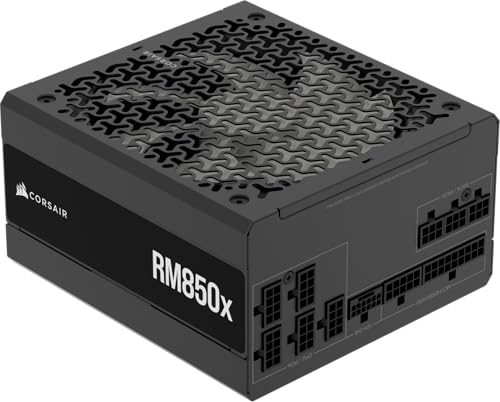
When an 850W actually works: Corsair RM850x ATX 3.1
Specs
Wattage | 850 W continuous |
Standard | ATX 3.1, PCIe 5.1 |
Efficiency | Cybenetics Gold |
GPU connector | Native 12V-2x6, 600 W |
Cabling | Fully modular |
Transient headroom | 200% excursion per ATX 3.1 |
Warranty | 10 years |
Wattage
850 W continuous
Standard
ATX 3.1, PCIe 5.1
Efficiency
Cybenetics Gold
GPU connector
Native 12V-2x6, 600 W
Cabling
Fully modular
Transient headroom
200% excursion per ATX 3.1
Warranty
10 years
What it does well
It clears the bar that matters, which is the excursion allowance rather than the number on the box. ATX 3.1 obliges it to ride out roughly 120 percent of rating for tens of milliseconds, and that bracket is where the 5090's 627.5 W window lives. Next to a 162 W Ryzen 7 the whole system fits inside 850 W on that window, with the shorter and taller spikes covered by the higher rungs of the ladder.
Platform quality carries over from its 1000W sibling. Same CWT build, same Cybenetics Gold rating, same native 12V-2x6 cable, same ten-year warranty. This is not a cheaper unit, it is a smaller one. We ran the same question one tier down for the 5080, and the shape of the answer is identical.
What you give up
Margin, and with it every upgrade path. On the worst frames this build runs close to its rating, and there is nothing left for a CPU swap, a second GPU generation, or the drives you will add in year two.
It also gives up the accessory-heavy build. A 360mm AIO with a full fan complement, a pump, four NVMe drives, and a fan hub is 60 to 90 W that nobody counts, and on this unit that is the entire remaining margin. Buyers have flagged a modest undervolt as the standard mitigation for this pairing, which helps, but it is a mitigation rather than a green light.
Who it's for
The builder who already owns this unit, or one like it, and is dropping a 5090 into an existing 9800X3D or 7800X3D machine with a modest drive count. Check the label before you commit: an ATX 2.x 850W is a different product from this one despite the identical wattage.
When to step up: Seasonic Vertex GX-1200

Specs
Wattage | 1200 W continuous |
Standard | ATX 3.1, PCIe 5.1 |
Efficiency | 80 PLUS Gold |
GPU connector | Native 12V-2x6, 600 W |
Cabling | Fully modular |
Transient headroom | 200% excursion per ATX 3.1 |
Warranty | 12 years |
Wattage
1200 W continuous
Standard
ATX 3.1, PCIe 5.1
Efficiency
80 PLUS Gold
GPU connector
Native 12V-2x6, 600 W
Cabling
Fully modular
Transient headroom
200% excursion per ATX 3.1
Warranty
12 years
What it does well
It absorbs the CPU class that breaks the 1000W math. A Core Ultra 9 285K can hold a 325 W package ceiling under a sustained all-core load, and a 9950X3D reaches 228 W. Stack either on a 575 W card and the tens-of-milliseconds window clears 900 W before any accessory load is counted. At 1200W that sits inside the rating rather than the allowance.
Seasonic builds its own platforms, which is the shortest supply chain in this category, and backs the Vertex line for twelve years, the longest warranty of the three units here. Native 12V-2x6, fully modular, ATX 3.1 and PCIe 5.1.
The extra headroom is also the upgrade answer. If the plan is to keep the chassis and swap the card in three years, this is the unit that survives whatever replaces the 5090. Above it sits the 1200W and 1500W tier for multi-GPU and workstation loads.
What you give up
Money, space in the basement of the case, and idle efficiency further down the curve than either Corsair. 80 PLUS Gold is also a looser measurement regime than Cybenetics Gold at the same nameplate, taken at fewer load points and a friendlier ambient.
For a build that never leaves the Ryzen 7 tier, it is wattage you paid for and will not use. Size to the chip you are buying, not the one you might.
Who it's for
A 5090 next to a Core Ultra 9 285K or a 9950X3D, especially with an overclock, a full fan wall, or four or more drives. If you have not settled the CPU yet, which chip belongs next to a 5090 is the decision to make first.
Bottom line
If you are running a 9800X3D, a 7800X3D, or a Core Ultra 7 with one or two drives on an ATX 3.1 unit, an 850W supply like the Corsair RM850x ATX 3.1 clears it. If you are buying new, or the CPU is a Ryzen 9 or a Core Ultra 9, or the label says ATX 2.x, buy the Corsair RM1000x ATX 3.1. Go to the Seasonic Vertex GX-1200 when a 285K meets an overclock or a heavy drive and fan load. The badge decides more than the number at this wattage. Read the label before the spec sheet. The same arithmetic runs behind the general wattage framework if you want to apply it to a different card.
FAQ
Is 850W enough for an RTX 5090?
Only under conditions. The unit has to be ATX 3.1 so its excursion allowance covers the card's sub-10 ms spikes, the CPU has to be a Ryzen 7 or Core Ultra 7 class part rather than a Ryzen 9 or Core Ultra 9, and the build has to stay light on drives and fans. Meet all three and an 850W unit runs a 5090 without tripping. Miss any one of them and 1000W is the buy.
Will an 850W PSU shut my PC down when the RTX 5090 spikes?
On an ATX 3.1 unit with a modest CPU, no. The specification requires the supply to ride out roughly 120 percent of its rating for tens of milliseconds, which covers the card's 627.5 W excursion window with a Ryzen 7 alongside it. On an ATX 2.x 850W the risk is real. Those units were engineered to a sustained rating with no formal excursion requirement, so a 900 W burst reaches the over-current protection circuit and the machine drops.
Does undervolting the RTX 5090 make an 850W power supply safe?
It helps, and it is not a licence. A modest undervolt trims both the average draw and the height of the spikes, which buys back some of the margin an 850W build does not have. Buyers have flagged it as the standard mitigation for exactly this pairing. It does not change the excursion ladder your unit was built to, so an ATX 2.x 850W stays a bad idea undervolted, and a Ryzen 9 stays a 1000W build.
Do I need an ATX 3.1 power supply for the RTX 5090, or is any 850W fine?
At this wattage the badge matters more than the number. ATX 3.1 is what obliges the unit to absorb 200 percent of its rating for microsecond bursts and about 150 percent across ten milliseconds, which is the exact shape of what a 5090 does. An 850W unit without that specification has no defined behaviour in that window. Between an ATX 2.x 1000W and an ATX 3.1 850W next to a Ryzen 7, take the ATX 3.1 unit.
Why does NVIDIA recommend 1000W for the RTX 5090?
Because the recommendation covers a whole system, not the card. NVIDIA is sizing for a 575 W board next to a mainstream CPU, a couple of drives, fans, and enough margin that the supply is not living at its rating. Add the excursion behaviour on top and 1000W puts a typical build near 75 percent continuous load, which is where a Gold unit is quietest and most efficient. It is a sensible default rather than a hard floor.
Is the 12V-2x6 connector the limit, or the power supply?
The power supply, in almost every build. The 12V-2x6 connector is rated to 600 W and the card's rated TGP is 575 W, so the connector carries margin the rail does not. What the connector controls is failure mode: a native 12V-2x6 cable from the unit removes the four-headed adapter that sits behind most of the melted-connector reports. All three units here ship one.
Related Articles

Best 1000W PSUs for RTX 5090 Builds (2026)
The RTX 5090 pulls 575W TDP with transient spikes past 650W. Here are five 1000W ATX 3.1 PSUs that handle it without throttling or burning cables.
Jun 6, 2026

Best RTX 5090 PSU 2026: Why 1000W Isn't Enough (5 Picks)
The best PSU for an RTX 5090 is not Nvidia's 1000W floor. Transient spikes explained, five 1200W to 1500W ATX 3.1 picks, and 12V-2x6 cable notes that matter.
Aug 10, 2026

Best ATX 3.1 Power Supplies (2026): 5 Native 12V-2x6 Picks
Five ATX 3.1 power supplies with native 12V-2x6 connectors, Cybenetics Gold through Platinum, all 850W, plus how to spot an ATX 3.0 unit sold with an adapter.
Aug 14, 2026

Is 750W Enough for an RTX 5080, or Do You Need 850W? (2026)
Is 750W enough for an RTX 5080? Yes with a Ryzen 7 class CPU on an ATX 3.1 unit, no with a 9950X3D or Core Ultra 9. Here is the wattage call and the picks.
Aug 4, 2026

How Much PSU Wattage for a Gaming PC? 9 GPU Tiers (2026)
How much PSU wattage do you need? Sized floors for 9 GeForce and Radeon tiers, why 850W is usually overkill for gaming, and an ATX 3.1 pick at each tier.
Sep 22, 2026