Affiliate Disclosure: As an Amazon Associate we earn from qualifying purchases. Some links may earn us a commission at no cost to you.

Ryzen 7 vs Ryzen 9 for Gaming (2026): Do Cores Earn It?
For gaming, buy the Ryzen 7. The extra cores on a Ryzen 9 do not turn into frames, and reviewer suites now put AMD's 16-core cache chip within about one percent of the 8-core one across large game samples. That is the whole comparison, stated up front.
The Ryzen 9 earns its place in exactly one situation: the same machine also does sustained multi-threaded work. Rendering, 4K video export, long compiles, heavy virtualization. If that describes your week, the extra cores are free performance in the work you get paid for. If it does not, they idle while you play.
At a glance
Chip | Cores / threads | L3 cache | Gaming tier | Best for | Buy |
|---|---|---|---|---|---|
8 / 16 | 96 MB | Top of the chart | Gaming-led builds | ||
16 / 32 | 128 MB | Top of the chart | Gaming plus heavy CPU work |
- Cores / threads
8 / 16
- L3 cache
96 MB
- Gaming tier
Top of the chart
- Best for
Gaming-led builds
- Buy
- Cores / threads
16 / 32
- L3 cache
128 MB
- Gaming tier
Top of the chart
- Best for
Gaming plus heavy CPU work
- Buy
Verdict by scenario
Your situation | What limits you | Winner |
|---|---|---|
Pure gaming at 1440p or 4K | GPU, long before core count | |
Competitive 1080p at 240 Hz and up | CPU cache and clocks | |
Sim, strategy, MMO, or Tarkov | L3 cache, heavily | |
Gaming and streaming with GPU encode | GPU encoder, not cores | |
Gaming plus 4K editing, rendering, or long compiles | Core count under sustained load | |
Workstation first, gaming in the evenings | Multi-threaded throughput | |
Gaming-led build with the budget stretched | GPU tier you can still afford |
Pure gaming at 1440p or 4K
- What limits you
GPU, long before core count
- Winner
Competitive 1080p at 240 Hz and up
- What limits you
CPU cache and clocks
- Winner
Sim, strategy, MMO, or Tarkov
- What limits you
L3 cache, heavily
- Winner
Gaming and streaming with GPU encode
- What limits you
GPU encoder, not cores
- Winner
Gaming plus 4K editing, rendering, or long compiles
- What limits you
Core count under sustained load
- Winner
Workstation first, gaming in the evenings
- What limits you
Multi-threaded throughput
- Winner
Gaming-led build with the budget stretched
- What limits you
GPU tier you can still afford
- Winner
Benchmarks
Act 3 in the Lower City is the canonical CPU bottleneck, and it is where the stacked cache separates from the core count.
- 155 FPS
- 155 FPS
- 101 FPS
Creation Engine leans on memory latency, so the two cache parts pull clear of the identical-core-count 9950X.
- 171 FPS
- 165 FPS
- 124 FPS
A lighter CPU load flattens the field, and the 8-core part edges its 16-core sibling.
- 380 FPS
- 373 FPS
- 357 FPS
Dense NPC simulation is one of the harshest CPU tests in the current cycle.
- 132 FPS
- 128 FPS
- 90 FPS
How we weigh cores against cache
Games are not render farms. A modern engine spreads its real work across roughly six to eight threads, plus a handful of light background ones. Feed those threads fast enough and the frame goes out the door. Core seventeen has nothing queued for it.
What does move frames is cache. AMD's stacked V-Cache gives the chip a 96 MB pool of L3 to keep game state close to the cores, and in the titles that thrash memory hardest the pool is worth a full tier of performance on its own. GamersNexus measured 155 FPS average in Baldur's Gate 3 on the cache parts against 101 on the non-cache 9950X. Identical core counts. Cores were never the variable.
Cores pay when the work is sustained and parallel: a Blender render, a video export, a compile, a virtual machine chewing through a build. Those saturate every thread you hand them and keep going for minutes. That is a different machine than a gaming rig, and it is the only reason to walk up to a Ryzen 9. If you want the full AMD stack laid out by price to performance rather than by tier, we ranked the gaming chips separately.
Order of operations matters more than the chip choice here. Size the CPU to the graphics card and the monitor in front of it, not to the spec sheet. A cache chip behind a mid-tier card at 4K produces the same frames as a cheaper part, because the graphics card ran out of headroom first, and the money belongs in the card instead. Our gaming CPU picks by budget walk that ladder tier by tier.
Best for pure gaming: AMD Ryzen 7 9800X3D
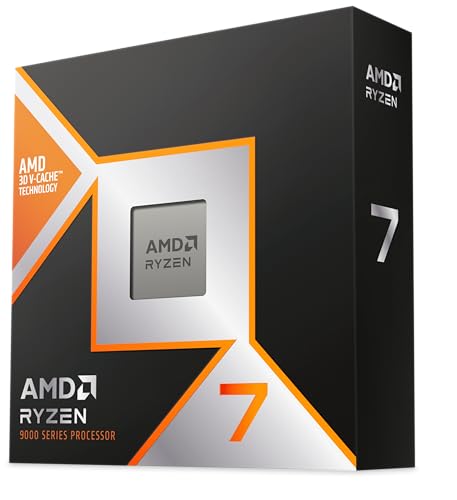
Specs
Cores / threads | 8 / 16 |
L3 cache | 96 MB (2nd-gen 3D V-Cache) |
Boost clock | 5.2 GHz |
TDP | 120 W |
Socket | AM5 |
Memory | DDR5-5600 official, 6000 CL30 sweet spot |
Cores / threads
8 / 16
L3 cache
96 MB (2nd-gen 3D V-Cache)
Boost clock
5.2 GHz
TDP
120 W
Socket
AM5
Memory
DDR5-5600 official, 6000 CL30 sweet spot
What it does well
This is the fastest gaming processor you can buy, and core count has nothing to do with it. AMD moved the stacked cache underneath the compute die this generation, which let the chip clock higher and shed heat through the top of the package instead of through a layer of cache. The practical result is an X3D part that behaves like an ordinary Ryzen 7 under a cooler.
Efficiency is the part buyers underrate. TechSpot measured the 9800X3D at 2.46 frames per watt against the 9950X3D's 1.61, drawing roughly 79 watts under gaming load where the 16-core part pulled about 121. That gap buys back a cooler tier and gives the power supply room it would otherwise spend on the processor.
Cache-heavy libraries are where the distance from non-X3D parts opens up. Sim racing, flight sim, late-game strategy, dense MMO content, factory builders, Escape from Tarkov. Those engines sit pinned on memory latency, and 96 MB of L3 is the fix. If that is your library, this chip is not a preference, it is the answer. We looked at whether the 9800X3D earns its price on its own terms separately.
What you give up
Eight cores. That is the trade, stated plainly. A Blender render finishes later. A Handbrake queue finishes later. A large compile finishes later. If you stream with a CPU encoder on a slow preset rather than handing the job to the graphics card, you will feel it during a busy scene.
There is no headroom story here either. Engines have crept from four well-used threads to six or eight over a decade, so eight cores has room, but a buyer who wants a machine that grows into heavy content work is shopping the wrong tier. The honest framing is that this is a specialist part that happens to be excellent at one thing.
Who it's for
Anyone whose machine is a gaming machine. 1080p at high refresh, 1440p, 4K, sim rigs, competitive shooters. Productivity that amounts to photo edits, spreadsheets, and the occasional video export runs fine here, and the money you did not spend on cores belongs in the graphics card.
Best for gaming plus productivity: AMD Ryzen 9 9950X3D

Specs
Cores / threads | 16 / 32 |
L3 cache | 128 MB total (64 MB stacked on one CCD) |
Boost clock | 5.7 GHz |
TDP | 170 W |
Socket | AM5 |
Memory | DDR5-5600 official, 6000 CL30 sweet spot |
Cores / threads
16 / 32
L3 cache
128 MB total (64 MB stacked on one CCD)
Boost clock
5.7 GHz
TDP
170 W
Socket
AM5
Memory
DDR5-5600 official, 6000 CL30 sweet spot
What it does well
This is the chip that refuses to pick. One compute die carries the stacked cache for games, the other carries eight more cores for everything else, and AMD's compatibility database now routes game threads to the cache die reliably enough that the part lands at the top of the gaming charts rather than a step behind. Across reviewer suites it sits within roughly a percent of the 9800X3D.
The productivity side is where the money goes. Sixteen cores and thirty-two threads cut render, export, and compile times close to in half against an 8-core part on work that scales. If the machine pays for itself between gaming sessions, that is not a luxury, it is the reason the build exists. Our roundup of CPUs for video editing and gaming covers the workloads where that scaling shows up most clearly.
The cache still does its job in games. GamersNexus recorded 155 FPS average in Baldur's Gate 3 at 1080p medium and 171 in Starfield, against 101 and 124 on the non-cache 9950X. Same core count, same clocks, different cache.
What you give up
Power and heat, and the build cost that follows. Roughly 121 watts under gaming load against the 9800X3D's 79 means a real all-in-one liquid cooler or a dual-tower air cooler rather than a mid-range single tower, plus a power supply with genuine headroom. The board matters too: a 16-core part pulling sustained all-core power deserves a VRM built to feed it, and socket compatibility is not the same thing as build readiness. Our guide to choosing a CPU and motherboard together covers where that floor sits.
Dual-die scheduling is the other asterisk. Reports from reviewers suggest AMD's compatibility database closed most of the gap that plagued the previous generation, but outlier titles still exist where the scheduler puts the game on the wrong die. Smaller risk than it was, not a solved one.
And if the productivity workload is aspirational rather than real, the extra cores sit at low utilization while you play. Buyers reach for this tier for more cores and then run Photoshop on weekends. It is the most common wrong-direction upgrade at this price point.
Who it's for
The buyer whose second workload is a job rather than a hobby. Video editors cutting 4K, 3D artists, developers with compiles measured in minutes, anyone running heavy background work on the same box they game on. If you can name the software and the job takes longer than a coffee, this is your chip.
Best for productivity first: AMD Ryzen 9 9950X

Specs
Cores / threads | 16 / 32 |
L3 cache | 64 MB (no 3D V-Cache) |
Boost clock | 5.7 GHz |
TDP | 170 W |
Socket | AM5 |
Memory | DDR5-5600 official, 6000 CL30 sweet spot |
Cores / threads
16 / 32
L3 cache
64 MB (no 3D V-Cache)
Boost clock
5.7 GHz
TDP
170 W
Socket
AM5
Memory
DDR5-5600 official, 6000 CL30 sweet spot
What it does well
Same sixteen cores, same clocks, same platform, without the cache premium. For multi-threaded throughput per dollar spent this is the stronger of the two Ryzen 9 parts, and nothing about a render queue or a compile cares that the L3 pool is smaller.
In games it is better than its reputation, as long as the graphics card is the limit. At 4K with ray tracing on, or at 1440p ultra behind a card already working hard, the frame rate lands where the GPU says it lands and the processor choice stops mattering. Plenty of buyers game exactly like that.
What you give up
The cache-sensitive floor, and it is a real floor. GamersNexus measured 101 FPS average in Baldur's Gate 3 at 1080p medium where the cache parts hit 155, and 124 in Starfield against 171. That is not a margin, it is a tier. Strategy, sim, and MMO libraries take the same hit for the same reason. The cores-versus-cache comparison at the chip level goes deeper on exactly where the non-cache part loses ground.
Board selection gets stricter too. A 170 watt part running all-core in a render punishes a cheap VRM, and the chip will quietly throttle rather than announce the problem. Budget for a board built for the class.
Who it's for
Buyers whose machine is a workstation that also plays games. If the render queue justifies the purchase and gaming happens in the evening at 4K, this is the honest pick, and the savings against the cache version are better spent on memory, storage, or a bigger graphics card.
Best on a budget: AMD Ryzen 7 7800X3D

Specs
Cores / threads | 8 / 16 |
L3 cache | 96 MB (1st-gen 3D V-Cache) |
Boost clock | 5.0 GHz |
TDP | 120 W |
Socket | AM5 |
Memory | DDR5-5600 official, 6000 CL30 sweet spot |
Cores / threads
8 / 16
L3 cache
96 MB (1st-gen 3D V-Cache)
Boost clock
5.0 GHz
TDP
120 W
Socket
AM5
Memory
DDR5-5600 official, 6000 CL30 sweet spot
What it does well
The previous-generation cache part still lands within single digits of the current one in most games. TechSpot's eight-game suite at 1080p averaged 231 FPS on the 7800X3D against 239 on the 9800X3D, and titles like Total War: Warhammer III and Halo Infinite closed to inside two or three percent. Same X3D behavior, same cache-heavy libraries, less money.
It also sits on AM5, so the upgrade path stays intact. A buyer who lands here today can drop a newer cache part into the same board later without touching the memory, the cooler, or the case. Our 1440p gaming CPU picks put this chip in context against the rest of that tier.
What you give up
First-generation cache stacking puts the cache above the compute die, so heat has to travel through it. Thermals are worse than the 9800X3D's and overclocking is effectively off the table. Titles that lean on raw clock speed rather than cache show the widest gaps: Tech4Gamers measured Dragon's Dogma 2 around sixteen percent apart and The Last of Us Part 1 around twenty.
Buyers pairing this chip with a newer 800-series board should confirm the shipping BIOS supports it out of the box. Reports of boards needing a flash before a 7000-series part will post are common enough to plan around.
Who it's for
The 1440p builder assembling around a mid-tier graphics card who wants X3D behavior without paying the current-generation premium. If the budget is tight and the real choice is between this chip and a graphics card tier, take the graphics card tier and this chip.
Bottom line
If you game and nothing else, buy the AMD Ryzen 7 9800X3D. If the budget is stretched and the graphics card needs the difference, the AMD Ryzen 7 7800X3D gets you most of the way on the same socket. If the same machine renders, exports, or compiles for a living, the AMD Ryzen 9 9950X3D is the one chip that does not make you choose. If the work comes first and gaming happens at 4K in the evenings, the AMD Ryzen 9 9950X saves you a cache premium you were never going to see. Ryzen 9 is a productivity tier that games well, not a gaming upgrade over Ryzen 7.
FAQ
Is a Ryzen 9 worth it for gaming?
For gaming alone, no. AMD's 16-core cache part lands within roughly one percent of the 8-core 9800X3D across large reviewer game samples, so you are paying for cores that do not turn into frames. The Ryzen 9 becomes worth it the moment the same machine also does sustained multi-threaded work: rendering, 4K video export, long compiles, virtualization. If you can name that workload and it takes real minutes, buy the 9950X3D. If you cannot, buy the Ryzen 7 and put the difference into the graphics card.
Do extra cores help gaming?
Up to a point, then they stop. Modern engines make real use of roughly six to eight threads and treat the rest as background, so a chip with eight strong cores feeds a game as well as one with sixteen. What does help is cache and clock speed. AMD's stacked V-Cache parts pull ahead of identical-core-count chips by a full tier in memory-hungry titles, which is why an 8-core X3D beats a 16-core non-X3D in strategy, sim, and MMO workloads.
Is a Ryzen 7 enough for gaming?
More than enough. The Ryzen 7 9800X3D is the fastest gaming processor available at any core count, and it holds that position at 1080p, 1440p, and 4K. The only gaming scenario that argues for more is streaming with a CPU encoder at a demanding preset while playing something already CPU-heavy. Hand the encode to the graphics card instead and even that case disappears.
Does a Ryzen 9 run hotter than a Ryzen 7?
Yes, and by enough to change the build. The 9950X3D carries a 170 watt rating against the 9800X3D's 120, and under gaming load reviewers measured roughly 121 watts against 79. In practice that means a 280mm or larger all-in-one cooler, or a dual-tower air cooler, where the Ryzen 7 is comfortable under a good single tower. Budget for the cooler and the power supply headroom when you compare the tiers.
Is the Ryzen 9 9950X3D faster than the 9800X3D in games?
Marginally, and only on average. Reviewer suites put the two within about one percent of each other across large game samples, with individual titles landing on either side. GamersNexus measured 171 FPS average in Starfield on the 9950X3D against 165 on the 9800X3D, and a dead heat in Baldur's Gate 3. Treat them as equals in games and let the productivity question decide.
Should I buy a Ryzen 9 for gaming and streaming?
Usually not. Modern graphics cards handle stream encoding on dedicated hardware that leaves the processor almost untouched, so a Ryzen 7 streams and games at once without stress. The Ryzen 9 makes sense for streaming only if you insist on CPU-based x264 encoding at a slow preset, which most viewers cannot distinguish from a good hardware encode. Save the money and spend it on upload bandwidth or a better microphone.
Related Articles

Ryzen 9 9950X vs Ryzen 7 9800X3D: Cores or Cache for Your Build?
Picking between the 16-core 9950X and the V-cache 9800X3D? Use-case matrix across gaming, streaming, and productivity to settle the choice.
May 19, 2026

Is the Ryzen 7 9800X3D Worth It in 2026? Buy or Skip
Buy the Ryzen 7 9800X3D for 360Hz shooters, sim racing and heavy strategy. Skip it at 1440p on a mid-tier GPU. Full 2026 verdict vs the 9600X and 9850X3D.
Aug 26, 2026

Best CPUs for Gaming in 2026: Top Picks for Every Budget
The best gaming CPUs for 2026 across every budget, from the Ryzen 5 7600X to the Ryzen 9 9950X3D, with full specs and clear buying advice for every tier.
Jul 8, 2026

Best AMD CPU for Gaming 2026: 8 Ryzen Picks Ranked
The best AMD CPU for gaming in 2026, ranked by price to performance: 8 Ryzen picks from the 9600X to the 9950X3D, plus the 9850X3D buy-or-skip verdict.
Aug 26, 2026

How to Choose a CPU and Motherboard
The buyer's framework for picking a CPU and motherboard pair: use case first, socket second, chip tier third, then the board class that matches.
May 17, 2026